J Handle vs EVA Grip Umbrellas for Hotels and Promotions
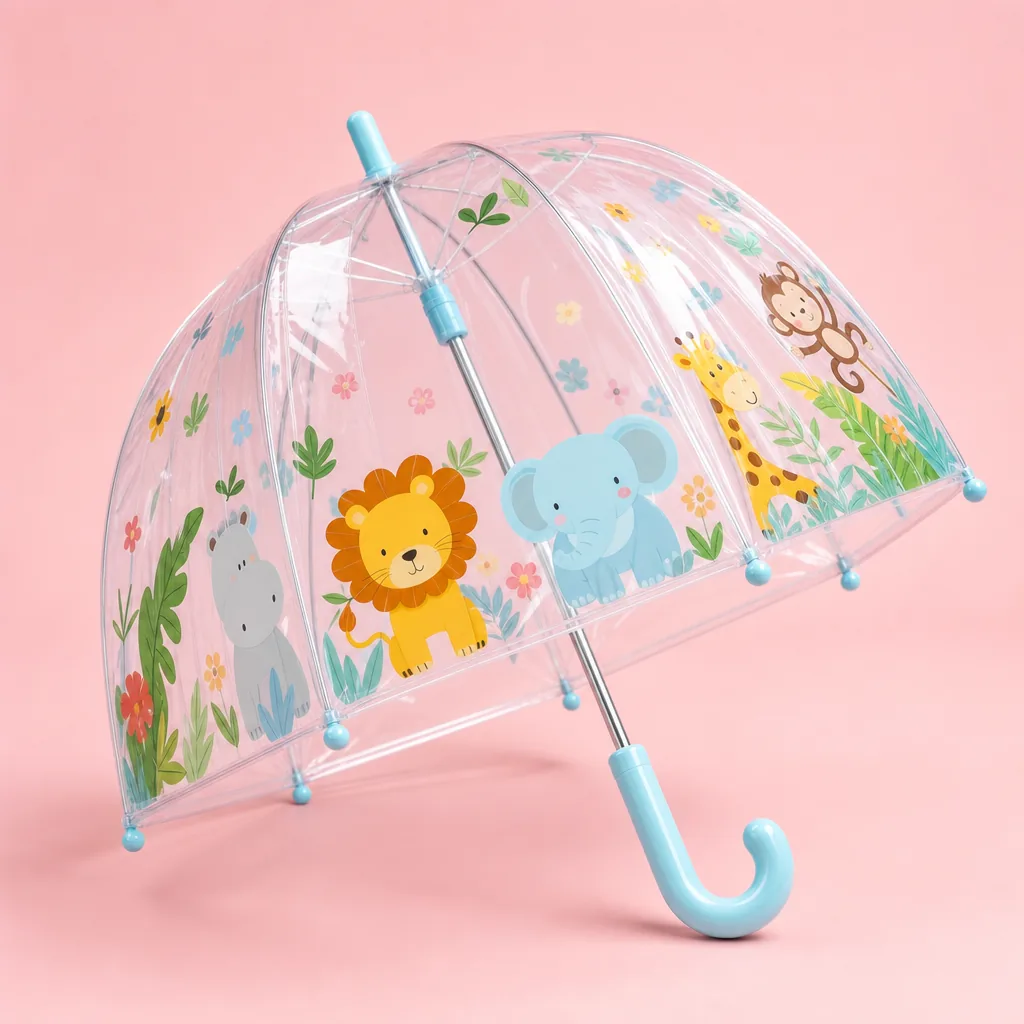
When buyers compare J handle umbrella options with EVA grips for hotel programs and promotional orders, the real tradeoffs are rarely obvious from a sample photo or catalog spec. On the factory floor, handle choice affects guest comfort, mold durability, logo decoration, carton efficiency, and even minimums when color matching or custom tooling is involved. The right decision depends less on style alone and more on how the umbrella will be used, packed, and reordered.
Where J Handles and EVA Grips Fit Different Programs
For hotel loaner fleets, the handle choice affects storage, durability, and how the umbrella reads in a guest-facing setting. A hook handle umbrella remains the standard for hotel guest umbrellas because staff can hang it on lobby racks, closet rods, and housekeeping carts, and guests can loop it over the forearm while moving luggage. The most common hotel spec is a 23-inch or 27-inch straight umbrella with 8K ribs, a steel shaft, and either fiberglass end ribs or full fiberglass ribs for better wind resistance in coastal or high-wind locations. At roughly 300 to 3,000 pieces, buyers usually pair a molded PP or ABS J handle with a 190T pongee canopy in black, or a POE canopy for a transparent concierge look. That construction adds a modest unit-cost premium over a plain straight grip, but it raises perceived value and makes the umbrella look like a maintained property asset rather than a disposable amenity. For resorts, gift shops, and larger 16K or 30-inch city styles, J handle umbrella options also support a more formal silhouette that fits premium entrances and front-of-house use.
An EVA grip umbrella fits programs where comfort, freight efficiency, and unit cost matter more than a formal presentation. Buyers commonly use EVA grips on 21-inch or 23-inch promotional umbrellas and on 23-inch or 27-inch auto-open commuter styles because the sleeve is inexpensive, fast to fit, and easier to hold with wet or cold hands than hard PP or low-grade PE foam. For retail straight umbrellas and commuter gifts, the usual build is 190T or 210T pongee with a black UV coating or Teflon finish, plus fiberglass ribs for windproof claims in the 40 to 50 mph range. EVA also hides scuffing better during FOB ocean shipment or DDP parcel redistribution and packs efficiently for event drops, transit promotions, and campus campaigns. At the low-to-mid promotional tier, an 8K steel frame with an EVA grip, 190T pongee canopy, and a 1-color or 2-panel logo print is usually the clearest value build because it balances MOQ, comfort, and retention. By contrast, premium hotels, property developers, and upscale retailers often move to molded J handles, fiberglass ribs, vented double canopies, and AQL 2.5 inspection, with lead times typically shifting from 25 to 35 days for stock EVA programs to 40 to 55 days for custom-color J handles, logo caps, or matched sleeves. In practical positioning terms, promotional umbrella handles with EVA signal utility and personal use, while a molded crook handle signals reuse, visibility, and a higher price band.
Material, Durability, and Comfort Differences
Handle material directly changes safety, service life, and replacement cost in hotel and event programs. Most J handle umbrella options use a PP or ABS plastic hook fixed to a straight shaft because the part is low cost, easy to Pantone-match, and holds a clean hook profile in lobby stands or coat racks. That format remains common on 23-inch and 27-inch hotel guest umbrellas used by front desk staff, doormen, and guests all day. Its tradeoff is wet-hand control: smooth PP or ABS gets slick faster in rain, especially when the user is carrying luggage or shopping bags. An EVA grip umbrella improves friction by adding a foam or rubberized contact layer over a molded core, which gives a warmer feel and more secure hold without changing the canopy size or frame function. In practice, hotels see more complaints from slipping at entrances and umbrellas dropped on tile or concrete than from small appearance changes after light use.
Durability depends on the handle material and how it is paired with the shaft and frame. PP and ABS hook handle umbrella builds resist water well and usually outlast low-grade plated steel fittings, but they scratch easily and can show whitening or gloss marks where the hook rubs against stand rings, housekeeping carts, or walls. EVA is more comfortable, but low-density foam can dent, tear, or polish smooth under daily abrasion in bins and carts. The more reliable construction is molded EVA over a PP core, or a hybrid handle that uses ABS structure with EVA or TPR touch zones to reduce peeling and edge failure. Frame pairing matters just as much: fiberglass ribs with a fiberglass shaft or black electroplated steel shaft generally age better than rust-prone basic steel builds. Weight also shifts the decision. A plain plastic hook is lighter on an 8K manual frame, but on heavier auto-open 10K or vented 16K umbrellas, grip geometry and wet-hand control usually matter more than saving a few grams.
Comfort comes from surface texture, handle shape, and total umbrella weight, not from handle material alone. A curved plastic or molded hook handle remains the most practical format for hanging on a forearm, reception counter, or stand rail, which is why it stays standard for many hotel guest umbrellas. A straight or contoured EVA-covered grip spreads pressure across the palm and feels steadier when wet, so it usually fits staff use, commuting, or longer carry times better than hard plastic. Buyers should match the handle to the expected replacement cycle and operating conditions. In humid properties, closed-cell EVA or molded TPR/EVA combinations usually keep their feel longer than glossy hard plastic. For short-life giveaways, PP or ABS promotional umbrella handles are often acceptable because cosmetic scratching is a manageable tradeoff at that price point. For umbrellas expected to last two or three rainy seasons, handle wear should be evaluated alongside shaft finish, fiberglass versus steel frame selection, and AQL 2.5 inspection standards, because handle comfort and frame durability fail together when the build is mismatched.
Branding Area and Decoration Limits
Rigid J handles give buyers a true second imprint location; EVA grips usually do not. On a standard ABS or PP hook handle umbrella, the logo can typically be pad printed on three workable zones: the outside curve, the side flat above the ferrule, and the end cap if the mold includes one. Realistic artwork size is about 35 x 8 mm on a slim crook and 45 x 12 mm on a wider hotel profile, with the final limit set by curvature and mold draft. One-color artwork is usually the lowest-risk choice because registration drift shows faster on a glossy curved part than on a flat plastic surface. For hotel guest umbrellas, dark molded handles paired with white, silver, or gold ink stay readable after repeated handling and still identify ownership when the umbrella is closed in a lobby stand. Among J handle umbrella options, that closed-position visibility is the practical reason to pay for handle printing instead of relying on canopy branding alone.
An EVA grip umbrella has stricter decoration limits because the foam sleeve is soft, slightly porous, and commonly textured. Higher-density EVA can sometimes accept pad print or screen print, but usable artwork is usually only 20 x 8 mm to 30 x 10 mm, and fine lines tend to break down sooner from wet hands, sunscreen transfer, and repeated rack or cart storage. Debossing only works when the grip was designed into the mold, which most low-MOQ promotional umbrella handles are not. In purchasing terms, EVA handle branding should be treated as a secondary mark, with the primary logo placed on the canopy or tie strap. On 190T or 210T pongee, one panel can usually carry a 200 to 260 mm wide logo by screen print, heat transfer, or sublimation, depending on color count and order size. Keep handle artwork within about 70% of the printable zone so normal placement variation can still pass AQL 2.5, and match handle ink to the canopy print rather than adding extra colors that raise reject risk without improving visibility.
Cost, MOQ, and Carton Efficiency
Handle choice affects umbrella cost before fabric or print does. Stock J handle umbrella options are usually the lowest-risk starting point because the mold cost was recovered years ago and the handle already matches standard ferrules, caps, and shaft cores used on 8K and 16K straight umbrellas. On 23-inch and 27-inch straight models with steel shafts and 190T pongee, many factories can quote 300 to 500 pieces per color with no new tooling. Custom-molded handles change that cost structure immediately. A new mold commonly adds about USD 1,500 to 4,000, with the higher end tied to undercuts, logo inserts, and multi-material parts such as ABS or PP frames with an EVA grip umbrella overmold. To spread that tooling cost, suppliers usually push MOQ to 1,000 to 3,000 pieces and add development time for sample approval. For a buyer comparing FOB or DDP offers, the decision is straightforward: a stock hook handle umbrella keeps entry cost and approval risk low, while a custom grip requires more upfront cash and makes short production runs less competitive.
Piece price also favors the simpler build, even when no new mold is required. A stock PP or ABS J handle assembles quickly and tends to hold tighter dimensional consistency at AQL 2.5, while an EVA grip umbrella adds fitting labor, adhesive control, and extra cosmetic inspection for seam opening, compression marks, and color variation. That repeatability matters for hotel guest umbrellas and reorder programs, where the second shipment needs to match the first without reopening handle specifications. Carton efficiency is another hidden cost. Straight umbrellas with classic J handles usually nest in one direction and load export cartons more tightly, but bulkier promotional umbrella handles create dead space, reduce pieces per master carton, and raise volumetric freight under LCL, courier, and DDP terms. On a 5,000-piece order, that carton loss can outweigh a small ex-works saving. In many factory quotes, a stock EVA-style grip adds only USD 0.12 to 0.35 per unit, but the premium often reaches USD 0.60 or more when custom geometry, engraved logos, lower MOQ runs, and weaker carton utilization are combined.
Specification Checklist Before Sampling
Lock the sample brief before you request prototypes; without a fixed spec, you cannot compare price, durability, or lead time fairly. Start with umbrella type and canopy size. For hotel guest umbrellas, the standard brief is usually a 23 inch x 8K or 27 inch x 8K stick umbrella; for lobby standby or golf-style coverage, move to 30 inch x 8K or 16K. If you are reviewing J handle umbrella options, name the handle material and finish exactly: glossy ABS, matte PP, wood, or faux leather wrap. That choice affects unit cost, carton weight, and DDP freight. Record canopy fabric by construction, not a generic label: 190T pongee is common for promotions, 210T pongee gives a tighter print surface, and POE or EVA belongs on transparent rain models. Also lock the print method early: screen print for 1-2 spot colors, heat transfer for gradients, and sublimation for full-panel artwork on white polyester.
Write the frame specification with the same discipline. Call out shaft material, tube diameter, wall thickness, and rib construction. Steel works for low-cost campaigns; fiberglass ribs paired with a fiberglass or aluminum shaft are the stronger choice for repeated hotel use and better wind performance. Do not accept “windproof” without the frame build behind it: specify full fiberglass, steel stretcher plus fiberglass end rib, or all-steel. State opening mode clearly. Manual open is acceptable, but auto-open is usually the practical format for stick umbrellas used by doormen; auto-open-close mainly belongs on compact telescopic models. For any EVA grip umbrella, define grip length and maximum diameter in millimeters because comfort changes materially between 26 mm and 32 mm. Add wrist strap requirement, ferrule color, tip material, and a handle pull-test requirement so the grip does not rotate on the shaft.
Include packaging and QC in the sample request, not after sample approval. Specify whether each umbrella ships in a polybag, nonwoven sleeve, matching fabric sleeve with shoulder strap, barcode sticker, hangtag, or bulk pack only, and confirm inner-pack and master-carton quantities. A 27 inch stick umbrella with a large hook handle umbrella profile can waste carton volume and change both FOB and DDP cost. Put QC expectations in writing under AQL 2.5. Require finish consistency across handle and plating lots, controlled gloss and color variation, clean mold parting lines, scratch-free shafts, even stitch density, and correct logo registration panel to panel. Functional inspection should cover repeated open-close cycling, runner lock engagement, top-notch alignment, rib symmetry, and a wet test to confirm the canopy does not invert early. If a supplier claims a vented design can handle 50 mph wind, ask for the test basis before you treat that number as real.
Frequently Asked Questions
Does an EVA grip make more sense than a J handle for commuter umbrellas?
Usually yes for compact or daily-carry use, because EVA offers a more secure wet grip and a more athletic feel. For hotel and classic straight umbrellas, a J handle is often preferred for hanging and traditional presentation.
Can buyers request a custom-molded handle shape for private label programs?
Yes, but custom molds typically require higher MOQ and added development time before mass production. Buyers should confirm tooling cost, sample timing, and whether the mold is exclusive or shared.
Does choosing a J handle instead of an EVA grip change carton packing efficiency or freight cost?
Usually yes. J handles create more empty space in master cartons, so loading efficiency is often slightly lower than straight EVA-grip umbrellas. On large export orders, that can increase carton count and sea freight volume by roughly 3% to 8%, depending on canopy size and shaft style.
Which handle type gives a better result for hotel logo presentation: J handle or EVA grip?
For most hotel programs, the larger branding area is on the canopy or sleeve, not the handle itself. J handles tend to support a more classic upscale look, while EVA grips are better when the buyer wants a lighter-use guest umbrella with a comfortable soft-touch hold and simple one-color canopy branding.
Do J handle and EVA grip umbrellas usually have different MOQs in OEM production?
They can. If the factory uses a standard in-stock handle mold, MOQ may start around 300 to 500 pieces per color. If the buyer requests a custom-molded handle shape, color match, or handle logo insert, MOQ often rises to 1,000 pieces or more and tooling lead time may add 2 to 4 weeks.
Looking to Launch Your Custom Umbrella Line?
ZheBrella is a Zhejiang-based OEM/ODM umbrella manufacturer with 17 years of export experience. Free design, low MOQ from 100 pieces, windproof construction, full-color print.
Get Free Quote Now »People Also Search For
Related Articles
J-Handle vs EVA Grip Umbrellas for Hotels and Promo Use
Compare J-handle and EVA grip umbrella builds for hotel, retail, and promo programs, including comfort, cost, print opti...
Read More »J Hook vs EVA Umbrella Handles for OEM Buyer Programs
Compare J hook and EVA handle options by grip, durability, branding, carton impact, and target market fit for OEM umbrel...
Read More »
J Handle vs EVA Grip Umbrellas for Promo and Retail Use
Compare J handles and EVA grips by comfort, cost, branding area, and durability so buyers can match umbrella handle spec...
Read More »