Manual vs Auto Open-Close Umbrellas: Buyer Guide
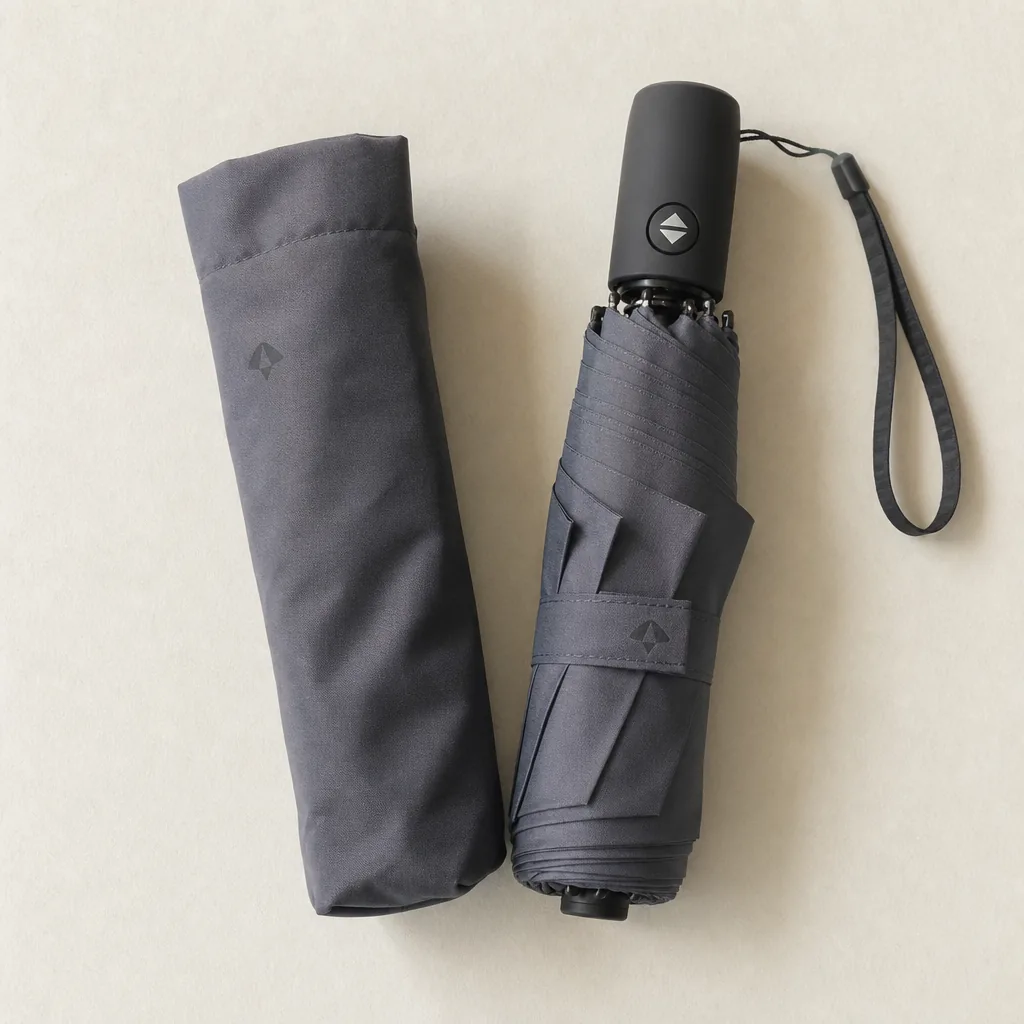
Choose manual folding umbrellas for lower cost, simpler QC and high-volume promotional programs. Choose auto open-close when one-hand convenience can support a higher unit cost and stricter spring and shaft cycle testing. For most retail programs, the decision should follow target price, expected use frequency and acceptable warranty risk, not appearance alone.
How the Two Folding Mechanisms Differ in Use
The use difference is one-hand canopy control, not basic rain coverage. A manual folding umbrella requires one hand on the handle and the other to push the runner up the shaft until it locks; closing also needs a release press and manual pull-down. That is acceptable for low-cost promotional orders, but it is weakest in common commuting moments: stepping out of a taxi, scanning a transit card, holding a phone, carrying coffee, or managing a child’s bag in rain. Auto-open improves deployment only: the button opens the canopy on the standard 3-fold 21" or 23" compact frame. Auto open-close adds button-controlled canopy collapse, so the user can enter a train, car, shop, or office lobby without fighting a wet canopy at the doorway. The telescopic shaft still must be compressed by hand after closing, so the benefit is faster control with one occupied hand, not fully hands-free operation.
Mechanism choice affects FOB cost, failure risk, and QC focus. A manual folding umbrella has fewer springs, trigger parts, and shaft load points, so it suits budget builds such as steel ribs with 190T pongee for events and giveaways. Auto open-close frames need a stronger center shaft, calibrated spring force, secure runner locking, and consistent button assembly. In a folding umbrella mechanism guide, the inspection priorities shift from only canopy stitching to button housing strength, shaft compression feel, lock engagement, rib-tip security, and cycle testing. A dependable 3-fold auto open-close model should pass at least 500 open-close cycles before shipment. For retail programs, buyers often move to 8K fiberglass ribs, 210T pongee with Teflon coating, and wind resistance around 35-45 mph. Vented double-canopy compact models can improve inversion recovery, but the added bulk may weaken handbag-size positioning.
For compact umbrella sourcing, the dominant retail and promotional format remains the 3-fold 21" or 23" umbrella. Manual open is still the practical choice for hotel amenities, charity events, budget distributor orders, and logo-driven campaigns, with MOQ often starting around 500-1,000 pieces per color depending on fabric and print method. Auto-open and auto open-close models fit retail shelves, corporate gifts, insurance campaigns, and travel accessories because the mechanism adds daily-use value buyers can feel immediately. As an auto open close umbrella manufacturer, we usually see upgrades when the umbrella must perform as a paid product or premium gift, not only as a logo carrier. Umbrella lead times MOQ depend on frame availability: plain manual 3-fold orders can ship in 25-35 days, while custom-color auto open-close frames, heat-transfer logos, or UPF 50+ coatings often need 35-50 days, especially before spring and monsoon demand peaks.
For component-level engineering detail, see our umbrella frame mechanism, spring, shaft and QC guide.
Internal Parts That Drive Cost and Failure Risk
The real cost gap sits in the shaft assembly, not in pongee 190T versus 210T canopy fabric. A manual folding umbrella typically uses a telescopic steel shaft, simple runner, notch, and sometimes a light top spring, which means fewer loaded parts and fewer tolerance points during assembly. An auto open-close frame adds a compression spring, release-button module, cord or tape linkage, locking plates, reinforced runner, and tighter tube fit. Spring force is the main failure variable: too little force makes a 21" or 23" frame open slowly and read as defective; too much force drives the runner into the notch, loosens rivets, and shocks the canopy stitching at the tips. Before approving handle shape, logo method, or fabric upgrade, a folding umbrella mechanism guide should confirm spring load, runner travel, shaft lock engagement, button consistency, and sample-to-sample repeatability under cycle testing.
Auto open-close models turn small tolerance errors into repair claims because every joint carries moving load. A 3-fold 8K frame has 8 ribs, 8 stretchers, 8 middle joints, 8 top joints, runner linkage, shaft locks, and multiple pins that can rattle after 500 to 1,000 cycles. A manual folding umbrella is more forgiving because the user controls opening speed and closing force. Auto close is harder on the frame: the canopy collapses quickly, then the user compresses the shaft by hand, which can bend low-cost thin-wall steel tubes. As an auto open close umbrella manufacturer, we reject standard retail samples when closing load rises above roughly 6.5 to 7.5 kg, because higher force increases breakage risk in promotional and retail programs where users may force the mechanism instead of closing it squarely.
Rib choice must match the mechanism, not just the FOB target. Steel ribs keep compact umbrella sourcing costs down, but they can take a permanent set when the auto-open spring fires off-axis or the frame sees side wind. Fiberglass ribs cost more on 8K and 10K folding frames, yet they absorb twist better and reduce broken-stretcher claims after gust testing around 30 to 40 mph; vented double-canopy builds can rate higher only when the shaft and runner are upgraded as well. The riskiest specification is a strong auto spring paired with thin steel ribs and a bargain runner: it may pass appearance inspection, then fail in cycle testing or after shipment. For umbrella lead times MOQ planning, manual frames often start at 500 to 1,000 pcs with 25 to 35 days, while custom auto open-close assemblies can require 2,000 pcs and 40 to 55 days when spring force, shaft color, or handle tooling changes.
Fabric, Frame, and Canopy Specs to Pair With Each Build
Lock fabric before artwork, because canopy weight changes fold diameter, spring load, print sharpness, carton quantity, and freight cost. For a 21" or 23" manual folding umbrella, 190T pongee is usually the safer compact umbrella sourcing choice: it folds tighter, keeps the grip from feeling head-heavy, and supports basic one-color screen print or heat-transfer logos for promotional programs. Use 210T pongee when the buyer needs a retail hand feel, cleaner logo edges, stronger color consistency, or a firmer canopy for auto-open or auto open-close release. The penalty is bulk at the crown and rib tips, so confirm sleeve fit and packed dimensions before sample approval. Keep PVC, POE, and EVA for clear umbrellas or fashion rain styles; in tight multi-fold travel umbrellas they crease, stick, and make the closed bundle too thick.
Specify UPF 50+ only when the product is truly a sun-rain hybrid, not as a routine rain umbrella upgrade. Silver or black UV backing is most practical on 210T pongee when the buyer accepts a different hand feel, slower drying, and possible color shift; coating choices must be finalized before sampling because late changes usually require a new sample. On lighter 190T compact canopies, weak finishing can show uneven coating, abrasion, or stress marks along fold lines after repeated opening. Teflon water-repellent treatment remains the better commuter spec when fast shake-off matters more than shade. A serious auto open close umbrella manufacturer should cycle-test coated canopies through repeated open-close use, not just spray testing, because failures often start where ribs, folds, and the runner load the fabric.
Use standard 8K construction as the default compact build unless the buyer is paying for a stronger frame. A 21" 3-fold manual folding umbrella with steel shaft, steel ribs, and fiberglass tips can usually stay around 300-360 g; a stronger 23" auto-open-close build with fiberglass ribs often lands around 380-450 g. Full fiberglass ribs improve recovery and can support 50+ mph wind-tunnel claims when paired with a vented double canopy, but they increase cost and folded thickness. In a folding umbrella mechanism guide, treat 10K as a premium compact option and 16K as uncommon in tight folding formats because sixteen rib sets crowd the crown, narrow sewing tolerance, and overfill standard sleeves. For umbrella lead times MOQ, plan 30-45 days after sample approval for standard 8K pongee builds, with longer schedules for custom UPF coating, special ribs, AQL 2.5 inspection, or FOB/DDP delivery.
QC Standards for Compact Umbrellas Before Shipment
Final QC for compact umbrellas should be judged against the approved pre-production sample, not a loose spec sheet: fabric hand feel, print position, handle finish, runner fit, packed weight, and carton configuration must match the signed sample. For a manual folding umbrella, inspectors should check smooth hand opening, positive runner-lock engagement, shaft wobble, rib alignment, canopy symmetry, tip tension, and stitch density at stress points, including rib tips, strap attachment, ferrule area, runner notch, and top cap. For auto open-close models, add functional cycle tests for the push button, spring return, center shaft lock, runner release, and telescopic shaft sections so the folding umbrella mechanism guide reflects bulk production, not just sample-room performance. Use AQL 2.5 for major defects, record failures by defect type, and separate spring inconsistency, shaft play, canopy sewing defects, coating damage, and print defects because each requires a different corrective action. A reliable auto open close umbrella manufacturer should test spring force across multiple cartons, since weak closing force and shaft wobble are common return drivers.
Match inspection depth to the distribution channel before shipment release. Retail orders need barcode scans, hangtag and care-label verification, color assortment checks, retail box condition review, and master-carton markings that match the purchase order and packing list. E-commerce orders need tougher transit checks because single umbrellas move through parcel networks: inner-box drop checks, master-carton compression checks, correct polybag suffocation warnings where required, and moisture control for sea freight. Compact umbrella sourcing should also tie QC decisions to umbrella lead times MOQ. If a low-MOQ order fails because of a systemic spring or shaft issue, component replacement can add 5 to 10 days; fabric or print rework can add 12 to 18 days depending on season. These gates give buyers a factual basis to approve shipment, request sorting, or hold production before defects become retail chargebacks, e-commerce returns, or missed launch dates.
MOQ, Lead Times, and Shipping Terms for Folding Programs
For compact umbrella sourcing, quote stock frames separately from custom compact frames. A stock manual folding umbrella can usually start at 300–500 pcs per color when the factory uses an existing 21" or 23" frame, 190T/210T pongee canopy, standard handle, and normal export carton. Auto open-close programs usually require 500–1,000 pcs because the shaft, spring, runner, and 8K/10K rib system must be fitted and tested as one unit; changing one part can affect opening force, closing reliability, and return rate. In a folding umbrella mechanism guide, treat canopy printing as the low-risk customization: logo print samples are typically ready 5–7 days after artwork approval. New handle tooling, frame color changes, custom sleeves, or retail packaging usually move sampling to 10–15 days. For umbrella lead times MOQ planning, allow 25–35 days for manual folding orders and 30–45 days for auto open-close orders after deposit and sample approval. Add buffer before Chinese holidays or when the order needs AQL 2.5 inspection before shipment.
Choose Incoterms based on who controls freight risk, not only the lowest unit price. FOB Ningbo or Shanghai fits importers with their own forwarder, consolidation plan, cargo insurance, customs broker, and control over destination charges. It is cleaner for distributors, retail rollouts, and wholesale orders of several thousand pieces, especially when comparing manual and auto mechanisms by landed cost rather than factory price. DDP works better for smaller buyers that want delivery to a warehouse, office, or 3PL without handling customs entry, duty payment, or last-mile trucking. The DDP unit price is higher because freight, duty, clearance, and delivery are bundled, but it reduces surprise charges on 300–1,000 pc orders. Before comparing any quote from an auto open close umbrella manufacturer, confirm carton size, gross weight, HS code, Incoterms, delivery address, inspection requirement, and export handling. A low EXW price can lose its advantage once China domestic trucking, port fees, and document charges are added.
Frequently Asked Questions
Are auto open-close folding umbrellas less durable than manual ones?
Usually yes, because they use more internal parts and higher spring tension. A well-made auto open-close model can still perform well, but buyers should require cycle testing and tighter QC than for a manual compact umbrella.
What MOQ difference should buyers expect between manual and auto open-close models?
Auto open-close models often have higher MOQs when using a specific frame platform or custom trim package. Exact quantities vary by factory and stock availability, but buyers should expect less flexibility than with basic manual folding umbrellas.
Which folding umbrella type is better for low-defect bulk orders?
Manual folding umbrellas usually have fewer moving parts, so they are simpler to inspect and tend to have lower mechanism-related defect risk. For auto open-close models, buyers should require repeated open-close cycle testing, spring tension checks, and shaft lock inspection before shipment.
How much more does an auto open-close folding umbrella usually cost than a manual model?
Auto open-close folding umbrellas typically cost more because of the spring system, button assembly, stronger shaft, and extra QC steps. The final difference depends on rib material, canopy fabric, handle design, and order quantity.
What MOQ and lead time should buyers expect for custom compact umbrellas?
For logo-printed compact umbrellas, a typical MOQ is about 500-1,000 pieces per model or color. Sampling usually takes 5-10 days, while bulk production is commonly 25-45 days after artwork approval and deposit.
Looking to Launch Your Custom Umbrella Line?
ZheBrella is a Zhejiang-based OEM/ODM umbrella manufacturer with 17 years of export experience. Free design, low MOQ from 100 pieces, windproof construction, full-color print.
Get Free Quote Now »People Also Search For
Related Articles
Manual Open Compact Umbrellas for High-Volume Promo Orders
Learn when manual compact umbrellas outperform auto-open styles on cost, defect risk, and packing for large promotional ...
Read More »
Manual Open vs Auto Open Mini Umbrellas for Gift Programs
Choose the right mini umbrella for gift and promo programs by comparing manual and auto-open builds, size, durability, p...
Read More »
Manual Open Stick Umbrellas for Events and Daily Use
Learn when manual open stick umbrellas outperform auto-open models for events, retail, and uniformed use, with specs, QC...
Read More »