Telescopic Travel Umbrellas: Designing a Compact That Lasts
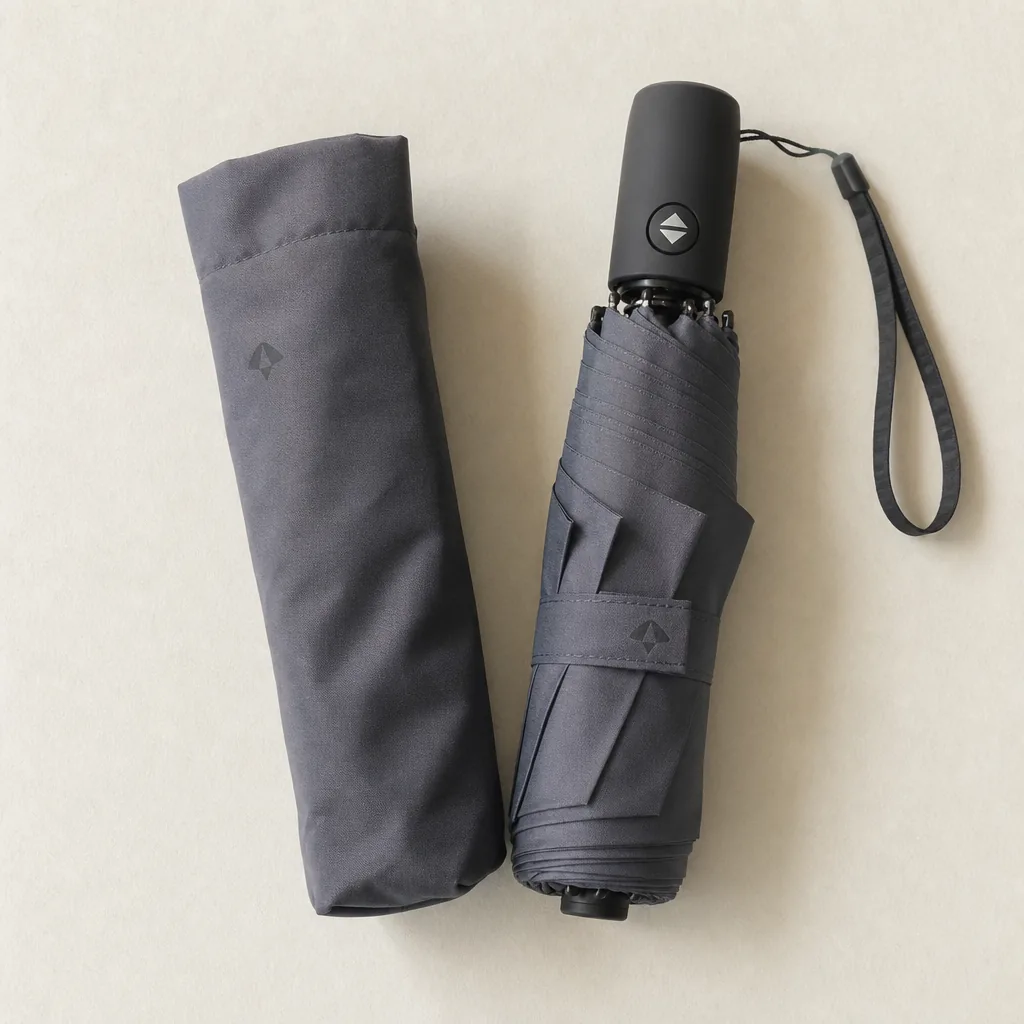
For brands building a carry-everywhere rain product, the challenge is making a telescopic umbrella small enough for a bag while keeping it from failing at the worst moment. The weak points are usually easy to spot on the factory floor: section fit, rib geometry, hinge wear, and how the mechanism holds alignment after repeated opening and closing. Compact only matters if the structure still survives daily use, wind, and sloppy handling.
The telescoping shaft explained
The telescoping shaft is the part that makes a telescopic umbrella compact without turning it into a sloppy stick of tubes. In a typical 2-stage or 3-stage shaft, the outer tube stays fixed to the handle and the inner sections slide inside it, each section stopping on a formed shoulder or rivet point so the canopy can be loaded correctly when open. The geometry matters more than buyers usually expect: if the tube clearance is too loose, the umbrella rattles and twists; if it is too tight, it binds after a few wet cycles and dirt exposure. On a pocket umbrella, the shaft is usually shortened by adding more nested sections rather than making each section thinner to the point of weakness, because wall thickness and concentricity control how long the product stays usable.
A proper collapse sequence is staged, not forced. First the runner comes down the shaft and releases the rib tension, then the shaft sections slide inward one by one until the ferrules stack flush and the handle can close the package cleanly. In manual models, that action depends on spring force, stop-ring placement, and the friction between plated steel or aluminum tubes; in auto-open-close versions, the internal spring and latch have to match the shaft length exactly or the reset becomes unreliable. For a travel umbrella manufacturer, this is where compact umbrella design either succeeds or fails, because the collapse stroke has to be short enough for handbag or backpack carry but long enough to avoid overstressing the joints. A badly tuned telescopic umbrella often looks fine in the sample room and starts failing after repeated opening on windy days.
Material choice changes the shaft behavior more than branding does. Steel gives better dent resistance and lower cost, but it adds weight and can corrode if the plating is poor; aluminum keeps the carry weight down, though thin-wall tubes need better straightness control and tighter forming tolerances. For longer-life construction, some factories pair a steel outer tube with aluminum inner stages, then use nylon or acetal bushings to reduce metal-on-metal wear during collapse. Our standard practice is to check coaxiality, lock strength, and full-extension wobble before canopy assembly, because a pocket umbrella with a perfect canopy still feels cheap if the shaft flexes under hand pressure. In real production, the telescoping mechanism is not a decorative feature; it is the load path that determines whether the umbrella survives daily commuting or gets discarded after a few weeks.
Balancing compact size with strength
The core problem in a telescopic umbrella is simple: every time you shorten the folded length, you lose lever arm and stiffness. A 21-inch frame can carry thicker ferrules and longer ribs without drama; once you push into a pocket umbrella format, the sections get smaller, the sliding points multiply, and any looseness shows up as wobble in wind. On the factory floor, I treat compact umbrella design as a materials problem first, not a styling problem. Thin steel saves cost but creates weight and corrosion risk; fiberglass saves the frame under gust load, especially in the top rib and stretcher, but you still need the right wall thickness or the joints feel sloppy. For a travel umbrella manufacturer, the real target is not the shortest folded length at any cost. It is a frame that opens cleanly, tracks straight, and survives repeated flexing without the canopy going out of square.
In practice, the best balance usually comes from a mixed structure: fiberglass ribs for elasticity, aluminum or steel in the shaft where you need compressive strength, and reinforced hub points so the telescopic sections do not ovalize after 1,000 open-close cycles. A 3-section telescopic umbrella can be built very compact, but once you go beyond that the user starts paying for smaller diameters, more play in the runners, and lower wind resistance. Our standard practice at ZheBrella is to test folded length against load behavior, not just pocket size, because a cheap 10-inch folded unit that flips inside out in a mild storm is worse than a slightly longer one that holds its shape. If the brief demands a true pocket umbrella, I usually recommend prioritizing 190T or 210T pongee, a vented canopy if wind matters, and a frame spec that can tolerate real use instead of just passing a photo sample.
Mechanism options for travel umbrellas
For a telescopic umbrella, the mechanism choice is not just a convenience feature; it sets the whole weight, failure rate, and pack size. Manual open is still the most reliable option in a true pocket umbrella because it keeps the shaft simple, usually with fewer spring parts and less friction in the runner. That matters when you are trying to hold a 21-inch or 23-inch canopy in a folded length under 11 inches. On the factory floor, manual models also tolerate tighter clearances in the telescoping tubes, which reduces rattle and helps the umbrella survive repeated compression in a bag or suitcase. Our standard practice at ZheBrella is to spec stronger runner plastics and a cleaner rib hinge finish before adding convenience features, because a bad mechanism ruins the compact umbrella design faster than a weak fabric panel.
Auto-open is the middle ground most buyers should start with for a travel umbrella manufacturer quote. One push button gives quick deployment, but the closing stroke stays manual, so the spring load is lower and the handle can stay slimmer. That usually makes it easier to keep the total weight around 280 to 350 grams with fiberglass ribs, 190T or 210T pongee, and a three-stage shaft. The catch is button quality: if the latch surfaces are soft or poorly plated, the opener gets sticky after humidity and salt exposure. I would rather see a simple, well-made auto-open than a flashy mechanism with a weak return spring, especially for retail packs where the user will open the umbrella one-handed in traffic or at a hotel door. It is the practical choice for many telescopic umbrella programs.
Auto-open-close is the most convenient and also the most sensitive to cost control. It adds a second spring path, more moving interfaces, and more chances for a weak lock, so the handle, shaft button, and slider tolerances have to be tighter than on a manual or open-only model. In compact umbrella design, that usually means a slightly thicker handle, a heavier head assembly, and more attention to fatigue testing, because the close button gets abused far more than the open button. For a pocket umbrella, I only recommend auto-open-close when the buyer needs clear retail positioning or one-handed use is part of the spec. If the target is pure durability, a well-built manual or auto-open model often outlasts it under the same AQL 2.5 inspection standard, especially when the canopy is small and the folding geometry leaves little margin for misalignment.
Weight targets and materials
For a telescopic umbrella, the weight target starts with the shaft, not the canopy. Aluminum is the normal choice when the brief is a true light-carry product: 6.0 mm to 7.6 mm aluminum shaft tubes keep the stick slim, resist corrosion, and cut grams fast compared with steel. In a pocket umbrella, that matters more than buyers usually admit, because once you add a runner, top cap, handle, and frame hardware, the weight climbs quickly. A practical compact umbrella design usually lands around 220 g to 320 g for a 21-inch format, depending on whether the customer wants manual open, auto-open, or auto-open-close. Our standard practice at ZheBrella is to confirm the target finished weight before tooling, because a 30 g mistake in the shaft spec often forces a redesign later in the frame stack.
Fiberglass ribs are the other half of the equation. They weigh less than steel, flex under load instead of staying bent, and reduce the chance of permanent deformation when a traveler stuffs the umbrella into a bag or cabin bin. For a travel umbrella manufacturer, the usual compromise is full fiberglass ribs on the main arms with a reinforced aluminum shaft, which gives a better carry feel than an all-steel build without making the frame flimsy. On larger 23-inch or 27-inch versions, a hybrid structure can keep the mass acceptable while still surviving gusty street use. The important point is that light carry should not mean disposable construction; a well-made telescopic umbrella still needs clean ferrule fit, decent rivet tension, and enough frame spring to open consistently after repeated compression. That is what separates a usable pocket umbrella from a cheap giveaway piece.
Branding and case design
A telescopic umbrella lives or dies on the sleeve and box, because that is what the buyer and end user touch first. For a pocket umbrella, I prefer a sleeve that is cut with enough ease to slide over a wet canopy without tearing at the seam, usually 190T pongee, nonwoven, or a matte PVC-free fabric if the customer wants a cleaner retail look. Branding works best when it is printed on the sleeve, not only on the canopy, because the sleeve gives you a larger flat panel for a logo, QR code, or one-color retail mark without fighting the rib geometry. As a travel umbrella manufacturer, our standard practice is to keep the print area separate from the seam allowance so the logo does not warp after heat setting or washing. If the buyer wants a premium feel, a woven label or debossed patch on the sleeve reads better than oversized screen ink.
Giftable presentation should match the compact umbrella design, not pretend the product is bigger than it is. A rigid paper box with a tuck-end lid, insert tray, and color-managed sleeve usually sells better than loose polybag packaging for corporate gifts and retail sets. The box needs to hold the folded length tightly so the telescopic umbrella does not rattle, and the insert should protect the runner, handle button, and tips from abrasion during transit. For higher-value programs, I recommend a two-layer presentation: outer carton for shipping, inner retail box for display. That gives room for product claims like auto-open, UPF 50+, windproof vented canopy, or fiberglass ribs without overcrowding the umbrella itself. In practice, the packaging should support the purchase decision in under five seconds on a shelf or in a procurement sample review.
The best branding choices are the ones that survive production, not just the mockup. On short-run orders, hot-stamp foil, matte lamination, and spot UV can look sharp, but they need tolerances that account for die-cut drift and the small format of a telescopic umbrella case. If the order is for giveaways, I usually push buyers toward simple one- or two-color printing, because it stays legible on a 21-inch or 23-inch folding umbrella and keeps unit cost under control at low MOQ. For premium retail, a magnetic closure box, custom tissue wrap, and a printed care card add perceived value without changing the actual umbrella hardware. The right presentation turns a basic travel umbrella into a giftable item, but only if the sleeve, carton, and insert are engineered together from the start instead of being added after the sample is approved.
Frequently Asked Questions
Are telescopic travel umbrellas durable?
They can be, if built with quality nested shaft sections and fiberglass ribs. The more the shaft collapses, the more engineering it takes to stay rigid, so a well-made compact costs more than a flimsy giveaway but lasts far longer.
What is a good weight for a travel umbrella?
Many quality compact travel umbrellas land around 300-450 grams. Lighter is possible with aluminum shafts and fiberglass ribs, but going too light usually sacrifices wind resistance.
How many shaft sections are best for a compact travel umbrella without making it too weak?
For most carry-everywhere designs, 3-section shafts are the best balance of pack size and strength. A 2-section build can be sturdier but usually folds longer, while 4-section versions save more space but need better tolerances to avoid wobble.
What rib material is usually chosen for a durable telescopic umbrella?
Fiberglass ribs are the most common choice for travel umbrellas because they flex in wind instead of snapping. A typical OEM spec uses fiberglass for the main ribs and steel or aluminum for the shaft, depending on target weight and cost.
What MOQ and lead time are typical for custom compact umbrellas?
For OEM/ODM runs, MOQ is often 1,000 to 3,000 pcs per style, depending on canopy print and handle options. Sample development usually takes 7 to 10 days, and mass production is often 30 to 45 days after sample approval.
Looking to Launch Your Custom Umbrella Line?
ZheBrella is a Zhejiang-based OEM/ODM umbrella manufacturer with 17 years of export experience. Free design, low MOQ from 100 pieces, windproof construction, full-color print.
Get Free Quote Now »People Also Search For
Related Articles
Mini Pocket Umbrellas: Sourcing Guide for Promo and Retail Kits
Compare mini pocket umbrella builds, 5-fold frames, pongee fabrics, auto-open limits, MOQ, QC, and packaging for retail ...
Read More »
Travel Umbrella Specs for Airlines, Hotels, and Commuters
Compare 3-fold and 5-fold travel umbrella specs, fabric grades, frame materials, and pack sizes to source compact models...
Read More »
Travel Retail Umbrellas: Compact Specs for Airport Buyers
Specify compact umbrellas for airport and travel retail with smart fold sizes, durable ribs, pouch branding, carton pack...
Read More »