Matching Umbrella Components to Brand Colors and Finishes
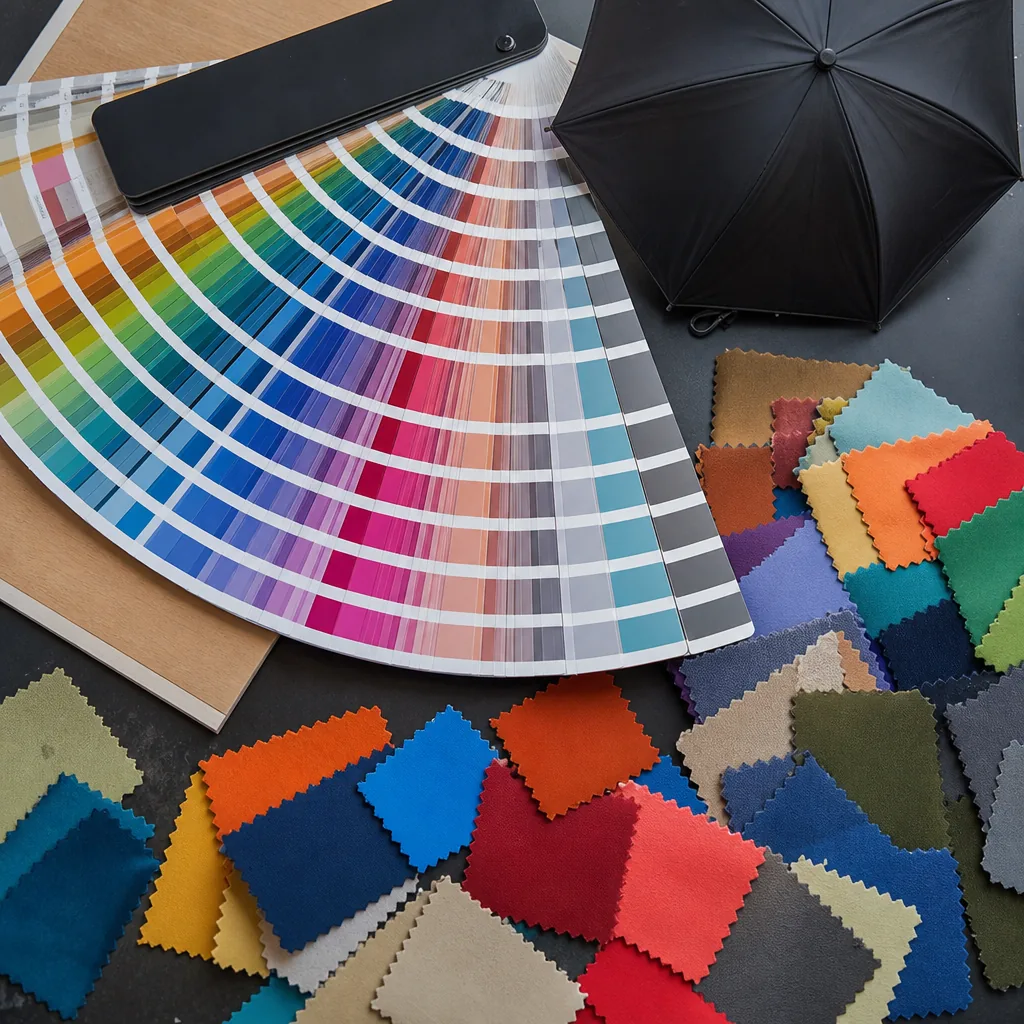
When a buyer approves a canopy color but leaves the handle, tips, strap, or frame finish vague, the finished umbrella can look mismatched even if every part passes inspection. On our Songxia production floor, umbrella component color matching means checking plastic resin, plated metal, painted shafts, webbing, and logo inks under real sampling and assembly conditions, not just comparing Pantone chips. Getting these details locked early protects brand consistency while avoiding surprise MOQs, resampling delays, and finish changes before shipment.
Which Umbrella Parts Can Be Color-Matched
For umbrella component color matching, specify molded plastic parts first and metal hardware second. Beyond the canopy, the practical match points are the handle, top cap, ferrule, rib tips, closure strap, push button, sleeve, and selected shaft finishes. ABS, PP, and TPR parts can be tinted by masterbatch to a Pantone target before injection molding, so handles, tops, ferrules, and tips usually give the cleanest match. Plated metal does not hold Pantone color reliably. Straight and golf umbrellas offer the widest branded umbrella components program because the handles, ferrules, top details, and 27" to 30" exposed frames are larger and easier to inspect. Folding umbrellas, especially 21" to 23" auto open-close models, need tighter control because the button bezel, outer handle shell, and handle insert may come from different tools or materials. Approve assembled pre-production samples under daylight and indoor light; loose component swatches hide mismatch at the joints.
Use stock colors where the part is small, hidden, or expensive to tool. Black, white, navy, and translucent are common stock choices for buttons, bezels, and small umbrella trim options, while custom-matched molded parts often require 1,000 to 3,000 pieces per item. Textile trim gives more flexibility: closure straps and wrist straps can use dyed polyester webbing or be cut from the same 190T or 210T pongee lot as the canopy to reduce hue shift. Sleeves are straightforward in self-fabric pongee, RPET, or POE, but piping, hook-and-loop, and zipper tape usually follow supplier color cards unless the order supports custom dyeing.
Treat shaft and rib finishes as coordinated finishes, not exact Pantone matches. Steel shafts are commonly black electrophoretic coated, chrome plated, or powder coated; aluminum shafts on premium folding umbrellas can be anodized in black, gunmetal, or champagne, with normal lot-to-lot variation. Fiberglass ribs are usually kept black for scuff resistance and consistency, while full-color ribs on compact folding frames add visual risk without much brand impact. For reliable umbrella component color matching, put the strongest color emphasis on the shaft, handle accents, tips, button area, strap, and sleeve. On straight and golf umbrellas, larger exposed hardware makes broader shaft and rib finishes more viable; on folding umbrellas, fewer matched parts usually means lower MOQ risk, faster approval, and fewer rejected samples.
Material Limits That Affect Color and Finish Choices
Material choice sets the real limit for umbrella component color matching before a Pantone target is approved. ABS handles for straight and golf umbrellas mold cleanly in standard brand colors—black, navy, red, white, and gray—but fluorescent green, bright orange, and other high-chroma colors can shift after polishing because the resin base is not optically neutral. PP tips, runners, caps, and ferrules are lower-cost and suitable for volume orders, but PP has a waxy surface, so paint adhesion is weaker; molded color is safer for parts exposed to impact, carton rub, or repeated opening. EVA foam handles match less tightly than hard plastic because the open-cell texture dulls the shade, making navy, brown, and black look dusty. Rubberized coatings over ABS or PP create a soft-touch feel but add cost, reduce gloss choices, and show fingerprints more readily on matte black and dark gray.
Shaft and rib finishes create the highest durability risk. Painted steel shafts can follow a brand color, but the finish must survive runner travel, spring contact, carton abrasion, and repeated open-close cycles. On auto-open and auto-open-close frames, black, silver, or dark gunmetal usually hides small scratches better than a custom painted color. Chrome-plated steel and electrophoretic black steel also deliver more consistent shaft and rib finishes on 23-inch and 27-inch umbrellas than low-volume custom colors. Fiberglass ribs behave differently: standard colors are black, dark gray, or natural charcoal because the fiber-and-resin texture remains visible. Paint can cover fiberglass, but bending on 8K or 10K windproof ribs may crack the coating, especially on models rated around 50 mph. For branded umbrella components, match the handle, end cap, sleeve piping, canopy print, and closure strap before specifying a fragile custom rib finish.
Frame structure determines how many umbrella trim options remain practical. A manual 23-inch stick umbrella gives the most separation between parts: top notch, runner, ferrule, tips, handle insert, sleeve, and strap can be specified independently. A double-canopy golf umbrella adds vent panels, extra stitching, and more alignment points, so contrast binding, colored vents, and custom tips increase sewing labor and inspection risk under AQL 2.5. A 3-fold auto-open-close umbrella has tighter tolerances; telescopic shafts, springs, safety runners, and button housings are usually sourced in standardized black or nickel finishes. Button color customization is normally limited to the outer button cap or handle insert, not the internal trigger. Approve a physical pre-production sample under daylight and indoor lighting before bulk production, because screen proofs cannot predict resin shift, coating gloss, or fiberglass texture.
How to Build a Coherent Brand Palette Across Parts
Build the palette in a fixed hierarchy: primary color on the canopy, secondary color on the closure strap and edge details, and one accent finish on exposed hardware. That approach keeps the logo readable at roughly 3 meters and avoids the common OEM mistake of spreading four or five Pantones across one style. For umbrella component color matching, lock fabric before trim colors. A 190T pongee canopy looks lighter and more promotional; 210T pongee looks denser and more premium because the tighter weave dyes more evenly and shows fewer patchy shifts between panels. Keep contrast functional, not subtle. White or light-gray logos need dark grounds such as navy, black, or deep green. Dark logos need pale canopy shades or a white print block. Avoid low-contrast combinations that disappear under trade-show lighting and in rain-darkened use, especially royal blue on black, dark red on burgundy, and similar close-value pairings used for retail displays or event giveaways.
Choose shaft and rib finishes only after the canopy color is approved, because finish changes how the same umbrella reads in hand. Matte black fiberglass ribs with a rubberized black handle make 210T pongee look modern and controlled; bright electroplated steel shafts, chrome ferrules, and gloss handles push the same canopy toward a lower-cost giveaway position. Use matte trims with darker canopies and gloss trims with high-contrast palettes such as white, red, or cobalt. Keep branded umbrella components disciplined on 190T campaign styles: one trim finish, one handle color, one strap color. Extra plating mixes, colored tips, and mixed runners increase QC risk because each batch reflects light differently. For button color customization, match the ABS release button to the strap or repeat a minor logo color already present in the artwork; a third unrelated accent usually looks cheap, especially on auto-open and auto-open-close frames. If you want tone-on-tone retail styling, create separation through finish, such as forest 210T pongee with a matte black frame and dark gunmetal shaft. Approve canopy swatches, plastic pellets, and plated samples together under D65 light, and inspect finished goods to AQL 2.5 so color approvals are judged as a full set, not in isolation.
Approval Standards for Production-Ready Color Decisions
Treat umbrella component color matching as a production approval, not a design preference. Before bulk ordering, approve physical chips for every visible material: 190T/210T pongee or other canopy textile, POE/PVC panels, molded plastic handles, tips, caps, buttons, straps, sleeves, and painted or plated shaft and rib finishes. Textile lots can shift by dye batch, plastic can look warmer or cooler depending on resin and pigment load, and metal paint can change with primer, gloss level, or curing. Set written tolerance expectations before the pre-production sample: acceptable shade range for fabric panels, gloss and coverage standard for painted parts, and match standard for button color customization and other branded umbrella components. If a spectrophotometer is used, record the agreed ΔE limit; if not, use signed physical chips under consistent D65 daylight or buyer-approved light conditions.
The signed pre-production sample must become the master reference for mass production and AQL 2.5 inspection. Inspectors should compare randomly pulled finished units against the locked references for canopy panels, umbrella trim options, handle, tips, cap, strap, sleeve, logo print, shaft, and ribs. A documented shade band between two approved canopy dye lots may pass, but mixed warm and cool panels on the same 23-inch umbrella should fail. Define defect severity before inspection starts: paint chips, mismatched buttons, uneven rib coating, incorrect logo color, and unapproved substitute trims should not be debated at carton closing. Lock high-resolution photos of the signed PPS from the top, underside, handle close-up, rib and shaft close-up, sleeve, packaging, and logo area. Keep the signed physical sample and approved chips as the controlling standard; photos support remote review and FOB/DDP shipment records, but they do not replace physical approval.
MOQ, Lead Time, and Shipping Impact of Custom Trim Colors
Use stock hardware colors to keep MOQ and unit cost under control. For 21", 23", and 27" promotional umbrellas, black plated steel shafts, matte black fiberglass ribs, and standard PP handles or tips in black, navy, or white usually support 300-500 pieces per colorway. Expect 1,000 pieces when the frame is auto-open-close or built on a less common 10K or 16K structure, because frame sourcing is narrower and the factory cannot spread setup across as many open orders. MOQ climbs when umbrella component color matching extends to visible trim such as the runner, ferrule, tip set, safety cap, or wrist strap. Those parts must be stocked by Pantone shade and finish, so the practical range moves to 1,000-3,000 pieces per color-and-finish combination. The sharpest MOQ increase comes from branded umbrella components that require a new handle mold, a custom ABS button insert, or a nonstandard rubberized coating. At that stage, the constraint is not canopy sewing capacity; it is resin batching, mold setup, and the plastics supplier’s minimum run for matched parts.
Lead time follows the same pattern: dyed plastic parts are faster than custom-painted or plated shaft and rib finishes. Painted or plated metal needs pretreatment, spray, cure, and adhesion testing, and weak specs tend to chip where the ribs, notch, and runner contact during opening and closing. A practical rule is to reserve exact brand matching for the handle, top cap, and button color customization, while leaving internal frame parts in standard finishes unless the umbrella is aimed at retail shelves. Sampling is typically 5-7 days with stock trim after canopy artwork approval, 7-12 days with custom plastic color chips, and 15-25 days for new molds or special shaft and rib finishes. Bulk production is commonly 25-35 days after sample approval for standard trim and 35-50 days when several umbrella trim options are custom-colored across the handle, runner, tip, strap, and sleeve zipper pulls. Shipping risk also rises with each custom-colored component: one late sub-supplier can stop final assembly. Under FOB Ningbo or Shanghai, buyers can sometimes split shipments if carton marks, SKU control, and booking windows are fixed early. Under DDP, partial shipments usually cost more because customs clearance, labeling, and warehouse appointments are duplicated. For orders with multiple custom trims, add a 7-10 day buffer to the ex-factory date and do not book vessel space until incoming inspection and AQL 2.5 inline checks confirm fit and color consistency.
Frequently Asked Questions
Can fiberglass ribs be matched to a brand color like metal parts?
Usually not in the same way as painted steel. Fiberglass ribs are typically black or neutral and are chosen for wind resistance, while visible brand-color matching is more often done on handles, tips, straps, and painted steel shafts.
Do custom-colored buttons or handle caps increase lead times on folding umbrellas?
Often yes, especially if the factory needs custom paint or molded color approval for small parts. On auto-open folding styles, custom trim colors can add approval steps and may extend bulk lead time by about 7-15 days depending on part availability.
Can plastic handles, tips, and buttons be Pantone matched for the same umbrella order?
Yes, plastic components can usually be Pantone matched, but each molded color may require its own MOQ, often around 1,000–3,000 pieces depending on the part. Buyers should approve a physical color chip or pre-production sample before mass production.
Do custom shaft and rib finishes add lead time to an OEM umbrella order?
Yes. Standard black, silver, or white frames are usually fastest, while custom painted, plated, or color-coated shafts and ribs may add 7–15 days for sourcing, finishing, and approval.
What finish options are commonly available for branded umbrella frames?
Common options include black electroplated steel, silver galvanized steel, fiberglass in black or custom colors, painted aluminum, and matte or gloss coated shafts. The best choice depends on the umbrella type, target price, and corrosion resistance requirements.
Looking to Launch Your Custom Umbrella Line?
ZheBrella is a Zhejiang-based OEM/ODM umbrella manufacturer with 17 years of export experience. Free design, low MOQ from 100 pieces, windproof construction, full-color print.
Get Free Quote Now »People Also Search For
Related Articles
Matching Umbrella Trim Colors to Brand Systems at Scale
Learn how to coordinate canopy, strap, handle, piping, and frame colors on branded umbrellas while managing MOQ, toleran...
Read More »
Matching Umbrella Trim Colors to Brand Identity Systems
Learn how to specify trim colors on straps, piping, tips, and binding so branded umbrellas stay consistent across SKUs, ...
Read More »
Matching Branded Umbrella Components Beyond the Canopy
Learn how to align canopy, strap, piping, sleeve, and handle colors so branded umbrellas look consistent across producti...
Read More »