Mini Capsule Umbrellas: OEM Spec Guide for Promo Buyers
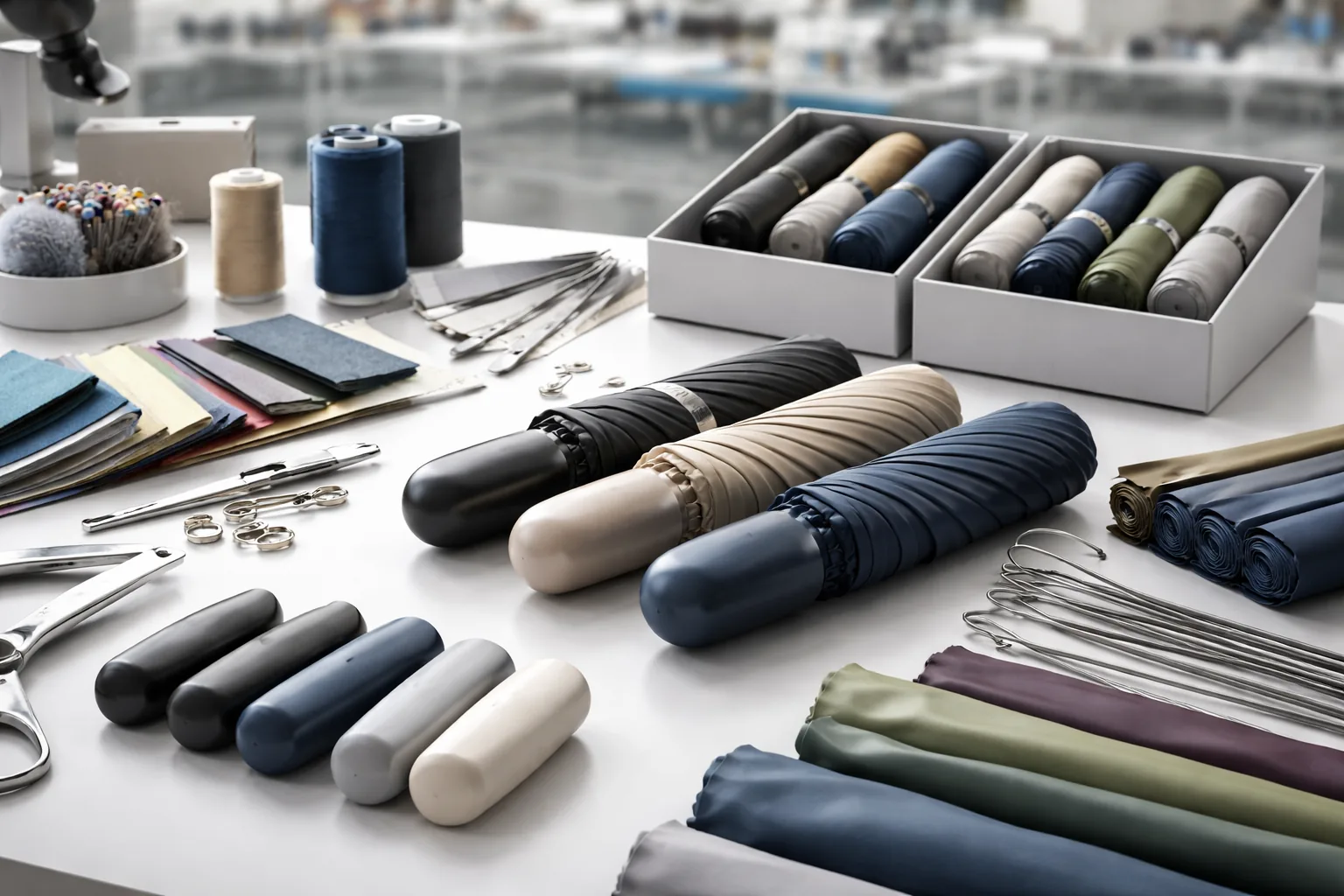
Promo buyers often like mini capsule umbrellas for their gift appeal, but the real sourcing risk is whether a cute compact unit can survive daily use after the logo is printed. On our Songxia factory floor, the issues show up fast: ribs too light for the fold size, pongee that wrinkles under heat transfer, capsule cases that crack in packing, and QC plans that miss open-close fatigue. Getting the spec right before sampling protects both budget and brand reputation.
What Defines a Mini Capsule Umbrella
A true mini capsule umbrella is defined first by folded length, not by canopy marketing photos. In factory specs, we normally classify it as 15–19 cm closed length for 5-fold frames and about 13–16 cm for 6-fold frames, depending on shaft sections, runner design, and handle thickness. The capsule case is not just packaging; it controls the final usable size because the umbrella must slide in without forcing wet fabric into the ribs. Most cases are ABS or PP plastic, sometimes with a silicone ring or matte coating, and the case adds 15–35 g to the finished weight. For pocket promotional umbrellas, buyers should ask for both bare umbrella size and capsule-packed size, because a 17 cm frame can become a 19.5 cm gift item after the shell is included.
The folding structure is where the trade-off becomes real. A 5-fold mini umbrella is easier to assemble, usually smoother to open, and less prone to shaft twist than a 6-fold version; a 6-fold frame wins on purse and pocket size but has more joints, shorter rib segments, and tighter sewing tolerance. Most OEM mini umbrellas use 6K or 8K ribs, with steel ribs for low-cost campaigns and fiberglass tips or mixed fiberglass ribs for better recovery. Canopy fabric is usually 190T pongee for retail-feel compact gift umbrellas, while polyester is used when the price target is aggressive. Manual open is the safest choice at this size; auto-open and auto-open-close mechanisms need more spring length, so they push weight and folded diameter upward.
Canopy diameter should be specified honestly. Many mini capsule umbrellas sit around 85–92 cm arc diameter, giving a practical open diameter near 78–84 cm after curvature; that is enough for one adult walking short distances, not for two people or storm use. A 21 inch mini frame can look attractive in artwork mockups, but once you reduce rib length for a capsule body, coverage drops quickly. This is why a responsible capsule umbrella supplier will not promise the same wind performance as a 23 inch or 27 inch regular folding umbrella. Mini size favors portability, mailer-friendly weight, and daily convenience over heavy wind resistance; even with fiberglass reinforcement, I would position these as light-rain and commuting items, not 50+ mph windproof models. For mini capsule umbrellas, the winning spec is balanced: compact closed length, clean case fit, stable manual mechanism, and print area large enough for the logo without pretending it is a full-size storm umbrella.
Frame Choices for Small Folding Builds
Steel is still the safest default for many mini capsule umbrellas because the frame geometry is unforgiving. A 21" or smaller folding build uses short rib segments, tighter joints, and smaller rivets, so the load does not spread as smoothly as it does on a 23" or 27" standard compact umbrella. In 6K layouts, each rib carries more canopy tension, and steel main ribs with a steel center shaft tolerate repeated opening shock better than soft aluminum. The tradeoff is weight: a steel 6K mini frame often lands 20–35 g heavier than an aluminum version, which matters for pocket promotional umbrellas shipped in large event kits or retail gift boxes. For low-cost campaigns, I prefer steel for the first and second rib sections, then a lighter final tip section if the buyer insists on shaving grams.
Aluminum looks attractive on a spec sheet, but it needs honest qualification. Thin-wall aluminum shafts and ribs reduce weight, yet they deform faster at the runner notch, stretcher joint, and rib-to-tip hinge when users snap the umbrella open one-handed. That is why OEM mini umbrellas using aluminum should not be approved only by static pull tests. We run repeated open-close cycle checks, rib deflection checks, and post-test canopy alignment review, because ultra-light builds can pass the first inspection and still fail after 300–500 cycles. Fiberglass is usually best used selectively: fiberglass end ribs improve rebound in gusts, but full fiberglass mini frames are harder to package neatly inside a capsule shell because the rib memory fights the tight fold. For compact gift umbrellas, mixed construction often gives the best balance: aluminum shaft, steel stretchers, fiberglass tips.
An 8K frame feels more stable than 6K in the hand, but it also adds eight more hinge lines and more sewing control points on the canopy. On mini capsule umbrellas, that extra structure can reduce panel flutter, especially with 190T pongee or thin polyester, but poor riveting will create new failure points at the short rib segments. I look closely at rivet mushroom height, stretcher symmetry, and whether the runner locks without twisting the shaft. A capsule umbrella supplier should also define test conditions clearly: manual open or auto-open, dry cycle count, wet cycle count, and wind behavior at 20–30 mph, not vague “windproof” language. Our standard practice at ZheBrella is to tighten cycle testing on ultra-light mini frames before mass production approval, because a 5 g saving is worthless if the frame starts bending during a customer’s first rainy commute.
Canopy Fabric, Coatings, and Print Areas
For mini capsule umbrellas, 190T pongee is the practical baseline for most promotional programs because it balances cost, hand feel, water resistance, and print stability better than cheap polyester. On a 5-fold or 6-fold pocket frame, the canopy is already under more folding stress than a 21" or 23" compact umbrella, so fabric that is too stiff creates bulky folds and makes the capsule case hard to close. A good 190T pongee with standard water-repellent treatment beads rain well for daily commuting and event giveaways, especially when paired with fiberglass tips and light steel or aluminum ribs. If the order is for pocket promotional umbrellas used mainly as conference gifts, retail inserts, or travel kits, I would rather keep the money in cleaner stitching and tighter AQL 2.5 inspection than overspec the coating.
For higher-perceived-value programs, 210T pongee gives a denser surface, better color depth, and a smoother print face, but it also adds a little thickness when folded. If the brief includes rain plus sun protection, we normally move to black-coated pongee or a UV coating rated UPF 50+, especially for outdoor festivals, beauty brands, and resort retail. Silver coating is cheaper, but black coating looks cleaner from the outside and blocks glare better; the tradeoff is MOQ and slightly longer curing time after printing. On OEM mini umbrellas, confirm whether the coating sits inside only, because printing over coated surfaces can reduce adhesion unless the ink system and drying temperature are adjusted. For DDP schedules, I usually add 2–3 days of buffer for coated canopies after bulk print approval.
Logo space is the biggest mistake buyers make with compact gift umbrellas: the canopy panels are small, curved, and interrupted by seams, so a logo that works on a 27" golf umbrella often looks crowded here. On most capsule styles, a safe single-panel print area is roughly 120–160 mm wide by 60–90 mm high, depending on arc length and rib count; big horizontal slogans should be simplified or moved to the sleeve. Heat transfer handles gradients and tight brand colors better than screen print on small panels, while screen print is still fine for one- or two-color logos above 500–1,000 pcs. Capsule cases can carry pad print, UV print, or a small sticker label, but curved plastic limits perfect registration. As a capsule umbrella supplier, ZheBrella’s standard practice is to approve canopy, sleeve, and capsule artwork separately before cutting bulk fabric.
Capsule Case Design and Packaging Options
The capsule case is not just decoration; it drives the perceived value and the packing efficiency of mini capsule umbrellas. The common low-cost option is an injection-molded PP or ABS plastic capsule in two halves, usually 17–19 cm long for a 5-fold 18" or 19" frame, with a snap fit that must be tested after 500 open-close cycles because loose caps are a frequent complaint in promo orders. EVA cases feel softer and quieter in a handbag, but they need compression molding or heat-sealed seams, so the wall thickness and zipper quality matter more than the logo print. For pocket promotional umbrellas, I prefer ABS for bright Pantone colors and EVA for matte lifestyle branding, especially when the buyer wants a more retail-gift look rather than a giveaway item.
Color matching sounds simple until the shell, canopy, handle, wrist strap, and box all use different materials. A Pantone 186C red on 190T pongee will not look the same on ABS plastic or EVA foam, so our standard practice at ZheBrella is to approve one physical color chip for the case and one strike-off for the canopy before bulk production. A color-matched shell normally adds 7–12 days if the resin needs custom pigmenting, and the practical MOQ is often 3,000–5,000 pieces per color instead of 1,000–2,000 pieces for stock black, white, navy, or clear capsule shells. Metallic, translucent, or soft-touch finishes look good in photos but increase scratch sensitivity during DDP shipping unless each capsule is protected with an OPP bag or tissue wrap.
Packaging choice changes both unit cost and carton volume, which matters when compact gift umbrellas ship by air for events. Basic individual packaging is one umbrella inside the capsule plus an OPP bag and barcode sticker; this is the lowest-cost route and keeps cartons around 50–60 pieces depending on capsule diameter. A printed paper sleeve, hang tag, or carabiner clip usually adds a small material cost but can improve retail display without new tooling. A full-color retail box is better for OEM mini umbrellas sold through gift shops or online kits, but it adds die-cut setup, artwork proofing, and more CBM per 1,000 pieces. If you ask a capsule umbrella supplier for a custom case shape, expect tooling fees and a higher MOQ, because the mold must be tested for cap retention, drop resistance, and fit tolerance before AQL 2.5 inspection can be meaningful.
Production Lead Time and QC Priorities
Lead time for mini capsule umbrellas should be counted from approved pre-production sample, not from deposit date. For OEM mini umbrellas, a realistic sample cycle is 5–7 days for existing molds and fabric colors, or 10–14 days if the capsule shell needs a custom Pantone match, logo embossing, or new strap hardware. Once the buyer signs off on canopy fabric, print position, capsule fit, and opening mechanism, mass production normally takes 25–35 days for 3,000–10,000 pcs. Peak season before spring promotions or Q4 gifting can push that to 40–45 days, especially when 190T pongee colors, POE cases, or UV-coated fabrics must be booked from upstream mills. I do not recommend releasing bulk fabric cutting before the sample is checked physically; a 2 mm logo drift on a 21 inch compact canopy looks worse than the same error on a 30 inch golf umbrella.
Shipment planning depends on the event date and how much risk the buyer can absorb. FOB Ningbo or Shanghai is usually the cleanest choice for distributors with their own freight forwarder, while DDP works better for promotional-product buyers shipping direct to warehouses in the U.S. or EU. Pocket promotional umbrellas are dense but not very heavy; the capsule case increases carton volume, so a 50 x 35 x 32 cm export carton may hold fewer pieces than a normal 5-fold umbrella carton. For urgent launches, air freight can work for 500–1,000 pcs, but sea freight is more rational above that quantity. Our standard practice at ZheBrella is to confirm carton drop-test strength, barcode placement, master carton marks, and packing ratio before booking space, because a cracked capsule case in transit creates more complaints than a slightly delayed vessel.
QC priorities for compact gift umbrellas are different from full-size rain umbrellas because the buyer is handling a small object at close range. Under AQL 2.5 for major defects, inspectors should cycle the manual or auto-open-close mechanism several times, check rib symmetry after opening, confirm the shaft locks without wobble, and verify that the canopy folds back into the capsule without forcing. Frame alignment matters even on 6K or 8K mini frames; if one steel or fiberglass rib sits high, the umbrella looks twisted and the logo print appears off-center. For mini capsule umbrellas, I would also measure strap length consistency, case inner clearance, cap thread or snap fit, and hanging loop pull strength. Print durability needs a rub test on screen print, heat-transfer, or sublimation panels, plus water exposure after drying, because promo buyers care less about lab theory and more about whether the logo still looks clean after a rainy trade-show day.
Frequently Asked Questions
Are mini capsule umbrellas suitable for windy cities?
They are best for light rain and emergency use, not strong wind. For windy markets, buyers should consider 8K fiberglass ribs, reinforced joints, and realistic warranty positioning.
What is the usual MOQ for a custom capsule case?
A printed standard capsule case may start at a lower MOQ than a custom-molded case. Custom shell colors, new molds, or special finishes usually require higher MOQ and longer sample lead time.
What specifications should buyers confirm before ordering mini capsule umbrellas?
Confirm the folded length, open diameter, rib material, fabric weight, handle style, capsule case size, and printing method. For giveaways, common specs include 5-fold or 6-fold frames, 170T or 190T pongee fabric, and a matching plastic capsule case.
What is a typical MOQ for OEM mini capsule umbrellas?
A practical MOQ is usually 1,000 to 3,000 pieces per color or design, depending on fabric color, capsule case color, and logo printing. Fully customized mold colors or special packaging may require a higher MOQ.
How long does production take for branded pocket promotional umbrellas?
Sampling usually takes 5 to 10 days after artwork approval, while bulk production is commonly 25 to 40 days depending on order quantity and material availability. Buyers should add extra time for pre-shipment inspection and sea or air freight planning.
Looking to Launch Your Custom Umbrella Line?
ZheBrella is a Zhejiang-based OEM/ODM umbrella manufacturer with 17 years of export experience. Free design, low MOQ from 100 pieces, windproof construction, full-color print.
Get Free Quote Now »People Also Search For
Related Articles
Mini Capsule Umbrellas for Promo Kits: Buyer Spec Guide
Learn how to specify mini capsule umbrellas for promo kits, from 5-fold frames and pongee fabric to printing, MOQ, lead ...
Read More »
Mini Pocket Umbrellas: Sourcing Guide for Promo and Retail Kits
Compare mini pocket umbrella builds, 5-fold frames, pongee fabrics, auto-open limits, MOQ, QC, and packaging for retail ...
Read More »
Flat Mini Umbrellas: Retail Buyer Spec and Sourcing Guide
Source flat mini umbrellas for retail with clear specs for folding structure, rib strength, pongee fabric, coating, pack...
Read More »