Plastic-Free and Recyclable Umbrella Packaging Options
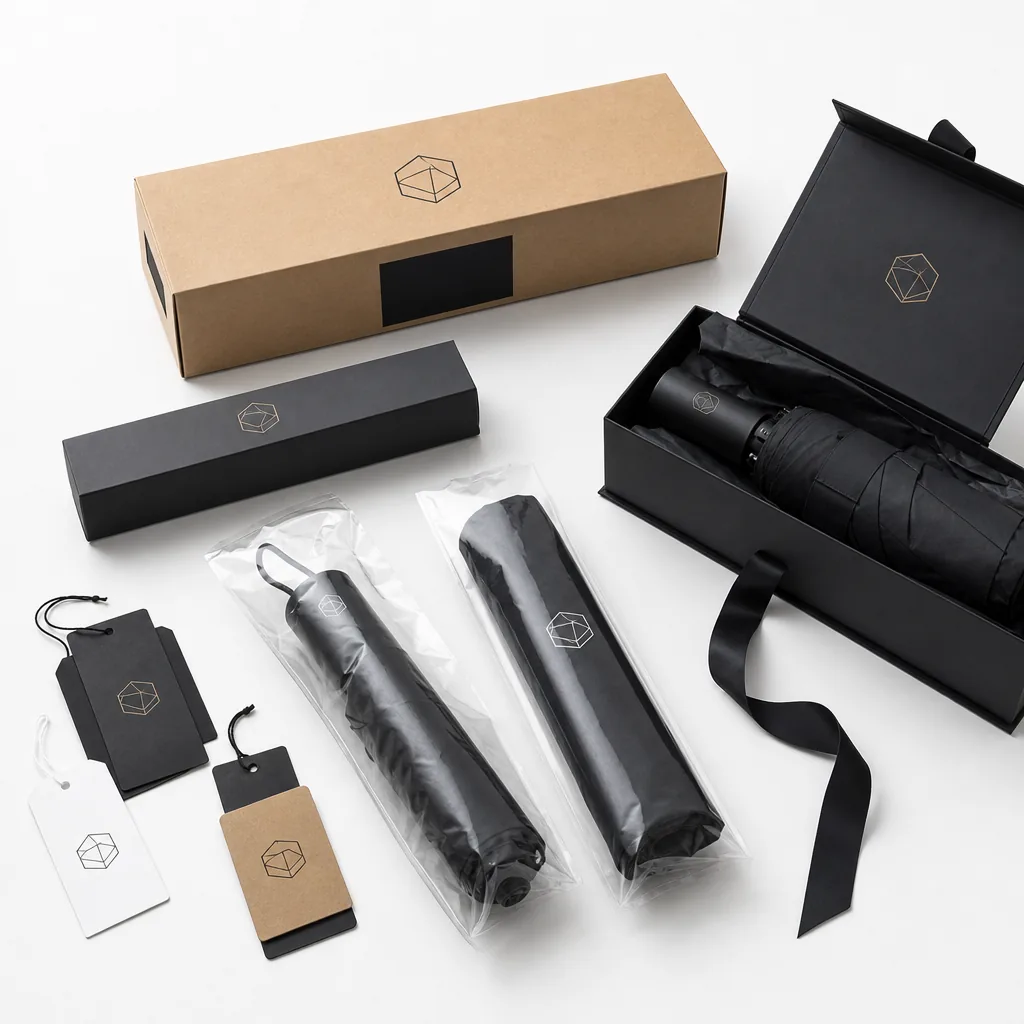
Umbrella buyers are under pressure to cut plastic without compromising transit protection, shelf appeal, or landed cost. In factory production, the weak points are usually the same: edge damage, moisture, print durability, and packaging that looks cheap after one shipping cycle. The practical path is recyclable umbrella packaging that fits the product, runs cleanly on packing lines, and stays compatible with EPR rules and regional recycling systems.
The default plastic problem
The default packaging on most umbrellas is still a thin PVC or PE sleeve plus a clear polybag, sometimes with a paper header or hanging tag stapled on top. On the factory floor, that looks cheap and efficient, but from an EPR standpoint it is exactly the kind of low-value, mixed packaging that gets penalized. A PVC sleeve, PE bag, ink, adhesive, staple, and hang tag are not a clean recycling stream; they are several materials that a sorter has to separate, and in practice they usually end up as residual waste. That is why umbrella packaging EPR has become a real cost item in the EU and UK, especially for importers who are now tracking weight, material mix, and producer responsibility fees line by line. The criticism is not theoretical. A 21" fold umbrella in a 0.03 mm polybag can look harmless, but when you ship tens of thousands of units, the packaging tonnage and compliance paperwork stack up fast.
If the goal is recyclable umbrella packaging, the first move is to remove the plastic sleeve and polybag entirely or replace them with a single-material paper solution. A sustainable umbrella sleeve made from FSC kraft, uncoated art paper, or recycled board is easier to collect and sort than laminated plastic film, and an eco umbrella box can carry product data, barcode, and care instructions without adding extra wraps. For larger retail programs, we often see better results with a flat-fold paper belly band or a die-cut carton that protects the canopy edge without full enclosure. The tradeoff is real: paper adds bulk and can dent if you under-spec the board, so you have to match the pack to the umbrella size, whether it is a 23" auto-open stick or a 10K fiberglass folding model. In other words, plastic free umbrella packaging is not just a design choice; it is a packaging engineering decision that affects freight, shelf presentation, and EPR exposure at the same time.
Recyclable and paper-based alternatives
For plastic free umbrella packaging, the cleanest path is a mono-material sleeve made from kraft paper or a single resin family, not a mixed bag of film, glue, and foil that can’t be sorted after use. In practice, a good recyclable umbrella packaging spec is simple: a paper sleeve for the canopy, a paper hang tag, and a carton with no lamination, no soft-touch coating, and no plastic window. If you need print, use water-based ink on uncoated stock and keep the coverage moderate so the sleeve still breaks down in normal paper recovery. The sleeve has to fit the folded umbrella tightly enough to stop scuffing, but not so tight that customers tear it on first opening. For 21-inch compact umbrellas, a 120-150 gsm kraft sleeve usually works; for longer 23-inch or 27-inch models, increase stock weight and add a die-cut thumb notch so the user can remove it without damaging the shaft finish.
RPET sleeves are the compromise when the buyer wants a clear cover but still wants a recyclable umbrella packaging story that is easier to defend than PVC. The key is to keep the construction mono-material and avoid mixed trims, because one bad heat-sealed label can turn a sleeve into waste instead of recycling feedstock. I do not recommend glossy laminated film for this use; it looks expensive for a month and creates sorting problems for years. A printed sustainable umbrella sleeve in 30% to 100% RPET can work well for retail sets, but it should be specified with the actual resin content, thickness, and end-of-life claim spelled out in the packing file. ZheBrella treats this as a packaging engineering problem, not a branding exercise, because the sleeve has to survive warehouse handling, bundle compression, and export carton friction without cracking or fogging.
Paper bands and FSC cartons solve different problems, and buyers should not treat them as interchangeable. A paper band is the lowest-material option for merchandising, but it only works if the umbrella fabric is cleanly folded and the band has enough stiffness to stay on during transport. For gift or retail programs, an eco umbrella box made from FSC-certified board gives better shelf presentation and better crush protection, especially when the canopy is sublimated or has a Teflon finish that can mark against rough corrugate. If you are building umbrella packaging EPR into a European or UK program, the carton surface area, print coverage, and fiber sourcing matter just as much as the visual design; overbuilt mixed-material packaging increases compliance cost without improving the product. My rule is simple: use the lightest structure that still passes transit tests, then document the board grade, ink type, and recycled content so procurement can defend the spec instead of guessing later.
Protection vs sustainability tradeoffs
The main mistake I see is replacing plastic with weak paper and calling it sustainable. An umbrella still leaves the factory with residual moisture from final inspection, so the package has to handle damp canopies, wet tips, and abrasion from carton-to-carton rubbing. For recyclable umbrella packaging, the practical path is a kraft paper sleeve or paperboard wrap with the right surface treatment, not a flimsy uncoated shell that turns soft in transit. A 210T pongee canopy with a Teflon finish can scuff a plain sleeve during long ocean freight, so we usually look at FSC kraft, water-based coatings, and reinforced folds at the handle and ferrule points. That keeps the pack recyclable while still protecting print quality and preventing edge wear. If the shipment is going into retail, a clean paper sleeve also gives better shelf presentation than loose bulk packing, especially for 21" and 23" folding models.
If the goal is plastic free umbrella packaging, the tradeoff is usually moisture resistance versus end-of-life simplicity. A fully plastic-free structure can work, but only if the umbrella is dried properly before packing and the sleeve is sized correctly so the canopy does not scrape through the side seams. In humid lanes like Southeast Asia, I would avoid uncoated paper in carton contact zones and use a sustainable umbrella sleeve with a water-based barrier on the outside only; that preserves recyclability better than film lamination. For larger stick umbrellas, a paperboard belly band plus molded pulp tip protector often performs better than a full pouch because it blocks abrasion where the load is highest. ZheBrella’s standard practice is to test packaging after vibration and compression so the customer does not discover ink rub, corner crush, or mildew staining after arrival.
An eco umbrella box is worth the extra material only when the channel justifies it: retail sets, gift programs, or brand launches where shelf damage matters more than freight density. For bulk export, a reinforced corrugated shipper with paper inserts is usually the better balance because it reduces void fill and avoids mixed-material waste. This is where umbrella packaging EPR starts to matter, because a design that is technically recyclable but full of glued foams, plastic windows, and metallized films will create disposal headaches in markets with stricter producer-responsibility rules. The cleaner solution is one-material paper construction, soy-based inks, and minimal adhesive coverage so the pack can enter normal paper recycling streams. In practice, that usually means accepting slightly lower wet-strength than plastic, then compensating with smarter geometry, tighter carton fit, and better pre-drying at the packing line.
Branding on sustainable packaging
Recyclable umbrella packaging does not have to look plain, and in practice the strongest branding usually comes from the substrate, not from adding plastic. A 350- to 450-gsm kraft board eco umbrella box can take sharp flexo or offset printing, blind embossing, foil-free debossing, and a single spot color that reads cleanly on shelf. For a plastic free umbrella packaging program, I usually recommend uncoated or lightly clay-coated paperboard because it accepts dense black, PMS red, and high-contrast line art without the muddy look you get from glossy film wrap. On a factory line, that matters more than designers admit: if the box folds well, holds square corners, and survives carton compression, the print looks better in transit and on arrival. A sustainable umbrella sleeve in 120- to 140-gsm kraft also gives a premium first touch without adding a separate bag or shrink film.
The unboxing impact comes from structure and sequence. A well-cut insert can center a folded 21-inch or 23-inch umbrella so the customer sees the handle first, then the canopy panel graphics, then the brand mark on the sleeve or lid. ZheBrella typically uses soy or water-based inks, because they stay compatible with curbside recycling and still reproduce fine type at 4 to 6 pt if the plate setup is correct. You can also build a stronger reveal with a two-piece telescoping box, a magnetic-free tuck lid, or a matched sleeve over a corrugated mailer, all of which stay within recyclable umbrella packaging rules. If the artwork is planned around one or two imprint surfaces instead of wrapping every face, the result looks more deliberate, not cheaper. That is usually where buyers get the best balance between cost, print quality, and assembly speed.
The practical part is compliance and SKU discipline. Umbrella packaging EPR rules are getting stricter in the EU and several state programs in the U.S., so the box has to be easy to sort, flatten, and recycle without mixed-material lamination or unnecessary windows. If you need color without plastic film, specify fiber-based textured board, aqueous coating, and black or brown print contrast rather than full-coverage gloss. For retail sets, an eco umbrella box can still carry barcode, QR code, care instructions, and a short brand story without bloating the panel count, and it can be packed at the same AQL 2.5 standard used for the umbrellas themselves. The point is simple: branding works when the package survives shipping, opens cleanly, and looks intentional on the shelf, not when it adds decorative waste that the recycler has to strip out later.
EPR and cost implications
In the EU, packaging is no longer judged only by what protects the umbrella in transit. It is also a cost item under umbrella packaging EPR, because fees increasingly track material type, weight, and recyclability. A heavy mixed-material pack with a PVC sleeve, adhesive labels, metal staples, and laminated cardboard is harder to sort and can land in a worse fee category than a simple mono-material paper structure. That is why recyclable umbrella packaging is not just a branding choice; it affects landed cost, reporting burden, and whether the pack is accepted by local recycling streams. If the carton is easy to flatten, the sleeve is paper-based, and inks are limited to standard water-based printing, the compliance story is cleaner and the fee profile is usually better than with plastic-laminated alternatives.
The practical move is to design plastic free umbrella packaging around materials that can be declared clearly in EPR filings. A sustainable umbrella sleeve made from kraft paper, uncoated board, or FSC-certified paperboard usually avoids the sorting problems that come with film lamination and mixed polymers. For an eco umbrella box, keep the structure simple: one substrate, minimal adhesive, no magnetic closures, and no hidden plastic windows. That reduces both the recyclability question and the risk of non-compliance when a buyer sells across France, Germany, or the Netherlands, where packaging registrations and fee calculations are taken seriously. Our standard practice is to specify the pack by material family first, then by print method and thickness, because those choices drive both recyclability and the cost of declaration.
The biggest mistake is assuming that a cheaper pack at the factory gate is cheaper overall. In Europe, a low-cost sleeve made from mixed plastic and paper can create higher EPR fees, more documentation, and more customer pushback than a slightly more expensive recyclable umbrella packaging format. Buyers should ask for the exact material breakdown, estimated pack weight, and whether the design is accepted as recyclable in the target market before they lock the artwork. If the product ships in bulk for retail replenishment, the packaging can often be reduced further, but if it is hanging-ready or gift-ready, the carton must be engineered carefully so the outer pack still meets shelf requirements without adding unnecessary components. That is where cost and compliance are decided, not at the design mockup stage but in the bill of materials.
Frequently Asked Questions
Can umbrella packaging be plastic-free?
Largely yes. The sleeve can move to recyclable mono-material or RPET, outer wraps to paper bands, and boxes to FSC-certified recyclable board. The main tradeoff is moisture and abrasion protection, so test that a paper-based or recyclable sleeve still protects the canopy in transit.
Does sustainable packaging reduce my EPR fees?
It can. EU packaging EPR fees are increasingly modulated by recyclability, so recyclable mono-material packaging may cost less in fees than mixed plastics — on top of the marketing benefit. Lighter, recyclable packaging is both a compliance and a cost lever.
Which packaging structure is usually easiest to recycle for umbrellas?
A single-material paper setup is the simplest option: a kraft sleeve or folding carton, paper tape, and a corrugated shipper. Avoid mixed laminates, plastic windows, magnets, and foam inserts if the goal is straightforward recycling.
What MOQ should a buyer expect for custom umbrella packaging?
For printed paper sleeves or folding boxes, many factories quote around 1,000 to 3,000 pieces per design and size. If you need multiple umbrella models or languages, the MOQ is often higher because each artwork version needs its own print setup.
How long does it take to produce plastic-free umbrella packaging?
Typical lead time is about 15 to 25 days after artwork approval for standard paper packaging. If you add special dies, embossing, or multiple Pantone colors, plan for extra time for sampling and prepress checks.
Looking to Launch Your Custom Umbrella Line?
ZheBrella is a Zhejiang-based OEM/ODM umbrella manufacturer with 17 years of export experience. Free design, low MOQ from 100 pieces, windproof construction, full-color print.
Get Free Quote Now »People Also Search For
Related Articles
Sustainable Umbrella Packaging Options for Brand Buyers
Evaluate plastic-free and recycled packaging for umbrellas with practical guidance on materials, protection, MOQ, and co...
Read More »
Sustainable Packaging Branding for Private-Label Umbrellas
Compare kraft, FSC paper, soy ink, and recyclable sleeves for private-label umbrellas, with branding tips for retail and...
Read More »
Eco-Minded Umbrella Packaging for Private-Label Brands
Plan recyclable umbrella packaging with FSC paper, kraft boxes, reduced plastic, and factory specs that support brand go...
Read More »