Private-Label Retail Umbrellas: Store Program Buyer Guide
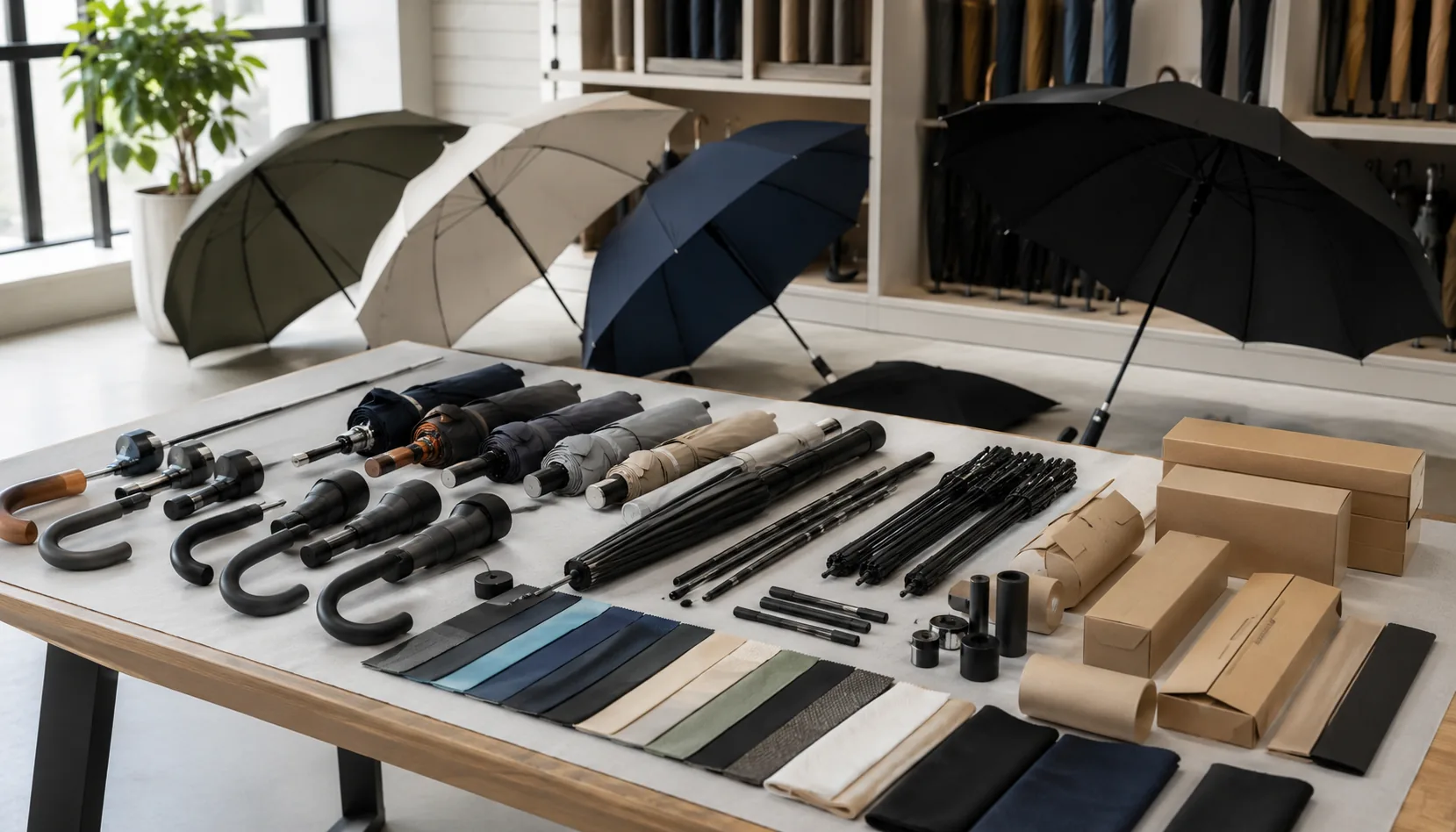
Buying private-label retail umbrellas is rarely about the sample that looks good in a meeting; it is about whether the program can hold margin, survive shelf handling, and repeat cleanly across reorders. From the factory floor, the failures usually start in unclear specs: fabric weight, rib gauge, runner fit, hangtag placement, and carton count. Buyers who lock those details early avoid the quality drift that turns a seasonal launch into returns and chargebacks.
Define the retail price tier before choosing the build
Set the retail price first, because the shelf target decides the frame long before color cards and handle sketches do. For private-label retail umbrellas aimed at the value tier, think roughly $12.99 to $19.99 retail. The cleanest build is a 21" or 23" manual or basic auto-open frame with 190T pongee or clear POE canopy, a black-plated steel shaft, and standard 8K ribs. That keeps FOB cost under control, but the umbrella will feel heavier in hand than buyers expect if you overspec the steel. I usually reserve steel-only ribs for promotional channels, not for store programs where consumers compare weight and opening smoothness on the peg. Keep packaging simple: OPP sleeve, swing tag, and export carton markings. If your retail umbrella specifications also require printed graphics, solid spot colors on pongee are much more forgiving than full-panel gradients on cheap POE, and they hold margin better when MOQ is only 1,200 to 3,000 pieces.
Mid-tier programs, usually $19.99 to $34.99 retail, are where material choices start to matter more than decoration. Move up to 210T pongee, a better runner and spring set, and a hybrid frame: aluminum shaft with fiberglass end ribs or full fiberglass ribs on an 8K layout. Aluminum drops weight fast, which helps perceived quality the moment a shopper picks it up, but it does not fix a weak frame if the rib joints and notches are thin. A 23" auto-open stick or a 27" golf style in this band should feel balanced, not just light. This is also the right tier for matte rubber handles, woven labels, recycled paper wraps, and cleaner retail packaging instead of loose sleeves. If you are comparing lead times, remember that custom boxes, hangtabs, and barcode labeling often add more calendar days than canopy sewing; a sensible estimate is 35 to 45 days ex-factory after sample approval, versus 25 to 30 days for a plain bulk-pack reorder.
Premium retail, from about $39.99 upward, is where buyers often get distracted by 8K 16K ribs without asking what problem the rib count is solving. A 16K frame looks dense and expensive on shelf, and for fashion umbrellas that visual texture can justify the cost, but a well-engineered 8K frame with thicker fiberglass main ribs, a vented double-canopy umbrella, and a calibrated auto-open-close mechanism will usually outperform it in real wind. If you want a credible windproof claim, specify fiberglass and aluminum combinations that can survive 50+ mph in internal wind-tunnel testing, plus 210T or 230T pongee with Teflon and UV coating rated UPF 50+. Add a gift box only if your margin can absorb the freight penalty; premium packaging increases carton volume faster than most buyers model. At ZheBrella, our standard practice for private-label retail umbrellas is AQL 2.5 on opening, closing, stitch count, print registration, and top-notch alignment before shipment, because premium returns are usually caused by small functional misses, not by fabric color.
Canopy fabric and weather performance at retail
The fabric decision sets the ceiling on perceived quality in private-label retail umbrellas long before a shopper tests the frame. Between 190T and 210T pongee, 190T is the workhorse for 21-inch and 23-inch compact styles because it folds smaller, costs less, and still gives acceptable color density on screen print or heat-transfer logos. But on a retail shelf, 210T reads better immediately: the hand feel is denser and less papery, the panel surface is smoother, and fine lines or small serif type print with cleaner edges because the weave is tighter and more uniform. Water shedding is similar if both fabrics get the same DWR or Teflon finish, yet 210T usually holds a round bead longer after repeated open-close cycles, while 190T tends to wet out sooner at fold creases. When buyers compare retail umbrella specifications, 190T fits value tiers; 210T earns its premium on gift, department-store, and brand-license programs where touch and print definition actually affect sell-through.
UPF 50+ coating is worth paying for only when the SKU is meant to work as both rain gear and sun shade; otherwise it becomes a margin leak. The best candidates are 23-inch fashion sticks and 27-inch golf or resort umbrellas sold in the South, the Southwest, and outdoor-event channels where customers will carry one umbrella for July sun and a pop-up storm. A black PU or silver UV backing blocks transmission far better than standard pongee, but it also adds weight, slightly stiffens the canopy, and can shift the fabric from a soft drape to a more boardy hand. That matters on auto-open-close compacts, where too much coating memory fights clean folding. For print, 210T handles UV backing more gracefully than 190T, especially on pale grounds, because the face fabric stays smoother and hides the backing better. Our standard practice at ZheBrella is to lab-check color change and spray rating after coating, not just rely on the coating supplier's UPF claim.
A double-canopy umbrella earns its extra cost only in markets that punish a standard single skin: coastal cities, college campuses with open quads, commuter-heavy downtowns, and 27-inch golf umbrellas used at sports venues. The vented upper canopy lets gust pressure escape, but it works only when the frame is built for it; pair it with fiberglass ribs and stretchers, not bargain steel, and expect the best results on 8K rib layouts where each panel has enough width for a meaningful vent path. Buyers often ask about 8K 16K ribs as if more ribs always means more windproofing. On the factory floor, 16K is usually a fashion decision, not a storm decision: more seams, narrower panels, harder print registration, and less effective vent geometry. For private-label retail umbrellas, the sensible windy-market spec is a 23-inch or 27-inch vented frame tested to survive 50+ mph, inspected to AQL 2.5 for seam puckering and vent symmetry, with lead times extended by about 5 to 7 days because there is another canopy to cut, sew, and match.
Artwork, color control, and shelf presentation
Print failures usually start in the CAD stage, not on press. For private-label retail umbrellas, logo scale has to be set against panel geometry, not against a flat AI file. A 23-inch 8K canopy gives you eight wider panels and better billboard space; a 16K fashion frame gives you narrow wedges, more seams, and far less tolerance before text or circular marks get chopped by stitch lines. I tell buyers to keep critical copy at least 12-15 mm off the seam and 20 mm above the tip pocket, because panel stretch changes once the canopy is tensioned on the frame. A centered mark that looks balanced on an 8K manual umbrella can look crowded on a 16K auto-open-close style, and a double-canopy umbrella adds another registration variable because the vent opening and inner layer break the eye line. If shelf presentation matters, decide early which panel faces front when the strap is closed and hung, then lock that orientation into the retail umbrella specifications rather than treating artwork placement as a last-minute print note.
Color control is where most reorders drift. Pantone matching on umbrellas is not just ink selection; the base cloth, weave, and finish all move the shade. A logo printed on 190T pongee often reads slightly flatter than the same ink on tighter 210T, and black fabric with a Teflon or UV coating can shift perceived contrast under store lighting. Approve a physical standard, not a phone image: one signed Pantone reference, one strike-off, and one sealed canopy swatch from bulk production. At ZheBrella, our standard practice is to record print method as well, because screen print, heat transfer, and sublimation do not land the same red or navy on polyester. If the buyer wants exact cross-SKU consistency, write acceptable tolerance into the spec, such as Delta E under 2.0 for fabric-dyed programs and visual match under D65 light booth for printed logos. Custom dyeing and repeat strike-offs also affect lead times; stock-color runs can move in 25-35 days, while custom-matched fabric or revised artwork can easily add 7-12 days before sewing starts.
Shelf presentation is usually won or lost by the small components buyers ignore: insert cards, hang position, and barcode discipline. A clean canopy print does not help if the paper insert covers the hero panel or the UPC label sits crooked across the closure strap. For retail packs, I prefer a narrow belly band or handle-hang card that shows the canopy color, opening mechanism, and key specs such as 8K 16K ribs, auto-open-close, or UPF 50+, while leaving the front panel visible from four feet away. Put the barcode on the back of the insert or the polybag seam side, with enough quiet zone that scanners read it the first time; do not stick it directly onto pongee unless the retailer specifically requires unit labeling on fabric. The stores that keep private-label retail umbrellas consistent across reorders freeze these details in the master BOM: insert stock, barcode location, panel-facing direction, carton marks, and even strap wrap angle. Then QC checks packaging to AQL 2.5, not just the umbrella itself, because mixed labels and reversed-facing units create just as many chargebacks as broken ribs.
Retail compliance and quality control checks
Most returns in private-label retail umbrellas come from defects that a casual factory walkthrough misses: handle looseness, canopy skew, and rough finishing at the customer touch points. For retail programs, I set the acceptance plan at AQL 2.5 on finished, packed goods, not just inline canopy sewing checks, because mechanism faults and packing damage only show up at the end. A routine lot inspection should include 200 open-and-close cycles per sampled unit, with a higher 500-cycle qualification test on first orders or any new frame, especially auto-open-close styles where spring fatigue and runner cracking appear early. On frames built with 8K and 16K ribs, the visual check is simple but strict: every rib tip cap fully seated, no exposed wire ends, no burrs on the ferrule or top notch, and no plating flakes that can cut fingers or snag 190T or 210T pongee. If the umbrella does not track straight when opening, or if one panel pulls harder and shifts the crown off center by more than about 5 mm, reject it; canopy skew is one of the fastest ways to create store returns even when the frame itself is structurally sound.
Stitching is the second place retail buyers lose margin, because loose seams rarely fail in the carton; they fail after a few wet-dry cycles in consumer use. I want canopy seams locked at a consistent 3.0-3.5 mm stitch length, clean backtacks at the tie strap and closing band, and no skipped stitches around the tip pockets where stress concentrates in wind. A double-canopy umbrella needs tighter inspection than a single canopy because the vent opening, mesh, and upper and lower panel alignment create more opportunities for puckering and water trapping. On 23-inch or 27-inch sticks with fiberglass ribs, inspect panel symmetry from tip to tip; on 16K fashion umbrellas, check every other gore first because the higher panel count hides drift until the canopy is fully tensioned. At ZheBrella, our standard practice is to hand-twist the handle after cycling and then apply a firm axial pull; any rotation, clicking, or gap at the shaft joint is a reject, because handle looseness that feels minor at shipment becomes a warranty claim after a week on a store shelf.
Carton performance matters more than many buyers expect, because poor packing turns acceptable umbrellas into bent-tip claims before the goods ever hit the distribution center. For private-label retail umbrellas, I want final inspection to include carton drop resistance on packed masters: one corner, three edges, and six faces from 76-80 cm, with no burst seams, no crushed handle windows, and no permanent deformation of ribs or stretchers inside. This is where retail umbrella specifications need to spell out carton weight, divider use, polybag thickness, and whether hooks or J-handles are nested head-to-toe. Build the QC calendar into lead times rather than treating it as an afterthought: inline sewing audit at 20% output, frame-function audit before canopy assembly, and final random inspection when at least 80% of the order is packed and labeled. When a buyer is sourcing multiple constructions, such as POE kids' domes, 21-inch compact 8K, and 30-inch golf styles, each needs its own defect priorities, but the same rule applies: AQL 2.5 only works when the defect list is written around return drivers, not cosmetic trivia.
Ordering model, MOQ, and replenishment planning
The first PO for private-label retail umbrellas should lock the SKU architecture, not just the total unit count. Buyers get into trouble when they approve “3,000 umbrellas” without splitting MOQ by canopy color, logo version, and packaging format. A typical stock 23-inch straight umbrella with 8K fiberglass ribs, auto-open frame, and 190T pongee can often run at 600 to 1,200 pieces per color per logo layout; move to 16K ribs, a custom handle mold, or a printed sleeve with separate UPC labels, and the practical MOQ climbs fast because the factory is changing more than fabric. If you want black with a one-color white logo and navy with a tonal logo, treat those as separate production assumptions from day one. The same applies to retail umbrella specifications such as hook handle versus EVA grip, steel shaft versus fiberglass shaft, and whether the hangtag is generic, retailer-branded, or bilingual for export markets. Sample approval needs a calendar, not a vague promise. For a stock frame with new artwork, I would reserve 7 to 10 days for pre-production samples after art is released, and another 3 to 5 days if the buyer wants revisions to print scale, Pantone match, or retail packaging. If the program includes a double-canopy umbrella, edge binding color, or mixed 8K 16K ribs across the line, approval usually slows because fit, tension, and symmetry have to be checked physically, not from a PDF.
Replenishment planning should be built on realistic sell-through and factory cadence, not on best-case forecast numbers from the buying team. For chain stores, I generally advise setting the first PO to cover launch plus at least 8 to 12 weeks of replenishment demand, because umbrella sales spike unevenly by weather event and region. If 21-inch compact units sell through faster than 27-inch golf styles, the reorder cycle cannot assume a flat replacement ratio across the assortment. Manual open, auto-open, and auto-open-close mechanisms also consume different component inventories, so the factory may be able to repeat a stock 8K frame in 30 to 40 days while a vented windproof style with fiberglass ribs and custom handle trim needs 45 to 60 days. That is why lead times belong inside the forecast model, not at the bottom of the PO. Our standard practice at ZheBrella is to separate reorder assumptions into three buckets: stock-frame repeat, repeat with packaging changes, and full spec rerun. A stock-frame repeat using the same 190T or 210T pongee, same print screens, and same carton pack can move quickly once canopy fabric is booked. Change the polybag warning copy, inner pack count, or retailer carton markings, and the job becomes slower than buyers expect because compliance and warehouse handling rules change. AQL 2.5 should already be written into the first order terms so replenishment quality does not drift when volumes rise or the season compresses.
FOB versus DDP pricing changes margin math in different ways depending on who owns the inventory risk after production. Chain stores that already have contracted ocean freight, customs brokerage, and domestic distribution usually compare factories on FOB Ningbo or FOB Shanghai because they can spread logistics across multiple categories and keep landed cost predictable. In that case, a $0.18 savings on unit ex-factory might matter more than a slightly lower freight-inclusive offer. Distributors are more mixed: if they break bulk into multiple customer programs, FOB gives them flexibility, but they still need to model drayage, duty, compliance testing, and warehouse touches before they know the real margin. Marketplace sellers often underestimate this and choose the lowest FOB quote, then discover that small-volume inland delivery, customs clearance, and storage erase their gross profit. DDP works best when the buyer wants a cleaner landed-cost number and does not have logistics scale, but it is not automatically cheaper. With DDP, the factory or forwarder is pricing in ocean volatility, destination charges, customs handling, and last-mile risk, so the umbrella cost looks higher even if the total landed math is safer. For private-label retail umbrellas sold on tight shelf pricing, that tradeoff matters: a chain buyer may prefer FOB to protect margin through its own network, while a smaller brand launching 2,400 to 4,800 units may accept DDP for simplicity and cash-flow visibility. The correct choice depends less on the umbrella itself than on who can control freight, clearance, and replenishment timing without missing the season.
Frequently Asked Questions
What build is safer for a retail umbrella that will be sold across several climates?
A fiberglass-rib frame with a 190T or 210T pongee canopy is usually the safest baseline because it handles repeated use better than a low-cost steel-only build. If the line is marketed for windy cities, add a double-canopy option to reduce inversion risk.
How much variation should a retailer allow between the sample and mass production run?
Set the sample as the approval reference for color, panel tension, logo placement, and opening force. Then require the factory to hold those specs within the agreed AQL 2.5 limits and confirm any material substitution before production starts.
What specifications should a retail buyer confirm before approving a private-label umbrella sample?
Confirm canopy size, fabric weight, rib count, shaft material, handle type, opening mechanism, logo placement, packaging, carton quantity, and barcode requirements. For retail programs, buyers should also lock the approved color standard and all component materials to keep reorders consistent.
How do 8K and 16K ribs affect retail umbrella pricing and positioning?
An 8K umbrella is usually lighter and more cost-effective for entry or mid-tier retail price points, while 16K construction gives a fuller canopy and stronger shelf appeal for premium programs. The final cost also depends on rib material, canopy size, fabric, handle, and packaging.
What lead time should retailers plan for a private-label umbrella order?
A typical first order takes about 30–45 days after sample approval and deposit, plus time for packaging artwork and QC. Repeat orders using the same materials and packaging can often be faster if fabric and components are reserved in advance.
Looking to Launch Your Custom Umbrella Line?
ZheBrella is a Zhejiang-based OEM/ODM umbrella manufacturer with 17 years of export experience. Free design, low MOQ from 100 pieces, windproof construction, full-color print.
Get Free Quote Now »People Also Search For
Related Articles
Private Label Rain Umbrellas: Good-Better-Best Specs
Build a good-better-best umbrella line with fabric, rib, mechanism, QC, MOQ, and packaging specs that fit retail price t...
Read More »
MOQ, AQL 2.5, and Lead Times for Umbrella Import Orders
Use MOQ, AQL 2.5, lead time, and FOB or DDP terms to compare umbrella factories, control landed cost, and avoid late del...
Read More »
Walking Cane Umbrellas for Retail: OEM Buyer Spec Guide
Source walking cane umbrellas with the right shaft, crook handle, ribs, canopy fabric, tip design, MOQ, and QC standards...
Read More »