Retail Barcode and Compliance Labels for Branded Umbrellas
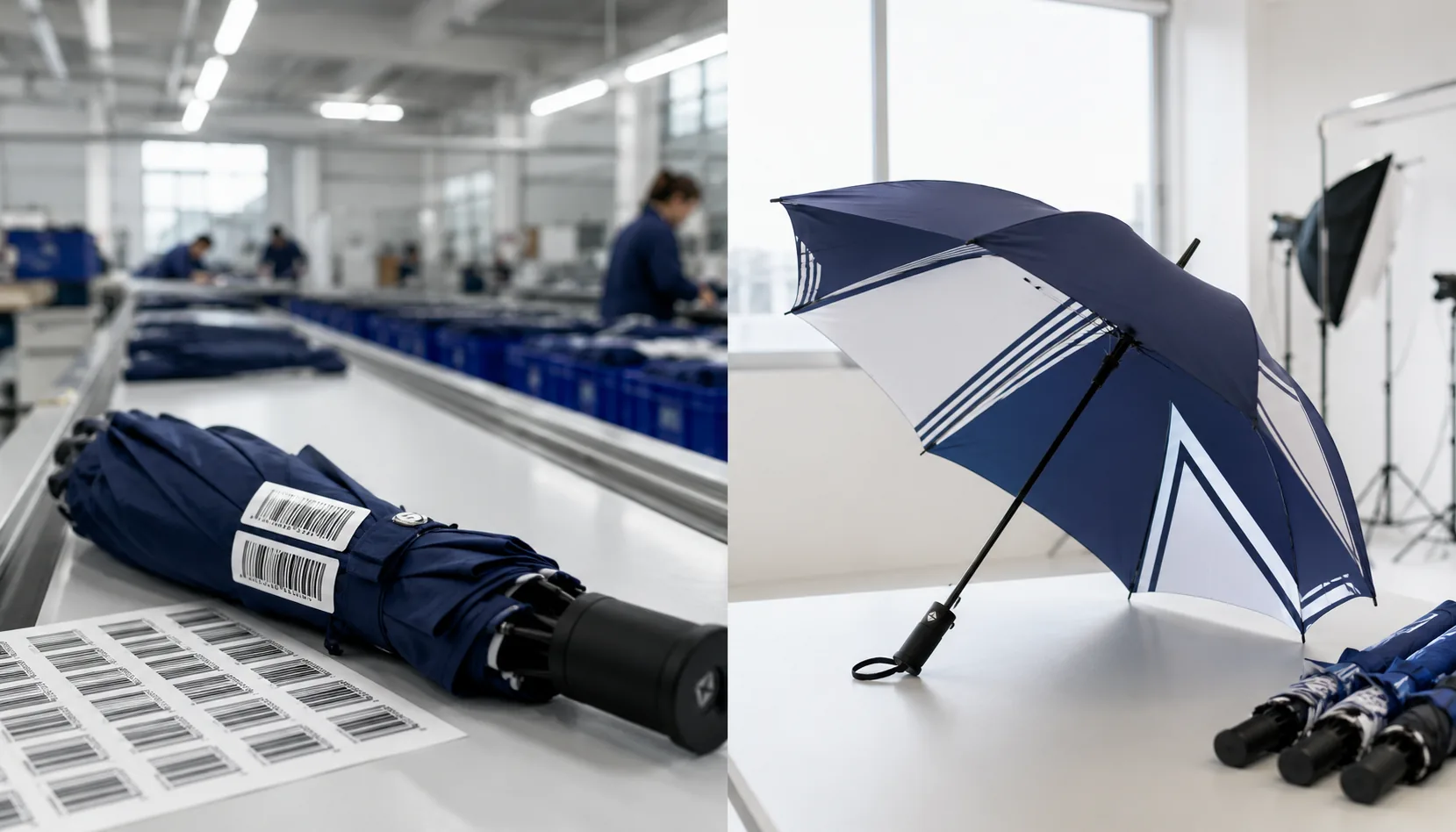
When a retail umbrella order reaches packing, small label errors can turn into chargebacks, customs questions, or a full relabeling run that burns time and margin. Buyers need umbrella compliance labels, barcodes, warning copy, and care marks matched to the retailer's spec before hangtags, sleeves, and master cartons are sealed. On our Songxia lines, that means checking scan readability, placement, and pack consistency at the same station where umbrellas are inspected and bundled.
Why retail labels matter in umbrella branding
Retail buyers reject umbrellas for labeling mistakes long before they argue about handle shape or canopy color. If the UPC does not scan on first pass, if the SKU on the unit pack does not match the PO, or if the country-of-origin statement is missing, the item can fail retail intake even when the umbrella itself is fine. For branded programs, umbrella compliance labels are what let a 21 inch manual compact or a 27 inch auto-open golf umbrella move cleanly through the retailer's DC, inventory system, and returns desk. Care copy also matters more than many buyers expect, especially on 190T or 210T pongee with Teflon or UV coating, because retailers want a clear statement on drying, storage, and cleaning to reduce customer complaints about mildew, rust spotting, or coating transfer.
Fiber content is another quiet gatekeeper. If the canopy is polyester pongee, recycled PET, or POE/EVA clear film, that needs to be declared correctly where the retailer's compliance manual requires it; a vague "fabric umbrella" description is not acceptable for most chain accounts. In practice, the cleanest setup is a consumer-facing hang tag carrying brand, UPC, SKU, color name, and price ticket area, with origin, care, and fiber content either printed on the reverse or added as a small folded label when the retailer insists on permanent disclosure. For private label umbrella packaging, the canopy sleeve usually carries the fastest visual ID on shelf: style number, color dot, size such as 23 inch 8K or 30 inch golf, and sometimes a duplicate barcode when the hang tag may tear off in store.
Placement should follow how the umbrella will be handled after final packing, not just what looks neat in a mockup. Barcode labeling for umbrellas belongs on the hang tag when the store will scan the selling unit at checkout, on the polybag when the retailer or 3PL receives units in sealed e-commerce prep, and on the master carton when the DC is scanning cases rather than pieces. The polybag also often needs the suffocation warning, while the carton needs outer retail packaging specs such as PO number, SKU breakdown, carton count, gross and net weight, dimensions, and shipping marks. If the buyer wants floor-ready presentation, the canopy sleeve becomes the main visible label, but it still has to survive handling without sliding off a slick POE or tightly folded 190T canopy.
Most chargebacks come from mismatch, not from absence alone. A carton marked black/white assortment that actually contains navy/gray, or a UPC on the hang tag that differs from the retailer's approved item file by one digit, creates receiving exceptions that can hold the shipment. Our standard practice at ZheBrella is to treat label verification as part of AQL 2.5 inspection, not as an office afterthought: scan the UPC, match SKU to packing list, confirm origin and fiber statements, and check that every inner pack and carton follows the approved label map before booking FOB or DDP. That is especially important when one production lot mixes auto-open-close compacts, clear EVA bubble umbrellas, and vented golf styles under the same purchase order, because the physical product differences are obvious on the line but easy to confuse once everything is cased.
What information should appear on the pack
The pack has to identify the umbrella before anyone opens the carton. At minimum, I expect a clear model code or SKU, selling color, open size such as 21-inch folding, 23-inch stick, or 27-inch golf, and the fabric callout in plain factory language: 190T pongee, 210T pongee, POE, EVA, or PVC where relevant. If the frame is a selling point, print it directly: black steel shaft with fiberglass ribs, full fiberglass frame, or 8K auto-open with aluminum middle tube. Good umbrella compliance labels also state whether the mechanism is manual, auto-open, or auto-open-close, because returns often start when the pack implies one action and the frame delivers another. If there is a functional claim like Teflon water-repellent finish or UV protection, the pack should show the exact tested language, for example UPF 50+, rather than vague words like sun umbrella. Retail packaging specs should be tied to the approved spec sheet so the unit box, hangtag, and master carton all describe the same item.
For retail, the barcode panel needs to work for both warehouse receiving and store shelf checks, so keep the data disciplined. The UPC or EAN should sit next to the internal item number, PO reference if the buyer requires it, and the country-of-origin statement. For barcode labeling for umbrellas, I usually tell buyers to add size, fabric, and frame shorthand in human-readable text right under the code, because a scanner failure on the dock should not force the team to open random cartons. If the umbrella comes in private label umbrella packaging, include the pack count at each level: 1 piece per sleeve or gift box, inner quantity if any, and master carton quantity such as 24 or 36 pieces. Carton marks should also show gross weight, net weight, carton dimensions, and color assortment status, since mixed-color cartons create receiving errors faster than almost any print mistake. Our standard practice at ZheBrella is to keep the retail-facing panel and outer-carton mark sheet synchronized before mass printing starts.
Compliance copy should only appear when the factory file can support it. If you print UPF 50+, recycled content, or windproof language like double-canopy vented design tested to 50-plus mph, that claim needs a matching lab report or internal approval record; otherwise the buyer is carrying avoidable retail risk. The pack should also state any material facts that affect handling, such as POE canopy, PVC smell warning where applicable, or fiberglass rib construction if the customer wants a non-rusting frame message. For children’s formats or novelty domes, age grading and suffocation warnings may be required depending on the market and pack style. Final pack copy should be checked during AQL 2.5 inspection, not after goods are sealed, because the most common failure is a correct umbrella packed into a wrong printed box. The cleanest umbrella compliance labels are boring in the right way: exact model data, exact carton quantity, and no unsupported claim that a retailer has to explain later.
How label format changes by sales channel
Chain stores are the strictest channel because the label is tied to the retailer’s receiving system, not just the product. A 21-inch or 23-inch auto-open umbrella for a chain account usually needs a GS1 UPC or EAN on the unit, a separate ITF-14 or SSCC-compatible carton mark, a readable country-of-origin line, vendor style number, color code, and material callouts such as 190T pongee canopy, fiberglass ribs, or POE canopy if it is a clear dome. If the buyer has a routing guide, the print area, barcode height, quiet zones, and carton placement are specified down to the millimeter. That is where umbrella compliance labels stop being a graphic design task and become an operational one, because a barcode that scans fine in the sample room can still fail at a retailer DC if the curvature of the hang tag or strap wrap distorts it. Retail packaging specs for chain stores also drive the pack-out method. Many want the barcode on a flat hang tag instead of the canopy tie because the fabric twists in carton handling; others require the suffocation warning on the polybag and forbid sticker-over-sticker corrections. At ZheBrella, our standard practice is to verify scan rate after final packing, not before, and to tie that to AQL 2.5 inspection so label legibility, carton marks, and assortment accuracy are checked with the same lot sample as opening action and visual defects. That catches the common failure mode where the umbrella itself is fine, but the store rejects the shipment for mixed UPCs in a master carton.
Marketplace orders are less ceremonial than chain retail, but they are less forgiving about data mismatches. For Amazon FBA, barcode labeling for umbrellas often shifts from a consumer UPC to an FNSKU, and the placement has to avoid seams, straps, and curved handles that cause scanner bounce. A 27-inch golf umbrella with a double-canopy vent or a 10K folding umbrella with auto-open-close needs a flat surface, usually a belly band, insert card, or outer polybag label, because sticking labels directly on pongee with Teflon coating tends to lift in humid transit. Marketplace sellers also care about dimension and weight consistency because carton measurements affect inbound fees, so the label set often includes unit size, net weight, carton count, and colorway references that would never appear on a simple FOB wholesale pack. The compliance side depends on destination market more than on the marketplace logo. U.S. orders may add Prop 65 warnings if components trigger it, while EU marketplace shipments can require the importer record, EAN traceability, and packaging-waste marks depending on the country. For DDP, the paperwork burden increases because the shipper is usually expected to carry harmonized descriptions on the commercial invoice, carton labels, and broker files consistently; if the invoice says polyester umbrella and the carton says EVA dome umbrella, customs queries start immediately. That is why private label umbrella packaging for marketplaces should be built from one controlled data sheet, not from separate artwork files sent by sales, design, and freight teams.
Corporate resale packs sit in the middle: more polished than bulk FOB cartons, much simpler than chain-store retail. A promotional distributor selling umbrellas to a university bookstore, conference organizer, or hospitality group usually wants a branded sleeve, belly band, or printed hang tag with a clean SKU and a scannable UPC, but they rarely need the full vendor-compliance stack of chain retail. What they do need is clarity inside the pack. If the program has three colors of a 30-inch golf umbrella or two handle finishes on a 23-inch straight umbrella, the label should show item code, color name, finish, and pack quantity so the reseller can break cartons without mis-shipping mixed variants. This is where umbrella compliance labels should be practical first: oversized logos do not help if warehouse staff cannot distinguish navy from black under fluorescent light. FOB shipments for this channel can stay comparatively simple if the buyer controls import and downstream relabeling. In that case, plain master-carton marks, item number, quantity, gross and net weight, carton dimensions, and country of origin are usually enough, with the unit pack carrying only the consumer-facing barcode and warning copy. DDP is different because the factory side must align label language, invoice description, carton marks, and any destination-specific packaging registration numbers before the goods leave China. If the consignee resells into the EU or UK, that can mean importer identification and packaging-waste obligations even when the umbrella itself is not a regulated product. The mistake I see most often is treating DDP like freight service instead of a documentation discipline; the labels are what expose that mistake first.
Quality control checks before printing labels
The label proof should not be released until the sealed pre-production sample and the tech pack say the same thing, line for line. I have seen more chargebacks from bad copy than from crooked sewing: a hangtag says auto-open-close, but the finished unit is auto-open only; the sticker calls out fiberglass ribs, but purchasing substituted black steel on the 8K frame; the carton mark says double-canopy vented, but the umbrella is a single-canopy 190T pongee promotion style. Before printing umbrella compliance labels, lock the final spec sheet with size and construction details such as 21" or 23" arc, rib count, canopy fabric, coating, handle material, country of origin, and any claim like UPF 50+ or wind-rated 50 mph. Retail packaging specs also need approval at this stage, including label position on the sleeve, polybag warning copy, font size, and retailer-required PO or SKU format.
Barcode failures usually come from substrate and placement, not from the barcode number itself. A UPC or EAN that scans fine on plain paper can fail once it is printed on a glossy hangtag, a curved plastic handle label, or a crinkled polybag used for private label umbrella packaging. For barcode labeling for umbrellas, we test both with a verifier and with common retail scanners, because warehouse receiving guns are less forgiving when the quiet zone is crowded by graphics or the bars are distorted by thermal-transfer ribbon spread. I want at least a Grade C equivalent on the finished label, not just on the printer proof, and I check scan performance after labels are applied to a packed umbrella, belly band, and inner carton. Human-readable digits, carton quantity, color code, and style number must match the ERP and the customer PO, especially when one order mixes 21" kids POE domes with 27" golf umbrellas in the same shipment.
Final release should be tied to AQL 2.5 inspection, not to whoever is rushing to hit the vessel cutoff. At ZheBrella, our standard practice is to sample finished umbrellas and printed labels together under ANSI/ASQ Z1.4, General Inspection Level II, so the checker is verifying the real pack-out rather than isolated components. On a 3,200-piece order, that typically means a 125-piece sample, with major defects controlled at AQL 2.5: wrong barcode, wrong country-of-origin statement, mismatched color name, or a label that claims fiberglass ribs on a steel-framed unit all count as release blockers. Minor issues like light smudging, crooked placement, or weak adhesive still matter because they become store-level complaints and rework. This is where umbrella compliance labels either protect the shipment or create avoidable deductions; every label has to match the final umbrella specs, from auto-open mechanism to double-canopy construction, before cartons are sealed for FOB or DDP dispatch.
Common label mistakes that slow launches
The launch killer I see most often is a SKU mismatch between the umbrella, the hangtag, and the outer carton. A buyer approves one UPC for a 21-inch 3-fold auto-open-close in 190T pongee, but the packing line grabs the sticker roll for the manual-open version or the EVA sleeve for a different colorway. The product is physically fine, but the retailer receives a black handle umbrella labeled as navy, or a 23-inch straight umbrella scanned into the system as a 21-inch compact. That breaks barcode labeling for umbrellas at the DC level, and the chargeback usually lands before anyone argues about who changed the artwork. Good umbrella compliance labels are tied to a locked master pack list, carton mark file, and photo sample, not just a PDF barcode sent by email. On our floor, we do a first-carton verification against the approved SKU matrix before mass packing, because once 2,000 sleeves are labeled wrong, peeling and relabeling costs more than the original print run.
The second mistake is missing warning text, especially on polybags, PVC or POE sleeves, and retail sets packed for club stores or drug chains. Buyers focus on logo color, matte lamination, or private label umbrella packaging details, then forget the mandatory suffocation warning, country-of-origin statement, importer record, or age-grading language required by the retailer's routing guide. If the umbrella has a pinch-point auto-open mechanism, some chains also want a user caution near the runner or on the hangtag, not buried in the carton insert. These are not theoretical issues; a lot of retail packaging specs are written so the item can be rejected even when the canopy print, frame, and sewing all pass. The clean way to catch it is to treat labels as part of AQL 2.5 inspection, with checkpoints for text version, font legibility at final size, scan grade, and exact placement on the consumer-facing pack. ZheBrella's standard practice is to inspect finished goods against the retailer spec sheet, not just the approved umbrella sample.
Weak adhesive is another avoidable failure, and it shows up fastest on coated sleeves and tightly folded umbrellas. A paper label that sticks well on a dry kraft mailer can lift within 24 hours on slick EVA, frosted PVC, or a sleeve that picked up silicone, Teflon overspray, or simple humidity from a summer warehouse in Zhejiang. Then the barcode curls, catches when the umbrella is inserted, and drops off somewhere between final packing and shelf setup. Placement matters just as much: if you put a large label across the fold line of a 21-inch compact, it wrinkles the sleeve, snags the strap, and makes the umbrella look mishandled at retail. Put it over the front display panel and the buyer loses the logo window; put it near the tip end and many shelf trays will hide the scan area. The safe rule is to test adhesive on the actual sleeve substrate, then place the label on a flat, non-flex zone that survives folding, case packing, and store-facing display.
Frequently Asked Questions
Do retail umbrellas need different labels for manual and auto-open styles?
Often yes, because the safety and use instructions differ. Auto-open models usually need clearer warning text and sometimes a larger hang tag or insert card.
Can the same label set work for both 190T and 210T pongee umbrellas?
Not without checking the spec sheet. The material callout, UPC mapping, and carton description should match the exact fabric and construction on each SKU.
What barcode files should buyers provide before umbrella packaging production?
Most factories need UPC/EAN numbers, barcode artwork in AI/PDF format, and a placement guide showing size and location. For retail programs, confirm GS1 ownership and scan grade requirements before mass printing.
Can compliance labels be checked during AQL 2.5 inspection?
Yes. Inspectors can verify barcode readability, label position, warning text, care labels, hang tags, carton marks, and packaging artwork against the approved spec sheet under AQL 2.5 or a buyer-defined checklist.
When should retail label artwork be finalized for private label umbrellas?
Finalize barcode, warning, care, and price label artwork before pre-production sample approval. For OEM orders, allow about 3–7 days for digital proofing and label material confirmation before bulk packaging starts.
Looking to Launch Your Custom Umbrella Line?
ZheBrella is a Zhejiang-based OEM/ODM umbrella manufacturer with 17 years of export experience. Free design, low MOQ from 100 pieces, windproof construction, full-color print.
Get Free Quote Now »People Also Search For
Related Articles
Branded Umbrella Belly Bands for Retail and Gift Packs
Plan branded umbrella belly bands with paper stock, sizing, barcode space, and packing flow so retail and gifting orders...
Read More »
Branded Umbrella Belly Bands for Retail Shelf Recognition
Plan belly bands that show logos, specs, and barcodes clearly while keeping folded umbrellas neat for retail, gifting, a...
Read More »
Branded Umbrella Belly Bands for Retail Gift Presentation
Plan branded belly bands with logo, SKU, and gift messaging while keeping canopy quality visible, with material, sizing,...
Read More »