Sourcing Umbrellas for Department Stores and Specialty Retail
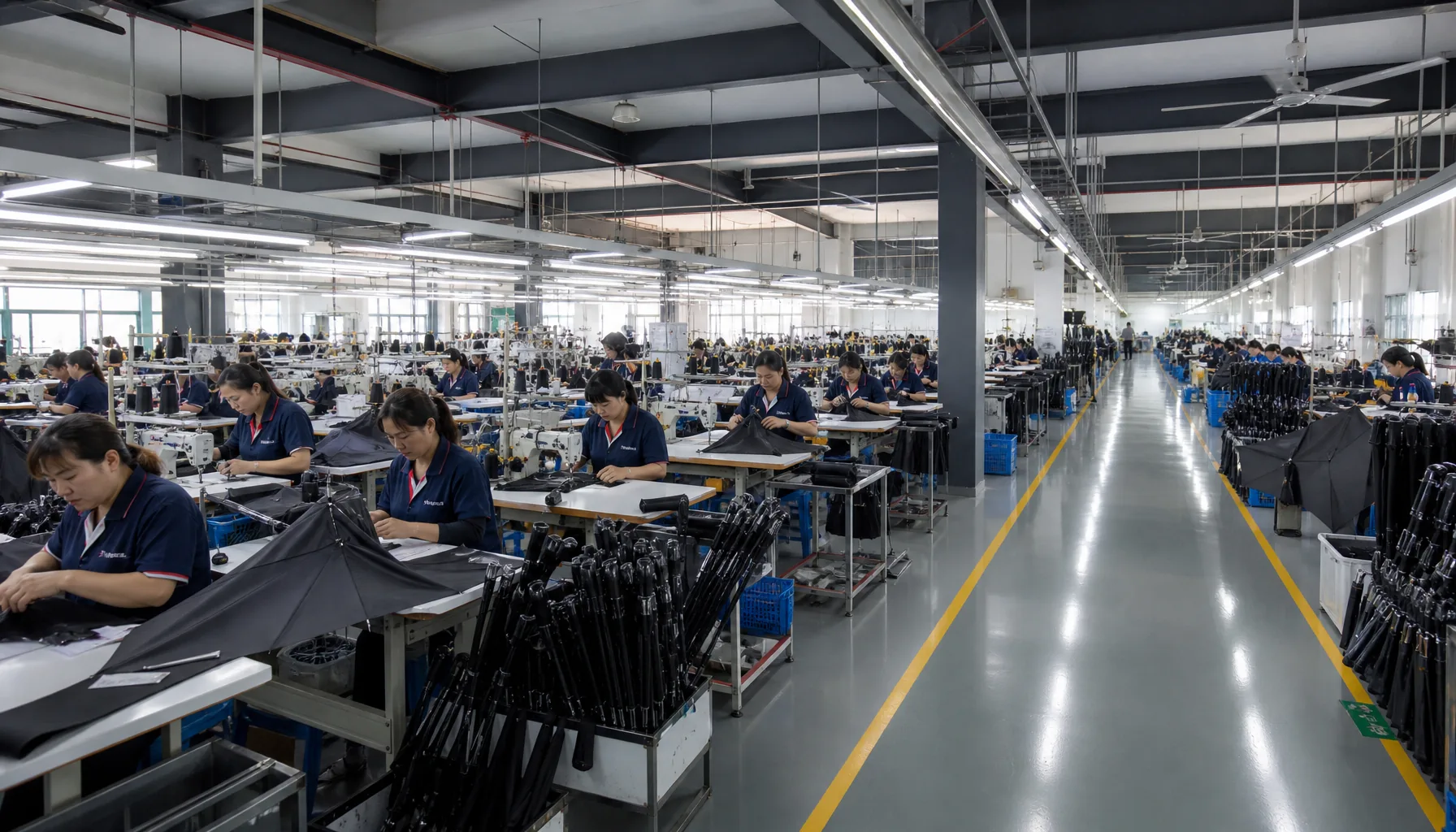
Buying umbrellas for department stores and specialty retail is less about finding the lowest unit cost and more about avoiding the failures that show up on the sales floor: color drift, weak mechanisms, inconsistent packaging, and missing compliance paperwork. In umbrella department store sourcing, buyers need a supplier that can hold spec across repeat runs, pack to retail standards, and keep replenishment moving without surprises. That requires factory-level control over materials, testing, and finishing, not just a sales sample that looks right.
What retail buyers actually evaluate
For umbrella department store sourcing, the first thing a serious buyer checks is not the sample alone but batch consistency. If one lot is 210T pongee with fiberglass ribs and the next lot drifts to thinner fabric, mixed resin points, or a different rib gauge, you will see returns fast. An umbrella retail buyer usually wants the same handfeel, opening force, stitch density, canopy cut tolerance, and print registration across every carton, not just one approved piece. On premium umbrella wholesale programs, I look at whether the factory can hold the same result across 500, 5,000, or 50,000 pieces with AQL 2.5 control, color shade matching, and repeatable frame tension. Specialty retail umbrella supplier status is earned by proving that the production line can keep panel symmetry, tip alignment, and button action stable run after run.
On-time delivery matters because retail calendars are unforgiving. A retail umbrella program tied to a spring floor set or holiday reset does not care that the factory had a fabric delay if the ship window misses the planogram. Buyers want a realistic lead time in days, plus proof that the supplier can protect it with raw material booking, inline inspection, and packing staged before final QC. In umbrella department store sourcing, I would rather quote 35 days and hit it than promise 20 days and slip by a week. The buyer scorecard usually includes OTIF history, container booking discipline, and the ability to manage FOB or DDP terms without surprises. If the supplier cannot explain how they handle peak-season congestion, carton rework, or split shipments, that is a weak operation.
Compliance documentation and packaging readiness are where a lot of otherwise decent programs fail. A specialty retail umbrella supplier should be able to deliver test reports for fabric composition, REACH or CPSIA where relevant, carton dimensions, barcode labels, country-of-origin marking, and packing lists that match the PO exactly. Retailers also care about whether the umbrellas arrive shelf-ready: hangtags placed correctly, polybags sized properly, master cartons strong enough for export, and case packs that fit the DC receiving flow. For premium umbrella wholesale, I expect clear carton counts, item master data, and print approvals before mass production starts, because fixing packaging after sewing is expensive and usually late. An umbrella retail buyer is not just buying product; they are buying a clean receiving process with fewer chargebacks, fewer compliance questions, and fewer missed launch dates.
Retail-ready packaging and barcodes
For umbrella department store sourcing, packaging has to do three jobs at once: protect the product, sell it from a hook, and pass receiving without handwork. A proper hangtag is usually 300-350 gsm art paper or coated card with a reinforced eyelet, UPC or EAN-13 printed at retail contrast, and enough face area for size, fabric, open method, shaft material, and care text. For a specialty retail umbrella supplier, I prefer one clear SKU label per colorway, not a generic family tag, because umbrella retail buyer teams want each variant scannable at the shelf and easy to reconcile against the PO. ZheBrella’s standard practice is to print the barcode on the hangtag and repeat it on the polybag label so stores can receive cartons without opening every unit.
Polybag and carton specs should follow the planogram, not just the factory’s convenience. For a retail umbrella program, use a clear PE bag around 0.03-0.05 mm thick with a suffocation warning where required, then pack in master cartons that hold a stable count, such as 12 or 24 pieces depending on stick or folding construction. Carton dimensions should be kept consistent across the assortment so the retail buyer can stack, face, and block the goods cleanly on shelf or pegboard, with barcode panels facing outward and no mixed lengths in the same case. For premium umbrella wholesale, I also recommend carton marks that show PO, color, size, and carton number, plus a simple insert or belly band if the store wants a more giftable presentation. That keeps rework down and makes umbrella department store sourcing easier to receive, scan, and merchandise in one pass.
Compliance and testing expectations
For umbrella department store sourcing, the PO usually does not move until the buyer has a complete compliance pack, not just a pretty sample. A serious umbrella retail buyer will ask for test reports tied to the exact fabric, frame, handle, coating, and print method being quoted. For the canopy, that often means colorfastness, azo-free dye confirmation, REACH or equivalent chemical compliance for the target market, and if the umbrella is marketed as UV protection, a verified UPF report rather than a hand-wavy claim. If the handle is TPR, EVA, wood, or plated metal, buyers may also ask for heavy-metal and phthalate data. A specialty retail umbrella supplier should be able to match the submitted sample to the production BOM, because retail chains will reject a report if the material mix changes after approval.
Premium umbrella wholesale programs also get screened on mechanical performance before a buyer signs off. Department store teams commonly want wind-tunnel or dynamic wind-resistance data for vented double-canopy models, plus opening-and-closing cycle test results for auto-open and auto-open-close mechanisms. For larger sticks, 27" and 30" golf formats with fiberglass ribs, they may ask for frame fatigue, rib deflection, corrosion resistance on plated steel parts, and salt-spray exposure if the assortment is going into coastal markets. If the product is positioned as a premium umbrella wholesale item, the buyer will usually want the test method named on the report, the lab accreditation listed, and the sample photo or model code tied to the report so there is no argument later about whether the test belongs to the same umbrella.
Before a PO, many chains also require factory-level proof that the production system is stable, not just one compliant sample. That can include ISO 9001, BSCI or SMETA social audit results, AQL 2.5 inspection records, carton drop-test confirmation, and a process sheet showing how canopy cutting, rib assembly, and print curing are controlled on the line. In practice, umbrella department store sourcing is easier when the supplier can hand over a clean document set in one shot: lab reports, material declarations, audit reports, and a signed specification sheet with size, rib count, fabric weight, and coating type. If any one of those pieces is missing, the retailer will usually hold the program, especially for private-label or seasonal launch orders with tight ship windows.
Replenishment and fill-rate reliability
Department stores do not tolerate late or short shipments because the cost is not just one missed PO, it is a broken replenishment rhythm. When a rain spike hits and the floor is empty, the buyer loses sell-through, the store loses ticket sales, and the vendor gets penalized with chargebacks, missed allocation, and lower future order priority. In umbrella department store sourcing, the real failure is usually not quality but fill-rate: cartons arrive with the wrong assortment, the shipment misses the delivery window, or the program cannot be replenished fast enough after the first sell-through. A specialty retail umbrella supplier has to think in terms of store weeks, not factory weeks, because retail replenishment is measured against planograms and DC cutoffs, not production convenience.
For a retail umbrella program, buffer stock should be set from real demand volatility, not wishful thinking. I usually work from confirmed weekly sell-through, then add protection for import transit, customs clearance, warehouse receiving, and the factory's own yield loss. On premium umbrella wholesale programs, a 10 percent to 20 percent safety stock is normal for core colors and best-selling sizes like 23-inch and 27-inch auto-open models, while fashion prints and seasonal colors need tighter buys because they age out quickly. ZheBrella's standard practice is to hold extra canopy and frame components for repeat programs so a re-order does not start from zero, which is the difference between a smooth retail shelf and a dead week in store.
An umbrella retail buyer should also plan replenishment by carton logic, not just by unit count. If the case pack does not match the store's shelf capacity or the DC's picking pattern, the fill rate looks fine on paper and still fails in execution. The practical answer is to build buffer at two points: finished goods for immediate shipment and component-level reserve for fast assembly on repeat styles. That is especially important for umbrella department store sourcing where lead times can stretch from 35 to 60 days depending on fabric, printing, and freight mode. The buyers who win are the ones who keep a clean base program, reorder before the first floor set is half gone, and treat late shipment risk as a margin problem, not an operations footnote.
Building a premium retail assortment
For umbrella department store sourcing, the assortment should be built in three clear tiers so the retail buyer can defend every price point. Start with an entry premium line in 23" manual or auto-open umbrellas using 190T pongee, black-coated steel shaft, and fiberglass ribs for a better hand-feel than commodity retail goods. Move the core line to 21" or 23" auto-open-close styles with 210T pongee, color-matched tips, and a cleaner silhouette that reads as premium on shelf. The top tier should be a hero assortment: 27" stick umbrellas, double-canopy vented windproof frames, and larger handle treatments like hardwood, EVA, or soft-touch rubber. That tier is where premium umbrella wholesale pricing is justified by structure, not print alone.
Materials are what separate a specialty retail umbrella supplier from a factory that only chases volume. Fiberglass ribs, reinforced stretchers, and a solid aluminum or steel shaft can survive repeated opening cycles and real wind, while cheap wire frames feel fine in a sample but fail after store returns start coming in. For the canopy, 190T and 210T pongee remain the most reliable retail fabrics because they print cleanly, hold color, and dry faster than low-grade polyester. Add Teflon water-repellent coating on the core and hero items, and UV protection with UPF 50+ on sun umbrellas or dual-use styles. If the buyer wants a visible performance story, a 50+ mph wind-tunnel claim backed by the frame spec is more credible than a generic “windproof” tag.
A practical retail umbrella program should not be built as one broad SKU family. It should be a laddered plan with color blocking, black basics, and a few fashion-driven prints so the umbrella retail buyer can cover office, travel, and gift occasions without bloating inventory. A good mix is 60 percent core solids, 25 percent seasonal colorways, and 15 percent statement designs, with 8K or 10K frame counts on compact styles and 16K on larger stick umbrellas where a stronger visual profile supports the price. For department stores, AQL 2.5 inspection is standard practice, and the line should be packaged for shelf efficiency with barcode labels, hangtags, and carton counts that fit replenishment logic. In umbrella department store sourcing, the winners are the products that look expensive at 2 meters away and still hold up after 3,000 open-close cycles.
Frequently Asked Questions
What packaging do retailers require for umbrellas?
Most chains want retail-ready presentation: a branded sleeve or box, a printed hangtag with the retailer's required UPC/EAN barcode, polybagging, and cartons that meet their packing and labeling spec. Get the retailer's vendor manual before finalizing packaging artwork.
How important is fill rate to retail buyers?
Very. Retailers measure suppliers on on-time, in-full delivery and may charge chargebacks for late or short shipments. Plan production and safety stock so you can hit replenishment windows reliably, especially in peak rain season.
What MOQ should a department store buyer expect for a custom umbrella program?
For OEM/ODM umbrella programs, MOQ is often 500 to 1,000 pieces per color or design, depending on the frame, canopy fabric, and print method. If you need multiple retail SKUs, many factories will allow mixed colors within a style once the base configuration is approved.
What lead time is typical for retail-ready umbrella orders?
Sample approval usually takes 5 to 10 days, and bulk production is commonly 30 to 45 days after artwork and specs are confirmed. If the order includes special packaging or testing, plan for a longer schedule before ship date.
What documents do retail buyers usually request from an umbrella supplier?
Most buyers ask for product specifications, carton dimensions, test reports, and compliance documents such as REACH or CPSIA depending on the destination market. For department store programs, they often also want barcodes, hangtag data, and packaging mockups before PO release.
Looking to Launch Your Custom Umbrella Line?
ZheBrella is a Zhejiang-based OEM/ODM umbrella manufacturer with 17 years of export experience. Free design, low MOQ from 100 pieces, windproof construction, full-color print.
Get Free Quote Now »People Also Search For
Related Articles

Umbrella Sourcing for Sports Clubs and Stadium Retail
Build stadium and club umbrella assortments with weather-ready specs, retail packaging, MOQ planning, and quality contro...
Read More »
Umbrella Sourcing for Security Teams and Venue Operations
Choose umbrellas for security teams and venue operations with fast deployment, durable frames, sensible MOQs, and QC sta...
Read More »Umbrella Programs for Luxury Retail Concierge and Valet
Build a premium umbrella program for luxury retail concierge and valet teams with upscale materials, branding, QC, and d...
Read More »