Umbrella Assortment Planning: Good-Better-Best Range Architecture

For buyers, umbrella assortment planning is really about preventing a line from turning into a price ladder with blurred edges. At the factory floor, the separation has to be built into the frame gauge, rib construction, canopy fabric, and hardware finish so each tier feels distinct to the customer and stays profitable for you. When those details are aligned, the good-better-best structure becomes easy to explain, easier to source, and harder to cannibalize.
Why good-better-best works for umbrellas
Good-better-best works for umbrellas because buyers do not shop by fabric swatch alone; they shop by use case, margin target, and perceived risk. In umbrella assortment planning, three clean tiers give a distributor or retailer a fast way to map simple, defensible choices: a low-cost manual 21" stick or compact with steel ribs, a middle tier with fiberglass ribs and auto-open, and a premium vented double-canopy model with 190T or 210T pongee, UV coating, and auto-open-close. That structure reduces decision fatigue and keeps the line from collapsing into twenty near-duplicates that only confuse the buyer. On the factory side, it also makes MOQ and colorway planning cleaner because each tier can share a controlled set of components instead of forcing every SKU to be a one-off.
A good better best umbrella range architecture also lifts average order value because it creates an obvious trade-up path. Buyers can start with a price-sensitive SKU to win the initial placement, then move customers up to a better model with stronger frame construction, nicer handle, and more durable canopy, then reserve the top tier for corporate gifting, retail, or weather-sensitive regions. That is not theory; it is how we see order baskets grow when a catalog is organized around clear umbrella price tiers rather than random style variations. A well-built middle tier matters most, because it captures the volume item while still leaving room for upsell. If the middle product is too close to the low end, the range has no ladder. If it is too close to the premium end, the buyer cannot justify paying more for the top model.
The practical benefit is tighter umbrella product line strategy. Instead of asking a procurement manager to compare 15 specs at once, you define what each tier is for: entry-level promotion, everyday resale, and premium brand presentation. That makes sourcing easier, quality control easier, and reordering faster, especially when the range is built around consistent canopy sizes like 23" and 27", windproof fiberglass ribs, and a few finish options such as Teflon or UPF 50+ coating. Our standard practice is to keep the tiers distinct enough that the buyer can explain them to sales teams without a technical briefing. If the assortment is disciplined, the catalog feels smaller to manage but stronger in margin, which is the whole point of umbrella assortment planning.
The levers that separate tiers
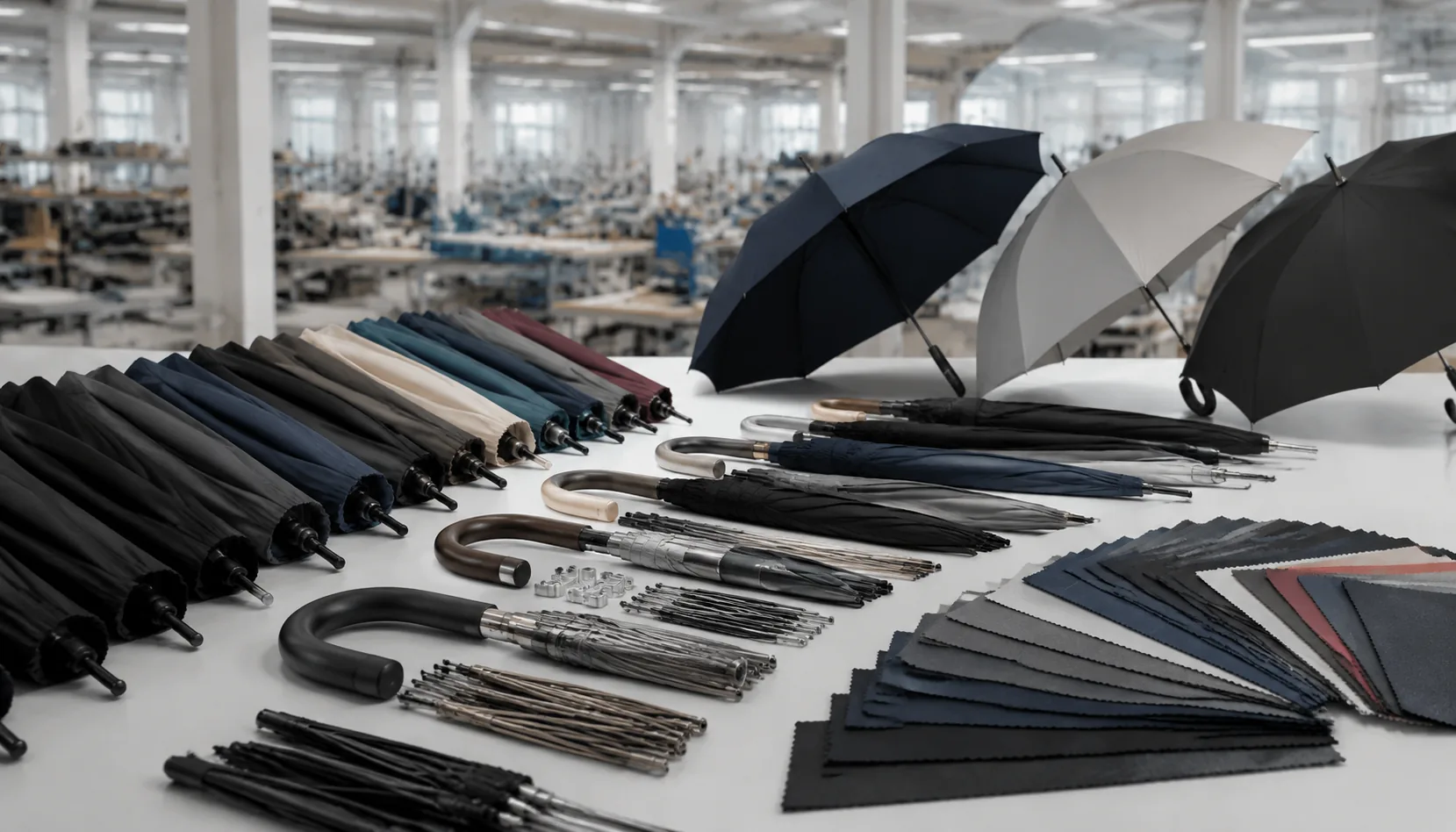
For umbrella assortment planning, the first real separator is the frame, not the print or the color. A good better best umbrella range usually starts with steel ribs and steel stretcher arms at the low end, because steel is cheaper and acceptable for light retail programs, but it is heavier and bends earlier under gust load. Move the mid-tier to fiberglass ribs and a steel shaft, and you get better flex recovery and fewer broken tips in transit. At the top end, full fiberglass or fiberglass-reinforced frames with 8K, 10K, or 16K rib constructions are what justify a true premium tier. That is the core of umbrella range architecture: the customer is buying wind performance, weight, and failure rate, not just a higher price. If the only difference between SKUs is a logo or panel count, the range collapses and the price tiers stop making sense.
Fabric weight is the next lever, and it needs to be specified in a way that buyers can actually compare. Entry models often sit around 190T pongee with a lighter coating, which is fine for promotions but not for long-life retail. Better programs move to 210T pongee or a heavier 180 to 200 gsm canopy construction, which gives a tighter hand feel, less light bleed, and better edge stability after repeated wet-dry cycles. For premium programs, add Teflon water repellency, UV coating for UPF 50+, or POE/PVC where the product brief calls for clear or novelty canopies. In umbrella product line strategy, fabric is what customers notice on opening day and what they blame when the canopy sags after six months. ZheBrella’s standard practice is to keep fabric, coating, and seam spec aligned with the target price tier instead of overbuilding one piece and underbuilding the rest.
The open mechanism and finish are where the range becomes commercially legible. Manual open is appropriate for entry price tiers, auto-open fits the middle, and auto-open-close usually belongs in the top tier where convenience and perceived value justify the added mechanism cost and spring complexity. The finish should also change with the tier: basic painted shafts and zinc hardware for low cost, then black electroplated or matte powder-coated components for better appearance and corrosion resistance, and finally refined touches like color-matched tips, ergonomic EVA or rubber handles, and vented double-canopy construction for windproof lines. If you are doing umbrella assortment planning correctly, each step up should add a visible and functional reason to pay more. That is what prevents a good better best umbrella lineup from turning into three nearly identical SKUs with different margins and no clear buyer logic.
Pricing gaps that make sense
Pricing gaps only work when the middle tier is the easiest item to defend in a buyer meeting. In umbrella assortment planning, the mistake I see most often is a $1.50 or $2.00 step between good, better, and best, which sounds neat on paper but does not move actual orders. The gap has to reflect visible construction changes: fiberglass ribs instead of steel, 190T pongee instead of thin polyester, auto-open instead of manual, and a vented double-canopy instead of a basic single layer. If the jump from good to better is too small, procurement treats the line as a rounding error; if it is too large, they collapse back to the cheapest SKU. The better tier should sit where the extra cost is easy to explain, but still low enough that most customers stop there without feeling forced.
A good better best umbrella should have price tiers spaced by what the shopper can see and feel in five seconds, not by hidden factory costs. For example, a 21-inch manual compact with steel ribs can anchor the low end, a 23-inch auto-open model with fiberglass ribs and Teflon coating can become the default, and a 27-inch or 30-inch golf umbrella with windproof venting and UPF 50+ coating can carry the premium. That middle SKU usually earns the most volume because it solves the practical objections: better wind performance, cleaner print quality on 210T pongee, and a mechanism that is fast enough for daily use without pushing the buyer into a large jump. In umbrella range architecture, the better tier should look like the sensible purchase, not the compromised one.
The cleanest umbrella product line strategy is to build pricing gaps backward from the buyer’s decision process. Start with the target retail or wholesale number, subtract freight, duty, decoration, and margin, then leave enough room for the middle tier to absorb the upgrades that matter in the field: stronger shaft wall thickness, better runner tolerance, tighter canopy sewing, and AQL 2.5 inspection that reduces claims. Our standard practice is to keep the better tier roughly 20% to 35% above good, with the best tier another 25% to 40% above better, but the exact spread depends on MOQ, FOB or DDP terms, and print method. That spacing gives distributors a clear default choice while preserving a real premium option for sports, corporate gifting, or retail packs. If every tier is priced too close together, the range looks busy but sells badly; if the gaps are disciplined, the buyer picks the middle without needing to be convinced twice.
Avoiding tier cannibalization
Tier cannibalization starts when the differences between your good, better best umbrella tiers are too small to matter at the shelf or in the quote. If the mid-tier only adds a slightly thicker shaft, the same 190T pongee canopy, and a marginally better handle, buyers will either trade down to save money or trade up because the premium is not justified. In umbrella assortment planning, each tier needs a clear job: entry price, core seller, and margin driver. That means separating tiers by visible and functional specs, not just by packaging or a $0.20 cost gap. The customer should be able to tell, in one glance, why the tiers are different and which one solves their use case better.
The cleanest umbrella range architecture usually splits on structure and performance, not cosmetic noise. A true good tier can use manual open, steel ribs, and 190T pongee for price-sensitive promo programs. The better tier should move to auto-open, fiberglass ribs, 210T pongee, and a more durable handle or shaft finish. The best tier needs a real jump: auto-open-close, double-canopy vented windproof construction, stronger fiberglass or hybrid frame, Teflon or UV coating, and a credible wind rating, not vague claims. If two tiers both survive roughly the same wind load, use the same rib count, and differ only by print method or strap color, they are not distinct products. They are the same product with a pricing problem.
From a product line strategy standpoint, keep price tiers wide enough that the buyer sees a reason to move up, but not so wide that the middle disappears. A practical spread is to separate tiers by at least one major material or mechanism change, and by enough margin to protect each step after freight, duty, decoration, and failure allowance. At ZheBrella, our standard practice is to map SKU roles before sampling so the 21-inch compact, 23-inch golf, and 30-inch storm models do not fight each other on spec or price. That discipline matters because umbrella assortment planning breaks when sales teams quote from the wrong tier just to win a deal. Once that happens, the lower tiers lose volume and the premium tiers lose credibility.
Communicating tiers on the page
For umbrella assortment planning, the page has to show the upgrade logic in one glance, not hide it behind vague copy. A comparison table works best when it is built around the decisions buyers actually make: canopy fabric, frame material, rib count, opening mechanism, and weather performance. A good better best umbrella page should put the entry model, the mid-tier, and the premium model side by side with hard specs like 190T pongee versus 210T pongee, steel ribs versus fiberglass ribs, and manual versus auto-open-close. That is the core of umbrella range architecture: make the price step obvious because the construction step is obvious. When buyers see that the higher tier adds a double-canopy vent, Teflon coating, or UPF 50+ UV protection, the price difference stops looking arbitrary and starts looking engineered.
Spec callouts should do the heavy lifting on the page, because most buyers do not read long descriptions. Use short labels beside each product card for the reasons to move up a tier: wind resistance tested to 50+ mph, 8K versus 10K versus 16K ribs, 21-inch compact versus 23-inch stick versus 30-inch golf size, and AQL 2.5 inspection for production consistency. In ZheBrella’s standard practice, the best-performing pages separate functional upgrades from cosmetic ones so the buyer can see whether they are paying for durability, print area, or a higher perceived gift value. That is the practical part of umbrella product line strategy: tie each umbrella price tier to a real use case, then repeat the same spec pattern across the catalog so procurement teams can compare SKUs without guessing.
Frequently Asked Questions
How many price tiers should an umbrella line have?
Three is the sweet spot — good, better, best. It gives buyers an anchor, a default, and a premium without overwhelming them. Differentiate the tiers with tangible specs (steel vs fiberglass ribs, fabric GSM, manual vs auto-open) so the price gaps feel justified.
How do I stop my mid-tier from cannibalizing the premium umbrella?
Keep meaningful spec and price separation. If the 'better' and 'best' umbrellas are too close in frame, fabric, and features, buyers default to the cheaper one. Reserve standout materials and finishes (premium fabric, wood handle, gift box) for the top tier.
How many umbrella tiers should a buyer launch with for a new retail program?
Three tiers is usually the cleanest starting point: an entry model, a mid-range model, and a premium model. That setup gives you clear price separation without creating too many SKUs to manage.
What product features should change between good, better, and best umbrellas?
Use visible and measurable differences: canopy fabric weight, rib material, shaft diameter, open/close mechanism, handle finish, and packaging. For example, a good tier may use a basic steel frame and manual open, while a best tier can move to fiberglass ribs, automatic open, vented canopy, and upgraded handle materials.
What MOQ is typical when building a three-tier umbrella assortment with OEM production?
For custom programs, many factories will quote around 300 to 500 pcs per style per color, depending on printing, handle tooling, and packaging. Sampling is often 7 to 15 days, and bulk lead time is commonly 30 to 45 days after sample approval.
Looking to Launch Your Custom Umbrella Line?
ZheBrella is a Zhejiang-based OEM/ODM umbrella manufacturer with 17 years of export experience. Free design, low MOQ from 100 pieces, windproof construction, full-color print.
Get Free Quote Now »People Also Search For
Related Articles
Private Label Umbrella Line Planning: SKUs, Specs, and MOQ
Plan a private label umbrella range with smart SKU tiers, shared frames, MOQ control, lead times, and specs that protect...
Read More »
Building a Promo Distributor's Umbrella Catalog: SKU and Tier Strategy
How a promotional-products distributor should structure an umbrella line: which core SKUs to stock, good-better-best tie...
Read More »
Private Label Umbrella Assortments: Building a Retail Line
Build a profitable private label umbrella range with the right SKU mix, frame specs, fabrics, packaging, MOQ strategy, a...
Read More »