Umbrella Belly Bands and Wrap Cards for Retail Branding

For umbrella retailers, the challenge is adding enough brand presence to stand out on the shelf without paying for full boxes that slow packing and raise unit cost. At the factory floor, we see that umbrella belly band packaging and wrap cards work best when artwork, barcode placement, and sleeve tension are planned together, because a good-looking band still has to scan cleanly and survive fast packing lines. The right format can protect margins, keep MOQs practical, and fit the way umbrellas are actually folded, stacked, and shipped.
Why Belly Bands Work for Retail and Promotional Orders
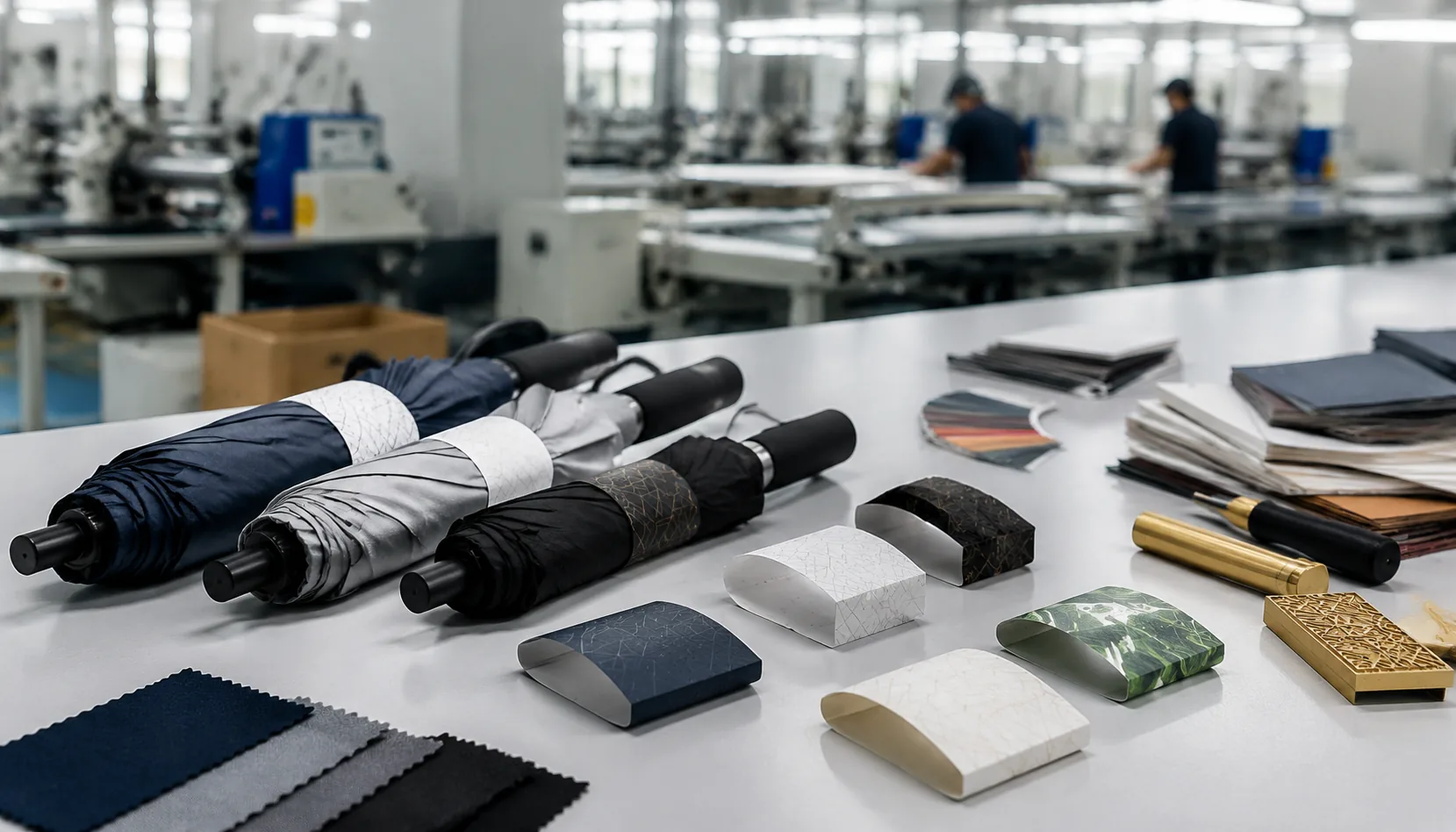
Belly bands solve a retail packaging problem with fewer materials and less cost than a rigid box: they give a folded umbrella a branded face while still letting the product show through. A printed paperboard or synthetic wrap around the canopy and handle can carry the logo, barcode, size, care copy, and feature callouts, so the shelf message is complete without adding carton weight. That is especially practical for umbrella belly band packaging on 21" or 23" folding umbrellas made with 190T or 210T pongee, where the umbrella itself already looks retail-ready. The band can highlight auto-open, UPF 50+, fiberglass ribs, or a Teflon coating without changing the base product. Compared with a full box, it uses less board, reduces freight cube, and keeps FOB cost tighter for price-sensitive launches, seasonal color drops, and chain-store tests.
A wrap card umbrella branding format is also easier to revise when buyers change artwork, legal text, or multilingual labeling. That flexibility makes it a strong fit for umbrella MOQ packaging, especially when the order volume is too small to justify custom box tooling. In practice, belly bands are often used around 1,000 to 3,000 pieces, depending on print method and finishing, which works well for spring rain promotions, event giveaways, regional assortments, and other low-risk retail trials. If sell-through is strong, the buyer can later move to a box program without changing the umbrella construction. For small launches, the band protects margin, speeds approval, and limits waste when the market is not yet proven.
Operationally, belly bands are straightforward to pack on bulk lines, especially for pongee umbrella retail pack orders where each umbrella already sits in an OPP sleeve or polybag before master carton loading. A band can separate 8K, 10K, and 16K frames, identify steel versus fiberglass ribs, and distinguish manual from auto-open models without changing the core SKU. At ZheBrella, we check fit, print registration, barcode scanability, and adhesive hold during final inspection under AQL 2.5, because a loose wrap reads as low quality even when the umbrella is built well. For promotional orders and retail tests, that mix of lower material use, 15 to 25 days after artwork approval, and controlled risk is why umbrella belly band packaging often wins over heavier box programs.
Information Buyers Should Put on a Wrap Card
A wrap card should solve two problems at once: it has to sell the umbrella on a peg and prevent SKU errors in pick, pack, and receiving. Put the brand mark first, then the style name and a SKU that matches the PO, carton label, and inner-pack code exactly. Add the buyer-facing spec line shoppers and merchandisers actually use: 23" auto-open, 8K fiberglass ribs, 190T pongee canopy, double-canopy windproof, UPF 50+, or rubberized straight handle. For umbrella belly band packaging, keep the front panel focused on branding and the back panel on operational data; that layout improves retail umbrella presentation without burying the main claim under price stickers or dense copy.
Treat the barcode as a production requirement, not decoration. Print EAN, UPC, or Code 128 on a flat panel with a proper quiet zone, and place the human-readable number directly below it. Avoid folds, seams, and dark flood backgrounds that trigger scan failures at checkout or in DC receiving. Add country of origin in plain language, such as Made in China, if accurate, plus the material callouts buyers use to compare programs: 190T or 210T pongee, POE canopy for clear bubble styles, steel shaft, or fiberglass ribs. State the opening method clearly—manual, auto-open, or auto-open-close—because those terms are easy to mix up across an umbrella MOQ packaging run.
Use care icons and short copy to cut damage claims and store questions. Show dry before closing, do not force shut on auto-open-close models, and keep POE, PVC, and EVA canopies away from heat. If the umbrella has a coating, name it directly, such as Teflon water-repellent finish or UPF 50+ UV coating. A complete wrap card umbrella branding layout usually needs only the facts that affect conversion, compliance, and returns: brand, SKU, barcode, origin, size, opening method, material, and care. For most pongee umbrella retail pack programs, a 300-400 gsm coated card with matte lamination and one hang hole is enough; anything more should earn its place by reducing risk or improving sell-through.
How Product Specs Affect Band Size, Fit, and Stability
Closed umbrella geometry is driven by construction, not artwork. A 23-inch straight umbrella with an 8K steel frame usually closes into a slimmer, more predictable cylinder than a 21-inch 3-fold auto-open-close model, because the folding runner, spring cartridge, and nested rib joints create thicker points under the tie strap. Moving from 8K to 16K construction adds more rib tips and fabric wedges at the centerline, so the closed diameter increases even when canopy size stays the same. That is why umbrella belly band packaging should be approved from the actual closed sample, not the canopy arc alone. For retail approval, measure the widest point at the rib stack, the runner or neck area, and the handle transition, then set band width and overlap so the wrap stays flat in carton storage and on shelf.
Mechanism also changes wrap tension. Manual straight umbrellas generally compress cleaner because they do not include the spring cartridge and secondary locking parts found in auto-open and auto-open-close folding models. Those folding units resist over-tight wrapping and can push back after 24 to 48 hours in export cartons, which affects both stability and print alignment on a wrap card umbrella branding format. Allow a few millimeters more clearance on folding SKUs, then test the band after overnight compression and vibration handling. The goal is enough holding force to prevent slippage, but not so much tension that card edges curl or the fold line cracks during retail opening.
Material choice changes bulk as well. Pongee 190T usually packs a little leaner than 210T, especially on 10K and 16K canopies where more panels increase fabric layers at closure. The difference is small per unit, but it matters when tuning a pongee umbrella retail pack for high-volume shipments. Steel-rib models often pack tighter than fiberglass frames of the same 21-inch, 23-inch, or 27-inch size because fiberglass ribs are thicker and less willing to flatten into a narrow bundle. For umbrella MOQ packaging runs of 1,000 to 3,000 pieces, approve the band size against the exact production frame and fabric, not a similar sample, or the closed set will shift once production starts.
Printing, Assembly, and QC Checkpoints
For umbrella belly band packaging, specify the substrate and finish first because they determine shelf appearance, scuff resistance, and barcode readability. For a standard 21"–23" straight umbrella, 250–300 gsm C2S art paper is usually sufficient for a simple band; a wrap card umbrella branding format with a hanging tab or locking fold often needs 350 gsm to stay flat. Choose matte lamination when you want lower glare and better fingerprint control, and gloss lamination when the carton will see more rubbing during freight or warehouse handling. On dark canopy colors such as black, navy, or red, gloss usually shows less visible scuffing. Match the print system to the code requirements: leave a proper quiet zone, keep barcode bars crisp after lamination, and verify scan performance on the finished pack, not just on the proof. For pongee umbrella retail pack programs, especially 190T and 210T fabrics with PU or Teflon-style water repellency, the band must hold shape without curling or slipping on the folded canopy.
Adhesive choice should follow the closure method and shipping risk. Double-sided tissue tape works for a closed band on low-risk domestic shipments, while a higher-tack strip or mechanical tab-lock is safer for export cartons, humid storage, or a 30–45 day lead time. Test the wrap on folded samples before approving umbrella MOQ packaging, because smooth pongee surfaces can let the band slide more easily than coarse fabric. Size the overlap so the band secures the canopy without crushing the fold, marking the runner, or leaving adhesive residue on print. A band that is too loose will shift in carton transit and weaken retail umbrella presentation; one that is too tight can dent the fold and damage the canopy edge. In production, keep the assembly sequence simple and repeatable so operators can place the band consistently without slowing packing.
Use AQL 2.5 for final inspection and check the defects that affect sellability: print color against the approved proof, wrap alignment, SKU accuracy, barcode readability, and whether the band slides during carton transit. Inspectors should confirm that the human-readable SKU, product name, and country-of-origin text match the packing list, then scan samples instead of judging the code by eye. Add a carton shake or vibration test to confirm the band stays centered, does not rotate, and does not expose the barcode under the fold. If the adhesive lifts, the band leaves residue, or the wrap shifts enough to cover critical print, hold the lot for correction before release. That transit check matters more than a perfect tabletop sample, because retail buyers reject packaging that moves in distribution even when the umbrella itself meets spec.
Cost, MOQ, and Export Planning for Wrap-Card Programs
The first budgeting error is treating umbrella belly band packaging as if it shares the umbrella MOQ. It usually does not. The umbrella itself can start around 500 pieces, while printed bands often need 1,000 to 3,000 pieces per artwork because the print shop wants an efficient sheet-fed or offset run. That separation matters when you split a 1,000-piece program into four colors or sizes: each SKU can fall below the band MOQ, pushing up unit cost or leaving you with excess inventory. The main cost advantage is that the format is tooling-free. A standard wrap-card die line can be adjusted for 21", 23", 27", or 30" folded umbrellas by changing panel length and fold position, so you avoid mold charges and long sample cycles. For buyers comparing umbrella MOQ packaging options, that makes a printed band faster to approve, easier to revise, and cheaper to launch than rigid packaging.
In production, wrap card umbrella branding also changes packing speed. A hand-applied band usually adds 3 to 6 seconds per umbrella on a stable line, which becomes meaningful at 5,000 to 10,000 units. Auto-open frames, vented double-canopy models, and hook handles slow the process further because the folded umbrella has to sit square before the band is closed. For a pongee umbrella retail pack, the folded diameter should be confirmed before artwork release: 190T and 210T pongee compress differently, so a band that fits a sample can split or wrinkle on bulk goods. If you ship banded at origin under FOB, the factory must absorb counting, alignment, and carton loading, so labor and packing speed affect the landed cost directly. Under DDP, some buyers choose to ship umbrellas closer to destination and finish the banding there to reduce origin labor, but that adds handling steps, more coordination, and higher risk of damage or mismatch if the packaging arrives separately.
Frequently Asked Questions
Are belly bands secure enough for e-commerce orders?
They can work for marketplace or direct-to-store replenishment when paired with a polybag or mail-ready secondary pack. For single-unit parcel shipping, buyers usually need an added protective layer to prevent band damage and canopy marks.
Can a wrap card replace a hangtag on a branded umbrella?
Yes, if the wrap card has enough space for barcode, compliance text, and core product specs. Many buyers still keep a small tag when they need multilingual details or retailer-specific labeling.
What is the MOQ for umbrella belly bands or wrap cards?
For simple printed belly bands or wrap cards, MOQ is often 500-1,000 pieces per design, depending on size, paper stock, and print colors. If you need multiple SKUs, many factories can combine artwork versions within the same production run.
Can belly bands hold barcodes and SKU labels without a full box?
Yes. A well-designed wrap card can include a barcode, SKU, size, color, and country-of-origin text while still keeping the product visible. Many buyers use a white reserved area for scanning and leave the rest for branding.
How much packing speed do wrap cards add compared with no packaging?
A simple belly band or wrap card usually adds only a small amount of labor, often about 5-10 seconds per umbrella when pre-folded and pre-printed. It is much faster than assembling a folding box, especially for high-volume retail packing.
Looking to Launch Your Custom Umbrella Line?
ZheBrella is a Zhejiang-based OEM/ODM umbrella manufacturer with 17 years of export experience. Free design, low MOQ from 100 pieces, windproof construction, full-color print.
Get Free Quote Now »People Also Search For
Related Articles
Branded Umbrella Belly Bands and Wrap Cards for Retail
Use belly bands and wrap cards to add brand story, barcodes, and specs without a full box, while keeping umbrella retail...
Read More »
Branded Umbrella Belly Bands and Wraps for Retail
Use belly bands and wraps to add brand messaging, size info, and retail polish without changing the umbrella structure o...
Read More »Umbrella Strap Wraps and Belly Bands for Retail Branding
Use belly bands and strap wraps to add branding, sizing, and compliance info without full box costs or slower packing li...
Read More »