Branded Umbrella Belly Bands and Wrap Cards for Retail
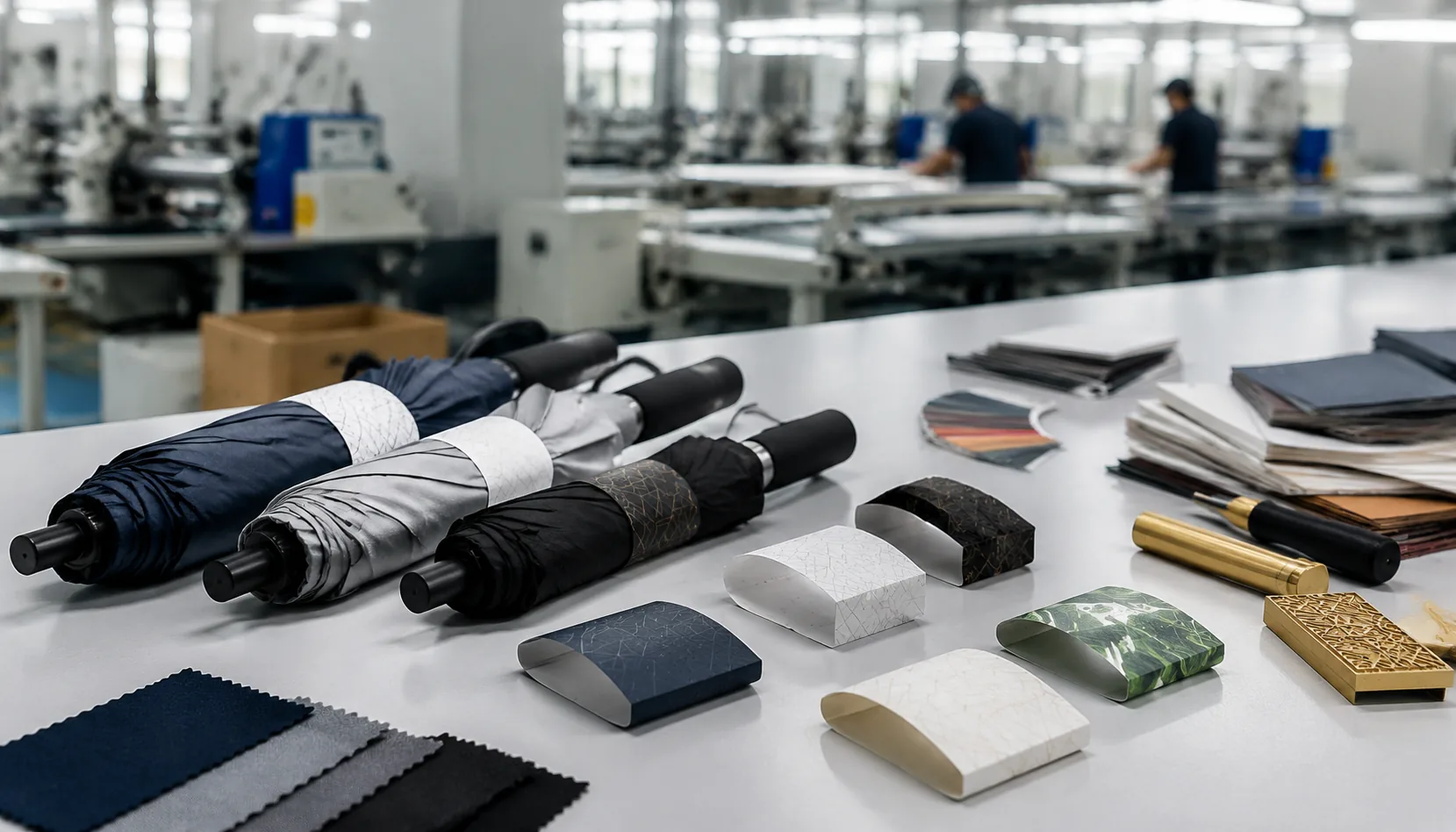
Retailers want product information at point of sale without the expense of full packaging, but slapping a sticker on an umbrella shaft looks cheap and often peels off. Umbrella belly band printing solves this by wrapping a custom card around the folded canopy, giving you space for barcodes, specs, or a short brand story while keeping the product visible and the cost per unit low.
When Belly Bands Make Sense Instead of Full Packaging
Umbrella belly band printing works when the buyer needs the umbrella to stay visible on a peg, counter, or pop-up table and wants to avoid the board, assembly time, and freight weight of a full carton or printed sleeve. A 35 to 55 mm paper band can carry the logo, size, color, SKU, barcode, and country-of-origin copy while leaving the canopy and handle exposed for retail inspection. That makes it a strong fit for private label umbrella presentation in stores and event retail, where shoppers need to see the actual product before purchase and staff need a fast packout process with no tuck-end box, rigid insert, or complex fold pattern. Compared with boxes, branded retail umbrella bands use less paper stock, fewer die lines, and less manual labor, which lowers setup risk on short runs and helps buyers approve a new colorway or assortment faster.
A wrap card umbrella packaging format usually uses 250 to 350 gsm coated paper with aqueous or matte varnish and a glue dot or locking tab to hold the umbrella closed. Common umbrella barcode card sizes are 40 x 100 mm or 50 x 120 mm, which leaves space for UPC, color name, assortment code, and basic compliance text without crowding the layout. The main advantage is speed to market: the artwork stays flat for proofing, copy changes are easy to update, and the finished pack is lighter and cheaper to ship than a sleeve or carton. The tradeoff is protection. Boxes still make more sense for ecommerce, warehouse stacking, or higher-theft channels, while wrap cards and belly bands are better for stores, museum shops, golf club shops, and seasonal pop-ups where visibility and low material cost matter more than crush resistance.
The format choice also depends on umbrella size and handle shape. A 21-inch compact automatic closes tightly and accepts a band cleanly, while a 23-inch or 27-inch stick umbrella with a wood or EVA handle often needs a wider card and tighter fold placement so the wrap does not slip in transit. For that reason, umbrella belly band printing is usually the better option when the order needs a low MOQ, a short lead time, and a simple launch path for event retail or private label programs. A modular dieline can carry a barcode, hang hole, and one or two language versions without changing the base structure, which reduces rework and keeps the packaging program easy to scale across store groups and seasonal drops.
Design Around the Closed Umbrella Structure
Belly band width and placement must account for the folded umbrella's specific profile, not a generic rendering. An 8K compact collapses into a 7-inch cylinder requiring a 2- to 2.5-inch band positioned between the handle base and closure strap—avoiding the Velcro. A 16K stick umbrella with a curved handle measures 12 inches long, allowing a 3-inch band on the straight shaft. Miss the width, and the band either covers the strap (making it unusable) or leaves a gap causing slippage during transit. For umbrella belly band printing, artwork must also steer clear of the auto-open button and closure strap, keeping the barcode or brand logo fully visible during retail handling. We validate placement on actual production units—not flat mock-ups—using a 24-hour vibration test to ensure the band remains tight under racking and stacking; a quarter-inch shift can misalign the barcode, leading to checkout failures.
Hardware bulk further complicates fit. An auto-open-close mechanism adds a thick button housing and spring-loaded shaft, increasing closed diameter by roughly 10% versus a manual fold. A double-canopy vented windproof model has extra fabric and a secondary frame, making the top noticeably fatter. Rigid card stock wrap that doesn't stretch will tear or wrap loosely on these builds, so we recommend flexible paper or polypropylene belly bands that conform to uneven profiles. For wrap card umbrella packaging, the print layout must shift per model—not a one-size-fits-all template—to keep the barcode and branding clear of the button and closure strap. We test each prototype band on actual production units, checking for shifting under vibration before sealing the MOQ. The barcode position is always validated against the folded umbrella’s natural resting shape—not a flat layout—to prevent misalignment at retail checkout. This per-model approach ensures consistent fit and compliance across 8K, 16K, and specialty builds.
Include Retail Information Without Cluttering the Brand
Keep the belly band's front panel clean—logo or product name only. Shift all mandatory retail data (barcode, SKU, pongee 190T or 210T fabric, UPF 50+ claim, care icons, country-of-origin) to the back or inside flap. A 27-inch auto-open canopy requires a 4-inch-wide band, yielding about 2.5 square inches of legible space per side at 8-point sans-serif; text blurs beyond arm's length on a shelf. Seven to nine data points (e.g., one barcode, one SKU, two fabric specs, one care icon, one UPF rating, one origin) fit cleanly in high-contrast black-on-white. More than twelve items forces 6-point font, failing AQL readability checks under standard retail lighting.
Wrap card umbrella packaging frees the belly band for visual branding by placing barcode and SKU on the card's back panel. A 3.5-by-5.5-inch card accommodates a GS1-128 barcode at 100% magnification plus a human-readable SKU line, leaving the front for a hero image. The belly band becomes a thin 1.5-inch branded retail umbrella band wrapping the closed canopy and card, showing only the logo and a two-word tagline (e.g., 'Windproof Black' or 'UPF 50+'). This split meets big-box requirements for scannable barcodes and material disclosures while keeping retail information off the primary surface. Specify barcode placement on the card mockup at least two weeks before production to align the die-cut shape with the band's overlap and avoid covering the scannable area.
For private label umbrella presentation, a two-panel belly band prevents clutter. The front panel shows the brand and one benefit line (e.g., '190T Pongee, Auto Open')—limit to five words max. The back panel holds the barcode, SKU, and a QR code linking to care instructions or warranty registration. Country-of-origin text ('Made in China') is legally required for U.S. and EU retail; print it at 7-point on the back panel only. If the buyer insists on a single-sided band, move all material callouts to a hang tag, keeping the band clean for the barcode and brand. This approach ensures umbrella belly band printing meets retailer compliance without cluttering the brand surface.
Choose Paper, Finishes, and Attachment Methods for Transit
For umbrella belly band printing that survives FOB shipment or DDP last-mile handling, substrate choice is the first variable to control. Coated card (300–400 gsm with gloss or matte aqueous coating) produces the sharpest logo and barcode reproduction, but warps in high humidity—a real risk during Zhejiang’s monsoon season or a 30-day ocean container at 80%+ relative humidity. Uncoated kraft (250–300 gsm) holds its shape better under those conditions, though it absorbs ink and feels rougher. Laminated card (polypropylene or PET film on one side) resists both moisture and scuffing during pallet stacking, but adds ~15% cost per band. Avoid 200 gsm uncoated stock entirely: it curls or tears off in export cartons, especially when umbrellas are packed tight against adjacent frames.
Attachment method is where most branded retail umbrella bands fail in the field. Spot adhesive (a single dab of hot-melt or water-based glue at the overlap) works for single-use retail display, but for wrap card umbrella packaging used at trade shows or sample kits, a mechanical lock is safer. Tabs (die-cut interlocking slots) or a small perforated tear strip add ~$0.003 per unit and eliminate adhesive failures in hot warehouses or cold trucks. For private label umbrella presentation, use double-sided tape with a release liner on the band’s inner face—not the outer—so the retailer removes it cleanly without residue on the canopy. ZheBrella’s wind-tunnel tests at 50+ mph show tabbed bands hold; glued-only bands pop off after 10 seconds.
Export packing and last-mile handling expose the band to abrasion from umbrella rib tips and frame edges. A common mistake is using a wrap card longer than the umbrella’s closed length (e.g., a 30-inch card on a 27-inch umbrella), which bends in the carton and looks crumpled on the shelf. Keep the card exactly the umbrella’s folded length plus 2 mm tolerance. For umbrella barcode card placement, position the barcode on the band’s flat side—not the curved edge—to avoid scanner misreads at retail checkouts. If your order goes DDP to a US or EU distributor, add a clear poly bag over each banded umbrella ($0.02 per unit) to prevent scuffing from cardboard dust during 40+ day ocean transit. Switching from glued to tabbed bands with a protective sleeve cut AQL 2.5 rejections by 30% in our own production.
Verify Fit, Packing Efficiency, and Inspection Standards
We fit-test 20 samples pulled from the first 200 assembled umbrellas before full production. A belly band 2 mm too narrow on a 23-inch auto-open model tears during packing or slides off in transit, so we verify the band overlaps cleanly without buckling at the fiberglass rib-tip and ferrule. For wrap cards with die-cut tabs or barcode slots, we confirm the card clears the handle curve and doesn't block the auto-open button. If the card serves as an umbrella barcode card, it must scan without removal—using a 210T pongee canopy, any misalignment that forces manual scanning adds 12 seconds per unit and risks retail rejection. A single fit failure triggers a re-cut before inline production proceeds.
Packing efficiency drops sharply with added bands or cards. A standard 27-inch stick umbrella packs 24 units per carton; a branded retail umbrella band reduces that to 18 units due to canopy bulk, and a wrap card extending past the handle loses another 2 units per carton. We calculate revised carton quantities during sampling and confirm them in the packing list to avoid freight surcharges. For heat-shrink or snap-button bands, we run a 30-minute drop test at 1.2 meters to ensure no shifting. Labor allocation is 8 seconds per unit for banding and card insertion; double-sided wrap cards with perforated tear lines add 3 seconds, raising MOQ from 1,000 to 1,500 units to maintain per-unit cost at FOB Songxia.
We inspect belly bands and wrap cards under AQL 2.5. Inline checks include color consistency (Delta E ≤ 2.0 vs. PMS swatch) and ink adhesion via a 3M tape test—no ink lift after firm press and peel. For umbrella belly band printing, final inspection includes 100% count verification; missing or damaged packaging is a top-3 rejection reason in retail audits. Barcodes on wrap cards are scanned per AQL sample lot; one unreadable barcode fails the entire lot. Lead time extends 5–7 days with bands or cards, compressible to 3 days if artwork is print-ready and PVC material is in stock. MOQ changes only if custom tooling—like snap-button molds—adds a 500-unit minimum per SKU.
Frequently Asked Questions
Do belly bands slow down umbrella packing significantly?
They can add labor if applied by hand, especially on compact umbrellas packed in tight export cartons. Buyers should confirm per-unit application time during sampling because it can affect lead time on large runs.
Are wrap cards durable enough for imported retail programs?
Yes, if the board weight and fastening method are matched to the umbrella size and shipping route. For sea freight or long domestic distribution, heavier card stock and scuff-resistant finishes are usually worth the extra cost.
What information should a retail umbrella belly band include?
A typical belly band includes the product name, canopy size, handle type, open/close mechanism, barcode, and care instructions. For importers, adding a carton pack count and country of origin is also common, especially when the band is doing the job of a package insert.
Are wrap cards or belly bands suitable for hanging display in stores?
Yes. A wrap card can be die-cut with a euro slot or hang tab so the umbrella can go straight onto a peg hook. This is common for folded umbrellas sold in mass retail, and it avoids the cost of a full printed box.
What is the usual MOQ for custom printed umbrella bands or cards?
For printed paper bands or wrap cards, many factories will start around 1,000 to 3,000 pieces per design, depending on size, paper stock, and finishing. If you need multiple SKU-specific barcode versions, it is better to group them into one print run to reduce setup cost.
Looking to Launch Your Custom Umbrella Line?
ZheBrella is a Zhejiang-based OEM/ODM umbrella manufacturer with 17 years of export experience. Free design, low MOQ from 100 pieces, windproof construction, full-color print.
Get Free Quote Now »People Also Search For
Related Articles
Umbrella Belly Bands and Wrap Cards for Retail Branding
Use belly bands and wrap cards to add retail branding without full boxes, while controlling MOQ, artwork space, scanabil...
Read More »
Umbrella Belly Band Packaging for Branded Retail Sets
Use belly bands to bundle branded umbrellas, show barcodes, and communicate fabric, frame, and UV benefits without bulky...
Read More »
Premium Umbrella Belly Bands for Retail Brand Storytelling
Use belly bands to add brand story, sizing, care details, and scan codes to umbrellas without raising packaging cost or ...
Read More »