Retail Umbrella Header Cards and Belly Bands for Brand Impact
Retail buyers of umbrellas often lose brand impact at the last step of the supply chain: the package has to protect the product, fit the carton, and still look sharp on a crowded shelf. From factory floor experience, umbrella header cards can do that job well when sizing, board weight, and print layout are matched to the canopy, handle, and packing method, leaving enough space for barcodes, warnings, and retailer requirements without slowing assembly.
What Header Cards and Belly Bands Do in Retail
Umbrella header cards do the heavy lifting when a product has to sell from a peg hook or a crowded dump bin without a full carton. A stiff header card can carry the logo, barcode, size, canopy fabric, and feature callouts such as fiberglass ribs, auto-open, or UPF 50+ treatment, giving shoppers the key facts in one glance. That matters in retail umbrella branding because buyers often make a decision from 3 to 5 feet away and use packaging to judge whether the item belongs in a value, mid-market, or premium private label umbrella packaging program. Print finish also signals price tier: uncoated stock reads basic, while matte or gloss lamination, metallic ink, and a cleaner layout support a higher shelf price. For hanging displays, a hole-punched card is the most efficient choice because it keeps the umbrella upright, improves visibility, and leaves enough space for point of sale umbrella presentation without adding the cost of a box.
Umbrella belly bands work better when the umbrella is already visible and does not need to hang from a hook, such as open-sell floor displays, shelf stacks, and loose carton presentations. The band holds the folded umbrella together, identifies the SKU family, and helps stop the canopy from springing open during transit or on the sales floor. That makes it useful for 21-inch travel umbrellas, 23-inch compact styles, and larger 27-inch or 30-inch stick umbrellas that are easier to stand or lean than to hang. Unlike a header card, an umbrella belly band keeps the product compact while still giving space for color, panel count, and canopy material callouts. Use umbrella header cards for peg hooks and dump bins where vertical visibility matters; use belly bands when the product is displayed loose but still needs controlled, branded retail umbrella branding.
For buyers, the choice usually comes down to cost, durability, and fixture fit. Both formats are far cheaper than a full box and can be produced to support AQL 2.5 private label umbrella packaging runs. Match the structure to the display: peg hooks need a stiff card so the umbrella does not tilt or slide, dump bins need larger print areas so the brand and feature claims stay readable, and open-sell floor displays need bands that remove cleanly without scuffing the canopy edge. In assortments with multiple SKUs, these low-cost components reduce shelf confusion, separate variants quickly, and protect margins by improving sell-through without adding packaging waste.
Choosing the Right Format by Umbrella Type
Compact umbrellas are the easiest fit for umbrella header cards, but the format still has to match the folded bundle, not just the umbrella category. On 21" and 23" folding umbrellas, a header card typically sits cleanly when the folded diameter stays around 3.5 to 4.5 cm after the strap is closed. If the elastic tie lands too close to the ferrule or the handle, the bundle shifts in carton packing and the top edge of the board gets crushed. For private label umbrella packaging, a narrow card with a die-cut hanging hole works best when the product will go on peg hooks. Switch to umbrella belly bands when the canopy is slick 190T or 210T pongee and the bundle tends to slide, because the band grips the midsection better and reduces assembly time.
Straight umbrellas need more control because the shaft and handle shape work against a stable top card. A 23" straight umbrella with a J-handle or wood handle usually holds an umbrella belly band better than a full header card, especially when the frame is 16K and the rib stack adds bulk near the crown. An 8K frame is slimmer and easier to strap, so the band stays square with less twisting. Smooth canopy materials such as POE, PVC, or UV-coated fabric also reduce friction, which makes band tension more important if you need a clean point of sale umbrella presentation. Keep the handle visible, but do not let the strap sit so low that the pack flares at the top or shifts in transit.
Golf umbrellas are where fit errors become obvious because the folded profile is larger and the frame bulk varies more than on foldables. A 27" or 30" golf umbrella with an 8K frame can still take umbrella header cards if the board is wide and properly slotted, but a 16K build adds enough rib and runner bulk that the card can buckle during packing. Vented double-canopy styles create even more thickness near the crown, so umbrella belly bands usually secure better for palletizing and shelf-ready retail umbrella branding. As a rule, if the folded diameter exceeds about 6 cm or the handle is bulky EVA or molded rubber, start with a band. Use a header card only when the carton opening, peg hook, or display requirement makes top-hanging necessary.
What Product Claims and Specs Should Appear on Pack
Umbrella header cards should carry only claims that can be backed by a cut sheet, test report, or factory inspection note. The standard buyer-facing specs are opening mechanism, frame construction, canopy fabric, and size: auto-open or auto-open-close, 190T or 210T pongee, fiberglass ribs, steel shaft, 21-inch, 23-inch, 27-inch, or 30-inch canopy, and UPF 50+ only when the fabric and coating have been tested to support it. If the umbrella is a double-canopy windproof style, say “double-canopy vented” only when the vent is built into the structure, not just printed on the artwork. Those are the details buyers use for retail umbrella branding because they affect price, returns, and shelf comparison more than decorative copy does.
Umbrella belly bands should do the same job with even less space: separate verifiable specs from vague marketing language. Avoid phrases like “premium quality,” “super strong,” or “all-weather protection” unless you can tie them to a measurable claim such as fiberglass ribs, steel shaft, Teflon water-repellent coating, or a documented wind test at 50+ mph. For private label umbrella packaging, list 3 to 5 facts a buyer can confirm at a glance, such as 8K or 10K rib count, pongee weight, canopy size, and opening style. That keeps point of sale umbrella presentation clear, reduces back-and-forth with distributors, and lowers the risk of claims that cannot be supported after launch.
Print, Material, and Durability Choices for Transit and Store Handling
For umbrella header cards, start with the substrate, not the artwork. A practical spec is 350–400 gsm SBS or CCNB for folded cards, or 700–1000 gsm grayboard/duplex when the card must span a header slot without sagging. A 250 gsm card may pass a sample check, but it will curl in humidity, crease at the fold after repeated warehouse handling, and crush when export cartons are stacked. For private label umbrella packaging moving FOB or DDP, require the card to keep the umbrella aligned and the barcode inside the scan window after 3–6 weeks of storage and transit. That means testing against humidity, carton compression, and repeated pull-and-rehang cycles before production release.
Lamination should be selected for scuff resistance and barcode legibility, not just appearance. Gloss or matte film at 20–25 microns protects better than raw varnish when canopies rub against the card during packing or when retail staff repack units on the floor. Aqueous coating with spot UV can support retail umbrella branding, but keep the barcode on an uncoated or lightly coated area and verify readability after finishing. Use a 3 mm quiet zone, print black on white or very light stock, and avoid fold lines, staples, and die-cut corners. For point of sale umbrella presentation, weak lamination usually fails first at the edges, then in barcode washout after carton rub or repeated handling.
Umbrella belly bands are lower cost, but the fastening method has to survive compression and humidity. A 20–30 mm band in 250–300 gsm coated paper works for 21" and 23" umbrellas if the overlap is accurate and the adhesive seam or locking tab holds after repeated handling. In export cartons, weak bands loosen when cartons are squeezed, then slip off as fibers soften in humid warehouses or ports. For higher-risk lanes, shake the packed unit and rub the edge 20–30 cycles against corrugated board; if the print scuffs or the lock opens, it will not survive distribution. The best result comes from matching the header card or umbrella belly bands to the actual packing method, because most failures come from weak structure, not the print file.
Supplier Checklist: MOQ, QC, and Shipping Terms
Start your supplier checklist with MOQ at the packaging-SKU level, not just the umbrella model. A 21" manual umbrella in a plain sleeve is a different line from 8K or 10K retail sets that use umbrella header cards and umbrella belly bands, because each add-on requires die-cutting, folding, collation, and hand placement. Ask for MOQ by paper stock, coating, and print method: for example, 300 gsm CCNB with matte lamination will not cost or pack the same as 350 gsm art paper with spot UV. Also confirm whether the MOQ is per style, per colorway, or per artwork version, and require the factory to state added packing time per unit, not just material cost. That tells you whether the real bottleneck is print setup, line speed, or manual labor.
Treat artwork approval as a hard gate before production. For private label umbrella packaging, require a signed proof that locks the die line, bleed, barcode quiet zone, fold direction, spine position, and Pantone target, plus the exact fit around the folded umbrella profile. If placement shifts by even 2–3 mm, point of sale umbrella presentation looks uneven and retailers notice. Specify one logo window, one hole position, and one fold sequence across every carton so placement stays consistent on the packing line. Then approve a golden sample and inspect the first run to AQL 2.5 for print registration, scuffing, glue squeeze-out, and board cracking at the fold. If the supplier cannot repeat placement from carton to carton, the package fails even when the print itself is acceptable.
Finish by deciding whether umbrella header cards and umbrella belly bands are applied before FOB shipment or after DDP arrival. Pre-FOB application usually gives better packing speed and lower per-unit labor because the factory finishes the job in one pass, ships retail-ready cartons, and uses the same crew and fixtures already on the line. Post-DDP application adds handling, increases carton volume, and usually costs more in local labor, while also creating more risk of transit damage to loose umbrellas. Ask the supplier to quote both terms with the same carton count, lead time in days, and added seconds per piece so you can compare total landed cost. A proper quote should also show whether transit affects the AQL 2.5 pass rate, since rework after arrival can erase any savings from lower factory pricing.
Frequently Asked Questions
Are belly bands more efficient than full retail boxes for umbrella programs?
In many cases, yes. Belly bands use less material, reduce carton cube, and are easier to apply, though they offer less protection and less printable area than a box.
Can header cards carry compliance and barcode information for chain retail?
Yes, if the card size is planned correctly. Buyers should reserve enough area for UPC or EAN codes, country-of-origin marking, and any retailer-required item identifiers before final artwork approval.
How much print area should I leave on an umbrella header card for barcode and compliance text?
For most retail umbrella programs, allow at least 25–35 mm of clear space for barcode placement and another 20–30 mm for fiber content, country of origin, and warnings. If the SKU needs multiple languages, a larger card or a two-panel layout is usually safer.
What is the practical difference between a header card and a belly band for packed umbrellas?
A header card usually adds more shelf impact and hanging display value, while a belly band is lighter and more packing-efficient. For high-volume cartons, belly bands often reduce paper use and can improve carton fill density, but they offer less branding visibility on peg hooks.
How do sizing choices affect packing efficiency for folded umbrellas?
A card that is 5–10 mm too large can increase carton thickness and reduce the number of units per shipper. For compact folding umbrellas, many buyers target a narrow band or slim header card that still covers the closure point without adding unnecessary bulk.
Looking to Launch Your Custom Umbrella Line?
ZheBrella is a Zhejiang-based OEM/ODM umbrella manufacturer with 17 years of export experience. Free design, low MOQ from 100 pieces, windproof construction, full-color print.
Get Free Quote Now »People Also Search For
Related Articles
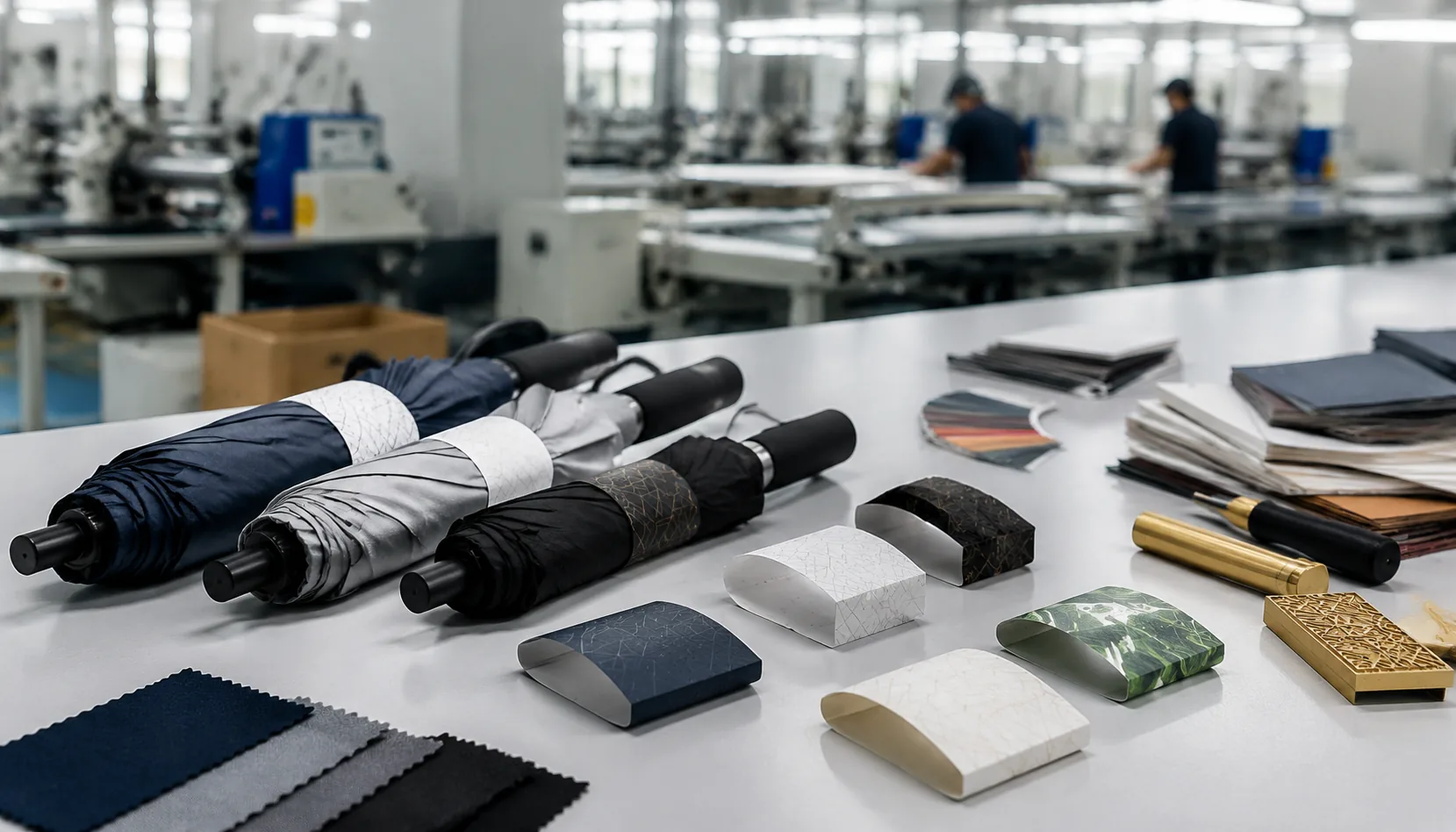
Branded Umbrella Belly Bands and Wrap Cards for Retail
Use belly bands and wrap cards to add brand story, barcodes, and specs without a full box, while keeping umbrella retail...
Read More »
Branded Umbrella Belly Bands for Retail Gift Presentation
Plan branded belly bands with logo, SKU, and gift messaging while keeping canopy quality visible, with material, sizing,...
Read More »
Umbrella Retail Belly Bands for Clean Private-Label Branding
Use belly bands to add private-label branding, sizing, and campaign messaging to folded umbrellas without committing to ...
Read More »