Umbrella Carton Compression Testing for Export Damage Prevention

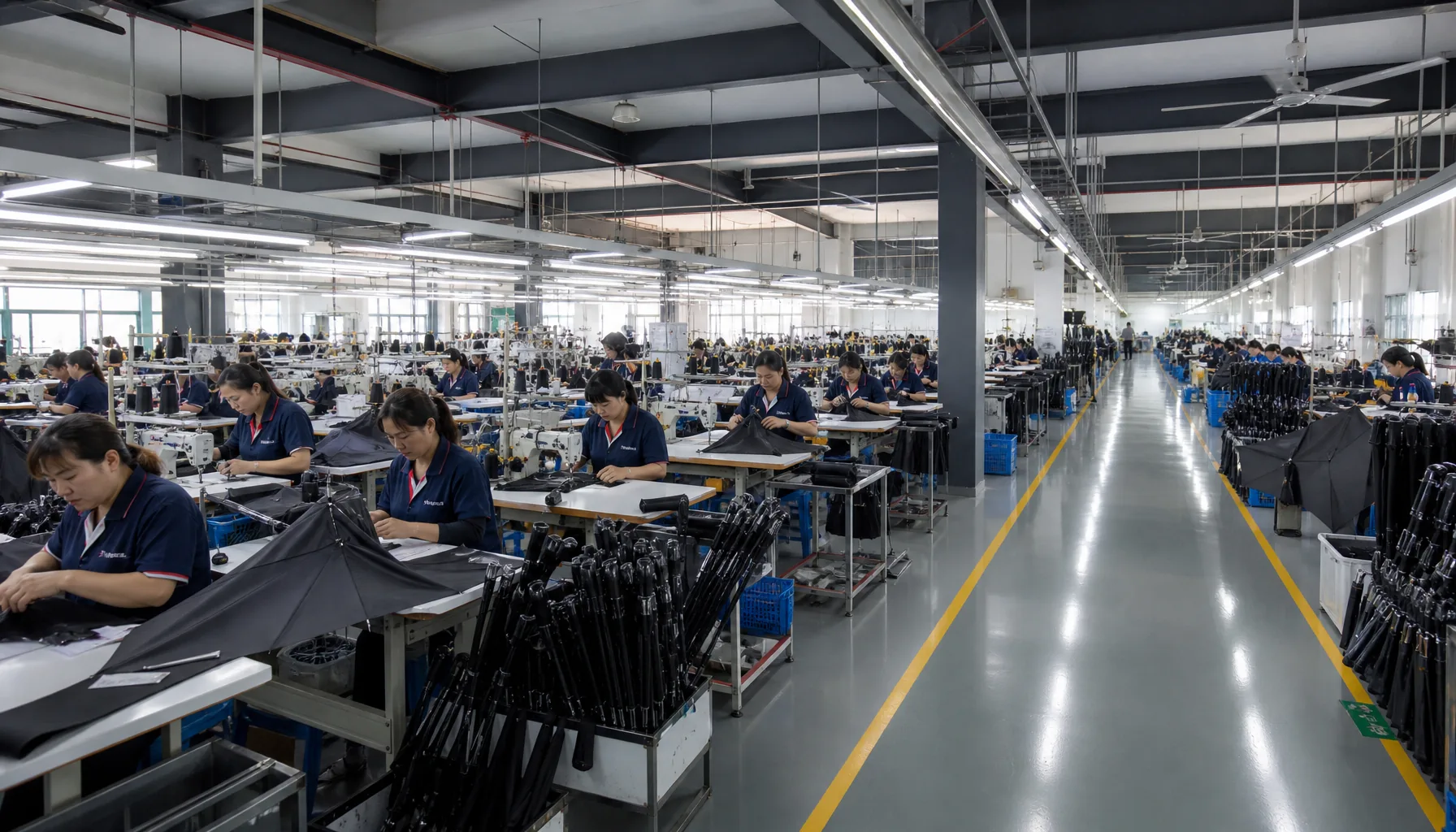
Export umbrella damage usually starts before the container door closes: a carton stacked too high, a handle pressing against the wrong panel, or a pack-out that shifts after the first port transfer. On our factory floor in Songxia, umbrella carton compression testing is tied directly to real loading patterns, drop checks, rib protection, and inner-box design, so buyers can reduce bent ribs, cracked handles, crushed tips, and avoidable claims before bulk shipment.
Why carton strength matters for umbrella exports
Carton strength decides whether an export umbrella arrives sellable or becomes a claim. A 23" auto-open model may be light per unit, but 24 to 36 pieces in one master carton concentrate pressure at tips, ferrules, handles, shaft ends, and rib ends. When cartons are stacked 5 to 7 layers high on a pallet and later double-stacked in a warehouse or container, weak sidewalls bow first. After the carton loses its rectangular shape, vertical load moves from the corrugated board into the product bundle. Typical defects include bent steel ribs, cracked plastic tips, distorted shaft alignment, crushed end caps, scuffed rubberized handles, and canopy creases that do not steam out cleanly. For promotional orders, minor abrasion on a plated handle or transfer-printed logo can still fail AQL 2.5 inspection. Umbrella carton compression testing should therefore sit inside export packaging engineering, not be treated as a final packing-room formality.
Most bulk shipment damage develops over weeks, not from one visible impact. A container shipped from Ningbo or Shanghai to the U.S. or Europe can face 25 to 40 days of vibration, humidity changes, port handling, and uneven stacking pressure. Thin single-wall board, poor edge-crush strength, or the wrong flute direction usually fails at the corners first; then the top panel sinks and the inner partitions stop holding umbrellas in position. Long 27" and 30" golf umbrellas with fiberglass ribs are exposed to bending force because the carton length amplifies stress during forklift handling and container movement. Compact 21" auto-open-close umbrellas face a different risk: dense packing can crush plastic cases, deform end caps, and scratch plated handles when bundles shift under compression. Reliable OEM umbrella packing must match carton grade, divider layout, polybag thickness, tape, strapping, and pallet pattern to the umbrella weight, carton size, and shipping route.
At ZheBrella, umbrella carton strength is specified with the product, alongside rib count, canopy fabric, frame material, and mechanism type. A 190T pongee manual umbrella packed 60 pieces per carton does not need the same compression margin as a 10K double-canopy windproof model with an EVA handle and heavier fiberglass frame. For export orders, we check gross weight, carton dimensions, stacking height, pallet pattern, and whether cargo will move as loose cartons, palletized goods, or mixed-container freight. Umbrella carton compression testing confirms whether the master carton can survive vertical pressure before the shipment spends weeks at sea. It also exposes cost-saving choices that create downstream risk: oversized cartons with empty headspace, soft recycled board, weak corners, poorly aligned partitions, or tape that loses adhesion under humidity. Preventing carton collapse costs less than sorting bent frames, replacing tips, repacking scuffed handles, or negotiating warehouse deductions after delivery.
How to design carton dimensions around umbrella pack-out
Design carton dimensions from the closed, sleeved umbrella, not from a stock carton list. For folding models, measure packed length after the strap is secured and include the thickest handle point: a 21-inch 3-fold auto-open-close umbrella often packs at 30-32 cm, while a compact manual mini may be 24-26 cm. Straight umbrellas are controlled by shaft length and end hardware; a 23-inch stick umbrella usually needs 84-88 cm internal length, and a 27-inch golf umbrella may need 98-104 cm depending on tip design and curved handle size. Keep 8-12 mm clearance on the long dimension and 5-8 mm per layer on width and height. Less clearance can bulge the handle end and reduce umbrella carton strength during umbrella carton compression testing; more clearance creates dead space, lets units shift during sea freight vibration, crushes fabric folds, and transfers load into one carton wall instead of the full stack.
Set inner and master carton counts around handling weight as well as compression load. In OEM umbrella packing, folding umbrellas commonly run 12 pieces per inner carton and 48 or 60 pieces per master carton; straight umbrellas often run 12 or 24 pieces per master depending on rib count, handle material, and packed diameter. A 60-piece carton of 10K steel-frame folding umbrellas can exceed 18-20 kg, increasing drop risk in warehouses, so export packaging engineering should keep master cartons under 16 kg when the buyer accepts a higher carton count. Use dividers selectively: glossy plastic, wood, and rubber-coated handles need separation, while pongee 190T/210T folding umbrellas with sleeves and polybags often do not need full partitions. Spend the saved space on tip-side and handle-side compression pads, which prevent localized punctures that later appear as bulk shipment damage.
Pack orientation determines whether the carton performs in the stack. Folding umbrellas should usually alternate handle direction by layer; putting all handles on one side creates a wedge-shaped carton that loses vertical compression strength. Straight umbrellas normally pack parallel in one direction with protected tips, using a snug rectangular carton instead of a tall square carton. Long, narrow cartons need stronger B/C flute or BC double-wall board because they bend during container loading and pallet handling. Vented double-canopy golf umbrellas with fiberglass ribs need more height allowance than steel 8K promotional umbrellas because the folded canopy rebounds after packing. At ZheBrella, the final pack-out is checked with a packed carton drop check and umbrella carton compression testing before shipping mark artwork is locked. Saving 2 cm in carton height is false economy if the master carton collapses under five stacked layers and triggers claims, repacking, or delayed FOB/DDP delivery.
Compression, drop, and vibration tests used in factories
Compression is the baseline test because it predicts whether the master carton can hold stacked weight in a container after warehouse dwell time and humidity exposure. For umbrella carton compression testing, calculate the target top-load from carton gross weight, planned stack height, storage time, and moisture risk, then apply a safety factor before testing. A typical 5-ply export carton for 23 inch auto-open umbrellas may weigh 12 to 18 kg gross; at 6 or 7 layers under mixed cargo, the bottom carton can carry about 90 to 130 kg before road vibration and weakened board reduce strength. For OEM umbrella packing, ZheBrella runs the carton to the target load and rejects any panel collapse, corner buckling, tape rupture, or deformation that presses into handles, tips, retail sleeves, or printed packaging. Spring-back alone is not a pass: crushed corner posts mean the carton has lost stacking geometry and will fail sooner in export handling.
Drop testing exposes failures that top-load tests miss: corner impact, seam burst, shifted contents, and hard pressure points at the ferrule and handle. In export packaging engineering, use ISTA-style drops matched to gross weight: 76 cm for cartons under 10 kg, 61 cm for 10 to 19 kg, and 46 cm for heavier umbrella cartons. Test one corner, three edges, and six faces, with extra attention to long golf umbrellas and 30 inch stick umbrellas because the shaft, ferrule, and handle concentrate impact at opposite ends. A pass allows scuffed board or small dents, but the inner polybags, sleeves, retail boxes, frame ribs, shaft finish, and printed canopy surfaces must remain saleable. Failures include opened tape, split sleeve bundles, bent steel shafts, cracked plastic handles, displaced tip protectors, or cartons that no longer stack square. Real umbrella carton strength comes from board grade, flute direction, divider placement, and tight carton sizing, not extra tape on a weak structure.
Vibration testing finds bulk shipment damage caused by dense, narrow umbrellas moving against each other for days by truck, rail, and ocean freight. Use random vibration or fixed-frequency table testing to simulate container transport, typically 30 to 60 minutes per axis for routine validation and longer cycles for new retail packaging. After vibration, inspect handle abrasion, metal tip punctures, scratched gift boxes, loose hangtags, and canopy transfer marks, especially on black pongee 190T/210T with light logos. Repeat umbrella carton compression testing after vibration when the pack design is new, because shifted contents can transfer load from carton walls onto the umbrellas. A carton passes only when dimensions remain within tolerance, stacking faces stay flat, barcodes stay readable, and the umbrellas meet AQL 2.5 inspection without packaging-related defects. For FOB or DDP orders with 30 to 45 day transit windows, these tests reduce destination claims by proving the carton can survive handling before mass production ships.
Materials that improve export carton performance
Start export packaging engineering with board grade, not factory habit. Match flute structure to gross weight, carton length, pallet stack height, and route risk before quoting OEM umbrella packing. For 21" manual compact umbrellas packed 50 pcs per master carton, B-flute or BC-flute double-wall is workable when gross weight stays under 18 kg and pallet stacking is controlled. For 23" auto-open, 27" stick, and 30" beach umbrellas, BC or BE double-wall with a verified edge crush value is the lower-risk choice because long cartons usually collapse at the corners before the top panel shows visible damage. Umbrella carton compression testing should simulate stacking after vibration and humidity exposure; port dwell time and ocean transit can reduce practical stacking strength by 30-40% even when the carton looks clean. Single-wall board may cut a few cents from carton cost, but it raises chargeback risk when retail display boxes arrive crushed or promotional master cartons must stay presentable for event handling.
Build umbrella carton strength from the inside, not only through heavier corrugated. Loose umbrellas shift during truck braking and container vibration, turning rib tips, ferrules, crook handles, EVA grips, and plated steel parts into point loads against the carton wall. Use paperboard dividers, honeycomb end pads, or molded pulp trays when lacquered wooden handles, retail sleeves, or plated ribs cannot tolerate scuffing. Corner protection matters most on tall-stack pallets, club-store programs, and clamp-truck handling, where load concentrates on four vertical edges. A 3 mm kraft angle board can prevent the common claim pattern: umbrellas remain saleable, but the master carton is visibly deformed and the buyer rejects or discounts the shipment. For promotional distributors, inserts also lower repacking labor because logo orientation stays consistent when cartons are opened for kitting.
Ocean freight weakens cartons through moisture before compression damage is obvious. A shipment loaded in Zhejiang in summer may face high humidity, container condensation, and 25-35 days on the water before inland delivery. Select PE liner bags, desiccant packs, water-resistant kraft, pallet top sheets, and container desiccants by route and product risk, especially for 190T pongee canopies with heat-transfer printing or umbrellas with metal shafts and plated steel ribs. ZheBrella typically keeps basic inner polybags for short FOB shipments, then upgrades to stronger master carton liners and container desiccants for DDP programs into humid or cold markets. Stronger board and moisture barriers increase unit packaging cost, but umbrella carton compression testing can make the decision measurable: reducing bulk shipment damage claims from 2.0% to below 0.5% on a retail program is cheaper than one rejected container or a season of deductions.
Packaging specs buyers should lock before production
Freeze the export carton in the purchase order before fabric cutting, not after finished umbrellas reach packing. For each SKU, list folded length, outside carton dimensions, pack count, inner polybag or sleeve, retail box requirement, and master-carton layout such as 12, 24, 36, or 48 pieces. A 23-inch auto-open straight umbrella with a wooden shaft and 8K fiberglass ribs needs a different cube plan than a 21-inch auto-open-close folding umbrella in a retail box. The PO should also cap gross weight: 15-18 kg for courier movement and 20-22 kg for sea-freight pallet loading are typical working limits. Above that range, bulk shipment damage increases at corner seams, hand holes, and lower-stack cartons. Umbrella carton compression testing is only meaningful when these inputs are fixed, because stacking performance changes with carton height, flute grade, moisture exposure, and pack density.
Treat barcode and mark placement as warehouse compliance, not artwork. Specify UPC, EAN, or FNSKU label size, print contrast, side-panel location, scan orientation, and whether codes must remain readable after stretch wrapping. For OEM umbrella packing, the PO should define shipping marks, country-of-origin wording, carton numbering, mixed-SKU rules, master carton weight limit, and retail-carton drop-test approval before mass packing. Inspection terms need the same precision: AQL 2.5 for umbrella workmanship, named carton compression or burst-strength standard, drop-test height, moisture limit, and sampling point before container loading. At ZheBrella, we check umbrella carton strength after final packed weight is confirmed; an empty sample carton does not predict real export handling risk.
DDP requests require stronger export packaging engineering than standard FOB because cartons may move through truck terminals, parcel hubs, customs holds, and last-mile handling before the buyer sees the shipment. If the destination is Amazon, a retail DC, or an event venue, confirm pallet height, corner protectors, stretch-film turns, edge-crush requirements, and whether cartons must survive non-palletized courier handling. Seasonal deadlines also affect both packaging choice and lead time. For rainy-season promotions, graduation campaigns, or Q4 launches, buyers may ask to cut production from 35 days to 25 days, but 5-ply cartons, custom inserts, printed retail boxes, and pre-shipment umbrella carton compression testing can add 3-7 days. Locking these terms in the PO prevents the common dispute: factory packed to normal FOB practice while the buyer expected DDP-level damage resistance.
Frequently Asked Questions
What is the biggest packaging mistake in umbrella export orders?
Using a carton that fits the product but does not survive compression and pallet stacking. Umbrellas are long, slender, and easy to deform, so weak board and poor internal support often lead to broken tips and bent ribs.
Should umbrella cartons be tested before the first shipment?
Yes. A carton test before mass packing helps catch problems with board strength, insert design, and pack count. It is much cheaper to adjust packaging at sample stage than to handle claims after arrival.
What carton test values matter most for bulk umbrella exports?
For B2B umbrella shipments, buyers usually review compression strength, burst strength or edge crush test values, and drop-test results. A common benchmark is confirming the master carton can hold planned stacking load for 4-6 weeks of warehousing and ocean transit without panel collapse.
Can pack-out quantity affect umbrella damage rates?
Yes. Changing from 48 pieces to 36 or 24 pieces per master carton can reduce internal movement, sidewall bulging, and handle-to-rib contact. The tradeoff is higher carton count and freight cube, so factories normally balance damage reduction against container utilization.
When should a buyer request carton validation before mass production?
Request it after sample approval and before final packaging is locked for production. A practical process is 1 pre-production pack-out review, followed by compression and drop testing on 2-3 pilot cartons, which helps avoid rework once bulk packing starts.
Looking to Launch Your Custom Umbrella Line?
ZheBrella is a Zhejiang-based OEM/ODM umbrella manufacturer with 17 years of export experience. Free design, low MOQ from 100 pieces, windproof construction, full-color print.
Get Free Quote Now »People Also Search For
Related Articles
Umbrella Carton Engineering for Export: Pack-Out and Damage Control
See how carton size, pack-out count, inserts, and pallet design reduce transit damage and control freight cost on export...
Read More »
Umbrella Carton Packing: Reducing Damage in Ocean Freight
Reduce freight damage with stronger umbrella cartons, correct inner packing, moisture control, drop-test checks, and cle...
Read More »Factory Packaging Design for Umbrella Export Damage Control
Reduce transit damage with export carton engineering, pack-out rules, and packaging specs that fit OEM retail and wholes...
Read More »