Umbrella Compliance Testing for US and EU Import Programs

For umbrella import programs, the hardest part is not the design; it is proving every material, label, and safety claim will hold up under US and EU scrutiny before the shipment leaves the factory. In umbrella compliance testing, small gaps in fabric chemistry, sharp-edge control, or product marking can trigger delays, rework, or a rejected container. From the production floor, we see that successful programs start with the testing plan, not the paperwork after the fact.
Map the compliance scope by destination market
For US EU umbrella import compliance, the first mistake is treating every umbrella as one product category. Adult rain umbrellas, golf umbrellas, kids' umbrellas, and fashion parasols are judged differently because the rules follow the materials, the age grade, and the claims on the packaging. A plain 23" manual umbrella with a polyester or pongee canopy is usually a straightforward general product safety case, but once you add a child-directed design, small detachable parts, a whistle, LED light, or a toy-like feature, CPSIA umbrella safety becomes relevant and the bar moves up fast. For kids' products, age grading, physical test expectations, and lead and phthalates control can matter more than the frame style itself. For adult products, the focus is usually on chemical content, labeling, and whether the construction creates an obvious pinch, spear, or sharp-edge hazard.
REACH umbrella materials is the main EU chemical lens, and it is material-specific, not umbrella-specific. A buyer should care about the canopy fabric, print inks, coating, handle, tip, ferrule, strap, and any plasticizer-heavy parts such as EVA or PVC components, because each of those can carry its own restricted-substance risk. The same umbrella can be low risk in one configuration and fail in another if the coating, adhesive, or decoration changes. On the US side, Prop 65 umbrellas only becomes relevant when the product or its packaging exposes California consumers to listed chemicals above warning thresholds, which often comes down to pigments, PVC compounds, metal components, or surface prints rather than the umbrella function itself. The practical point is that umbrella compliance testing has to follow the bill of materials and the final artwork, not just the sample shape.
General product safety expectations still apply even when no single named regulation is triggered. Buyers should expect checks for sharp points, tip retention, rib end exposure, opening force, pinch points, seam integrity, and label accuracy, especially on auto-open and auto-open-close models where spring force and rebound are higher. Windproof claims, UPF 50+ claims, or water-repellent claims also change the file because they require evidence, not just a nice sample. If you claim fiberglass ribs, UV coating, or a double-canopy vented design, the importer should keep test records tied to the exact production spec, not an older prototype. In practice, the cleanest program is to define the destination market first, then lock the materials, graphics, and age grade before testing, because re-testing after artwork or component changes is where projects lose time and budget.
Review material risks in canopy, handle, and ink choices
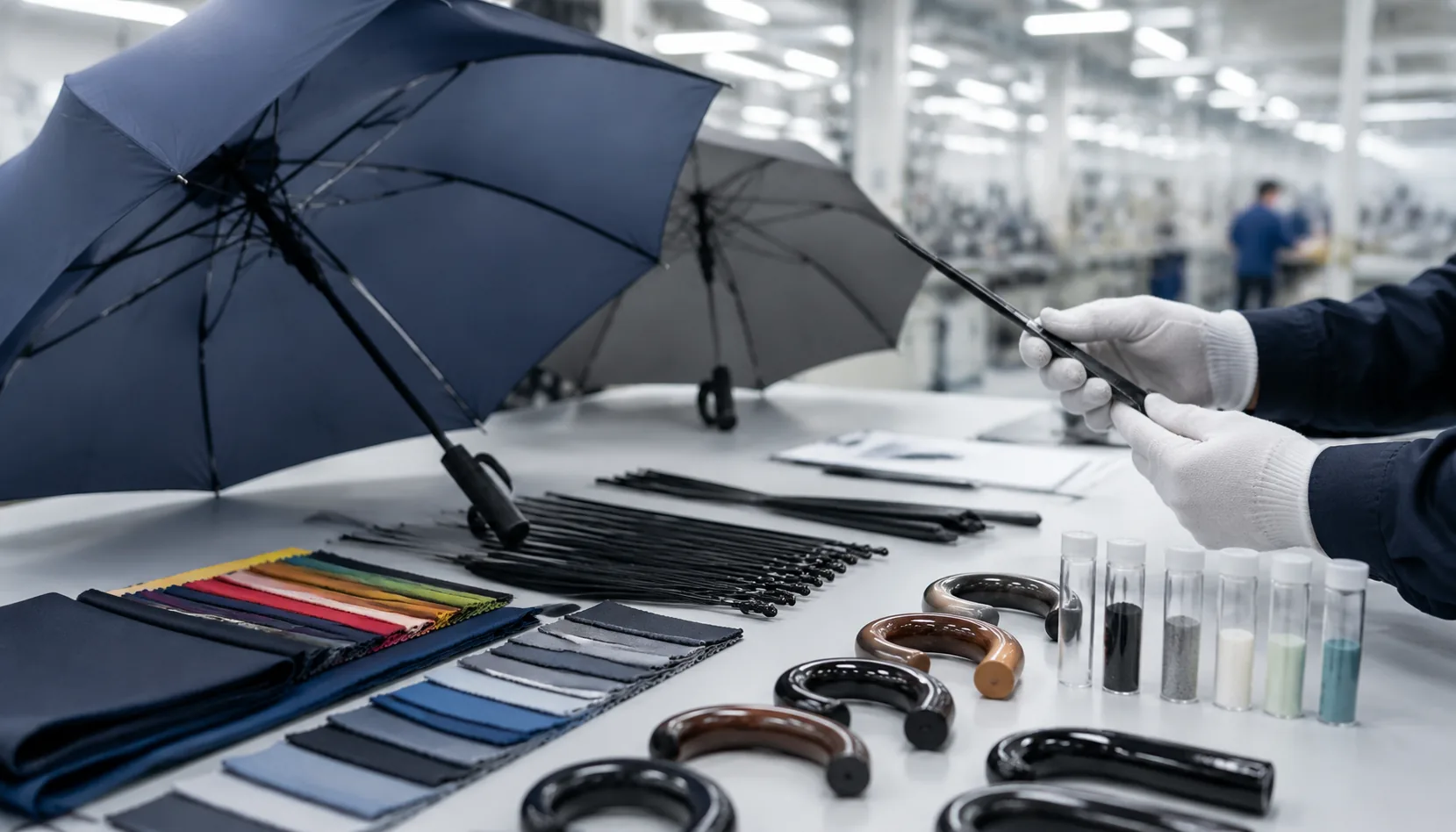
The first place umbrella compliance testing gets messy is not the frame, it is the canopy chemistry and the handle compounds. For US EU umbrella import compliance, the risk is usually in dyes, PU coatings, PVC trim, soft-touch TPR or EVA grips, and printed logos that use heavy-metal pigments or solvent-based inks. If the canopy is 190T or 210T pongee, the buyer should ask for the exact fiber content, dye class, and coating system, because the same fabric specification can behave very differently depending on whether it uses PU, PA, or acrylic back coating. In practice, REACH umbrella materials checks often start with supplier declarations, then move to lab reports for restricted azo dyes, phthalates, SVHC screening, and any metal content that could affect the finished umbrella, especially on dark colors and high-coverage prints.
PVC parts are a separate problem because they can trigger phthalate and plasticizer concerns even when the rest of the umbrella is clean. Soft-touch grips, tip caps, strap snaps, and molded sliders should be treated as materials with their own compliance file, not bundled under the canopy spec. For Prop 65 umbrellas, the most common exposure points are printed logos, black inks, pigments in handles, and certain coated fabrics that may carry lead or other listed substances in trace amounts. If the product is for children or has youth branding, CPSIA umbrella safety adds another layer: lead in accessible substrates, phthalates in plastics, and correct tracking-label information. A factory should be able to map each visible component to a material declaration, lot code, and test status before production starts, not after shipment is booked.
Umbrella compliance testing works best when the buyer forces decisions at the sample stage. Ask the supplier to identify whether the canopy is 190T or 210T pongee, whether the coating is PU or another resin system, and whether the logo print is screen, heat-transfer, or sublimation, because each route has a different chemical profile and different paper trail. We also see avoidable failures when a vendor changes pigment supplier or swaps a handle compound without updating declarations. For US and EU programs, the cleanest path is to require a pre-production material stack-up, then collect test reports or declarations for the fabric, coating, ink, and any PVC or soft-touch accessory. That is usually cheaper than re-testing a finished lot after packing, and it gives procurement a defensible file if customs, a retailer, or a marketplace asks for evidence later.
Define the documents buyers should request before shipment
Before release, an importer should ask for the full document set, not just a single “passed” report. For umbrella compliance testing, that means material declarations for canopy fabric, ribs, tips, handles, coatings, inks, and packaging, plus the lab test reports tied to the exact style and colorway. If you are importing into the US and EU, the file should show what was tested for US EU umbrella import compliance, including REACH umbrella materials for substances of concern in textiles, coatings, and plastics, and Prop 65 umbrellas screening if the product or packaging will touch California channels. For children's models, ask for CPSIA umbrella safety records as a separate file set, not buried inside a general commercial invoice packet. If the supplier cannot map each component to a declaration, the paperwork is too weak for customs or buyer QA.
The certificate file should match the commercial product, not a generic umbrella family. That means the test report number, sample photos, PO reference, fabric composition, handle material, and finished umbrella construction should all line up, and the carton labels should carry the same style code, size, and country-of-origin statement as the booking documents. Factory QC records matter because they show whether the shipment was controlled after lab testing: incoming fabric checks, in-line frame inspection, open-close cycle checks, and final AQL results. Our standard practice at ZheBrella is to keep these records together by production order so buyers can see whether the tested sample and the shipped lot are actually the same build.
Ask for batch-level traceability whenever the order has multiple colors, mixed handle materials, coated fabrics, or any regulatory risk tied to a specific component lot. The practical trigger is simple: if one subcomponent could create a failure in REACH umbrella materials, Prop 65 umbrellas exposure, or CPSIA umbrella safety, then lot-coded inspection records are worth demanding. That includes roll numbers for canopy fabric, resin or metal lots for handles and tips, rib material batches, and carton label runs linked to the packing list. If the supplier uses rework, split shipments, or partial replacements, traceability should go down to each carton and pallet. Without lot codes, an importer can prove only that some sample passed, not that the shipped units were controlled under the same umbrella compliance testing basis.
Connect compliance to factory process control
Umbrella compliance testing starts long before a lab report. If the factory does not control incoming materials, the sample is almost meaningless. For US EU umbrella import compliance, we check canopy cloth, inks, coatings, plastic handles, ferrules, tips, and stitching thread at receiving, because REACH umbrella materials issues usually come from the wrong resin, pigment, or surface treatment entering the line unnoticed. A compliant pilot sample can pass flammability, chemical, or strength checks while bulk production drifts because a substitute lot arrives with different additives, metal plating, or coating weight. That is why process discipline matters more than one-off test success. At ZheBrella, the standard practice is to tie approved BOMs to specific supplier lots, keep incoming inspection records, and block unapproved substitutions before cutting starts.
In-line control is where most compliance failures are prevented or missed. We inspect rib set length, stitch density, canopy panel alignment, glue cure, and open-close function during production, not just at the end. That reduces the chance of a mechanical failure that later becomes a CPSIA umbrella safety or Prop 65 umbrellas issue, especially when a finish contains restricted lead, phthalates, or other listed substances. For printed umbrellas, ink laydown and curing temperature have to be watched closely because a sample can clear testing while a hotter production run changes migration or adhesion behavior. This is why umbrella compliance testing should be paired with documented process checks, operator sign-off, and lot traceability. Without that control, one passed sample does not prove the next 5,000 units will match it.
Final AQL 2.5 inspection is the last gate, not the main control. It catches visible defects such as broken tips, missed stitches, crooked logos, pinholes, rust spots, and inconsistent opening force, but it cannot fix a bad material decision made two weeks earlier. For bulk programs, we also separate compliance-critical checks from cosmetic checks so the team does not treat them the same way; a shade mismatch is not the same risk as a contaminated PVC handle or an off-spec coating. If the buyer needs documented umbrella compliance testing, the factory should keep batch records, retained samples, and test references linked to the shipment lot. That is the practical difference between a controlled production run and a one-time showroom sample: one is repeatable, the other is just an example.
Build a launch checklist that avoids customs delays
The cleanest way to avoid customs delays is to treat umbrella compliance testing as a lead-time item, not a last-minute document hunt. Lock the bill of materials first: canopy fabric, frame metal, handle plastic, ink system, packaging, and any chemical finishes such as PU, Teflon, or UV coating. For US EU umbrella import compliance, I want the test request opened before bulk cutting starts, because the lab needs the actual fabric construction and all accessory materials, not a marketing description. If the order uses pongee 190T or 210T, POE, PVC, or EVA, that detail has to match the commercial invoice, packing list, and carton marks. The biggest problems I see are mismatched fiber content declarations, missing country-of-origin labels, and an artwork proof that shows one SKU while the cartons ship another. For imported promotional umbrellas, that kind of paperwork gap invites a hold even when the goods themselves are fine. A realistic plan is 10 to 14 days for test booking and sample shipment, then another few days for internal document review before cargo leaves port.
For REACH umbrella materials and Prop 65 umbrellas, the weak point is usually not the frame, it is the coated canopy, printing ink, soft-touch grip, or metal finish. If the umbrella uses fiberglass ribs, steel shafts, or rubberized handles, make the supplier identify each material by component so the compliance file can answer customs questions without guessing. I also check whether the set is adult or child use, because CPSIA umbrella safety becomes relevant when the product is sized or marketed for children, especially if there are small parts, sharp tips, or lead-content concerns in decoration. The practical rule is simple: do not wait for the final factory photo to start the declaration review. Send the draft test report, carton artwork, and HS code guess for signoff while production is still in sewing and assembly. That gives time to catch a missing fiber declaration, a wrong warning statement, or a label in English that does not match the product registration before the shipment is loaded.
The last checkpoint is document consistency across the shipment, because customs usually spots the mismatch before the importer does. The commercial invoice, packing list, carton label, and product mark should all say the same size, mechanism, and material set, whether that is a 21-inch manual folding umbrella, a 23-inch auto-open-close model, or a 30-inch golf style with a double-canopy vented frame. If the lab report covers only the canopy but the invoice describes a full accessory kit, expect questions. Our standard practice is to review the test scope, artwork, and shipping docs together 5 business days before ETD, then do a final pre-alert 48 to 72 hours before vessel cutoff so any missing declaration can be corrected while the cargo is still on the factory side. That timing is more useful than rushing a certificate after loading, because umbrella compliance testing only helps if the report, label, and customs entry are aligned when the shipment lands.
Frequently Asked Questions
Do all umbrellas need the same compliance tests?
No. The required tests depend on the destination market, age grade, materials, and any performance claims. A children's umbrella, a rain umbrella with UV claims, and a basic promotional umbrella can trigger different documentation needs.
When should a buyer request lab testing from the factory?
Request it before bulk production if the order uses new materials, new inks, or a new market destination. For repeat programs, re-test when the material stack or supplier changes.
What documents should a US or EU importer request before placing an umbrella order?
At minimum, request a materials declaration, supplier test reports for the canopy, handle, shaft, and coatings, plus a finished-goods inspection checklist. For children's umbrellas, add CPSIA evidence for lead and phthalates; for EU shipments, keep REACH SVHC status and any required declarations on file. Most importers also store artwork proofs and carton labeling approval with the compliance pack.
Do different canopy colors or prints require new compliance testing?
Not always. If the base fabric, coating, ink, and supplier stay the same, one test report may cover multiple colors, but a new pigment, print process, or coating usually triggers re-testing. Many buyers revalidate after any material change or at least once per production year.
How long does compliance testing usually take for a new umbrella program?
Basic material screening is often completed in 5 to 10 business days once samples are in the lab. If you need a full US/EU documentation set with revisions, expect 2 to 3 weeks, longer if the factory changes components during review.
Looking to Launch Your Custom Umbrella Line?
ZheBrella is a Zhejiang-based OEM/ODM umbrella manufacturer with 17 years of export experience. Free design, low MOQ from 100 pieces, windproof construction, full-color print.
Get Free Quote Now »People Also Search For
Related Articles
REACH and Prop 65 Compliance for Umbrella Imports
Understand REACH and Prop 65 risks in umbrella materials, from dyes and coatings to handles, tips, nickel parts, and pri...
Read More »
Umbrella Import Compliance for U.S. and EU Buyers Checklist
Know which fabric, plastic, and coating tests matter for U.S. and EU imports so you can clear customs, avoid holds, and ...
Read More »
Rain Umbrella Compliance for REACH and Prop 65 Programs
Learn how buyers source umbrellas for REACH and Prop 65 programs, from material risk points to lab testing, documentatio...
Read More »