Umbrella Rivet and Joint Strength: Production Specs That Matter
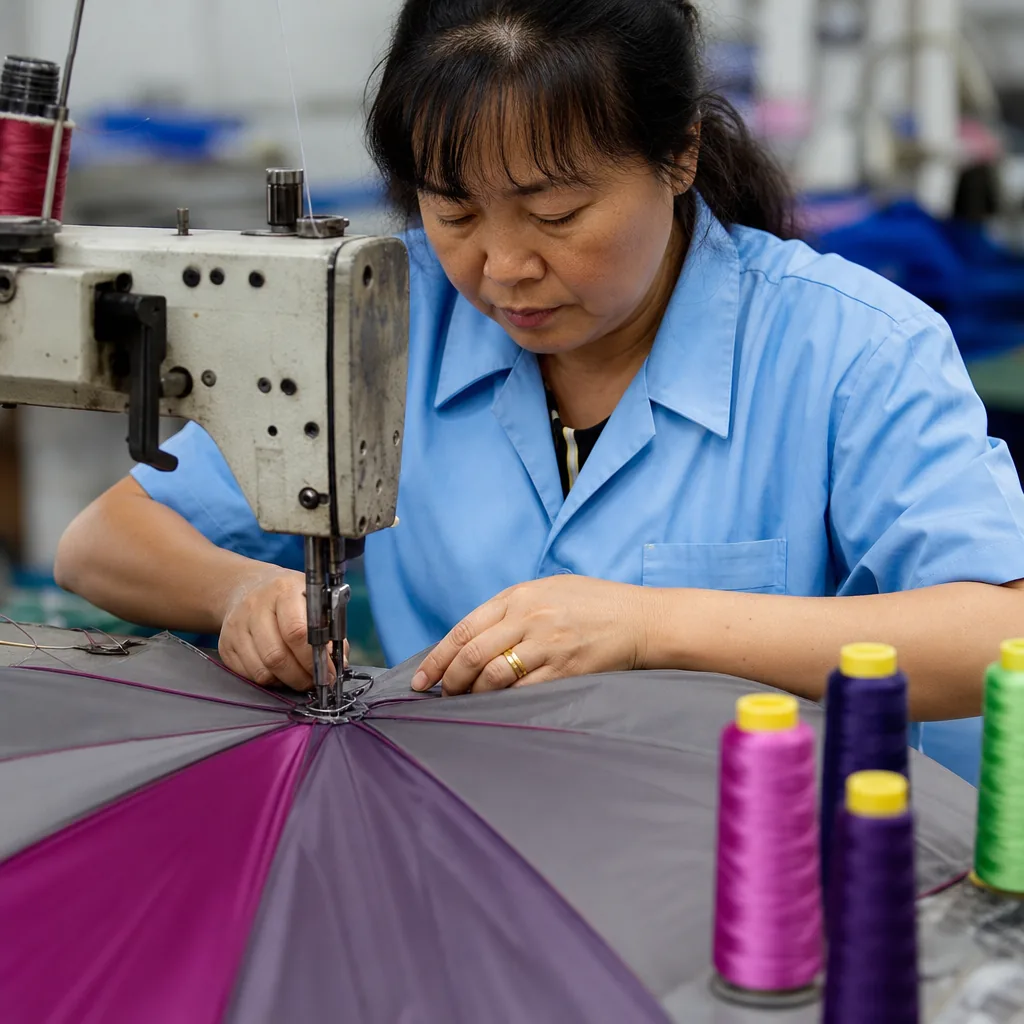
When an umbrella frame comes back with loose ribs, cracked links, or a runner that starts wobbling after a few hundred cycles, the root cause is often hidden in the joint, not the fabric. On our Songxia lines, small changes in rivet diameter, pin material, eyelet clearance, and upsetting force can make the difference between smooth opening cycles and early field failures, which is why buyers need to look closely at umbrella rivet joint strength before approving production specs.
Where Rivet Failures Start in Umbrella Frames
Most umbrella frame failures start at three pivots, not across the full structure: the rib-to-stretcher joint, the stretcher-to-runner hinge, and the top-notch pivot where the main ribs articulate. On a 21 in or 23 in 8K folding frame, these joints take the highest opening shock and reverse-bending load on every cycle. On a 27 in or 30 in golf frame, the same points also carry more canopy drag and a longer lever arm under wind, which raises stress at the rivet line. Buyers reviewing umbrella rivet joint strength should check these locations first, especially on auto-open and auto-open-close styles where spring force drives the runner upward at high speed. Risk climbs when thin stamped steel stretchers are paired with oversized rib holes or soft aluminum rivets, because impact loading hits before the linkage fully stabilizes. Larger 16K frames and double-canopy golf umbrellas add torsional load: gusts twist the upper rib geometry, and small-diameter pivot rivets lose safety margin quickly under that torque.
The rib-to-stretcher joint usually shows failure first, and the progression is predictable: looseness, visible wobble, then rivet shear or hole elongation. In practice, that often traces back to rivet material selection. A soft shank may head cleanly during assembly but deform after a few hundred open-close cycles; a harder rivet resists deformation but can crack under side load if clearance or hole alignment is off. The stretcher-to-runner hinge is another high-risk point because runner impact in auto-open frames accelerates fretting, opens the hole wall, and increases joint play when tolerances stack up. Good frame joint testing measures post-cycle play, hole growth, cracked plating at pivots, partial rivet-head pull-through, and uneven wear between left and right linkages, instead of relying on initial hand-feel. For umbrella assembly QC, require opening-cycle data, destructive shear checks on representative joints, and AQL 2.5 inspection focused on these three hinges. On auto-open folders and 30 in golf umbrellas, those OEM durability specs expose weak joints before shipment, when correction still costs less than a field failure.
Choosing Rivet Material, Diameter, and Head Type
Umbrella rivet joint strength starts with matching rivet metal to the frame load path and selling environment. Plain carbon steel rivets remain the standard choice for 21" to 27" folding umbrellas with steel main ribs and steel stretchers because they deliver the highest shear strength per dollar and fit cost-sensitive OEM durability specs. Stainless steel rivets typically cost more, but they are the lower-risk choice for beach umbrellas, golf umbrellas, and humid-market shipments where wet storage, salt air, or failed plating can stain, seize, or weaken standard steel hardware. Aluminum rivets cut weight, but they are better limited to compact or low-load joints because they deform faster under repeated open-close cycles and lose joint retention sooner than steel. Rivet material selection also has to match the mating parts. Steel-to-steel joints can usually take a harder rivet, while mixed-material assemblies need tighter control of rivet hardness and hole fit to reduce wear, hole elongation, and play over time. For buyers, the approval standard should be the actual use case: target cost, corrosion exposure, cycle count, and the frame bill of materials matter more than choosing steel, stainless, or aluminum by name alone.
Diameter and head type should follow frame geometry, rib count, and canopy load, not a factory default. Most umbrella factories stay within a 2.0 mm to 3.0 mm rivet range: 8K and 10K compact frames usually run at the low end, while 16K domes, 30" golf umbrellas, and vented windproof frames often need larger rivets at the runner, notch, and primary rib pivots. Frame material combinations change that calculation. Fiberglass ribs flex and recover, while steel stretchers transmit load more sharply into the joint, so fiberglass-plus-steel frames often need tighter hole tolerances, smoother shank finish, and, at high-stress points, a larger rivet than an all-steel frame. Canopy fabric matters too. A 210T pongee canopy adds more weight and wind drag than 190T pongee, especially with full-panel dark printing or a Teflon finish, increasing load at rib eyelets and runner connections. Broader flat heads distribute bearing load better on thin stamped parts; undersized heads can speed hole ovalization when washer stack or part hardness is wrong. To confirm umbrella rivet joint strength, require frame joint testing on finished samples—open-close cycling, pull checks at key pivots, salt-spray review for plated steel parts, and wind testing—then release production only through umbrella assembly QC with AQL 2.5 records tied to each critical joint.
How Joint Design Affects Wear Over Repeated Cycles
Joint geometry determines service life, so the writer should state the pivot tolerance at the rib, stretcher, and notch instead of treating fit as a visual check. On thin stamped steel parts, a punch hole that runs 0.15-0.20 mm oversize can turn clean rotation into side-loading, then start hole elongation long before the canopy fails. Good umbrella rivet joint strength comes from matching rivet shank diameter to the full stack thickness and controlling the clearance window so the joint moves freely without audible rattle. On 21 inch and 23 inch compact frames, the buying standard is practical and easy to verify: the umbrella opens fully, the pivot rotates smoothly, and there is no visible wobble at the joint. The writer should explain why this clearance is a cost and durability issue, not just a feel issue. If clearance is too tight, the pivot binds and spring force shifts into the rib elbow, runner, or top notch. If clearance is too loose, the rib and stretcher slap under load, wear accelerates after repeated cycles, and failure risk rises in gusts.
Washer use, clinch pressure, and rivet material selection need their own technical treatment because they directly affect wear over repeated cycles. The writer should cover why a flat washer or shoulder washer is often required when fiberglass ribs run against plated steel stretchers: it spreads load, reduces burr bite, and keeps the rivet head from cutting into the softer part. That point also belongs in rivet material selection, since aluminum, iron, and stainless rivets upset differently under the same clinch pressure and can produce either binding or excess play if the press setting is wrong. Overtight riveting locks the pivot, makes manual and auto-open frames feel stiff, and concentrates stress at nearby joints; loose riveting does the opposite, increasing plating wear, joint play, and wind-load failure risk on 8K and 10K frames. For frame joint testing, umbrella assembly QC, and OEM durability specs, buyers should ask for repeated open-close cycle data, side-load checks on vented and non-vented frames rated above 50 mph, inline inspection of clinch consistency and washer orientation, and finished-frame release to AQL 2.5 with clear joint failure criteria for binding and excess play.
Production Controls and Durability Testing at the Factory
The fastest way to judge umbrella rivet joint strength is the riveting station, not the approval sample. A controlled line uses dedicated fixtures for rib, stretcher, and notch joints so hole alignment, rivet shank length, upset diameter, and head concentricity stay within spec before the press cycle starts. If fixture play develops or rivet length drifts by 0.2 to 0.3 mm, joints can pass incoming checks yet loosen after repeated opening cycles. Rivet material selection also changes the setup window: aluminum, iron, stainless, and brass do not flare the same under one die pressure, and mixed assemblies such as fiberglass ribs with steel stretchers often need die adjustment to avoid uneven clinching. For 10,000- to 50,000-piece OEM runs, buyers should ask how the factory controls setup drift across shifts: whether first-piece samples are locked at the start of each shift and after every die change, whether master samples are checked to fixed standards for head shape, joint free play, and articulation, and whether those records are retained by line and lot. Most failures in volume production come from process drift, not one obviously bad rivet batch.
Reliable suppliers treat destructive pull checks and frame joint testing as routine process control, not a pre-shipment formality. Inspectors should pull finished rib-joint samples from each lot, apply destructive checks, and record the failure mode—rivet head pull-through, rib eyelet tearing, or binding before failure—because each points to a different root cause in umbrella rivet joint strength, from die pressure to shank length to upstream hole punching. Durability standards should match the mechanism: a 21-inch 8K auto-open-close frame creates much higher shock loads at the runner and stretcher joints than a 23-inch manual stick umbrella, so 3,000 to 5,000 open-close cycles by assembly type is more useful than a generic “tested” claim. Umbrella assembly QC should also reject cracked nickel or black electrophoretic plating at the rivet shoulder, off-center or deformed heads, burrs that can cut 190T or 210T pongee, and joints that are too tight or too loose in articulation. Buyers should confirm that final inspection runs to AQL 2.5 and that QC check sheets are separated for manual, auto-open, and auto-open-close assemblies; spring-loaded frames hide deformed heads and micro-cracked plating more easily, and they need stricter OEM durability specs to reduce field returns.
What to Specify in RFQs, Samples, and Final QC
The fastest way to lose control of umbrella rivet joint strength is to leave hardware unspecified in the RFQ. Name every rivet by frame position—top notch, runner, rib-to-stretcher, and handle pin—and lock four points in writing: material, shaft diameter, finish, and tolerance. A usable buyer checklist also states washer use where required, corrosion performance, and the exact frame build being quoted, such as an 8K 23-inch auto-open frame with fiberglass ribs, a steel shaft, and a 190T pongee canopy. For rivet material selection, call out nickel-plated steel or stainless grade rather than accepting a generic "metal rivet" note. That matters because low-carbon steel rivets may pass visual inspection but loosen after repeated opening cycles, especially on lightweight promotional frames. If the umbrellas are for coastal retail, long warehouse storage, or larger golf styles, add a corrosion target to the RFQ—salt-spray or controlled humidity exposure—so the factory prices the requirement up front instead of defaulting to a lower-cost domestic hardware spec.
Do not approve production on canopy appearance alone. First approve a cut and assembled joint sample on the actual frame, then lock three items before deposit: the golden sample, the cycle target, and the failure standard. For frame joint testing, 3,000 open-close cycles is a practical target for basic manual or auto-open umbrellas; heavier commuter or golf frames can be set at 5,000 cycles, with about 50 mph wind testing for vented designs where relevant. Define failure in measurable terms: rivet pull-out, ovalized hole, cracked runner ear, excessive hinge wobble, binding, or visible rust after the agreed exposure test. Final inspection should run to AQL 2.5 and treat hardware as a release item, not a secondary check: verify rivet head formation, clinch tightness, smooth articulation, opening force, closing alignment, and plating damage after function tests. Upgraded rivets in OEM durability specs usually change commercial terms as well—stainless or thicker-spec rivets can raise MOQ, add a few cents per piece, and extend lead time by 3 to 7 days, especially on ODM orders shipping FOB or DDP, where late hardware changes can miss carton booking or vessel cutoff.
Frequently Asked Questions
Do stainless rivets always make an umbrella frame better?
Not always. Stainless improves corrosion resistance, but the joint still depends on hole size, clinch pressure, and matching with surrounding parts. A poorly set stainless rivet can fail sooner than a correctly installed plated steel rivet.
What is the best way to compare joint durability between suppliers?
Use the same frame spec and require side-by-side opening-cycle testing plus post-test joint inspection. Ask each supplier to report where looseness appears first, not just whether the umbrella still opens.
What rivet diameter is typically used on standard folding umbrella frame joints?
For many 2-fold and 3-fold frames, joint rivets commonly fall in the 2.0-2.5 mm range, depending on rib thickness and link design. Heavier frames or golf umbrellas may use larger diameters to reduce play at high-stress pivot points.
Should buyers request salt spray testing for umbrella rivets and joints?
Yes, especially for coastal markets or long retail shelf life. A common buyer requirement is 24-48 hours of salt spray resistance on plated metal parts, but the exact target should match your finish type and corrosion-risk market.
Which frame joints fail first in repeated open-close cycle testing?
The highest-risk points are usually the runner connection, stretcher-to-rib joints, and top-notch link points because they carry repeated motion and load transfer. For OEM orders, buyers often ask factories to monitor these locations during cycle tests such as 500-1,000 open-close repetitions.
Looking to Launch Your Custom Umbrella Line?
ZheBrella is a Zhejiang-based OEM/ODM umbrella manufacturer with 17 years of export experience. Free design, low MOQ from 100 pieces, windproof construction, full-color print.
Get Free Quote Now »People Also Search For
Related Articles
Umbrella Frame Riveting Quality: Controlling Joint Failure
Learn how rivet selection, hole tolerance, and pull testing reduce loose ribs, twisted stretchers, and frame failures in...
Read More »
Umbrella Frame Riveting Process for Strong OEM Joint Quality
Learn how rivet size, setting pressure, rib material, and inline checks prevent loose umbrella joints before final AQL i...
Read More »
Umbrella Frame Riveting Quality for OEM Production
Learn how rivet diameter, hole clearance, and pull tests prevent loose ribs, bent stretchers, and noisy joints in 8K and...
Read More »