Umbrella Frame Riveting Quality for OEM Production
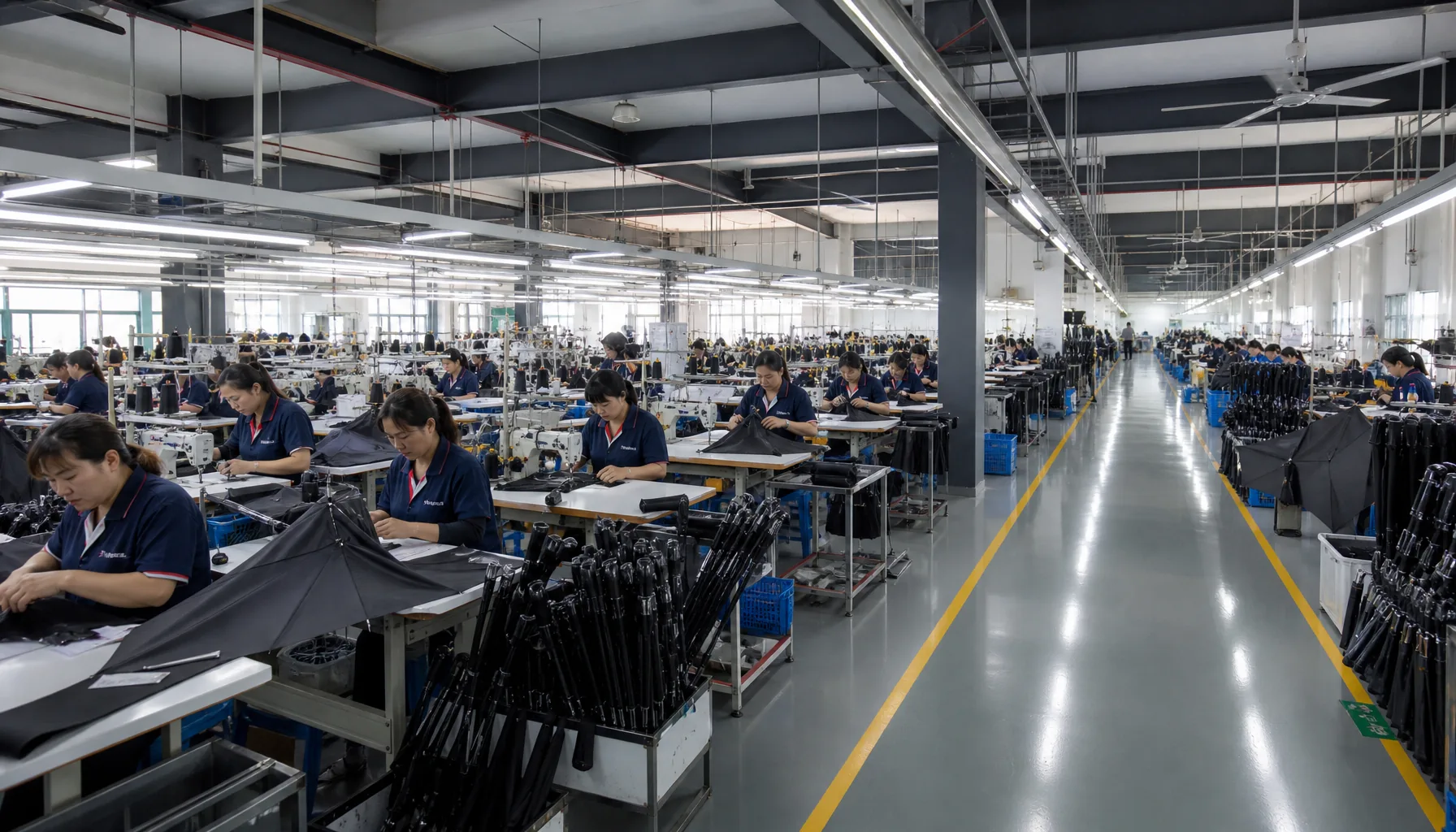
A frame that looks straight at incoming QC can still fail after a few open-close cycles if the rivets are undersized, the rib holes are loose, or the setting pressure varies by station. In OEM production, umbrella frame riveting quality is what separates a quiet, stable 8K or 16K frame from one with loose ribs, bent stretchers, and warranty claims. On our Songxia floor, we control rivet diameter, hole clearance, and pull-test results before frames move to canopy assembly.
Where Rivets Affect Umbrella Frame Performance
The most critical rivets in an umbrella frame are not hidden; they are exactly where the frame changes direction under load. On a standard 23" 8K straight umbrella, the rib-to-stretcher joint carries the push from the runner and the downward pull from the canopy, so loose umbrella stretcher riveting immediately shows up as rib wobble and uneven canopy tension. At the runner, each stretcher connection must rotate freely without side play; if one hole is punched off-center by even 0.3–0.5 mm, that rib opens late and pulls the canopy panel out of shape. Around the top notch, rivets and pins align the ribs radially, and poor setting there creates a crooked crown even when the fabric cutting is correct. In OEM umbrella frame assembly, these points decide whether the umbrella opens cleanly for 500 cycles or starts clicking, twisting, and sagging after a few rainy days.
Folding frames add more risk because every extra hinge is another riveted bearing surface. A 21" 3-fold auto-open-close frame may have two or three pivot points per rib line, including main rib sections, middle joints, stretchers, runner links, and sometimes safety runner components. If the rivet is over-compressed, the joint binds and the spring system needs more force to open; if it is under-compressed, the frame shakes and the canopy will not sit symmetrically. We check this by opening samples slowly and watching whether all 8K or 10K ribs reach full extension at the same time. Good umbrella rib joint strength is not only about using a harder rivet; it is about matching rivet diameter, hole tolerance, washer use, and setting pressure to the frame material, especially when mixing steel stretchers with fiberglass ribs.
Fiberglass rib production needs special attention because fiberglass does not behave like stamped steel. A steel rib can tolerate a slightly aggressive rivet set, but fiberglass ends can crack, whiten, or delaminate if the drilled hole is rough or the rivet head bites too deeply. Once that happens, wind load from a 30–50 mph gust concentrates at the damaged joint, and the rib fails long before the canopy fabric or shaft. Our standard practice at ZheBrella is to inspect riveting during in-line frame assembly, not only at final AQL 2.5 inspection, because bad umbrella frame riveting quality cannot be corrected after the canopy is sewn on. Early warning signs include ovalized holes, black powder near moving joints, uneven runner travel, ribs that do not lie in the same plane, and a frame that opens with a staggered “wave” instead of one clean snap.
Rivet, Rib, and Stretcher Material Compatibility
Material compatibility decides umbrella frame riveting quality before the first pull test is made. Steel ribs and stretchers tolerate a harder semi-tubular rivet because the joint hole does not ovalize quickly, but the rivet still cannot be so hard that it cracks during roll setting. For common 23" straight umbrellas with 8K steel ribs, we usually see 2.2–2.5 mm rivet shanks at rib-to-stretcher points, with a controlled flare height so the joint rotates without side play. Aluminum frames are less forgiving. If the rivet is too hard or the head is too small, the hole wears into an egg shape after repeated open-close cycles. For aluminum, a slightly softer rivet, wider head, or small washer is often needed to spread load. Washers are not decoration; they prevent thin stamped stretchers from cutting into the rivet head under torsion.
Fiberglass rib production needs a different mindset because fiberglass is strong in flex but poor under point crushing. On 8K or 10K fiberglass ribs, especially for windproof models rated around 50+ mph in tunnel testing, the rivet must clamp the metal connector or rib cap, not bite directly into raw fiberglass. If the umbrella stretcher riveting is over-pressed, the joint may look tight on the line but develop white stress marks or hidden delamination after 500 cycles. We use larger bearing surfaces, plastic or metal bush inserts, and carefully controlled rivet roll diameter where fiberglass connects to steel stretchers. For double-canopy vented golf umbrellas, 27" to 30" panels create much higher leverage at the runner and stretcher joints, so umbrella rib joint strength depends as much on washer stack-up and hole alignment as on the rivet itself.
Compact umbrellas and golf umbrellas fail in different ways, so they should never share the same joint specification just because both are called OEM umbrella frame assembly. A 21" auto-open-close compact has short ribs, many moving links, and high shock load from the spring mechanism; the rivets must be small, smooth, and consistent enough to avoid friction in nested steel or aluminum sections. Too much clearance causes rattling and canopy distortion, while too little clearance makes the runner stick during AQL 2.5 functional inspection. A 30" golf umbrella has fewer folding joints but much higher wind torque, especially with 190T or 210T pongee under rain load. For that product, we prioritize larger rivet diameter, thicker stretcher material, reinforced ferrules, and washers at high-load pivots. Good umbrella frame riveting quality means matching hardness, diameter, and bearing area to the exact frame geometry, not copying a drawing from another size.
Hole Clearance and Pressing Force Control
Hole clearance is one of the quiet killers of umbrella frame riveting quality because the joint can look acceptable on the line but fail after 200 to 500 open-close cycles. For a common 23" straight umbrella with 8K steel ribs, the rivet hole in the rib and stretcher should normally run only slightly larger than the rivet shank; when a 2.4 mm rivet is paired with a punched hole drifting toward 2.7 mm or more, the joint starts to rattle and the canopy tension becomes uneven. In OEM umbrella frame assembly, that looseness shows up as tip wobble, poor rib alignment, and higher stress at the runner when the umbrella is opened fast. On 27" and 30" golf umbrellas, the problem is worse because longer ribs create more leverage at the pivot. I do not accept “the rivet is still inside the hole” as a standard; umbrella rib joint strength depends on controlled clearance, not just visual attachment.
Pressing force needs the same discipline because too much force is just as damaging as too little. In umbrella stretcher riveting, excessive pressure can flatten the metal tube, pinch the joint so tightly that it cannot rotate smoothly, or create hairline cracks in plastic runners, notches, and rib seats. With fiberglass rib production, the risk shifts slightly: fiberglass itself handles bending better than thin steel, but the plastic connector or molded joint around it can crack if the rivet head is over-compressed. Our standard practice at ZheBrella is to set riveting machines by sample pull, rotation feel, and head diameter, not by operator judgment alone. A good rivet head should be formed evenly, with no sharp burrs, no tilted mushrooming, and no visible whitening or stress marks on nearby plastic. If the frame needs force to open after riveting, the press setting is already wrong.
Practical control starts with first-piece approval before mass riveting begins. For each shift, the line leader should check rivet size, hole punch condition, fixture alignment, formed head diameter, joint rotation, and one manual open-close test before releasing production. During bulk OEM umbrella frame assembly, hourly riveting checks are more useful than end-of-line sorting because a worn punch or drifting air pressure can produce hundreds of weak frames before anyone notices. I like to pull 5 to 10 frames per hour from different operators and check loose joints, over-tight joints, cracked plastic parts, and deformed stretchers, then record the result beside the work order. For export orders under AQL 2.5, these in-process records protect both the factory and the buyer. Umbrella frame riveting quality is not achieved at final inspection; it is built by controlling clearance and force while the rivet is being pressed.
Mechanical Tests for Riveted Umbrella Frames
Opening cycle testing is the first place weak rivets reveal themselves, because a frame may look clean on the table but loosen after 200–300 hard snaps. For OEM umbrella frame assembly, we normally test manual, auto-open, and auto-open-close samples separately because the load curve is not the same. A 23-inch 8K manual straight umbrella may pass 500 open-close cycles with standard brass or nickel-plated steel rivets, while a 21-inch 8K auto-open compact frame puts a sharper impact through the runner, stretcher, and top rib joints. For higher-risk programs, especially retail orders with AQL 2.5 inspection, I prefer 1,000-cycle testing on pre-production samples before approving bulk frame riveting. This is where umbrella frame riveting quality becomes measurable instead of subjective: no cracked washers, no ovalized rivet holes, no loose stretcher movement, and no delayed canopy tension after opening.
Rib flex and pull checks are used to separate cosmetic assembly from real umbrella rib joint strength. On steel ribs, the concern is usually hole deformation and rivet head seating; on fiberglass rib production, the bigger risk is crushing the rib wall or creating a hidden crack near the drilled joint. We flex each rib and stretcher set beyond normal canopy arc, then check whether the rivet still rotates smoothly without side play. For windproof frames, especially 10K or double-canopy vented designs rated around 50+ mph in wind-tunnel claims, the middle rib-to-stretcher rivet and runner-side stretcher rivets take repeated reverse loading. A simple pull check with pliers or a small force gauge can expose under-peened rivets, wrong shank length, or mismatched rivet diameter before the problem becomes a field return.
Manual shake tests sound crude, but after years on the assembly floor I still trust them. A finished frame is opened fully, locked, and shaken vertically and laterally while listening for clicking, rattling, or uneven metal-on-metal noise. Good umbrella stretcher riveting should allow controlled rotation, not chatter. Auto-open mechanisms make this stricter because spring force drives the runner upward quickly, so any clearance at the runner rivets becomes noise after repeated use. Double-canopy windproof frames add another stress point because air vents reduce inversion damage but transfer more twisting force into the ribs and stretchers. Our standard practice at ZheBrella is to combine shake testing with visual checks under tension: rivet heads must sit flat, joints must not bind, and all 8K, 10K, or 16K ribs should return to the same canopy profile after flexing.
How Buyers Can Specify Riveting Requirements
Tie these requirements directly to AQL 2.5 shipment inspection so the factory and buyer agree what fails the lot. Our standard practice at ZheBrella is to confirm rivet material, head shape, burr limit, and joint movement on the PP sample, then inspect production using a mixed method: visual check on the AQL sample size, functional opening test on every selected umbrella, and destructive pull or flex test on 5 to 13 frames per color or PO line depending on order volume. Critical defects include missing rivets, cracked joints, sharp burrs touching fabric, or frozen joints that block opening. Major defects include excessive looseness, rusty rivets, tilted heads, or uneven peening. Shipment acceptance should state that PP-approved riveting becomes the benchmark for OEM umbrella frame assembly, and any deviation must be reworked before FOB or DDP release.
Frequently Asked Questions
What are common signs of poor umbrella frame riveting?
Common signs include loose rib joints, clicking or rattling during opening, uneven canopy tension, bent stretchers, and rivet burrs that can snag fabric. These should be checked before final packing.
Are fiberglass ribs harder to rivet than steel ribs?
They require different control. Fiberglass ribs are flexible and corrosion resistant, but the joint design must avoid cracking, poor hole alignment, or excessive pressure during assembly.
What pull-test force should buyers ask for on rib and stretcher riveted joints?
For OEM sampling, buyers commonly request a defined pull-test range by frame type rather than a single pass/fail statement. A practical requirement is to have the supplier state the test method, fixture, and minimum force in newtons for both rib and stretcher joints, then verify it across at least 5 to 10 frames per model.
Why does hole clearance matter more on 16K frames than on 8K frames?
A 16K frame has more ribs, more rivet points, and tighter spacing, so small clearance errors stack up faster and create chatter, misalignment, or uneven opening resistance. On 16K designs, buyers should ask for tighter punching consistency and a pre-production assembly check before mass riveting starts.
Can fiberglass ribs use the same riveting settings as metal ribs?
Usually no. Fiberglass ribs can crack, delaminate, or loosen if the rivet compression is copied directly from metal-rib settings, so factories often adjust rivet diameter, backing support, and clinching pressure by rib material and thickness. Buyers should confirm that the supplier runs separate trial assemblies for fiberglass and metal frames.
Looking to Launch Your Custom Umbrella Line?
ZheBrella is a Zhejiang-based OEM/ODM umbrella manufacturer with 17 years of export experience. Free design, low MOQ from 100 pieces, windproof construction, full-color print.
Get Free Quote Now »People Also Search For
Related Articles
Umbrella Frame Riveting Process for Strong OEM Joint Quality
Learn how rivet size, setting pressure, rib material, and inline checks prevent loose umbrella joints before final AQL i...
Read More »
Umbrella Frame Riveting Quality: Controlling Joint Failure
Learn how rivet selection, hole tolerance, and pull testing reduce loose ribs, twisted stretchers, and frame failures in...
Read More »Umbrella Riveting Process Control for Stronger OEM Frames
See how controlled riveting, washer selection, and pull-force checks reduce loose joints, rib failures, and rework in bu...
Read More »