Umbrella Strap and Closure Branding for Stronger Daily Use

A closure strap is handled every time an umbrella is rolled, packed, displayed, or returned to a bag, so weak printing or poor stitching shows quickly in daily use. For buyers specifying umbrella strap branding, the real decisions are not only logo size and color, but also fabric choice, print or woven method, hook-and-loop or snap quality, seam reinforcement, and how the sample is approved before bulk production.
Why the Closure Strap Matters in Brand Visibility
The closure strap is usually the first branding surface a user sees because the umbrella spends most of its life closed. In a hotel lobby stand, retail bin, event carton, shuttle seat pocket, or backpack side pocket, the canopy print is rolled inside while the strap faces out. That makes umbrella strap branding a practical decision, not an add-on: it keeps the mark visible during storage, transit, and daily carry, including long stretches of dry weather when the canopy never opens. For promo programs, private-label retail, hotels, and event merchandise, that matters because buyers often overinvest in a large canopy logo and underuse the one area that stays visible when 21", 23", 27", or 30" umbrellas are stacked, packed in cartons, or carried handle-down. A readable strap logo gives better day-to-day exposure at a much lower decoration cost than adding another large canopy panel print, especially for conference giveaways, golf events, employee kits, and distributor stock where closed display is common.
A custom umbrella closure strap is also a low-cost factory-controlled detail because the component is simple and the variables are clear. Most straps use the same 190T or 210T pongee as the canopy, sewn into the canopy seam and closed with hook and loop, while snaps or magnetic closures are typically reserved for higher-end retail models. For hotel and promotional orders, a hook and loop umbrella strap is usually the lowest-risk choice because it tolerates wet fabric, uneven rolling, and repeated opening better than cheap snaps. Branding options include screen print, heat transfer, a stitched woven label, a rubber patch, or a woven strap logo umbrella construction where the logo is built into the strap itself. Fit still matters: a strap that is too short fights thicker 23" and 27" umbrellas with 8K or 10K frames, coated pongee, or bulky handles, while an overlong strap looks loose on shelf and throws the logo off-center. That is why strap length should be approved against the actual frame, coating, rib count, and handle, then checked at AQL 2.5 for alignment, stitch strength, logo position, closure grip, and color match before packing.
Branding Methods for Straps and Fasteners
For high-volume OEM runs, printed polyester webbing is the safest umbrella strap branding method because it keeps unit cost, sampling time, and sewing complexity low. Specify 10–12 mm polyester strap tape for 21" and 23" folding umbrellas, and 14–18 mm tape for 27" or 30" golf umbrellas. These widths stitch cleanly to 190T or 210T pongee canopies when the factory controls thread tension and prevents puckering at the canopy seam. Screen printing fits 1–2 color logos and simple marks; heat transfer is better for gradients, small text, and tighter artwork. The risk is wear: transfer film can crack or lift sooner when users wrap a wet canopy tightly every day. For promotional orders above 3,000–5,000 pcs, printed webbing usually gives the best cost-to-visibility ratio on manual and auto-open folding umbrellas.
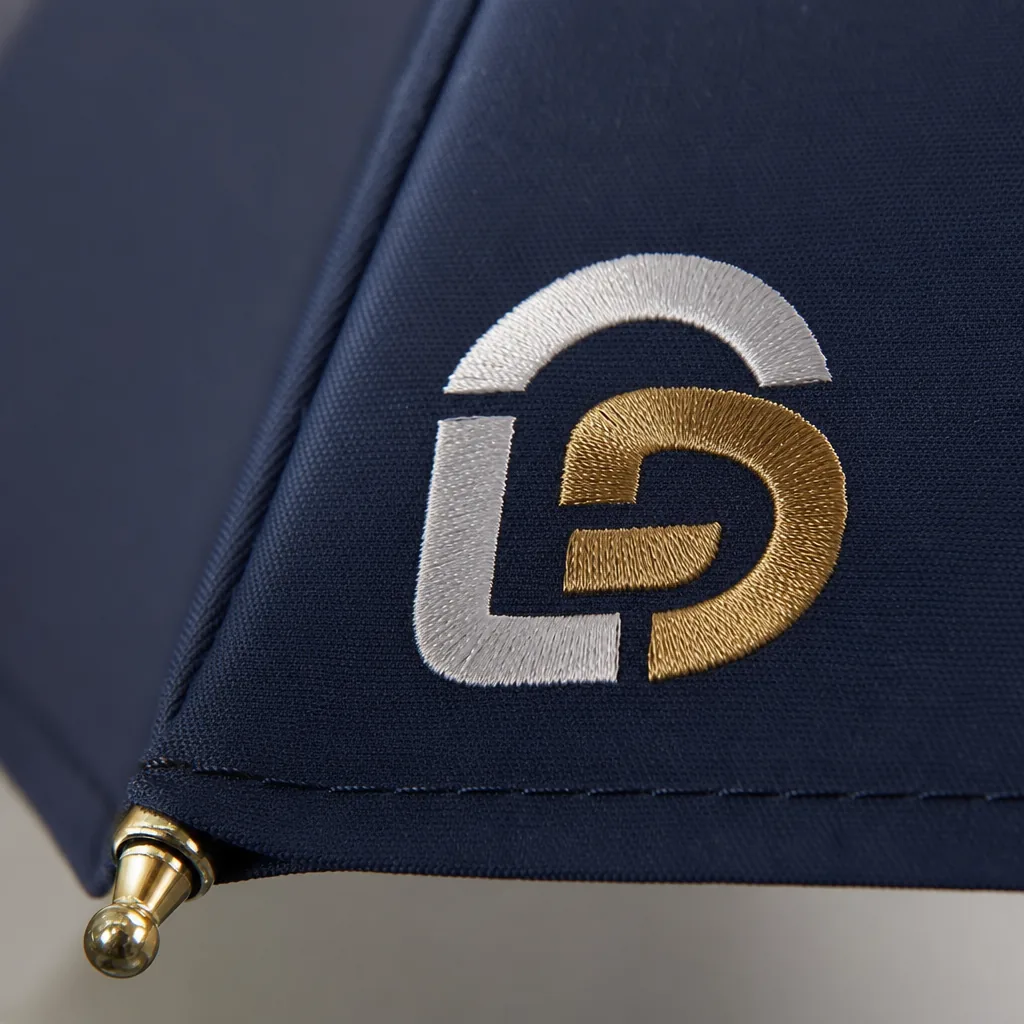
A woven strap logo umbrella looks more retail-grade than printed webbing, but the logo must be redrawn for yarn, not ink. Woven labels resist abrasion because the color runs through the thread, so repeated contact with hook-and-loop tape causes less logo loss than surface printing. Avoid thin serif type, QR codes, fine outlines, and tight gradients; they rarely reproduce cleanly at standard label density. The label can be sewn onto a polyester strap or built as the outer face of a custom umbrella closure strap. This method suits 210T pongee retail umbrellas, double-canopy vented golf umbrellas, and gift programs where branded umbrella details matter more than the lowest FOB cost. QC should not stop at visual approval: inspect bartack or box-stitch strength at the strap attachment point using AQL 2.5, pull testing, and repeated wrap testing.
Debossed PU patches, rubber badges, and branded hook-and-loop tabs create a more premium closure, but they add thickness, sewing time, and additional failure points. Debossed PU works best on black, navy, or beige pongee for a subtle tone-on-tone finish; low-grade PU can crack at the edges when wrapped tightly in cold weather. Rubber badges suit golf, outdoor, and team merchandise umbrellas because raised logos stay readable after rain exposure, but mold cost often raises MOQ compared with printed or woven options. A hook and loop umbrella strap can carry branding on the woven loop face, a printed pull tab, or a molded rubber end stitched over the tape. On 190T pongee budget umbrellas, avoid heavy rubber unless the strap is widened. On 210T pongee with fiberglass 8K or 10K frames, the added weight is usually acceptable.
Construction Choices That Affect Durability and Appearance
Specify strap width by frame size before approving artwork. For straight umbrellas, 18–22 mm tape suits most 23" and 27" frames; move to 25 mm on 30"+ golf umbrellas, especially with 190T/210T pongee canopies and water-repellent coatings that roll thicker when wet. Tape that is too narrow may look cleaner on a counter sample, but it twists during wrapping, cuts into damp fabric, and leaves pressure marks after repeated storage. For 3-fold umbrellas, keep the strap at 12–15 mm so the folded canopy still slides into the sleeve without a raised lump. For durable umbrella strap branding, use heat-sealed cutting plus folded-edge construction where the design allows; raw polyester tape finished only by hot knife can feather after 300–500 open-close cycles. Keep the logo field away from bartacks, hook-and-loop patches, snaps, and magnetic hardware so the branding stays flat and readable after sewing.
Build the stitch spec around commuting abuse, not showroom handling. Anchor the strap with a dense bartack or box stitch, typically 28–42 stitches depending on tape thickness; a single straight seam is cheaper but fails first when users wrap the canopy under tension. Auto-open and auto-open/auto-close umbrellas create extra load because commuters often close the canopy before the ribs and runner fully settle. Placement needs the same control: too near a rib tip, the strap pulls diagonally and puckers the panel; too far from the fold line, the roll loosens and jams in the sleeve. On a woven strap logo umbrella, leave enough stitch margin so the needle does not cut through the woven logo threads. At ZheBrella, strap pull strength and closure alignment are checked under AQL 2.5 because a crooked tab is visible even when canopy printing passes.
Match the closure to the buyer’s risk tolerance. A hook and loop umbrella strap is the most forgiving choice for promotional and daily commuter umbrellas because it closes even when the canopy is wrapped unevenly, but low-grade hook tape collects lint and loses grip in bags. Snap buttons give straight umbrellas a cleaner profile and stable service life, yet placement tolerance is tighter; an 8–10 mm shift in canopy roll can make the snap feel too tight or too loose. Magnetic closures can support a premium look, but they require corrosion-resistant parts and packing checks for export humidity. Straight umbrellas usually place the strap at mid-panel around the canopy, while 3-fold models must clear frame joints, sleeve bulk, and the auto-open/auto-close runner path. Treat these branded umbrella details as construction specs, not trim, because wet fabric, rushed wrapping, and thousands of cycles expose weak edges, loose stitches, and poor alignment quickly.
Testing, Inspection, and Brand Approval Criteria
Approve umbrella strap branding from a physical pre-production sample before bulk cutting, not from a PDF. The sign-off sheet must list logo width and height in millimeters, finished strap length, strap width, closure position, thread color, fabric shade, and decoration method: woven label, rubber patch, heat transfer, or direct embroidery. Use 1:1 artwork because a 2 mm logo shift is visible on a tightly wrapped 23" folding umbrella. For a custom umbrella closure strap, control finished length to ±3 mm on compact umbrellas and ±5 mm on 27" or 30" golf umbrellas; strap width should hold ±1 mm. Confirm edge clearance so the logo does not enter the stitching seam, sit under the hook-and-loop contact area, or distort when the canopy is wrapped tightly.
Test closure function on a wet umbrella, not on a dry loose canopy. Wet the 190T or 210T pongee canopy, shake it once, wrap by hand, and pack it into the sleeve; added water volume exposes weak hold strength and poor strap length. For a hook and loop umbrella strap, run at least 20 wrap-and-release cycles on pre-production samples and record whether the strap closes cleanly without pulling the stitch line out of shape. On a woven strap logo umbrella, check that yarns do not snag on the hook side and that loop tape corners do not lift. Stitching must be straight, with no skipped stitches, loose back-tacking, needle cuts, or strap twist at the canopy seam. Use bar-tack reinforcement on larger 27" and 30" umbrellas.
Treat branded umbrella details as functional AQL 2.5 checkpoints, not decoration. Inspectors should measure strap length and width with a ruler, compare logo position to the approved golden sample, test hook-and-loop engagement, check color consistency under D65 light, and confirm clean alignment when wrapped clockwise and counterclockwise. Classify missing logos, wrong strap color, detached hook-and-loop tape, and unusable closure length as major defects because the strap is handled every time the user stores the umbrella. Add carton-packing checks: straps can crease, crush, or deform if umbrellas are packed too tightly or before the canopy is fully dry. Final approval should include wet-use photos, packed-sleeve photos, and one retained golden sample for production control and reorders.
MOQ and Cost Tradeoffs for Strap Customization Programs
MOQ is the first real filter for umbrella strap branding. The lowest-risk option is a standard closure strap made from the same 190T or 210T pongee as the canopy, with a one-color screen print or heat-transfer logo. Because the strap width, hook-and-loop fastening, cutting, and sewing stay within standard production, MOQ usually tracks the umbrella body MOQ at about 300–500 pieces per colorway. The cost impact is usually measured in cents per unit, not dollars, and setup is limited to artwork separation, print position approval, and a pre-production sample. On mainstream programs such as 23-inch auto-open 8K umbrellas or 27-inch double-canopy golf styles, this level of customization typically adds only 2–4 days to lead time if canopy fabric and frames are already reserved. For promotional buying, that matters more than decoration complexity: you protect delivery dates while improving visible branding on a part the user handles every day.
Cost and risk increase once the strap stops being a standard sewn component and becomes a separate trim program. A woven strap logo umbrella, jacquard tape, molded rubber badge, injected PVC puller, debossed faux-leather tab, or a custom umbrella closure strap with non-standard width or hardware usually requires its own MOQ, often pushing practical volume to 1,000–3,000 pieces per design even when the umbrella order is spread across several SKUs. Woven trims need loom setup and yarn color approval; molded PVC or TPU parts add tooling charges from a few hundred dollars upward plus about 7–12 days for mold sampling before bulk sewing. These add-ons also create failure points that standard print does not: thick badges can interfere with a clean roll on a 21-inch folding umbrella, and poor adhesion or weak stitching will show up in daily use long before canopy wear does. Inspect stitch strength, peel adhesion, and wrap alignment to AQL 2.5. For 500-piece DDP promotional orders, keep branded umbrella details simple and proven. For premium retail collections shipping FOB, deeper strap customization makes sense when costs can be spread across roughly 3,000–10,000 units, repeat orders, or seasonal replenishment.
Frequently Asked Questions
Is a woven logo strap better than a printed strap for premium umbrellas?
Usually yes for a retail or private-label look, because woven branding resists abrasion and reads as more elevated. Printed straps are often more economical for large promotional runs and simpler one- or two-color marks.
Will strap branding hold up on umbrellas used in rain every day?
It can if the construction is specified correctly. Buyers should review strap material, stitching, closure strength, and logo method, then confirm performance with wet-use testing and pre-production samples before bulk approval.
What is the usual MOQ for custom umbrella closure straps?
For printed strap logos, MOQs often start around 500 to 1,000 pieces depending on the umbrella model. Woven straps or custom-molded hardware may require 1,000 to 3,000 pieces because of setup and material preparation.
Which strap branding method lasts longer for daily-use umbrellas?
Woven labels or jacquard woven straps usually resist rubbing better than basic screen printing. For retail or corporate umbrellas used frequently, buyers often choose woven logos or high-density heat transfer with reinforced stitching.
What approval points should buyers check before mass production?
Confirm strap length, logo direction when the umbrella is closed, hook-and-loop grip strength, stitch density, and color matching to the canopy or handle. A pre-production sample is recommended, with typical approval time of 5 to 7 days after artwork confirmation.
Looking to Launch Your Custom Umbrella Line?
ZheBrella is a Zhejiang-based OEM/ODM umbrella manufacturer with 17 years of export experience. Free design, low MOQ from 100 pieces, windproof construction, full-color print.
Get Free Quote Now »People Also Search For
Related Articles
Umbrella Strap Printing for Stronger Brand Recall
Learn how printed closure straps add repeat logo exposure, what artwork works best, and how MOQ, lead time, and QC affec...
Read More »Branded Umbrella Strap Closures With Printed or Woven Logos
Compare printed, woven, and molded branding options for umbrella strap closures, with MOQ, artwork limits, and factory l...
Read More »
Umbrella Strap and Closure Branding for Repeat Exposure
Plan strap and closure branding that stays readable in daily use, with clear guidance on print methods, material choices...
Read More »