Umbrella Strap Printing for Stronger Brand Recall
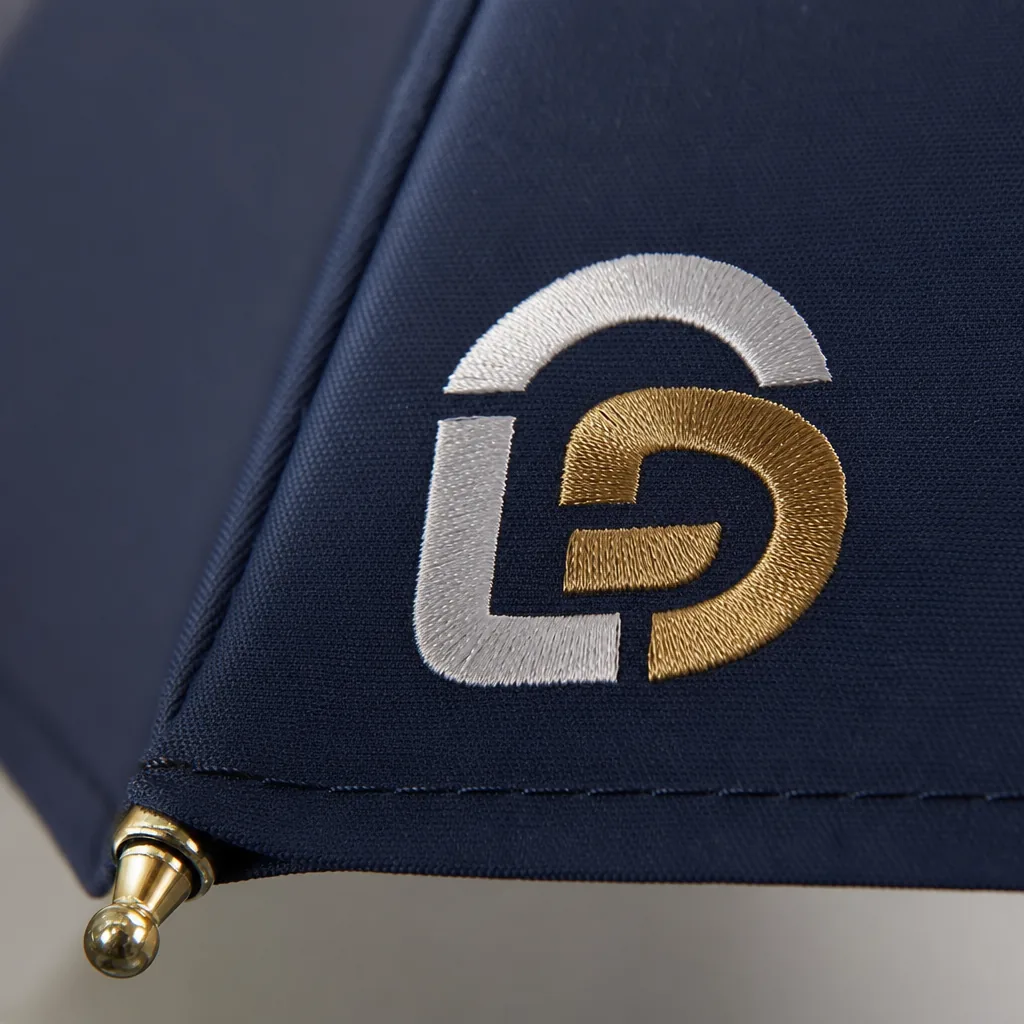
When buyers focus only on canopy panels, they miss one of the highest-repeat touchpoints on a custom umbrella: the closure strap that gets handled every time the product is opened and packed away. On our Songxia production lines, strap logo results depend on more than artwork alone—webbing width, ink adhesion, fold position, MOQ, and inspection method all decide whether umbrella strap printing actually improves brand recall or creates avoidable quality claims.
Why the Closure Strap Matters in Daily Brand Exposure
The closure strap keeps the logo visible after the umbrella is folded, which is why umbrella strap printing often delivers more repeat exposure than buyers expect. On 21 inch and 23 inch commuter umbrellas, the rolled canopy places the strap on the outside of the bundle at hand level, so the mark stays visible on trains, in office elevators, hotel lobbies, and retail entrances. Users typically open and refasten the strap several times in a day, which gives branded closure straps two advantages canopy graphics do not have when the umbrella is closed: repeated visual impressions and direct hand contact. For commuting programs, hospitality use, and promotional distribution, the logo is still working when the umbrella is carried, stored in a stand, or placed on a reception counter—not only when it is open in the rain.
Canopy decoration still matters, especially on 190T or 210T pongee with screen printing or heat transfer, but it only performs during active use. Once the umbrella is closed, even a large single-panel canopy logo disappears into the roll, while a hook and loop logo strap stays outward-facing and readable at normal standing distance. The print area is smaller, but it is usually enough for a wordmark, web address, or room number, which is why strap branding can outperform canopy-only decoration in hotel fleets and event giveaways. Staff can identify ownership without opening the umbrella, and guests keep seeing the mark in storage racks, lobby stands, and entryway bins. A capable OEM umbrella factory should treat strap artwork as a separate branding decision, because some of the most effective umbrella branding details appear on the closed product, where daily exposure is highest.
Printing Methods and Material Limits for Strap Branding
In umbrella strap printing, the strap substrate decides the print method before the artwork does. Folded pongee tabs, nylon webbing, polyester grosgrain, and hook-and-loop assemblies all behave differently even on the same umbrella. Screen printing is usually the lowest-cost option for flat woven polyester when the logo is 1-2 solid colors and the print area stays around 60-90 mm, which suits simple branded closure straps. Heat transfer is better for fine lines, small text, and tighter registration, but narrow straps need controlled heat and pressure; otherwise the folded edge can glaze, curl, or distort after sewing. On a hook and loop logo strap, print should stay on the soft loop-facing outer tab. The hook side abrades the image quickly during repeated opening, so direct printing there adds avoidable failure risk on daily-use compact umbrellas.
For premium programs or artwork with small lettering, woven and sewn options are usually more durable than direct ink. A damask woven label holds finer detail than basic screen print on textured webbing, while a satin label gives a smoother surface and more reflective finish. For POE, PVC, or EVA clear umbrellas, many buyers choose a sewn label instead of direct strap printing because plasticizer contact, surface tack, and long-term migration can reduce print stability. Canopy fabric still matters even though the strap is a separate part: a 210T pongee canopy has a denser, smoother face than 190T pongee, so the wrong strap fabric can read dull or off-shade under retail lighting, especially in navy, red, and black. A capable OEM umbrella factory should review the strap fabric, canopy swatch, and handle branding together before approval so umbrella branding details stay consistent after bartacking and 500-1,000 open-close cycles.
Artwork Rules for Small Logos and Readable Copy
Umbrella strap printing is constrained by the stitched strap size, not by the print method. On a standard compact umbrella, the closure strap is typically 18-20 mm wide, but edge stitching and foldover usually cut the safe print height to 12-14 mm. On a golf umbrella, a 25 mm strap generally leaves 18-20 mm of usable height. Build artwork to that live area, not to the raw tape width. As a working rule, keep uppercase text at 3.0 mm minimum; use 2.5 mm mixed-case only in a simple, open font with generous spacing. Minimum positive line weight should stay at 0.3 mm for screen printing and 0.25 mm for heat transfer, while reversed-out strokes need about 0.4 mm because fabric texture and ink gain can close small counters on pongee or polyester strap tape. For branded closure straps, that usually means one short word or symbol, heavier strokes, and high contrast rather than a detailed tagline that turns inconsistent across bulk production.
Bold marks outperform complex copy because the strap is narrow, wraps around the folded canopy, and is partly covered by hook and loop in actual use. A clean icon, monogram, or 4-8 character brand name stays legible far better than a slogan with thin serifs, tight tracking, or multiple words. If a hook and loop logo strap needs both symbol and text, place the logo at one end, keep the wordmark on one line, hold at least 1.5 mm clearance from the stitch line, and keep 3 mm clear of the rounded tip. Practical width limits matter in umbrella strap printing: a compact strap usually supports a clean 35-55 mm logo width, while a golf strap can carry about 50-70 mm before artwork runs into the fold or hook-and-loop zone. A reliable OEM umbrella factory should size art to the exact sewn strap, require vector files, convert text to outlines, and approve against a sewn sample before mass production. That step helps control repeat defects that can trigger AQL 2.5 failures across small umbrella branding details.
MOQ, Sampling, and Production Timelines
MOQ changes fast when umbrella strap printing moves from stock trim to a custom component. If you print on a standard black polyester closure strap, most OEM umbrella factory programs can stay close to the base umbrella MOQ, usually 500 to 1,000 pieces per color for 21-inch or 23-inch promotional umbrellas. The economics change when the strap needs its own trim setup: custom woven strap tape, dyed-to-match webbing, a hook and loop logo strap, sewn-in woven labels, or special edge binding. Those items are sourced through separate trim suppliers, so they carry their own setup quantities, color approvals, and defect exposure. In practical buying terms, 2,000 to 3,000 pieces is a common threshold once branded closure straps require dedicated trim production, especially on narrow 15 to 20 mm straps where logo registration must stay clean. That is the real purchasing divide: stock strap printing behaves like a normal umbrella order, while custom trim should be quoted as a separate cost line with its own MOQ, sampling cycle, and delivery risk.
Sampling time depends on how many parts change beyond the canopy. A standard umbrella sample with only canopy artwork is often ready in 5 to 7 days; adding strap artwork, label sewing, or special trim usually pushes sampling to 7 to 12 days. If the strap needs a new print screen, heat-transfer film, or woven-label loom card, add several more days because those components are normally made outside the main canopy and frame line. After sample approval and deposit, bulk lead time is typically 25 to 35 days for standard orders and 35 to 45 days when custom strap material or hook and loop tape is outsourced. Pre-production sample approval is the key risk-control step for umbrella branding details: it checks print sharpness, stitch placement, strap length, closure tension, and logo legibility after the umbrella is rolled and secured. Approving that sample before mass production materially reduces mismatch risk under a single PO, particularly where strap graphics look accurate on flat artwork but shift once wrapped around the folded canopy.
QC Checks Before Shipment
QC for umbrella strap printing should start with the component that fails first in daily use: the closure strap. Lock the inspection method to the decoration process and define pass criteria before bulk production, not after cartons are packed. For screen print, require a cross-hatch tape adhesion test on the approved production material. For heat transfer, check edge lift after flexing and confirm the print still sits flat after heat exposure. For sublimation on polyester webbing or 190T or 210T pongee strap fabric, inspect color migration, shade stability, and any drift from the signed Pantone standard. On a hook and loop logo strap, inspect the hook and pile areas for ink bleed or transfer contamination, because either will reduce closure grip after repeated opening and closing. A capable OEM umbrella factory should also reject cracked prints after flex testing, logo offset beyond the approved tolerance, and visible shade variation that a buyer can spot at arm’s length. Those checks matter because branded closure straps are bent, pulled, and re-fastened thousands of times over the life of the umbrella.
Construction checks need the same discipline. Inspect stitch density, back-tack security, and box-stitch placement where the strap joins the canopy panel or runner area, because that joint carries concentrated load every time the umbrella is wrapped. On 21 inch and 23 inch auto-open-close folding umbrellas, even 3 to 5 mm of strap misalignment is easy to see when the umbrella is packed; the hook-and-loop faces can miss each other, wrinkle, or close crooked. Sample units should be opened and closed repeatedly to confirm hook-and-loop alignment, strap length against the specified 8K or 10K frame, die-cut edge cleanliness, and thread trimming. For shipment release, use a defined visual inspection standard such as AQL 2.5 rather than a quick top-carton check. Inspectors should review logo centering, stains, skipped stitches, loose threads, hook-and-loop contamination, and any mismatch between the strap artwork and canopy artwork. When buyers compare umbrella branding details across suppliers, they should also compare shipment terms: FOB can look cheaper on the quote, while DDP gives a more accurate landed-cost figure for branded programs.
Frequently Asked Questions
Does strap printing require the same MOQ as canopy printing?
Not always. If the strap uses standard material with a basic print, MOQ may stay close to the umbrella MOQ, but custom strap construction or sewn branding elements usually push the minimum higher.
Can strap branding match a windproof premium umbrella program?
Yes. Strap branding can be added to higher-spec umbrellas with fiberglass ribs, double-canopy windproof construction, and auto-open mechanisms, as long as the strap width and artwork are planned early.
What logo size usually fits on an umbrella closure strap without losing readability?
Most closure straps print best with a logo width of about 1.6 to 2.4 inches, depending on strap shape and fold position. For small straps, factories often recommend bold marks, initials, or a simplified one-color logo rather than fine text under 5 pt.
Does strap printing use the same artwork file as canopy printing?
Usually the base logo file can be reused, but the strap version often needs a separate layout with thicker lines and fewer details because the printable area is much smaller. Many OEM suppliers will ask for vector AI or PDF files and provide a strap-specific proof before sampling.
How do factories check print consistency on branded closure straps during production?
QC typically compares strap prints against the approved PMS reference and placement sample, then checks alignment, edge cleanliness, and hook-and-loop function during inline inspection. For bulk orders, it is common to inspect a pre-production sample first and then spot-check cartons during final packing.
Looking to Launch Your Custom Umbrella Line?
ZheBrella is a Zhejiang-based OEM/ODM umbrella manufacturer with 17 years of export experience. Free design, low MOQ from 100 pieces, windproof construction, full-color print.
Get Free Quote Now »People Also Search For
Related Articles

Umbrella Strap and Closure Branding for Stronger Daily Use
Turn closure straps into repeat brand exposure with the right print, weave, and construction. Compare options, durabilit...
Read More »
Debossed Branding on Umbrella Straps and Closures
Use straps and closures to add subtle branding, protect the canopy design, and keep retail umbrellas consistent across r...
Read More »
Umbrella Strap and Closure Branding for Repeat Exposure
Plan strap and closure branding that stays readable in daily use, with clear guidance on print methods, material choices...
Read More »