8K vs 16K Folding Umbrellas: What Buyers Should Specify
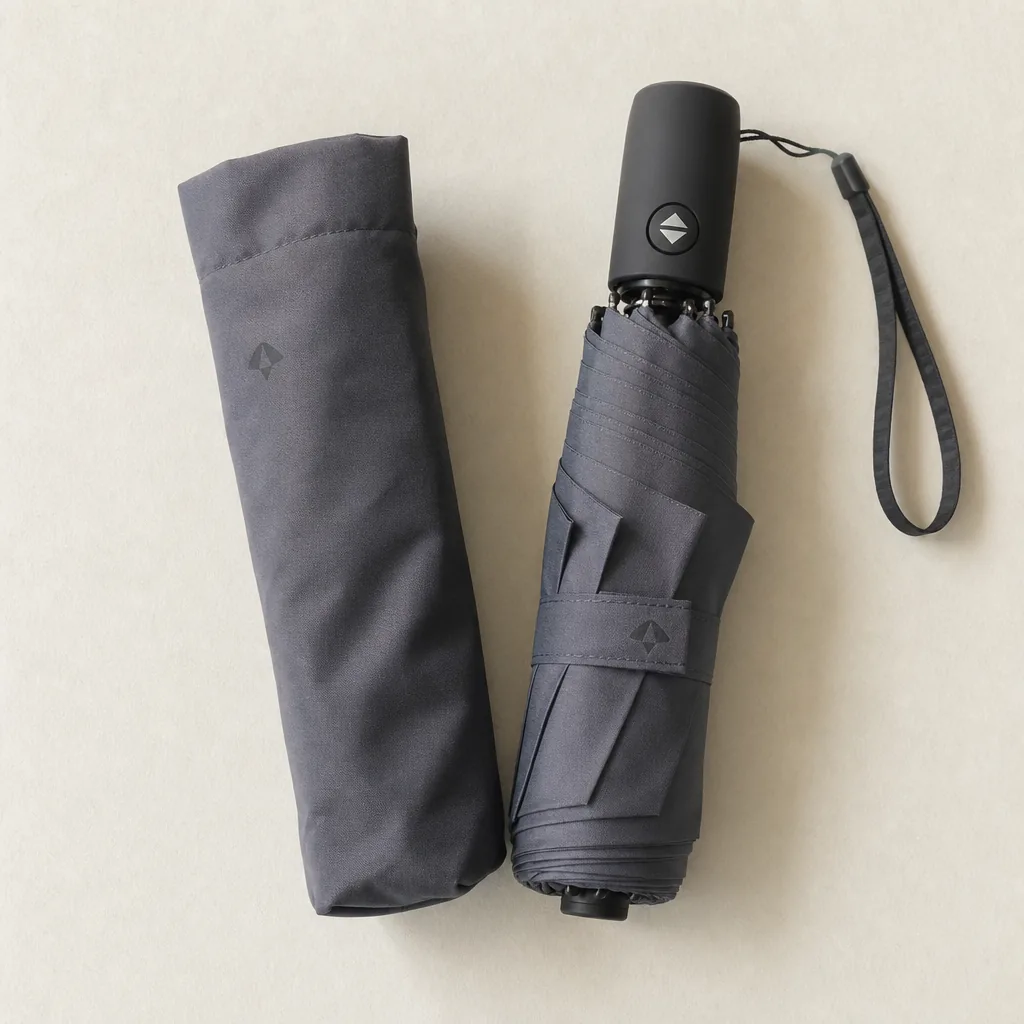
When a buyer asks for an 8K folding umbrella, the real question is not only rib count but whether the frame, canopy size, shaft, and target price match the use case. On the factory floor, we see 16K frames add visible stability, but they also change folded diameter, weight, assembly time, and cost. The safest specification starts with wind expectation, retail pack size, and acceptable hand feel before confirming the frame structure.
What 8K and 16K actually change
Rib count changes canopy geometry before it changes strength. An 8K folding umbrella has eight main rib bays, so each canopy panel is wider and the arc between ribs is more visible. A 16K umbrella build divides the same canopy circle into sixteen narrower panels, producing a rounder dome and a cleaner perimeter when opened. Buyers also feel the difference during deployment: sixteen attachment points spread canopy tension more evenly, so the open action can feel denser and more controlled. The tradeoff is complexity. In a telescopic folding frame, sixteen ribs mean more stretchers, stitch lines, tips, and alignment points, so poor assembly shows up faster as uneven panel pull, edge waviness, or a sticky runner. For a folding umbrella specification, rib count mainly affects shape, opening feel, finished weight, and perceived quality; it does not guarantee stronger rain or wind performance by itself.
Rib count helps umbrella canopy stability only when the frame and fabric stack can support it. On 21 inch and 23 inch folding umbrellas, sixteen ribs can reduce scalloping between panels and keep a smoother canopy surface, especially with lighter materials such as 190T pongee or thin POE. But the stronger buy is often a well-made 8K folding umbrella with fiberglass end ribs, a decent steel shaft, clean notch riveting, balanced canopy tension, and a runner that moves without play. A weak 16-rib frame built with soft wire, thin stretchers, loose tips, or inconsistent sewing simply adds more joints that can loosen or invert under gust load. For promotional umbrella sourcing, buyers should compare rib count together with open diameter, finished weight, manual versus auto-open or auto-open-close mechanism, rib composition such as steel plus fiberglass versus all steel, and canopy fabric such as 190T or 210T pongee. Sample review should include opening cycle feel, top-notch alignment, and AQL 2.5 inspection consistency. Expect umbrella lead times to run a few days longer on 16-rib orders at the same MOQ because sewing and frame assembly require tighter tolerance control.
Performance differences in daily use
Daily performance depends less on rib count as a headline claim and more on how the canopy behaves after repeated opening. An 8K folding umbrella uses eight primary ribs, so each 190T pongee panel spans a wider distance; when the canopy is tensioned for compact folding, deeper scallops often appear between rib tips. A 16K umbrella build divides the same 21 inch or 23 inch canopy into sixteen narrower panels, creating a rounder dome, smoother print surface, and cleaner perimeter in light wind. In roughly 15 to 20 mph gusts, the extra rib points can improve umbrella canopy stability by distributing pressure more evenly, but rib count is not a windproof rating. Failure risk still comes from the frame package: fiberglass middle ribs, a stable steel shaft, clean runner engagement, tight joints, and, where specified, a double-canopy vent will beat a low-cost 16K frame made with thin wire ribs and loose fittings.
Packability is the main cost of moving from 8 ribs to 16 ribs. On 21 inch and 23 inch folding frames, the added ribs usually increase weight by 40 to 90 grams, depending on whether the factory uses aluminum, steel, or fiberglass-reinforced parts. Folded diameter also grows because sixteen rib channels stack under the canopy instead of eight, so a 16K model often closes into a thicker barrel under the strap. For commuters, travel retail, hotel amenities, bank giveaways, university merchandise, and high-volume promotional umbrella sourcing, an 8K frame is easier to carry and easier to repeat under tight MOQ, FOB, and umbrella lead times. For department-store accessories, cosmetics gift-with-purchase sets, wedding favors, and branded commuter products, a 16K build can justify the extra bulk because 210T pongee over sixteen panels gives a smoother retail look. The folding umbrella specification should balance rib count with fabric, auto-open-close hardware, UV coating, target weight, and folded diameter before sample approval.
Frame, shaft, and hinge implications
Rib count changes the load path, so the shaft, runner, and hinge package should be specified with the frame, not copied across models. For a 21" or 23" 3-fold 8K folding umbrella, a black electroplated steel main shaft with fiberglass middle and end ribs is usually a balanced choice: the wider panel spacing gives each rib room to flex without forcing load into adjacent ribs. A 16K umbrella build needs a thicker-wall aluminum shaft or a steel-aluminum composite shaft, plus a runner with tighter tolerances, because the extra ribs increase stack height, friction, and torsion during open-close cycles. If a supplier keeps the same budget 8K shaft gauge and simply adds ribs, the sample can look premium on a table but feel loose after 1,500 to 3,000 cycles.
Hinge design drives failure rates more than rib count alone. An 8-rib folding frame can tolerate simpler stamped joints with about 0.1 to 0.2 mm side play and still survive normal promotional umbrella sourcing. A 16-rib frame needs cleaner knuckle alignment, controlled rivet setting, and lower side play because small errors repeat around the canopy and distort umbrella canopy stability. Poor joint precision shows up as uneven crown tension, runner snagging, and early cracking or loosening at the second fold hinge. For wind-resistant 16K frames, specify fiberglass top ribs, steel stretchers, and reinforced zinc-alloy or thickened steel joints. For economy programs where cost matters more than weight or premium hand feel, all-steel 8K frames remain a practical folding umbrella specification.
Write lock strength into the folding umbrella specification, because many field returns start with partial lock failure rather than a visibly broken rib. On manual and auto-open frames, the upper notch spring, runner latch, and shaft groove depth must match the rib package. A 16K frame creates more opening resistance; weak notch teeth or shallow grooves can cause bounce-back before the canopy seats under load. Auto-open-close models add misfire risk when hinge friction is high or runner machining varies. Require consistent rivet upset diameter, burr-free hinge ears, controlled opening force across pre-production samples, cycle testing, and AQL 2.5 checks on metalwork. On 190T pongee, even small panel skew is visible, so joint precision affects both durability and appearance. Mature 8K tooling often supports umbrella lead times of 25 to 35 days FOB; custom 16K shafts and hinges more often need 35 to 50 days after sample approval.
Canopy fabric, print area, and finish details
Specify canopy fabric by frame size, closed length, target price tier, and print method. 190T pongee is the cost-efficient baseline for most 21 inch and 23 inch promotional programs because it folds tighter, keeps piece weight lower, and suits volume runs of an 8K folding umbrella. 210T pongee has a denser hand and slightly higher weight, but it improves drape, reduces show-through under bright retail or event lighting, and gives solid dyed panels cleaner color depth. It also holds needle holes better through repeated open-close cycles, which helps reduce seam grin at panel joins. For a compact 3-fold umbrella where packability and low FOB cost matter most, 190T is usually the practical choice. For a premium retail feel, cleaner rain shedding, and better umbrella canopy stability, 210T is the stronger folding umbrella specification.
Panel count changes the printable area as much as it changes the frame. An 8K canopy gives eight wider wedges, so large logos, bold type, and step-and-repeat artwork fit with less seam interference. A 16K umbrella build divides the canopy into sixteen narrow panels; the open profile can look rounder and the closed umbrella more refined, but each panel offers less uninterrupted print width. That affects screen-print setup, heat-transfer registration, and artwork scaling. Small repeats and all-over patterns usually suit 16K; oversized marks may need to shrink, rotate, or bridge seams with tighter registration control. For promotional umbrella sourcing, approve artwork on the actual panel dieline, not a flat circular mockup. Seam allowance, tip curvature, and the crown cap area reduce usable print space, so confirm panel geometry against the exact frame size and rib count before sampling.
Finish choices affect color approval, sewing risk, QC, and umbrella lead times. Matte fabric can come from lower-sheen pongee or post-treatment, but dark Pantone shades often read flatter; match lab dips under daylight and office light before bulk approval. Water-repellent treatment should bead evenly in spray testing, while heavier coatings can stiffen the canopy and make a 3-fold umbrella harder to fold and strap neatly. UV-treated fabric rated UPF 50+ fits sun umbrellas and golf-style programs, but on compact folding styles it adds cost and can extend production by 3 to 7 days when the mill treats fabric after dyeing. As coating weight increases, seam quality becomes the risk point: check even stitch density, balanced thread tension, no skipped stitches at tip pockets, and no coating cracks along sewn edges. Inspect canopy sewing to AQL 2.5, with special attention to color-lot consistency between panels.
Procurement checklist for RFQ and sampling
Price the frame only after the RFQ fixes the measurable folding umbrella specification. State arc size, open diameter, folded length, rib count, shaft and rib material, and opening mechanism: for example, a 21 in x 8 rib 8K folding umbrella with a 95-98 cm open diameter, or a 23 in x 8 rib frame at about 102-105 cm. For 3-fold models, folded length usually falls between 24-32 cm; pushing below that range can reduce handle grip, spring strength, rib thickness, or finished weight. If quoting a 16K umbrella build, require written confirmation that it uses a true 16-rib frame, not an 8-rib frame with scalloped cosmetic paneling. Those constructions differ in material cost, assembly time, carton weight, and umbrella canopy stability. Specify manual, auto-open, or auto-open-close action because the runner, spring, and nested shaft are common failure points during inspection.
Put handle, fabric, MOQ, and packing data in the first RFQ, not after sampling. Define the handle as straight plastic, rubberized ABS, wood-look, or hook style, then confirm wrist strap, sleeve type, Velcro tie or snap closure, and whether each unit packs in an OPP bag, self-fabric sleeve, retail box, or individual inner box. Tie MOQ to color and decoration: stock-color 190T pongee with 1-color screen print may start around 500-1,000 pieces, while custom-dyed 210T pongee or matched handle colors often require 1,200-3,000 pieces. For promotional umbrella sourcing, carton data changes the landed cost, so request pieces per carton, carton dimensions, gross weight, and packing method before comparing freight. Quote FOB Ningbo first; move to DDP only after carton utilization is fixed, or the freight number will not be comparable.
Approve one pre-production sample against function, print, and assembly, not appearance alone. Check fabric spec, panel alignment, logo size and position, handle finish, top cap, stitching density, closure, exact opening action, and measured weight tolerance. For auto-open-close frames, request video of 20-30 consecutive cycles; for any 16-rib frame, inspect seam balance because poor panel cutting creates twist, uneven hem tension, and wrinkles near the ferrules. Put inspection terms in the PO: AQL 2.5 for major defects, with checks for open-close function, fabric flaws, print registration, needle holes, shaft scratches, and carton drop resistance. If the supplier claims windproof performance, define the construction basis, such as double-canopy venting, fiberglass middle ribs, or internal testing at 45-50+ mph. Standard umbrella lead times run 25-35 days after sample approval and deposit; custom-molded handles, Pantone-dyed fabric, or complex packaging can extend production to 35-50 days, with sampling adding 5-10 days for stock materials or 12-18 days for custom print plates and heat-transfer proofs.
Frequently Asked Questions
Is 16K always stronger than 8K?
Not by itself. A 16K umbrella can feel more stable, but the result depends on rib material, joint design, canopy tension, and overall workmanship. Buyers should request samples and wind testing, not just rib count.
Which is easier to source for promotional programs?
8K is usually easier to price competitively and works well for broad promo distribution. 16K is better when the buyer wants a more premium feel or improved canopy shape, even if the unit cost is higher.
Does a 16K folding umbrella always perform better than an 8K model?
Not always. A 16K frame usually gives better canopy support and a rounder appearance, but performance also depends on shaft material, rib thickness, joints, runner quality, and fabric tension. For price-sensitive promotional orders, a well-built 8K umbrella can be the better specification.
What specifications should buyers confirm before ordering 8K or 16K folding umbrellas?
Confirm rib count, open diameter, folded length, frame material, fabric weight, coating, handle type, logo method, packaging, test requirements, and spare parts policy. Buyers should also request pre-production samples before mass production, especially when changing from 8K to 16K construction.
How does rib count affect cost and lead time for custom folding umbrellas?
A 16K folding umbrella normally costs more because it uses more ribs, joints, sewing labor, and quality control time. Standard OEM folding umbrella lead time is often around 30-45 days after sample approval, but custom frames, special fabrics, or large retail packaging programs can extend the schedule.
Looking to Launch Your Custom Umbrella Line?
ZheBrella is a Zhejiang-based OEM/ODM umbrella manufacturer with 17 years of export experience. Free design, low MOQ from 100 pieces, windproof construction, full-color print.
Get Free Quote Now »People Also Search For
Related Articles
How to Specify a Stick Umbrella for Retail and Hotel Buyers
Learn how to spec stick umbrellas for retail and hotel programs, including ribs, canopy fabric, handle options, MOQ, QC,...
Read More »
How to Specify Umbrella Size for Retail and Promotional Buyers
Understand arc, rib length, and canopy diameter so you can specify the right umbrella size for retail, promo, travel, or...
Read More »Manual Open Compact Umbrellas for High-Volume Giveaway Orders
Learn when manual compact umbrellas beat auto-open models on cost, failure risk, packing, and MOQ for large promotional ...
Read More »