How to Specify Umbrella Size for Retail and Promotional Buyers
Choosing the wrong umbrella size leads to mismatched packaging, weak perceived value, and unhappy end users, especially when one program must serve retail shelves, promotional giveaways, or golf channels. The key is to translate the umbrella size specification into the measurements that matter on the factory floor—arc, rib length, and canopy diameter—so buyers can compare products accurately and avoid costly surprises in sampling and production.
Size terms buyers must not mix up
Arc, rib length, canopy diameter, and open span are not interchangeable, and mixing them up is how buyers end up approving the wrong sample. Rib length is the straight measurement from the center top to the tip of one rib; arc is the curved edge length of one panel side, which is always longer than rib length on the same frame; canopy diameter is the fully opened tip-to-tip width across the cover, usually measured straight through the center; open span is often used loosely to mean the same thing as diameter, but some suppliers use it for the widest usable coverage area. In a proper umbrella size specification, you should ask the supplier which term they are using, because the number on the sheet can change even when the physical frame does not.
For procurement teams, the safest canopy diameter guide is to treat rib length as the base number and confirm the finished open diameter in the same sentence. A 21-inch compact can look like a 38-inch open umbrella on one spec sheet and a 42-inch model on another, simply because one factory lists rib length while another lists arc or open span. That difference matters in retail packaging, freight planning, and fit claims. In OEM umbrella sourcing, I always tell buyers to require both rib length vs arc and the final open diameter, especially for styles with 6K, 8K, or 10K frames, because the rib count changes the shape but does not change the need for a consistent measurement standard.
Travel umbrella size is where confusion shows up fastest, because compact models are sold for portability, not maximum coverage. A 21-inch travel frame may fold to fit a bag, but once opened it still needs the same measurement logic as a full-size stick umbrella: rib length, arc, and canopy diameter should all be stated clearly, along with whether the number is manual-open or auto-open-close. The practical rule is simple: if two suppliers quote the same number but one uses rib length and the other uses arc, they are not quoting the same product. Buyers who read specs this way avoid overbuying oversized promos or approving a canopy that feels too small for retail customers.
Choosing size by end use
The right umbrella size specification starts with the use case, not the number printed on a spec sheet. For travel programs, a 21" to 23" compact frame is usually the sweet spot: it folds small enough for bags, but still gives usable coverage when the canopy is cut with decent depth. In a canopy diameter guide, that usually lands around 38" to 42" open diameter, depending on canopy shape and rib geometry. For commuter umbrellas, buyers usually move up to 23" or 25" builds with fiberglass ribs and automatic open, because people care more about shoulder coverage and wind stability than pure pocketability.
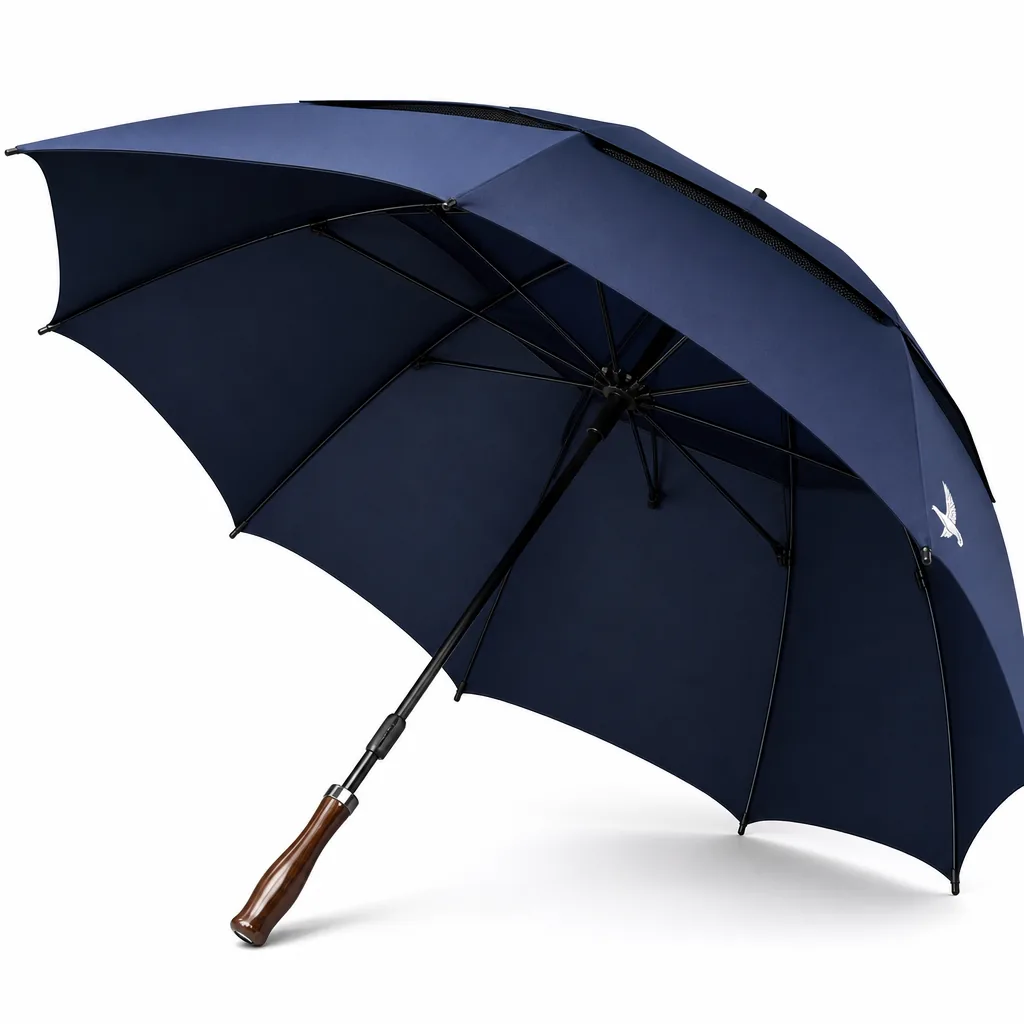
For golf and hospitality, undersizing is a mistake. A 27" or 30" shaft umbrella with an 8K or 10K frame gives better coverage for one person carrying luggage, or two people walking between buildings, and the extra rib length also improves panel tension in rain. In OEM umbrella sourcing, this is where rib length vs arc matters: a 23" rib length on a standard straight umbrella does not behave like a golf frame with a much wider arc, so buyers should confirm both measurements instead of assuming one number tells the whole story. Oversized vented double-canopy builds are also the right call for windy resorts and outdoor dining, especially when the spec calls for 50+ mph survival rather than just basic rain protection.
Event giveaway programs usually need the opposite approach: keep the umbrella size specification simple, low-cost, and easy to carry. A 21" auto-open mini with steel or mixed fiberglass-steel ribs works for mass distribution, but only if the imprint area is still large enough for the logo to read at arm’s length. If the brief is higher perceived value, a 23" standard automatic umbrella is the safer middle ground because it balances packed size, panel visibility, and failure rate under AQL 2.5 inspection. The practical rule is this: compact for portability, standard for daily commuting, oversized for hospitality and golf, and always confirm open diameter, rib count, and folded length before placing the order.
How size affects materials and weight
Umbrella size specification starts with the frame, not the canopy. Once you move from a compact 21-inch travel umbrella size to a 23-inch or 27-inch stick umbrella, the load on the shaft and stretcher set rises fast, so the factory usually steps up from thin steel to thicker steel or fiberglass shafts, and from 6K/8K builds to 8K/10K or even 16K rib layouts. A larger umbrella also needs a stronger runner, better spring tension, and a cleaner locking profile; otherwise the canopy looks fine on paper but pops, twists, or back-drives in real use. In OEM umbrella sourcing, that is where buyers get burned: the umbrella size specification is incomplete if it only lists canopy diameter and ignores the frame hardware that holds that span.
A proper canopy diameter guide should be read together with rib length vs arc, because a 55-inch arc and a 48-inch diameter do not behave the same in the hand or in the carton. Bigger panels mean more fabric, more stitching, and more reinforcement at the tips and crown, so the finished weight climbs even before you choose pongee 190T, pongee 210T, or a coated POE canopy. On the production floor, I see the same pattern every week: a larger canopy requires a more stable opening system, especially for auto-open and auto-open-close mechanisms, or the user feels too much resistance at the final click. That extra structure adds grams, which matters for promotional mailers, air freight, and retail set counts.
Shipping math changes with size faster than most buyers expect. A 21-inch travel umbrella may pack tightly and keep carton volume low, but a 30-inch golf umbrella usually forces a longer carton, more void space, and a much higher dimensional weight charge, even if the unit itself is not dramatically heavier. Larger shaft diameters, vented double-canopy construction, and fiberglass ribs also increase both piece weight and master carton size, so the freight quote often moves more than the product cost. For retail and promotional programs, the right umbrella size specification is the one that balances coverage, carry weight, and landed cost, not just the widest canopy possible.
What to confirm before placing an order
The first thing to lock down in any umbrella size specification is the measurement standard, because buyers and factories often talk past each other. Ask for the open diameter, closed length, rib count, shaft diameter, handle length, and canopy fabric on the same drawing, and make sure the open size is taken with the frame fully tensioned, not half-open on a workbench. For a real canopy diameter guide, I want the vendor to state whether the number is tip-to-tip across the open canopy or the rated arc; those are not the same, and rib length vs arc will change the marketed size by several inches.
For retail programs, the open diameter and closed length tell you whether the umbrella fits the shelf, gift box, or tote, but the rib count and shaft diameter tell you whether it will survive normal use. A 21-inch travel umbrella size may look compact on paper, yet if the shaft is too thin or the handle is too short, it becomes awkward in hand and unstable in wind. In OEM umbrella sourcing, I also ask for the canopy fabric callout up front—pongee 190T, 210T, POE, or PVC—because fabric weight affects stretch, panel shape, and the final measured diameter after tension.
Before approval, request a sample measured by the factory with the canopy fully opened and the runner locked, then compare that against the drawing with a tape, not just a photo. That is the only way to catch false claims on arc size, rib length, or handle dimensions before mass production starts. If the buyer wants a branded retail program, I would also document tolerance limits on each point, because a 1- to 2-cm deviation on closed length or handle length can break packaging, while a 3- to 5-cm error on open diameter changes the whole product position.
MOQ, lead time, and freight implications of size
Size affects logistics before it affects the customer. A 21-inch travel umbrella can fit dense carton layouts, but once you move to 23-inch, 27-inch, or 30-inch frames, the pack-out gets taller and wider fast. That changes carton count per master case, pallet height, and cube, so freight cost rises even if unit weight only changes a little. In a real umbrella size specification, buyers should compare the canopy diameter guide and the rib length vs arc numbers, because a 58-inch arc with fiberglass ribs behaves very differently in packing than a compact 42-inch travel umbrella size with a telescoping shaft. For OEM umbrella sourcing, I always look at finished fold length, not just open diameter, because that is what drives carton engineering and warehouse handling.
Smaller umbrellas are not automatically easier to source. A compact model may need a stronger auto-open-close mechanism, tighter runner tolerances, and more sewing control around the crown so the canopy does not wrinkle or jam in repeated folding. That adds labor and can push MOQ up if the factory has to dedicate hardware or panel-cutting setups. Larger umbrellas are simpler mechanically, but they consume more fabric, longer steel or fiberglass ribs, and more carton volume per piece, so the landed price can climb from freight alone. The right umbrella size specification should be tied to the end-use: retail shelves usually reward a clean 23-inch or 27-inch profile, while premium promotional orders often accept the higher freight of a 30-inch frame if print area matters.
When comparing quotes, buyers should separate factory price from landed cost. FOB tells you what leaves the port in China; DDP tells you what arrives at your door after ocean or air freight, duties, brokerage, and last-mile charges. That distinction matters more as size increases, because a bulky umbrella can look cheap on an FOB sheet and still lose on total spend once cube and destination fees are included. For retail programs, I recommend asking suppliers to quote at least two size options side by side with the same canopy material, rib construction, and print method, so the freight delta is visible before PO signoff. That is the only practical way to judge whether a larger model is worth the extra landed cost or whether a smaller travel format wins on margin.
Frequently Asked Questions
Why do factory quotes sometimes show different umbrella sizes for the same model?
Some quotes use arc length while others use canopy diameter or rib length. Buyers should ask for all three measurements to avoid comparing incompatible specs.
Does a larger umbrella always mean a better product?
No. Larger canopies improve coverage, but they can also add weight, increase wind load, and raise shipping cost. The right size depends on the channel, user profile, and target price point.
What umbrella size details should be included in an OEM purchase order?
List the arc, rib length, canopy diameter, number of ribs, folding type, and finished closed length. For example, a travel umbrella may be specified as 21-inch ribs, 8 ribs, 3-fold frame, with an approximate 38–42 inch arc depending on the canopy shape.
Why can two umbrellas with the same rib length have different canopy diameters?
Canopy diameter depends on panel shape, fabric tension, rib curvature, and whether the umbrella has a deep or shallow canopy profile. This is why buyers should request both rib length and finished canopy diameter before approving a sample.
What sizes are commonly used for retail, travel, and golf umbrella programs?
Travel umbrellas often use 19–23 inch ribs, standard stick umbrellas use about 23–25 inch ribs, and golf umbrellas commonly use 27–32 inch ribs. For bulk OEM orders, factories usually confirm the final size with a pre-production sample before mass production.
Looking to Launch Your Custom Umbrella Line?
ZheBrella is a Zhejiang-based OEM/ODM umbrella manufacturer with 17 years of export experience. Free design, low MOQ from 100 pieces, windproof construction, full-color print.
Get Free Quote Now »People Also Search For
Related Articles
Travel Umbrella Size Guide for Retail and Corporate Buyers
Compare travel umbrella sizes, folded length, canopy coverage, and sourcing tradeoffs so buyers can choose the right mod...
Read More »How to Specify a Stick Umbrella for Retail and Hotel Buyers
Learn how to spec stick umbrellas for retail and hotel programs, including ribs, canopy fabric, handle options, MOQ, QC,...
Read More »
8K vs 16K Folding Umbrellas: What Buyers Should Specify
Choose between 8K and 16K folding umbrellas by comparing stability, pack size, cost, and the specs buyers should lock be...
Read More »