Airport and Transit Umbrellas: Specs for Passenger and Crew Use

Buying airport umbrellas for passengers and crew is not just a style decision; it is a specification problem shaped by wind exposure, turnaround speed, storage limits, and branding rules. At the factory floor, we look at frame strength, canopy size, opening cycle, fabric weight, and handle options because small changes here determine whether the umbrella survives daily transit use or becomes a repeat replacement item. The right sourcing choice balances durability, presentation, and delivery terms that fit operational schedules.
Umbrella Use Cases Across Airports and Transit Networks
Airport umbrellas are not one product category in practice; they split into presentation pieces and hard-use pieces. VIP arrivals usually want a clean silhouette, tight panel alignment, and a straight shaft that looks good in photos, so the usual spec is a 23" or 27" auto-open umbrella with pongee 190T, color-consistent canopy printing, and a smooth EVA or rubber handle. For that job, people care more about how the umbrella opens, how the logo reads, and whether the ferrule and tips look finished than about extreme wind rating. By contrast, crew transport and shuttle transfer umbrellas get handled fast, left in vehicles, and used in rain and crosswind, so the frame spec matters more than the presentation. That is where fiberglass ribs, reinforced joints, and a windproof double-canopy start to matter.
Transit system umbrellas have a different failure mode: they are abused by volume, not by prestige. Station retail and lost-and-found programs need low complaint rates, predictable replenishment, and simple SKUs that can move through procurement without constant exceptions. In those channels, a manual model may still make sense for budget retail, but an auto-open umbrella usually sells better because passengers want one-hand operation while carrying bags or pushing through fare gates. For transit authorities and airport operators, the real question is whether the umbrella survives repeated opening in wet, dirty conditions and still closes cleanly without bent ribs or twisted stretchers. ZheBrella usually treats these as utilitarian programs, with AQL 2.5 inspection, pack-out that supports bulk handling, and lead times that fit seasonal demand rather than custom showroom schedules.
The spec choice should match who is holding the umbrella and why. VIP and corporate giveaway units justify better printing, tighter panel matching, and a cleaner canopy hand feel, while crew transport, lost-and-found retail, and station kiosks should prioritize service life, replacement cost, and easy reordering. A pongee 190T canopy is usually the floor for decent feel, but if the umbrella is expected to sit in a vehicle fleet or be used around terminals with strong wind, moving to fiberglass ribs and a double-canopy vented layout is the safer call. Buyers also need to settle logistics early: FOB DDP terms, carton quantity, and whether the program is a one-time promotional run or an ongoing transit system umbrellas contract. In my view, airport umbrellas should be specified by use case first, then by decoration method, because that avoids paying for premium appearance where only durability matters, or buying cheap frames for a job that needs to look controlled at the curbside.
Choosing the Right Frame for High-Traffic Public Use
For airport umbrellas and other transit system umbrellas, the frame choice is mostly a question of how many impacts you expect, not just how much wind. Steel ribs are cheaper and stiffer, so they hold shape well in stacked commuter use and under repeated opening and closing by staff, but when they fail they usually bend permanently or snap at the ferrule. Fiberglass ribs cost more, yet they flex and recover better when baggage carts, stroller wheels, or rushed passengers catch the canopy edge. In our standard practice at ZheBrella, fiberglass is the safer default for public-facing auto-open umbrella programs because broken metal points are a liability in dense circulation areas. For canopies, pongee 190T is fine for short-term distribution, while heavier 210T gives better tear margin if the umbrella will be used daily at curbside or on platforms. Price differences are real, but so is replacement cost when thousands of units are moving through a station network.
Rib count matters as much as material. An 8K frame is usually the right balance for a compact transit issue umbrella, especially in 21 inch or 23 inch sizes where you need low weight, fast drying, and controlled procurement cost. It opens quickly, stores easily, and with fiberglass ribs it handles normal urban wind without becoming overbuilt. A 16K frame is a different tool: more connection points, more load sharing, and a smoother canopy shape under repeated use. That makes sense when the umbrella will live in high-traffic public use, be checked out at a desk, or be carried by crew members who need a sturdier daily tool. The tradeoff is weight, part count, and a higher landed cost under FOB DDP quotes. If the program is purely promotional, 8K is usually enough; if the umbrella is expected to survive years of public handling, 16K is the safer engineering choice.
A windproof double-canopy is justified only when the environment is genuinely exposed, not just because it sounds more robust. On curbside pickup lanes, rail platforms, or bus bays with crosswind and turbulence from passing vehicles, a vented top layer lets pressure escape before the frame inverts. That design works best with fiberglass ribs, because the flex helps absorb gust loading instead of transferring it into a brittle hinge or runner. For sheltered indoor-to-outdoor movement, a single canopy is cheaper and easier to maintain; once you add vents, you add sewing steps, seam control, and more inspection points at AQL 2.5. If the buyer wants to standardize for both passengers and crew, I usually separate the spec: compact 8K auto-open umbrella for routine issue, and a windproof double-canopy model for exposed duty. That keeps replacement parts simpler and avoids paying for wind protection where the site conditions do not justify it.
Passenger-Friendly Features That Improve Adoption
For airport umbrellas, adoption comes down to speed and hand feel, not just weather protection. An auto-open umbrella is the practical default for passengers moving through curbside drop-off, taxi queues, shuttle stops, and parking lots because one hand is usually occupied with a suitcase handle or boarding pass. A button that opens cleanly in one motion matters more than a fancy finish. If the handle is too slick or too narrow, people drop it after the first use; a slightly thicker EVA, rubberized, or matte TPR grip gives better control when the floor is wet. In transit system umbrellas, that small usability detail reduces complaints and lost-item returns because riders can manage the umbrella while scanning a card or carrying a bag.
Canopy size is the other feature that determines whether people actually use the umbrella. For airport umbrellas, 23" and 27" frames are usually the sweet spot because they cover one adult plus a carry-on or small roller bag without becoming awkward in a crowd. A 30" canopy is useful for premium airport service, ground transport crews, or hotel shuttles where extra coverage matters, but it is less convenient in dense terminals and on escalators. A windproof double-canopy design also helps in open pickup lanes and curbside areas where gusts come through between buildings. The point is to cover the traveler and their luggage without making the umbrella so large that it becomes a nuisance to store or carry.
Fabric choice should match how hard the umbrella will be used. Pongee 190T is sufficient for standard passenger giveaways, one-time travel kits, and lower-cost airport umbrellas where the main requirement is reliable rain cover and decent print quality. For premium airport service, VIP lounges, crew issue, or repeated reuse in transit system umbrellas, pongee 210T is the better spec because it feels denser, sheds water more cleanly, and tolerates more open-close cycles before looking tired. If the program also needs longer service life, pair the fabric with fiberglass ribs and a simple auto-open umbrella mechanism instead of overspecifying the frame. For procurement, FOB DDP pricing usually changes more with frame complexity and fabric weight than with handle styling, so lock the functional spec first and then negotiate the logistics.
Branding, Wayfinding, and Program Structure
Branding on airport umbrellas works best when it behaves like wayfinding, not billboard art. Put the logo on one or two opposing panels, usually 120 to 160 mm wide on a 23" or 27" pongee 190T canopy, and keep route names or terminal identifiers in a narrower band near the edge so they read at arm's length without fighting the umbrella shape. For transit system umbrellas, I prefer a restrained layout: one primary mark on the front panel, a small directional cue on the back panel, and a clean handle tag or swing tag for extra text. That gives you visibility in queues, curbside pickups, and shuttle platforms without turning the canopy into clutter. On windproof double-canopy frames, the vent line already creates visual movement, so the artwork has to stay simpler than a flat-panel promo umbrella or it looks busy immediately.
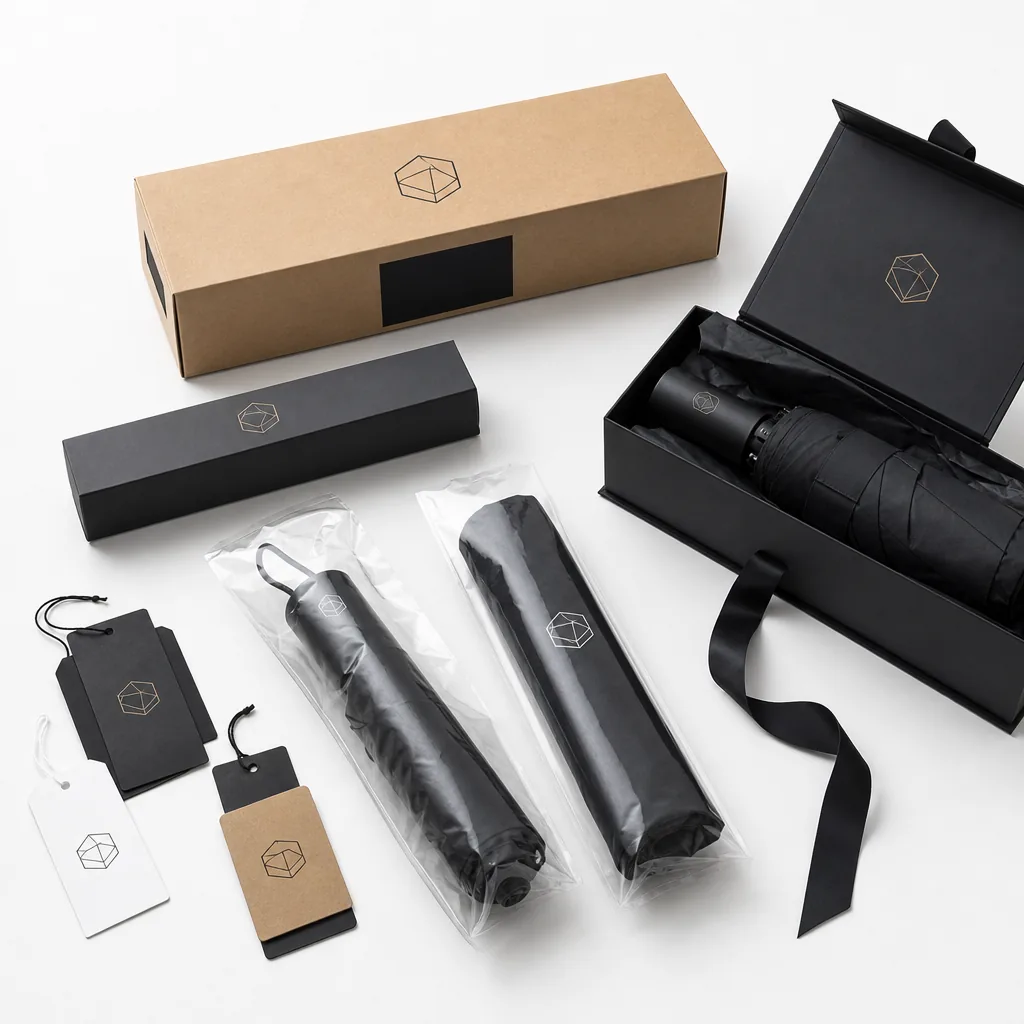
For passenger giveaways, staff issue stock, and retail-ready units, the SKU structure should be separated from day one. Passenger giveaway airport umbrellas usually need low-cost manual or auto-open umbrella mechanisms, a single-color print, and a tighter packing spec for high-volume distribution at terminals or events. Staff issue stock should be built differently: stronger fiberglass ribs, reinforced tips, and darker colors that tolerate daily use in shuttle stops, taxi stands, and loading zones. Retail-ready units belong in a third bucket with hang tags, barcode labels, retail cartons, and cleaner decoration, often with a more premium POE or 210T canopy. ZheBrella's standard practice is to keep artwork files, frame specs, and carton labels tied to separate SKU codes so procurement does not mix a commuter giveaway with a retail item that needs a different margin and presentation.
Program structure also matters for replenishment and logistics. The cleanest setup is one master umbrella spec with three decoration tiers, then separate MOQs and packaging rules for each lane. For example, a 21" passenger version may ship as a simple FOB DDP bulk lot with polybag packing, while a 27" staff version gets individual sleeves and a stronger inspection target, usually AQL 2.5 on print placement, canopy seam alignment, and open-close function. Retail units can justify a longer lead time because they often need hang tags, custom inserts, and carton marks for store distribution. That separation keeps transit system umbrellas from drifting into the wrong channel, and it gives buyers a practical way to scale from a few hundred branded giveaways to thousands of service umbrellas without reworking the whole program every season.
Procurement, Quality Control, and Delivery Planning
For airport umbrellas, I would not place a bulk order without a physical sample signoff and a carton-marking sample first. A pre-production sample should confirm canopy size, shaft length, handle style, print placement, and the actual opening force of an auto-open umbrella, because small differences matter when the product is used by passengers, crew, or ground staff. For transit system umbrellas, the sample also needs to show how the ribs behave after repeated opening, since a cheap mechanism feels fine on day one and starts sticking after a few hundred cycles. If the spec calls for a windproof double-canopy, I want to see the vent stitching, ferrule reinforcement, and the real fabric weight, usually pongee 190T for a balanced cost-to-durability point. Cartons should be labeled with PO number, SKU, color, size, quantity, gross and net weight, origin, and destination code so receiving teams can sort by terminal or depot without opening every case.
Quality control should be set at AQL 2.5, with clear limits for critical, major, and minor defects rather than a vague pass/fail note. On airport umbrellas, the usual failure points are misaligned panels, weak stitching at the top cap, bent ribs, poor open-close action, and loose handles; for printed transit system umbrellas, add ink offset, color drift, and smear resistance. A proper inspection lot should include random checks from the top, middle, and bottom of the carton stack, not only the first few pieces. If the order uses pongee 190T with fiberglass ribs, I also want bend recovery and salt-spray exposure reviewed when the route includes outdoor curbside or platform use. ZheBrella’s standard practice is to tie the inspection report to the same lot code printed on the carton, which makes claims, rework, and replenishment much easier to trace.
MOQ and lead time need to be set against the rollout model, not just the unit price. For a single-color airport umbrella, MOQ is often 500 to 1,000 pieces per style, while custom panels, mixed sizes, or multi-color printing can push that higher because cutting and screen setup become the cost driver. Normal lead time is about 25 to 40 days after sample approval, but peak season or more complex packaging can add time. FOB works well when the buyer already has freight control and a single destination, but FOB DDP becomes simpler for a multi-location rollout across terminals, depots, or regional warehouses because it removes customs handling, local delivery coordination, and surprise terminal charges from the buyer’s side. If the shipment is split across cities, DDP usually reduces the amount of back-and-forth on paperwork, which matters more than saving a small ocean-freight difference when dozens of cartons have to arrive in sequence.
Frequently Asked Questions
Are compact umbrellas or full-size umbrellas better for airport programs?
Compact umbrellas are better for passengers who need luggage-friendly storage, while full-size canopies work better for VIP service and crew use. Many operators buy both to cover different touchpoints.
What should transit buyers require in quality inspection?
At minimum, they should check opening action, rib alignment, stitching, and handle durability under AQL 2.5. For public-facing programs, packaging consistency and barcode labeling are also important.
What size umbrella is usually specified for airport passenger use versus crew use?
Passenger umbrellas are often specified at 21 to 23 inches for easy hand-carry and quick open/close use. Crew and shuttle staff usually need 25 to 27 inches or a golf-style canopy for better coverage during curbside work and longer exposure.
What construction details matter most in windy terminal and platform areas?
For exposed airport and rail environments, ask for a double-canopy vented design, fiberglass ribs, and reinforced joints. A 190T pongee canopy is common, but many buyers upgrade the rib count or shaft thickness for higher wind ratings.
What are typical MOQ and lead times for custom transit umbrellas?
For OEM/ODM orders, MOQ is often 300 to 500 pieces per style and color, depending on print method and frame specs. Standard lead time is usually 30 to 45 days after sample approval, with FOB or DDP terms available for larger programs.
Looking to Launch Your Custom Umbrella Line?
ZheBrella is a Zhejiang-based OEM/ODM umbrella manufacturer with 17 years of export experience. Free design, low MOQ from 100 pieces, windproof construction, full-color print.
Get Free Quote Now »People Also Search For
Related Articles
Branded Umbrellas for Healthcare Systems: Buyer Specs and Use Cases
How hospitals, clinics, and pharmacies can source branded umbrellas that balance patient comfort, staff durability, comp...
Read More »Branded Umbrellas for Cruise Lines and Port Excursions
Specify umbrellas for cruise operators and port programs with windproof frames, compact storage, logo durability, and le...
Read More »
Custom Umbrellas for Airports, Transit Hubs, and Passenger Programs
Specify umbrellas for airports and transit hubs with windproof frames, quick-dry pongee, and durable branding that holds...
Read More »