Branded Umbrellas for Healthcare Systems: Buyer Specs and Use Cases
Hospitals, clinics, and pharmacies need branded healthcare umbrellas that do more than carry a logo: they have to keep patients dry, survive daily handling by staff, and clear compliance checks without inflating landed cost. From the factory floor, the real challenge is balancing canopy coverage, frame strength, print durability, and packaging volume across different use cases. Buyers who specify those details early usually avoid the hidden costs that show up after the first rainy season.
Why Healthcare Uses Umbrellas Beyond Weather Protection
Healthcare systems buy branded healthcare umbrellas for utility first, not as swag. The strongest use cases are patient discharge bags, outpatient welcome kits, staff parking-lot walks, and pharmacy promotions tied to seasonal flu or rain events. In practice, the buyer is rarely one person: marketing wants clean branding, procurement wants price stability and spec control, and operations wants something staff and patients will actually carry without complaint. The best programs are usually specified as branded healthcare umbrellas with fiberglass ribs, pongee 210T canopies, and an auto-open umbrella mechanism because those choices lower breakage and make the product easier to use one-handed at a clinic exit. Success looks boring in the right way: low defect rates, consistent logo placement, and a product that survives daily commuting instead of looking good only in a mockup.
What matters on the factory side is not just appearance but controllable quality and replenishment. Healthcare buyers should ask for AQL 2.5 inspection on canopy print, shaft alignment, open-close function, and tip finishing, because loose ferrules or poor stitching show up fast when umbrellas are handed out in volume. For FOB umbrella sourcing, the real risk is not the freight term itself but whether the spec is tight enough to prevent shade variation, crooked panels, or weak ribs that fail after a few uses. In our standard practice, 8K or 10K fiberglass ribs, 21-inch or 23-inch folding formats, and neutral hospital-safe colors give the best balance of cost, durability, and daily practicality. The product only works if patients keep it, staff use it, and the logo still looks clean after repeat opening, closing, and bag storage.
Recommended Specs for Clinics, Hospitals, and Pharmacies
For clinics, hospitals, and pharmacies, fiberglass ribs are the safer default because they flex under load instead of kinking, which matters when an umbrella gets shoved into a taxi door or leaned against a cart. Steel ribs are cheaper on paper, but once you see bent stretchers, rust at the rivets, and sharp failure points after repeated opening, the maintenance cost is obvious. For branded healthcare umbrellas, I would specify 8K for low-wind urban use and 16K when the site has exposed entrances, valet lanes, or a lot of pedestrian traffic in bad weather. An 8K fiberglass frame is usually enough for indoor-to-doorway carry. A 16K frame gives better shape retention and better resistance to inversion, especially on longer 23-inch or 27-inch canopies used by staff and visitors.
On canopy cloth, pongee 190T is acceptable for short promotional runs, but pongee 210T is the better spec when the umbrella is expected to live in a nurse station, pharmacy counter, or patient discharge kit. The heavier weave holds print better, resists pinholes, and feels less flimsy in hand. An auto-open umbrella is the right call for healthcare settings because one-handed operation matters when someone is carrying documents, medication, or a bag. I would not pay for auto-open-close unless the user needs fast stowing in a compact format; the extra mechanism adds cost and more parts to fail. For FOB umbrella sourcing, clarify shaft finish, tip caps, and handle shape early, because those details affect both usability and package size.
UPF 50+ is worth specifying when the umbrella will actually be used outside, not just as a branded handout. That means ambulance bays, smoking shelters, outdoor patient check-in lines, shuttle stops, and pharmacy pickup areas with no canopy cover. A UV coating on pongee 210T is a practical upgrade there; it does more than the logo ever will. On quality control, I would ask for AQL 2.5 on appearance, function, and canopy tension, with extra checks on rib symmetry and opening force so the auto-open mechanism does not feel sticky. For healthcare buyers, the real decision is not branding versus utility; it is whether the umbrella survives daily handling without becoming a liability. ZheBrella’s standard practice is to tie the rib count, fabric weight, and inspection level to the actual weather exposure, not to a catalog photo.
Branding Methods That Hold Up in Clinical Environments
For branded healthcare umbrellas, the decoration method has to survive daily handling, not just look good in a mockup. Screen print is still the most reliable option for 1-color logos on a pongee 210T canopy because it lays down an opaque, durable ink film and stays readable on darker fabric. On an auto-open umbrella with fiberglass ribs, I prefer placing the logo on one or two opposing panels rather than wrapping the whole canopy; that keeps the mark visible when the umbrella is partially closed, which is how patients and staff actually see it in parking lots, entrances, and shuttle stops. For FOB umbrella sourcing, buyers should ask for strike-offs on the actual canopy color, not just a paper proof, because contrast changes a lot between white, navy, and charcoal.
Heat transfer makes more sense when the art needs 2 colors, fine linework, or tighter registration than screen print can hold at small size. It is useful on sleeves as well, especially when the canopy itself stays restrained and the brand moves to the carry pouch or sleeve for a cleaner clinical look. A small woven label or printed label near the ferrule sleeve, clasp, or wrap strap is usually enough for hospital systems that want identification without turning the umbrella into a billboard. In my experience, restrained branding works better in healthcare because it reads as organized and professional, while full-surface graphics can look promotional and distract from the practical purpose of the item.
The point is consistency: the logo should be legible at arm’s length, not compete with the coat, ID badge, or wayfinding signage already in the environment. One-color decoration gives the best contrast and lowest reject rate under AQL 2.5 inspection, especially when the artwork is simple and the brand uses a quiet placement near a panel seam or edge. Two-color decoration can still work, but only if the typography stays bold and the colors do not disappear on wet fabric. ZheBrella’s standard practice is to confirm logo size, placement, and sleeve branding together before production so the canopy, sleeve, and packaging all carry the same visual hierarchy without over-decorating the umbrella.
Quality Control, Packaging, and Compliance Checks
For branded healthcare umbrellas, I would not sign off on production without an AQL 2.5 inspection plan that separates appearance defects from functional ones. On the appearance side, we check canopy print registration, stitching skips, panel symmetry, ferrule fit, tip alignment, and handle finish; on the function side, we test latch engagement, spring tension, and whether the canopy locks fully without snagging. If the order uses fiberglass ribs, we also verify rib straightness, resin splash, and the rib tip sockets, because a small molding defect becomes a repeat failure under daily hospital use. With pongee 210T canopies, we look for coating consistency and seam puckering, since those show up fast once the umbrella is opened in rain and then dried repeatedly.
Cycle testing is just as important as visual QC. For an auto-open umbrella, I want a minimum open/close cycle check on sampled units before carton release, then a quick manual resistance check on the shaft and runner after cycling, because weak springs and loose ferrules are the first things to fail in transit or at the nurse station. Carton testing should include edge compression and drop tests from typical warehouse handling heights, not just a gentle shake, because FOB umbrella sourcing often means mixed consolidation, rough transfer, and long truck legs before the goods ever reach the buyer’s distribution center. We also confirm rib symmetry and tip retention after the drop test; if the frame moves, the canopy will print out fine but still come back as a complaint.
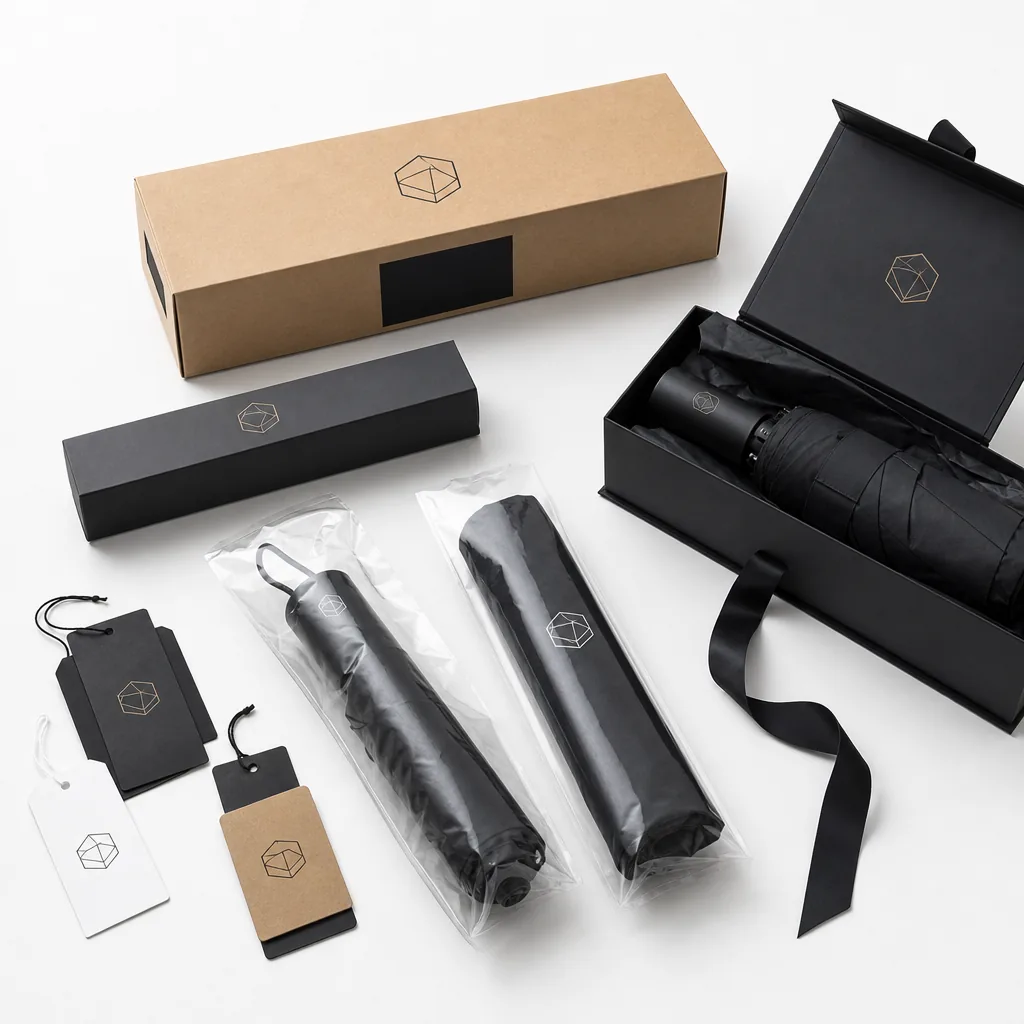
Packaging for healthcare channels has to support hygiene and fast distribution, not just retail presentation. The standard approach is individual polybags to keep dust off the canopy, barcode labels for receiving and lot traceability, and carton markings that identify size, mechanism, and colorway without opening the master case. For branded healthcare umbrellas going straight into hospital stores or direct mail programs, kitting matters: one umbrella per inner pack, insertion of care cards or donor slips if required, and consistent case counts so procurement teams can allocate by department or campaign without repacking. ZheBrella’s standard practice is to align packaging specs with the final channel before bulk production starts, because rework after sewing and printing is where time and money disappear.
MOQ, Lead Time, and Buying Terms for Healthcare Orders
MOQ on branded healthcare umbrellas is driven more by construction and decoration than by the logo itself. For a simple 23" auto-open umbrella with steel ribs and one-color screen print, I’d expect a factory MOQ around 300 to 500 pieces per colorway; once you move to fiberglass ribs, pongee 210T, vented double-canopy builds, or full-panel sublimation, the practical MOQ usually rises to 500 to 1,000 pieces because the setup time and material waste go up. If you want mixed sizes across 21" and 23" or custom handle molds, plan higher. Healthcare buyers often underestimate how much decoration complexity affects cost on branded healthcare umbrellas: a small chest logo is easy, but full-panel branding, reflective ink, or color-matched thread for stitch labeling will push both MOQ and unit price.
Sampling and production timing need to be treated separately, especially for hospital networks and GPO-driven programs. A clean sample on an existing frame usually takes 5 to 7 days; a true pre-production sample with custom canopy art, pantone matching, and packaging proof is closer to 10 to 14 days. Mass production for 3,000 to 10,000 units typically runs 25 to 40 days after sample approval, with longer timelines if you specify imported fiberglass ribs, special water-repellent coating, or individual retail packing. For healthcare buyers, the real schedule risk is not sewing—it is waiting on artwork sign-off, color approvals, and carton labeling corrections. At AQL 2.5, you should still leave time for in-line checks and final inspection before booking freight.
For FOB umbrella sourcing, the factory quotes the goods to the export port, so procurement gets a clean ex-works-plus-port cost structure and can control freight forwarder selection. That is the right model when your team already has a global logistics desk and wants to optimize ocean or air rates, but it does require you to manage duties, destination handling, and delivery appointments. DDP is better when the healthcare system wants predictable landed cost, one invoice, and fewer surprises at receiving; the supplier handles freight, customs clearance, duties, and final delivery, but you pay for that convenience in the unit price and lose some control over carrier choice. For branded healthcare umbrellas, I usually recommend FOB for repeat programs with stable lanes and DDP for one-time campaigns, rush replenishment, or buyers who need a fixed budget by site with no import headaches.
Frequently Asked Questions
What umbrella spec is best for hospital patient welcome kits?
A compact auto-open model with fiberglass ribs and pongee 190T is usually the best balance of cost and durability. If the kit is used outdoors often, step up to pongee 210T and a stronger 8K frame.
How do healthcare buyers reduce defect risk on large orders?
Use a pre-production sample, then inspect to AQL 2.5 before release. For hospitals and pharmacy chains, function tests on the opening mechanism and canopy stitching matter more than cosmetic extras.
What specs should a healthcare system prioritize when buying branded umbrellas for patients and staff?
For patient handouts, prioritize lightweight frames, auto-open operation, and a compact closed length around 21-23 inches. For staff use, upgrade to fiberglass ribs, a 210T pongee canopy, and wind-resistant construction to reduce breakage during daily commuting.
What is a practical MOQ for branded healthcare umbrellas from a factory in China?
A common MOQ is 300-500 pieces per design for standard stock umbrella sizes, with lower thresholds sometimes available for simple one-color printing. Custom handle, canopy, or packaging changes usually push the MOQ higher and can add 7-14 days to sampling.
How long does production usually take for OEM healthcare umbrellas?
Sample approval typically takes 5-10 days, and bulk production often runs 25-35 days after deposit and artwork confirmation. If the order includes custom packaging or multiple print locations, plan for an extra week to avoid freight delays.
Looking to Launch Your Custom Umbrella Line?
ZheBrella is a Zhejiang-based OEM/ODM umbrella manufacturer with 17 years of export experience. Free design, low MOQ from 100 pieces, windproof construction, full-color print.
Get Free Quote Now »People Also Search For
Related Articles
Branded Umbrellas for Telecom Field Teams and Retail Stores
Source umbrellas for telecom stores, installers, and field teams with practical specs, durable frames, QC targets, and d...
Read More »Umbrella Sourcing for Automotive Dealerships and Showrooms
How dealerships use branded umbrellas in service lanes, delivery bays, and customer gifts, with specs, MOQ, lead times, ...
Read More »
Branded Umbrellas for Patient-Transport Teams
Plan healthcare-campus umbrellas with UPF 50+, easy-grip handles, durable pongee canopies, and procurement rules that ke...
Read More »