All-Over Pattern Printing for Retail Umbrella Collections
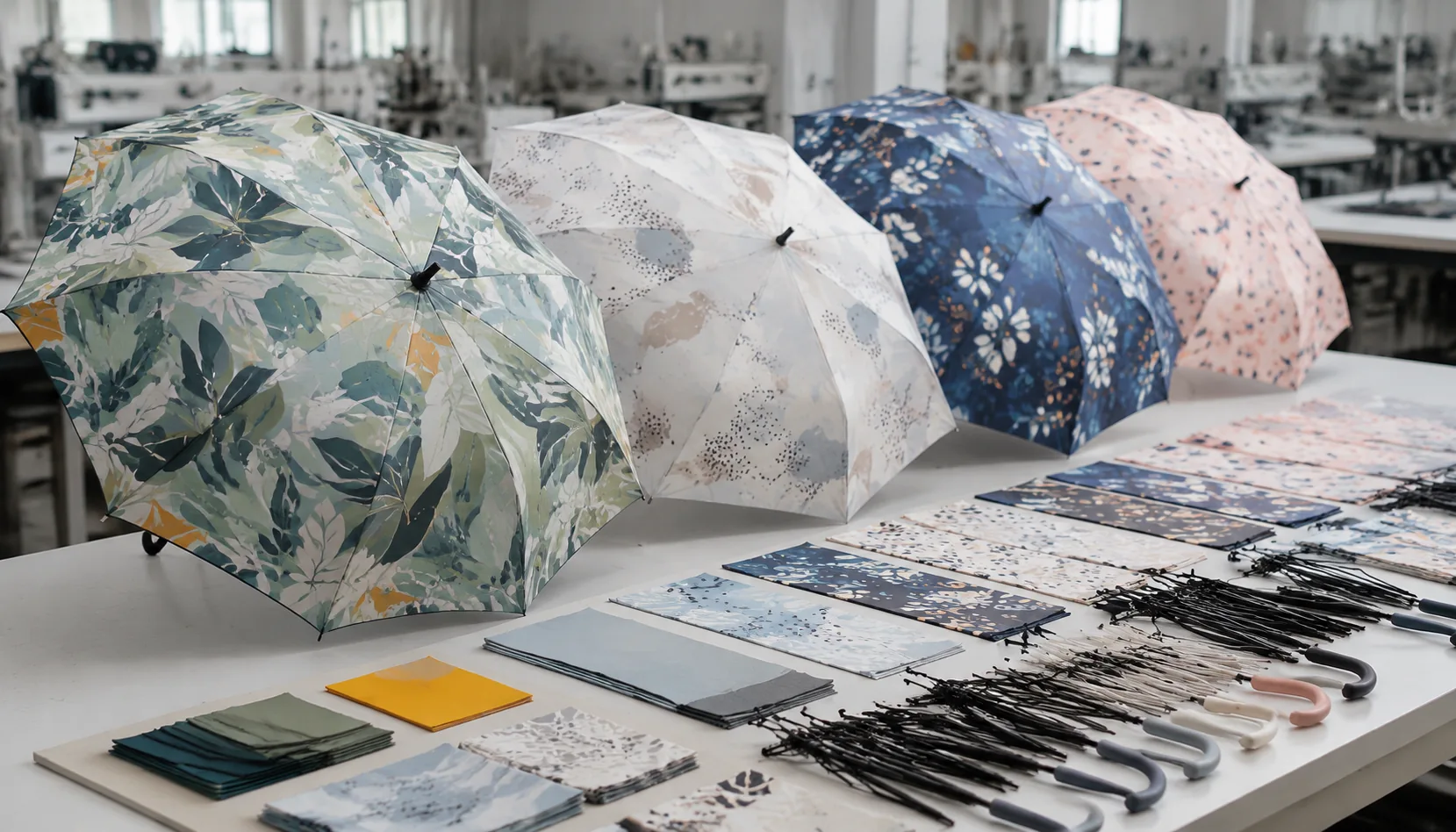
Retail buyers often approve a strong umbrella pattern on screen, then lose margin when the repeat drifts at panel seams or the logo softens after coating and cutting. On our Songxia factory floor, all over print umbrellas are controlled long before assembly: repeat scale, fabric weave, digital or screen process, and panel cutting marks all have to match the collection standard. That is what keeps a retail run consistent from first sample to carton inspection.
When All-Over Patterns Fit a Brand Program
All-over printing makes sense when the umbrella is part of a retail collection, not just a giveaway with a mark on one panel. Fashion labels, licensed character programs, museum shops, resort boutiques, and private-label rainwear ranges usually need the canopy to carry the same visual language as scarves, tote bags, or packaging. In those cases, all over print umbrellas give the buyer shelf impact from every viewing angle, especially on 23" stick umbrellas, 21" folding umbrellas, and 27" golf styles displayed open near the entrance. The pattern can be floral, geometric, animal print, archival artwork, city maps, or a seasonal color story. What matters is that the repeat is intentional, scaled correctly across 8K or 10K panel geometry, and not treated like a large poster chopped into triangles. For printed pongee umbrellas, 190T and 210T polyester are the most practical retail fabrics because they hold sublimation color well, dry quickly, and still pass normal AQL 2.5 inspection for seams, stains, and print defects.
Repeat patterns are different from single-panel logo placement in both production method and buyer expectation. A single logo on one panel is usually screen printed or heat transferred after sewing, with tolerance controlled around position, color, and adhesion. Logo repeat umbrellas require the artwork to be engineered before cutting, because the print must run across all eight panels without looking accidental at the seams. On promotional umbrellas, a 3 mm shift may be acceptable; on retail umbrella printing for a fashion or museum account, that same shift can make a stripe, monogram, or illustrated border look cheap. I always ask buyers whether they expect a true matched-panel repeat, a random repeat, or a directional pattern. True seam matching costs more and slows cutting, but it is necessary for plaids, borders, architectural artwork, and licensed patterns where the brand owner will reject distorted characters or broken motifs.
The strongest programs define the umbrella’s role before artwork starts: fashion accessory, licensed merchandise, souvenir item, or private-label rain essential. Patterned branded umbrellas for retail should have a target price, frame specification, and packaging plan locked early, because those choices affect print quality as much as the file itself. A 21" auto-open-close compact with a black electroplated steel shaft has less visible canopy area than a 23" fiberglass stick umbrella with a curved EVA handle, so the same artwork may need different repeat sizes. Buyers also need to decide whether branding is hidden in the repeat, placed on the sleeve, or added as a woven label; forcing a large logo onto an all-over pattern usually weakens the product. Our standard practice at ZheBrella is to request layered AI or PSD files, Pantone references, and one approved pre-production sample before bulk cutting, with normal retail lead times around 30–45 days after sample approval.
Repeat Layouts Across 8K and 16K Canopies
Panel count changes the way a repeat behaves more than most artwork files admit. An 8K umbrella has eight triangular canopy panels, so every seam is a hard visual interruption; a 16K canopy doubles the number of breaks and makes each panel narrower, which can either hide a dense repeat or chop up a large motif. For all over print umbrellas, I usually approve small geometric repeats, florals, dots, and diagonal textures at 15–40 mm repeat size because the eye reads continuity even when the print crosses a rib pocket. Large icons or mascot graphics need more discipline: place the main motif inside each panel’s safe zone, at least 20–25 mm away from the seam allowance, or accept that the image will be split by stitching. On 190T or 210T printed pongee umbrellas, heat-transfer and sublimation both hold fine detail well, but seam matching still depends on cutting accuracy, not print resolution.
Logo frequency should be decided after panel count, not before. On 8K patterned branded umbrellas, one logo per panel gives eight impressions, which is clean for retail and corporate gifting; two small repeats per panel can work if the logo is under 35 mm wide and not too high contrast. On 16K canopies, repeating the same logo on every panel can look crowded, so we often alternate logo panels with plain pattern panels or reduce logo scale by 20–30%. For logo repeat umbrellas, avoid placing a brand mark directly over the rib line, top notch, ferrule area, or bottom hem curve because these zones distort during sewing and final tensioning. Our standard practice at ZheBrella is to check the paper layout against a real panel template before strike-off, especially for auto-open 23-inch and 27-inch frames where canopy tension is higher.
Border elements are the easiest place to make a retail umbrella look expensive or cheap. A clean border should sit 30–45 mm above the hem on a 23-inch canopy, with enough clearance for the folded edge and lockstitch so the line does not disappear into sewing. On 8K retail umbrella printing, a continuous border must be stepped panel by panel; on 16K, the smaller panel width makes misalignment more visible if the stripe, wave, or chain motif is too rigid. I do not recommend putting faces, product names, QR codes, or legal copy across ribs, because even a 2 mm cutting shift becomes obvious once the canopy is stretched. For all over print umbrellas with large botanical, animal, or fashion motifs, build a 1:1 panel map showing seam allowance, rib pocket, top cap trim, and hem loss before sampling, then approve the strike-off under open-canopy inspection rather than judging only a flat fabric swatch.
Printing Method and Fabric Selection
Fabric choice decides whether all over print umbrellas look retail-grade or like a cheap giveaway. For full-panel gradients, watercolor florals, photographic city maps, or multi-color seasonal artwork, digital printing is the safer route because it does not require one screen per color and it handles soft transitions cleanly across 8K or 10K canopy panels. On 190T pongee, the hand-feel stays lighter and slightly softer, which works well for compact 21" and 23" umbrellas where fold thickness matters. 210T pongee gives a denser weave, better opacity, and a more premium drape on 23" and 27" stick umbrellas, but it needs tighter color profiling because darker grounds can reduce perceived brightness. For printed pongee umbrellas, we normally test strike-off panels under D65 light and after water-repellent finishing, because Teflon or standard PU coating can shift the final shade by half a tone.
Screen printing still earns its place when the artwork is disciplined: logo repeat umbrellas, two-color monograms, geometric marks, retail stripes, or simple patterned branded umbrellas with strong brand-color control. A well-made screen print lays down more ink than digital, so spot colors can look bolder on navy, forest green, burgundy, or black 190T pongee. The tradeoff is setup cost and registration risk; every added color means another screen, another alignment point, and more chance of panel-to-panel variation after cutting and sewing. For retail umbrella printing, I push buyers toward screen printing only when the repeat is clean, the logo size is not too small, and the order quantity can absorb screen charges, usually 500 to 1,000 pieces per design. Below that, digital usually protects both budget and schedule.
Coated UV fabrics need extra care because performance coatings change how ink sits in the yarn. UPF 50+ silver-coated or black-coated pongee is good for sun umbrellas, but printing on the coated side often feels plasticky and can reduce adhesion if the surface is too slick. Printing on the face side keeps a better hand-feel, while the UV layer stays inside; this is the usual construction for retail sun-and-rain collections. Color absorption is different on polyester pongee than on POE, PVC, or EVA transparent canopies: pongee absorbs and diffuses ink slightly, while plastic films keep sharper edges but show scratches and roller marks more easily. For all over print umbrellas with dense repeats, I prefer 210T pongee when the target is department-store presentation, and 190T when the buyer needs lighter weight, sharper landed cost, and faster drying after rain.
Sampling Workflow for Pattern Approval
Pattern approval starts before ink touches fabric, because a pretty flat artwork file can fail badly once it is split across 8K, 10K, or 16K umbrella panels. We first build a CAD mockup using the exact panel template for the requested size, usually 21" folding, 23" straight, 27" golf, or 30" event umbrella. The artwork is nested with seam allowance, top notch, grain direction, and rib alignment marked, so the buyer can see whether a floral, stripe, checker, or logo repeat will land cleanly at the tips and around the cap. For all over print umbrellas, I prefer sending both a flat panel map and a rendered open-view mockup, because procurement teams often approve the render but miss a broken repeat at the seam. Patterned branded umbrellas also need a closed-view simulation, since retail shoppers see the rolled canopy first on shelf or in e-commerce pack shots.
After CAD approval, the next control point is the print strike-off, not a full umbrella. For retail umbrella printing, we normally print one or two panels on the nominated fabric, such as 190T or 210T pongee, RPET pongee, or polyester with Teflon, PU, or UV UPF 50+ coating. This strike-off checks Pantone tolerance, line sharpness, ink penetration, coating reaction, and whether the fabric shrinks after heat fixation. Sublimation works well for photographic repeats and printed pongee umbrellas, while screen printing is better for simpler logo repeat umbrellas with fewer colors and stronger opacity requirements. Our standard practice at ZheBrella is to review the strike-off under D65 light and compare both dry and water-sprayed surfaces, because some dark grounds shift slightly after coating. If the buyer skips strike-off to save 5–7 days, they accept more risk on color variation, especially on navy, red, beige, and skin-tone artwork.
Only after the strike-off is signed do we cut a full umbrella sample, usually 2–3 pieces so one stays in the factory and one goes to the buyer or brand office. The full sample confirms panel matching, seam distortion, cap alignment, tip placement, handfeel, opening balance, and the way the pattern looks when the umbrella is closed with the strap wrapped. This is where all over print umbrellas often need one final adjustment: a repeat that looks balanced when open may show an awkward dark band or upside-down logo when rolled. Custom pattern runs usually push MOQ higher than stock-color logo jobs because fabric must be printed in a continuous batch; practical MOQ is often 300–500 pieces per design for digital/sublimation and 1,000+ pieces for economical screen production. Sampling normally adds 10–15 days before bulk production, and bulk lead time becomes 30–45 days depending on fabric booking, frame type, AQL 2.5 inspection, and FOB or DDP delivery schedule.
Bulk QC for Repeat Accuracy
Bulk QC for repeat accuracy starts before the umbrella is opened on the inspection table: we verify cut-panel sequence against the approved layout sheet, because one reversed gore can ruin a clean repeat even when the print itself is sharp. For all over print umbrellas, our inspectors pull samples under AQL 2.5, usually using ISO 2859-1 general inspection level II unless the buyer specifies tighter rules for retail display stock. Each sampled unit is checked for panel order, repeat direction from cap to hem, seam mismatch at the stitch line, color drift versus the signed PPS, stains from handling oil, and registration errors between colors. On 190T or 210T printed pongee umbrellas, a 2–3 mm seam offset is often commercially acceptable on busy patterns, but logo repeat umbrellas need stricter judgment because a chopped or tilted logo reads as a brand defect, not a sewing tolerance.
Print registration must be judged after tensioning the canopy on the actual frame, not flat on a cutting table. A panel that looks aligned before sewing can skew after the 8K or 10K ribs pull the fabric into shape, especially on auto-open folding frames where shorter ribs create more localized canopy stress. For retail umbrella printing, I like inspectors to open and close each sampled folding umbrella three times before checking the repeat, because loose tips, uneven rib lengths, or a tight runner can shift the visual line along the seams. Color drift is checked panel-to-panel and lot-to-lot using a light box or consistent daylight condition; sublimation, heat-transfer, and screen printing fail in different ways, so the QC sheet should separate shade variation, ghosting, ink bleed, and off-register outlines instead of using one vague “printing defect” category.
Inspection priorities change by product type. Folding umbrellas, especially 21" and 23" auto-open-close models, need extra attention at folded creases, because transfer marks and stains often appear where printed pongee umbrellas rub against plated steel or fiberglass ribs during packing. Golf umbrellas, usually 27" to 30" with 8K, 10K, or 16K frames, expose repeat problems more clearly because each panel is larger and the seam run is longer; a 5 mm mismatch across a double-canopy vent can look obvious on patterned branded umbrellas. Straight umbrellas are more stable under tension, but the longer shaft and deeper canopy make direction mistakes easier to miss, so inspectors should confirm that the pattern orientation is consistent when viewed from the front selling angle, not only from the top. At ZheBrella, bulk QC photos include close-ups of at least two adjacent seams, the hem, the cap area, and one full-open canopy shot for buyer approval records.
Frequently Asked Questions
Can a logo repeat pattern align perfectly across every umbrella seam?
Minor seam variation is normal because canopy panels are cut and sewn individually. Critical logos should be placed away from seam lines or designed as forgiving repeats.
Is digital printing better for all-over umbrella patterns?
Digital printing is usually better for gradients, photos, and complex multi-color repeats. Screen printing can be more cost-effective for simple one- or two-color patterns at higher volume.
Can repeat patterns be aligned across umbrella panels?
Yes, but alignment depends on the artwork, panel shape, and cutting tolerance. For retail orders, factories usually recommend a controlled repeat layout with 1–3 mm production tolerance rather than designs that require perfect matching at every seam.
Which printing method is best for all-over pongee umbrellas?
Digital printing is best for complex repeats, gradients, and smaller retail runs, while screen printing is more cost-effective for simple 1–4 color patterns at higher quantities. Pongee fabric is commonly used because it holds sharp logo edges and has a smooth retail finish.
What MOQ should buyers expect for custom patterned umbrellas?
Typical MOQ is around 500–1,000 pieces per design for OEM all-over print umbrellas, depending on frame type, fabric, and printing method. Sampling usually takes 7–14 days after artwork confirmation, with bulk production often taking 30–45 days.
Looking to Launch Your Custom Umbrella Line?
ZheBrella is a Zhejiang-based OEM/ODM umbrella manufacturer with 17 years of export experience. Free design, low MOQ from 100 pieces, windproof construction, full-color print.
Get Free Quote Now »People Also Search For
Related Articles
Repeat Logo Pattern Printing for Branded Umbrella Lines
Plan repeat logo umbrella prints with panel layout, fabric choice, sampling, and QC controls for retail, promo, and priv...
Read More »
All-Over Pattern Printing for Branded Umbrella Programs
Build repeat-pattern umbrella programs with print-ready artwork, panel planning, fabric choices, and QC steps that prote...
Read More »
All-Over Pattern Umbrellas for Private Label Branding
Develop all-over pattern umbrellas with repeat artwork, panel matching, fabric specs, and QC controls for private label ...
Read More »