All-Over Pattern Umbrellas for Private Label Branding
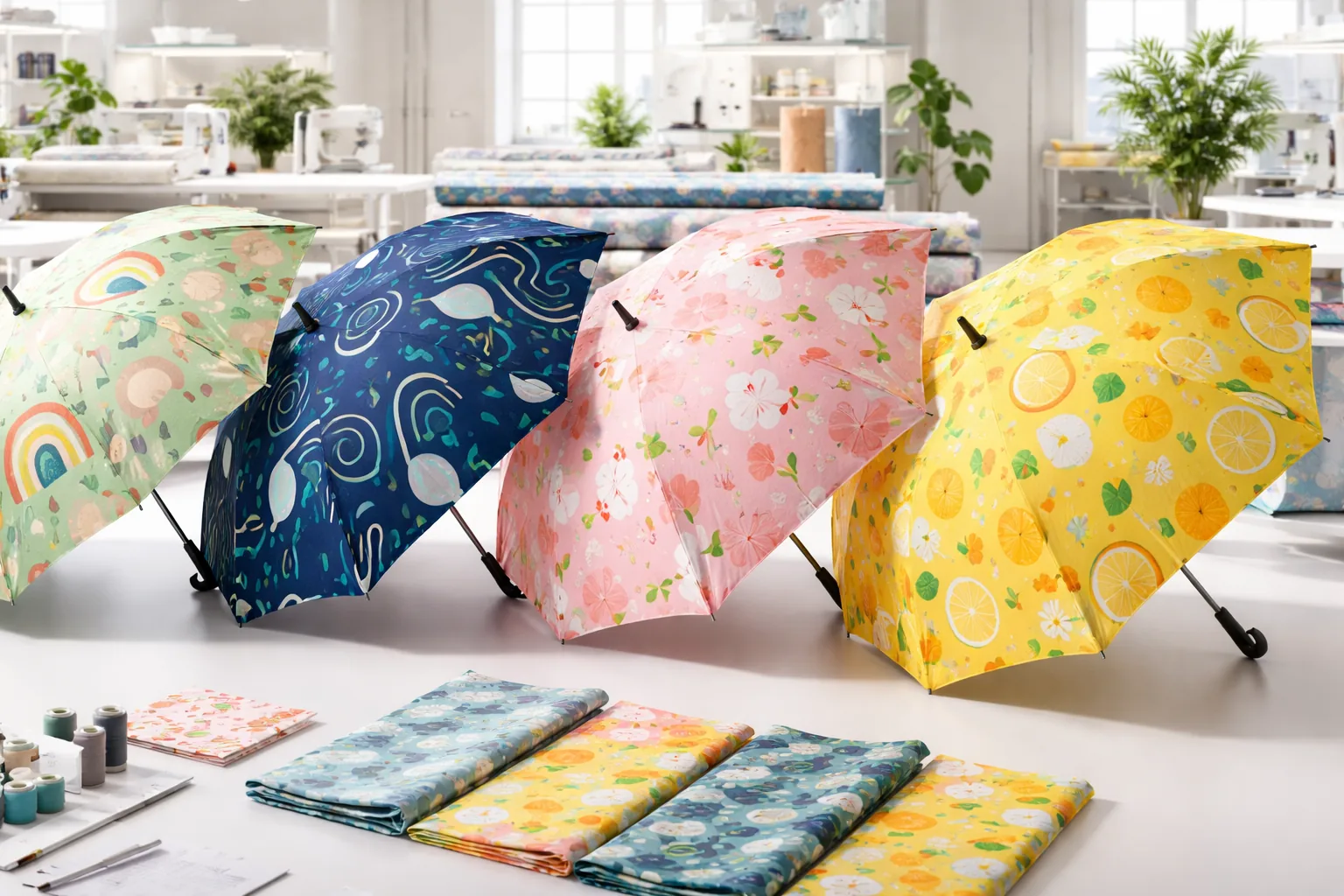
For private label buyers, all over print umbrellas look simple on a line sheet but become risky when repeat artwork crosses eight curved panels, fabric stretch shifts the pattern, and bulk sewing exposes every mismatch. On our Songxia factory floor, we check artwork repeat size, pongee coating, panel cutting direction, rib alignment, and final canopy tension before approving production, because small print and sewing errors quickly turn into retail rejects.
Building a Repeat Pattern That Fits Umbrellas
Repeat scale matters more on umbrellas than it does on flat fabric because the canopy is built from 8 or 10 curved triangular panels, not one continuous sheet. A 30 mm motif may look clean on a 21" compact, while the same pattern can feel too busy on a 27" golf umbrella; a 90 mm logo repeat may work for branded retail umbrellas but look broken when each panel narrows toward the top notch. For all over print umbrellas, I prefer checking the artwork at full size on a panel template before sampling, with seam allowance, ferrule hole, and hem fold marked. Writers should explain that the visible repeat is judged when the umbrella is open, not when the fabric roll is printed, so the design must be evaluated across the whole dome shape.
Motif direction is where many pattern printed umbrellas fail. If every logo points the same way on the fabric roll, half the canopy may appear upside down when panels are cut and sewn around the shaft. For private label umbrellas, we usually ask whether the buyer wants a radial layout, where motifs read outward from the center, or a fabric-repeat layout, where the repeat follows the textile grain and accepts some directional variation. A repeat pattern umbrella with stripes, arrows, monograms, or mascot faces needs special control because panel rotation changes the viewer’s perception. Center alignment is also critical: the top cap area should not land on a half-cut hero logo, and any medallion-style graphic should be positioned around the runner hole with enough clearance for stitching and cap hardware.
Panel shape creates edge cropping, so artwork should be designed with safe zones instead of assuming the repeat will continue perfectly across seams. Each panel has two bias edges, a curved hem, and a narrow top point; if a logo sits too close to those edges, sewing can cut it in half or bury it under the seam by 6–10 mm. For all over print umbrellas, awkward logo cuts at seams are avoided by offsetting the repeat, reducing motif size, or using filler elements near panel borders. Our standard practice at ZheBrella is to review a digital canopy mockup plus one printed strike-off before bulk cutting, especially for sublimation on 190T/210T pongee or heat-transfer logos on coated fabric. That step catches center misalignment, uneven motif flow, and cropped brand marks before the factory commits hundreds of panels to sewing.
Selecting Fabric, Rib Count, and Canopy Style
For all over print umbrellas, fabric choice controls both print sharpness and the way the umbrella feels in a customer’s hand. 190T pongee is the normal promotional-grade option: tight enough for clean screen printing or heat transfer, light enough for 21" and 23" compact auto-open-close frames, and easier to hit aggressive MOQ pricing. 210T pongee has a denser weave and smoother surface, so sublimation gradients, small logo repeats, and tone-on-tone patterns look cleaner, especially on dark grounds where ink coverage exposes every yarn line. The tradeoff is cost and slightly more bulk when folded, which matters on 3-fold and 5-fold compact models. For branded retail umbrellas, I usually push buyers toward 210T when the artwork has fine repeat spacing under 20 mm, photographic elements, or premium packaging. For simple two-color pattern printed umbrellas, 190T with a Teflon water-repellent finish is often enough, provided the strike-off is checked under both daylight and wet-rub conditions.
Rib count affects artwork planning more than many buyers expect. An 8K umbrella uses eight canopy panels, so a repeat pattern umbrella has fewer seam breaks and larger uninterrupted print zones; this is easier for plaid, floral, monogram, and mascot repeats. A 16K frame gives a rounder canopy and a more premium visual profile, but the pattern is chopped into narrow panels, increasing the risk of misalignment at the crown and rib seams. On production tables, we allow extra print bleed of 8–12 mm per panel and mark the notch direction clearly before cutting, because one reversed panel ruins the repeat. Compact umbrellas usually run 21" or 23" with 8K steel or fiberglass ribs, while golf umbrellas at 27" or 30" can use 8K, 10K, or 16K layouts. If the buyer wants a large logo hidden inside a repeat field, golf size gives better readability and fewer distorted edges near the ferrule.
Canopy style should follow the use case, not just the artwork. A single-canopy compact umbrella is lighter, cheaper, and better for giveaways or e-commerce bundles, but it is less forgiving in gusts when paired with a full-surface print that buyers expect to look premium. For private label umbrellas sold through retail, a double-canopy vented windproof construction is usually worth the added sewing time, especially on 27" golf models with fiberglass ribs and shaft. The vent lets pressure escape, helping good frames survive 50+ mph wind-tunnel tests instead of inverting hard and stressing the runner. The complication is print registration: the top canopy, lower vent layer, and binding tape must be planned as separate pieces, not one continuous graphic. Our standard practice at ZheBrella is to approve a digital panel map first, then a printed pre-production sample before AQL 2.5 inspection, because all-over artwork problems are expensive to find after 1,000 canopies are already sewn.
Balancing Pattern Branding and Logo Visibility
Do not ignore the small brand positions; they often save the design from becoming too loud. A woven or rubber strap logo, debossed EVA handle mark, printed sleeve, and small runner sticker can support brand recall without forcing a logo onto every panel. For branded retail umbrellas, one clear featured panel plus a strap logo is usually stronger than eight repeated logos, especially at shelf distance or in event photography. Our standard practice at ZheBrella is to mark the panel map before sampling: panel 1 for the hero logo, panels 2-8 for repeat artwork, strap logo centered within 45-55 mm, and handle mark sized to the grip diameter. That structure works across manual, auto-open, and auto-open-close mechanisms, and it keeps all over print umbrellas recognizable without turning the canopy into visual noise. Buyers should approve a paper strike-off first, then a sewn pre-production sample, because flat artwork never tells the full story.
Print Production and Color Control
Digital printing is the right tool when the artwork has complex repeats, watercolor effects, gradients, small icons, or edge-to-edge placement across 8 panels. For all over print umbrellas, we normally print panel-by-panel on 190T or 210T pongee before cutting, then align the repeat at the seam allowance so the pattern does not “jump” when the canopy is sewn. Sublimation works well on white polyester because the ink bonds into the fiber and keeps the hand feel soft; reactive or pigment digital routes are less common for umbrella pongee because water repellency and drying speed matter more than fashion-fabric softness. Screen printing still wins for limited-color pattern printed umbrellas: 1–4 solid colors, logo repeats, stripes, polka dots, or a clean repeat pattern umbrella where opacity and cost control are more important than photographic detail. The catch is setup: every screen needs film, exposure, registration, and wash-down time, so screen printing becomes economical only when quantity is high enough to absorb those fixed costs.
Pantone control starts before mass printing, not after cartons are packed. We ask buyers to nominate Pantone C or U references, but fabric is not coated paper, so we treat Pantone as an anchor color, not a promise of identical gloss or depth. A proper strike-off includes the real canopy fabric, the real coating, and the real print method; testing on uncoated sample cloth is a shortcut that causes trouble later. For private label umbrellas and branded retail umbrellas, our standard practice at ZheBrella is to approve a lab dip or printed strike-off under D65 light, then keep a signed sample in the printing room and one in QC. Reasonable color tolerance is usually Delta E 2.0–3.0 for brand colors on white pongee, wider for dark grounds or metallic-looking tones. If the design uses black, navy, or red as a major ground, we also check crocking, rub resistance, and whether ink buildup affects folding thickness.
Coated and UV fabrics need extra caution because the chemistry changes both color and adhesion. A Teflon water-repellent finish can make ink sit differently on the surface, while silver, black, or PU coatings used for UPF 50+ protection can shift the face color after heat pressing or curing. I have seen good-looking strike-offs fail because the buyer approved color on plain 190T pongee, then switched to UV-coated 210T pongee after price negotiation. That is why production testing should include water spray, tape adhesion, wet/dry rubbing, folding abrasion, and 24-hour recovery after compression in the finished umbrella shape. For all over print umbrellas with tight repeats, we also inspect panel direction, cutting position, and seam matching under AQL 2.5, because a perfect Pantone match still looks cheap if the repeat drifts at every rib. For export orders, allow 5–7 days for strike-off approval and 20–35 days for bulk production after artwork and deposit are confirmed.
Retail Program Specs, QC, and Logistics
For all over print umbrellas, MOQ depends less on the umbrella frame and more on how the artwork is applied. For cut-panel screen printing on 190T or 210T pongee, a practical MOQ is usually 500 pieces per colorway for 21" folding umbrellas and 23" stick umbrellas, because each panel needs registration control before sewing. Heat-transfer repeat patterns normally start around 1,000 pieces, while sublimation on white polyester panels is best from 1,000–2,000 pieces because the paper setup and color profiling need volume to make sense. For POE or PVC clear canopies, repeat pattern printing is possible, but ink adhesion testing should be done before approving bulk. Sampling usually takes 7–10 days after AI/PDF artwork and Pantone references are confirmed; bulk production runs 25–35 days for standard manual or auto-open frames, and 35–45 days for auto-open-close or double-canopy vented windproof models.
QC has to be stricter on pattern printed umbrellas than on solid-color promotional stock because a small panel mismatch becomes obvious when the canopy is opened. Our standard practice at ZheBrella is AQL 2.5 for major defects and AQL 4.0 for minor defects, with inline checks after cutting, sewing, frame assembly, and final packing. Inspectors should verify repeat alignment at rib seams, logo placement tolerance, fabric shade consistency, open-close function, rib straightness, tip attachment, and water repellency after Teflon coating when specified. For private label umbrellas, the golden sample should include canopy fabric, handle finish, button color, sleeve, hangtag, care label, barcode sticker, and carton mark; otherwise reorders drift over time. Retail cartons need item number, colorway, quantity, gross/net weight, carton size, destination, and any customer routing code printed clearly on two sides.
FOB Ningbo or Shanghai is the cleanest quoting basis when the buyer controls freight, but DDP is often better for branded retail umbrellas going into Amazon, chain stores, or event programs with fixed delivery windows. For DDP, we need the ship-to ZIP code, delivery terms, pallet requirements, barcode format, and whether cartons need FBA, GS1, UPC-A, EAN-13, or customer-specific labels. Inner packs are usually 12 pieces, master cartons 24 or 36 pieces depending on 21", 23", 27", or 30" size; golf umbrellas with 8K fiberglass frames and EVA handles often cube out before they weigh out. To keep a repeat pattern umbrella consistent across reorders, lock the fabric mill, coating, print profile, rib count, handle mold, and packing spec in the purchase order, not just the artwork file. A reorder made six months later can still match if the first production lot is documented properly.
Frequently Asked Questions
Can all-over patterns be used on both compact and golf umbrellas?
Yes, but the artwork needs separate templates because panel size and rib spacing differ. Golf umbrellas offer larger repeat visibility, while compact umbrellas need tighter pattern scale.
How do buyers avoid mismatched patterns at umbrella seams?
Use a panel-by-panel artwork file, confirm repeat direction, and approve an assembled pre-production sample. For 16K umbrellas, allow extra checking because more seams increase alignment risk.
Can repeat artwork be matched across umbrella panels?
Yes, panel matching is possible, but the tolerance depends on frame size, fabric stretch, and cutting accuracy. For retail programs, buyers should provide vector repeat artwork and approve a pre-production sample before bulk cutting.
What fabric works best for all-over pattern printed umbrellas?
190T or 210T pongee polyester is commonly used for retail umbrellas because it prints cleanly, dries quickly, and supports waterproof coating. For higher-end orders, recycled rPET pongee can also be used with custom pattern printing.
What MOQ and lead time should buyers expect for private label pattern umbrellas?
Typical MOQ is around 500–1,000 pieces per design, depending on frame type and print method. Sampling usually takes 7–12 days after artwork confirmation, with bulk production around 30–45 days after sample approval.
Looking to Launch Your Custom Umbrella Line?
ZheBrella is a Zhejiang-based OEM/ODM umbrella manufacturer with 17 years of export experience. Free design, low MOQ from 100 pieces, windproof construction, full-color print.
Get Free Quote Now »People Also Search For
Related Articles
All-Over Pattern Printing for Retail Umbrella Collections
Build retail umbrella patterns with clean repeats, controlled panel alignment, and fabric choices that keep logos sharp ...
Read More »
All-Over Repeat Pattern Umbrellas for Retail Branding
Plan repeat-pattern umbrella prints with cleaner panel joins, practical fabric choices, MOQ expectations, and approval s...
Read More »
Repeat Pattern Umbrella Branding for Retail Collections
Build repeat pattern umbrellas with clean panel alignment, fabric selection, rib planning, MOQ, and inspection rules for...
Read More »