All-Over Repeat Pattern Umbrellas for Retail Branding
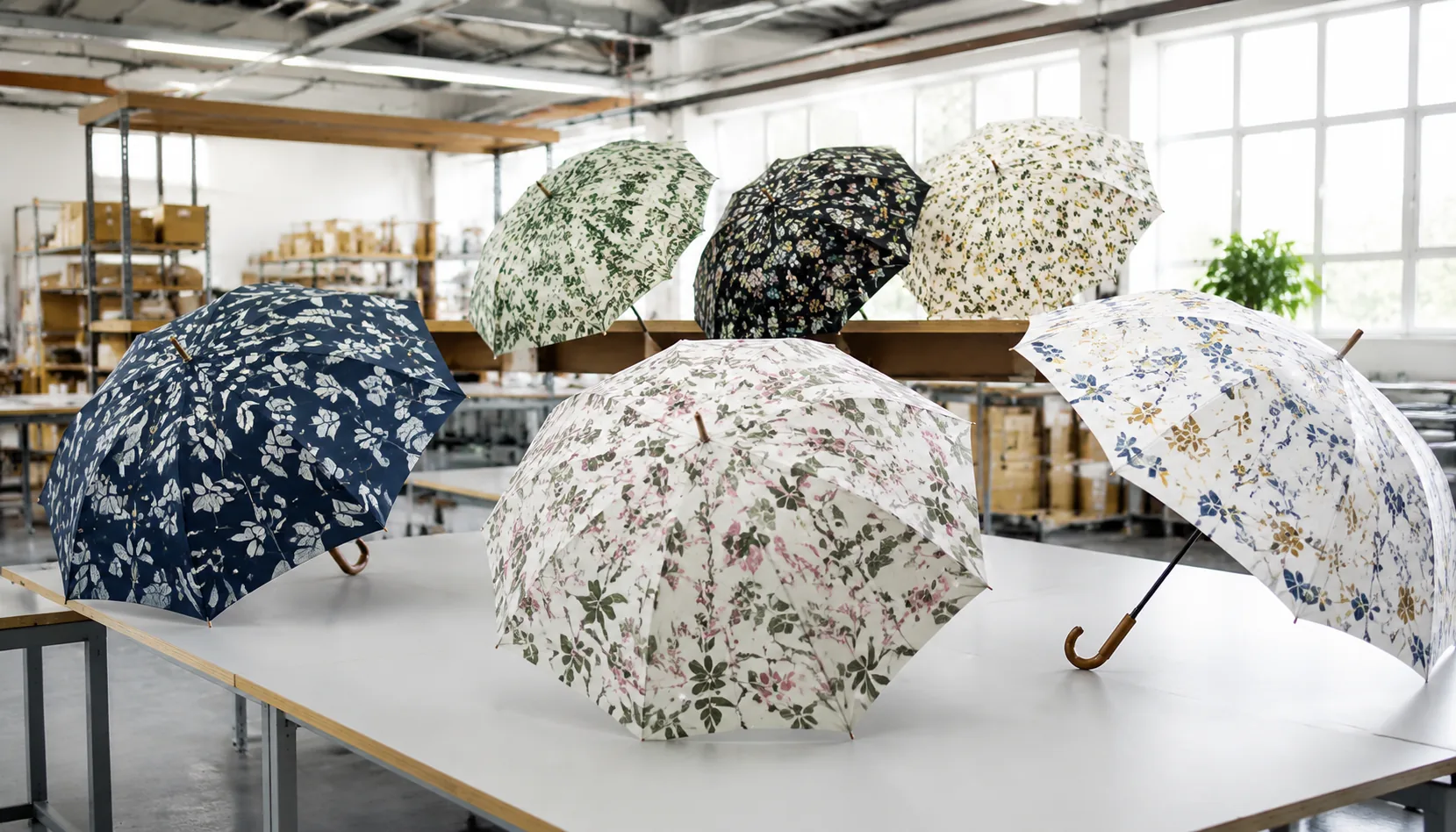
For retail buyers, the risk with an all-over canopy is not the artwork file—it is what happens when that pattern crosses eight cut panels, ribs, seams, and a tight production schedule. On our Songxia factory floor, repeat pattern umbrella printing is planned around panel layout, fabric shrinkage, print method, and pre-production approval so the finished goods look consistent on the shelf, not just on a mockup.
Why Repeat Patterns Work for Retail Umbrella Lines
Repeat layouts sell better at retail because the umbrella reads as a product, not a giveaway. A single chest-style logo on one canopy panel disappears when the umbrella is folded and often looks like a corporate premium when open. A custom canopy pattern built from monograms, small icons, mascots, florals, skyline marks, or seasonal motifs gives identity across all 8 panels, so the design is visible on the rack, in a gift box window, and in street photos. For most retail branded umbrellas, I prefer a controlled repeat with 30–80 mm motif spacing on 190T or 210T pongee; it hides panel-to-panel sewing tolerance better than a giant centered graphic and still looks intentional after the canopy is stretched over 8K or 10K ribs.
Fashion retailers use repeat pattern umbrella printing to extend a scarf, handbag lining, or seasonal capsule into rainy-day accessories without changing the brand language. Museum shops can turn artifacts, collection icons, architectural details, or exhibition graphics into an all-over umbrella print that feels collectible rather than souvenir-grade. Hotel boutiques often do best with quiet repeats: room-key motifs, palm leaves, crests, or local map fragments printed tone-on-tone on a 23 inch auto-open umbrella. Licensed merchandise is more strict; mascots and character heads need approved scale, rotation, and clear space so the pattern stays compliant after cutting, sewing, and tip alignment.
Production method matters because repeat patterns expose sloppy registration. Screen printing works for one- or two-color icon repeats on solid pongee, but heat transfer or sublimation is better when the artwork uses gradients, watercolor effects, or many brand colors. On private label umbrellas, our standard practice at ZheBrella is to request a full canopy layout, not just one panel, then check motif flow across seams before bulk cutting. For retail programs, I also recommend one strike-off and one pre-production sample before AQL 2.5 inspection, especially if the line includes 21 inch compact, 23 inch stick, and 27 inch golf sizes, because the same repeat needs different scaling to avoid looking crowded or empty.
Panel Layout Rules for 8K and 16K Canopies
For 8K canopies, the print layout has room to breathe. A standard 23" or 27" umbrella divides the canopy into eight triangular panels, so each panel gives a wider printable face and fewer seam breaks across the repeat. That is usually better for large florals, checkerboards, mascot graphics, monograms, or a custom canopy pattern where the buyer wants the motif recognized from 10–15 feet away on a retail floor. In repeat pattern umbrella printing, I normally keep critical artwork at least 12–15 mm away from rib stitch lines and 20–25 mm away from the outer hem, because sewing draw, fabric stretch, and hand feeding at the binding machine can shift the visible edge. On 190T or 210T pongee, a realistic panel-to-panel seam tolerance is about ±3 mm for regular production; PVC or POE clear canopies may need wider tolerance because the material feeds differently and shows misalignment more sharply.
A 16K canopy looks premium because the rib count is dense, but the artwork discipline is tougher. Sixteen ribs create narrower print zones, twice as many seams, and more interruptions where a diagonal stripe, logo repeat, or border pattern can step out of alignment. This matters most for retail branded umbrellas and private label umbrellas where the same SKU may sit in a display bucket and buyers compare multiple pieces side by side. Small ditsy repeats, tone-on-tone patterns, scattered icons, and engineered radial graphics usually work better than oversized motifs on 16K frames. If the design uses a continuous all-over umbrella print, the repeat should be built so the seam line cuts through background texture or low-contrast elements, not through faces, letters, animals, or brand marks. For 16K, I prefer 15–18 mm safe margins beside ribs and a written approval that minor seam mismatch is acceptable under AQL 2.5 visual inspection.
Flat artwork approval is necessary, but it is not enough. The CAD file shows each triangular panel cleanly, while the assembled umbrella adds seam allowance, rib tension, top notch compression, cap alignment, and canopy curvature. Our standard practice at ZheBrella is to review repeat pattern umbrella printing in three stages: flat panel layout with bleed and seam allowance marked, one cut-and-sewn strike-off sample, then an opened umbrella photo set from top view, front view, and 45-degree angle. For tight repeats, we also check whether the pattern appears balanced when the umbrella is closed, because retail customers often see the product folded first. Writers should call out that 8K and 16K layouts cannot share the same artwork blindly; the repeat scale, motif rotation, and seam hiding strategy must be adjusted to the rib count before mass cutting begins.
Fabric and Print Method Choices for Pattern Clarity
Pattern clarity starts with fabric density, not the printer. For retail branded umbrellas, 190T pongee is the common value choice: light, smooth enough for most logo repeats, and stable on 21" and 23" folding umbrellas. But when the artwork has tight geometry, thin outlines, or small brand icons repeated edge-to-edge, I push buyers toward 210T pongee. The higher yarn density gives cleaner color boundaries and reduces the fuzzy “feather” you see when ink spreads along looser polyester. It also feels more retail-grade in hand, especially on 27" golf umbrellas and private label umbrellas sold above the promo price point. In our standard practice at ZheBrella, we also check panel cutting direction before bulk production because a custom canopy pattern can look misaligned if warp/weft orientation changes between panels, even when the print file is technically correct.
Digital printing is usually the right method for repeat pattern umbrella printing when the design has gradients, many colors, photographic elements, or small repeated motifs. Screen printing still works well for bold one- to three-color graphics, but it becomes inefficient and less precise when every canopy panel carries a complex repeat. Each screen color needs registration, and on a curved umbrella canopy made from 8 separate panels, even a 1–2 mm shift can break the rhythm of an all-over umbrella print. Digital printing handles CMYK artwork directly, so paisley, camouflage, floral, checkerboard, cartoon, and luxury monogram patterns hold much better detail. For production, we still need a strike-off sample because polyester absorbs color differently after water-repellent coating, and dark navy, wine red, and black repeats often need profile adjustment before AQL 2.5 inspection.
Transfer printing has its place, but I would not use it as the default for full-canopy complex repeats unless the order quantity, fabric, or artwork makes it practical. Heat transfer is useful for small placements, metallic effects, reflective strips, limited-edition patches, or when a buyer wants a special finish on top of a digitally printed base. It can also help on shorter MOQ trial runs where making multiple screens is not economical. The limitation is hand feel and edge behavior: large transfer areas may feel heavier and can show film borders under strong light if the material is not matched correctly. For repeat pattern umbrella printing on private label umbrellas, the cleanest route is usually 210T pongee plus digital print, followed by panel-level QC for repeat continuity, color tolerance, and seam matching before sewing. That is where most pattern failures are caught, not at final packing.
Color Control, Sampling, and Bulk Approval
Color control for repeat pattern umbrella printing starts before artwork is separated. For retail branded umbrellas, I want every brand color tied to a Pantone Solid Coated or TPX reference, not just a CMYK value pulled from a PDF. Polyester pongee 190T/210T, recycled PET, POE, PVC, and EVA all take ink differently, so the same Pantone can look warmer on a matte 190T pongee panel than on glossy POE. For screen printing we normally confirm mesh count, ink system, curing temperature, and wet-on-dry sequence; for heat transfer and sublimation we check transfer paper density, press temperature, dwell time, and fabric shrinkage. A proper strike-off is made on the actual canopy material with the actual coating, including Teflon, black UV backing, or UPF 50+ treatment if specified. The strike-off should show the custom canopy pattern at full scale, including logo repeats, edge bleed, and alignment marks, because a clean A4 lab dip does not prove the pattern will match across 8K or 10K umbrella panels.
Bulk approval should move from strike-off to a full pre-production sample, not straight into cutting 3,000 panels. The pre-production sample must be built on the final frame size, such as 21 inch folding, 23 inch straight, 27 inch golf, or 30 inch oversized, because panel geometry changes the visual spacing of an all-over umbrella print. I recommend approving one opened umbrella under D65 light, one closed umbrella for wrap appearance, and one loose panel set for checking repeat continuity before sewing hides the seam margins. Acceptable shade tolerance needs to be written into the purchase order: for most private label umbrellas, a Delta E of 1.5 to 2.0 is realistic for coated polyester, while panel-to-panel variation should stay within a tight visual tolerance when viewed at 1 meter. On dark grounds, I pay extra attention to white underbase opacity and logo edge sharpness, since weak underbase makes the repeat look gray after rain testing and rubbing.
For bulk inspection, AQL 2.5 should cover both umbrella function and print appearance, with print defects called out clearly instead of buried under general workmanship. Inspectors should open samples under consistent light and check misregistration, broken repeat lines at seams, ink bleeding, stains, pinholes, transfer ghosting, wrong panel sequence, and obvious color inconsistency between panels. On repeat pattern umbrella printing, I treat one visibly off-shade panel as more serious than a small hidden stitch issue, because the buyer’s customer sees the canopy first. Our standard practice at ZheBrella is to pull random finished units plus loose retained panels, compare them against the signed pre-production sample, and record defects by location: top cap area, panel center, seam edge, tie wrap, and sleeve. If the shipment is FOB or DDP for retail delivery, approve cartons only after barcode, hangtag, sleeve print, and canopy color all match the final signed sample, because fixing a color claim after export costs far more than holding one day for reinspection.
MOQ, Lead Time, and Export Planning
For retail branded umbrellas, MOQ depends less on the frame and more on how the all-over fabric is made. If the design uses stock 190T or 210T pongee with panel-by-panel screen printing, we can sometimes hold 500–1,000 pcs per color, but the registration tolerance at panel seams is not as clean. For true repeat pattern umbrella printing on roll fabric before cutting, practical MOQ is usually 1,200–3,000 pcs per artwork because the mill needs greige fabric, coating, printing setup, color fixation, and wastage allowance. POE, PVC, and EVA clear canopies have different minimums because the printing method and drying behavior change. A 23 inch 8K auto-open umbrella and a 21 inch compact auto-open-close umbrella can share a custom canopy pattern only if the repeat scale is planned for both cutting layouts; otherwise the logo density looks wrong on one size.
Sampling takes longer than buyers expect because an all-over umbrella print is not just a paper proof. A digital strike-off normally needs 5–7 days after artwork approval, while a finished pre-production sample with frame, handle, woven label, hangtag, sleeve, and barcode usually takes 12–18 days. Bulk production is commonly 30–45 days after sample sign-off and deposit, or 45–60 days during March–June peak season in Shangyu. For private label umbrellas, I recommend freezing Pantone references, repeat size, logo spacing, seam position rules, rib count, shaft color, handle material, and carton packing before the PP sample is approved. At ZheBrella, our standard practice is to keep the approved AI/PDF print file, panel nesting file, and physical fabric swatch together, because repeat orders fail when a buyer only sends a screenshot from last season.
FOB Ningbo or Shanghai is cleaner when the buyer controls consolidation, inspection, and retail routing; DDP works better for smaller replenishment orders but needs accurate carton dimensions, HS code confirmation, and realistic duty planning. Umbrellas are bulky, so carton engineering matters: a typical 23 inch stick umbrella may pack 24 pcs per export carton, while 21 inch folding models often pack 36–48 pcs depending on sleeve and handle size. For mixed SKU planning, separate carton marks by artwork, colorway, size, and barcode, and avoid mixing too many private label umbrellas in one master carton unless the warehouse can scan inner cartons. For repeat pattern umbrella printing, keep a replenishment control sheet showing artwork version, fabric lot, coating type such as Teflon or UV UPF 50+, AQL 2.5 inspection history, carton mark layout, and last shipment photos so the second order matches the first retail delivery.
Frequently Asked Questions
Can a repeat pattern align perfectly across every umbrella seam?
Not perfectly in bulk production because each canopy is cut and sewn from separate panels. A factory can reduce visible mismatch by setting seam-safe zones and checking panel orientation during AQL 2.5 inspection.
Is 210T pongee better than 190T for all-over printed umbrellas?
210T pongee generally gives a smoother surface and sharper print detail, especially for small motifs. 190T can still work well for simpler repeats and budget-sensitive promotional or retail programs.
What MOQ is typical for a retail repeat-pattern umbrella program?
Most OEM factories set MOQ at 500-1,000 pcs per design, with higher minimums for complex panel matching or multiple colorways. If the artwork repeats across several canopy panels, expect the MOQ to be closer to the upper end of that range.
How long does it take to get a repeat-pattern umbrella approved and into production?
A normal schedule is 7-10 days for a sample or digital strike-off, then 30-45 days for bulk production after approval. If you need custom packaging or multiple SKUs, add about 1 week.
What files should a buyer send for panel alignment approval?
Send vector artwork, repeat size, Pantone references, and the umbrella panel count or CAD template. The factory should return a panel-by-panel layout proof so you can check seam breaks, logo position, and color consistency before production.
Looking to Launch Your Custom Umbrella Line?
ZheBrella is a Zhejiang-based OEM/ODM umbrella manufacturer with 17 years of export experience. Free design, low MOQ from 100 pieces, windproof construction, full-color print.
Get Free Quote Now »People Also Search For
Related Articles
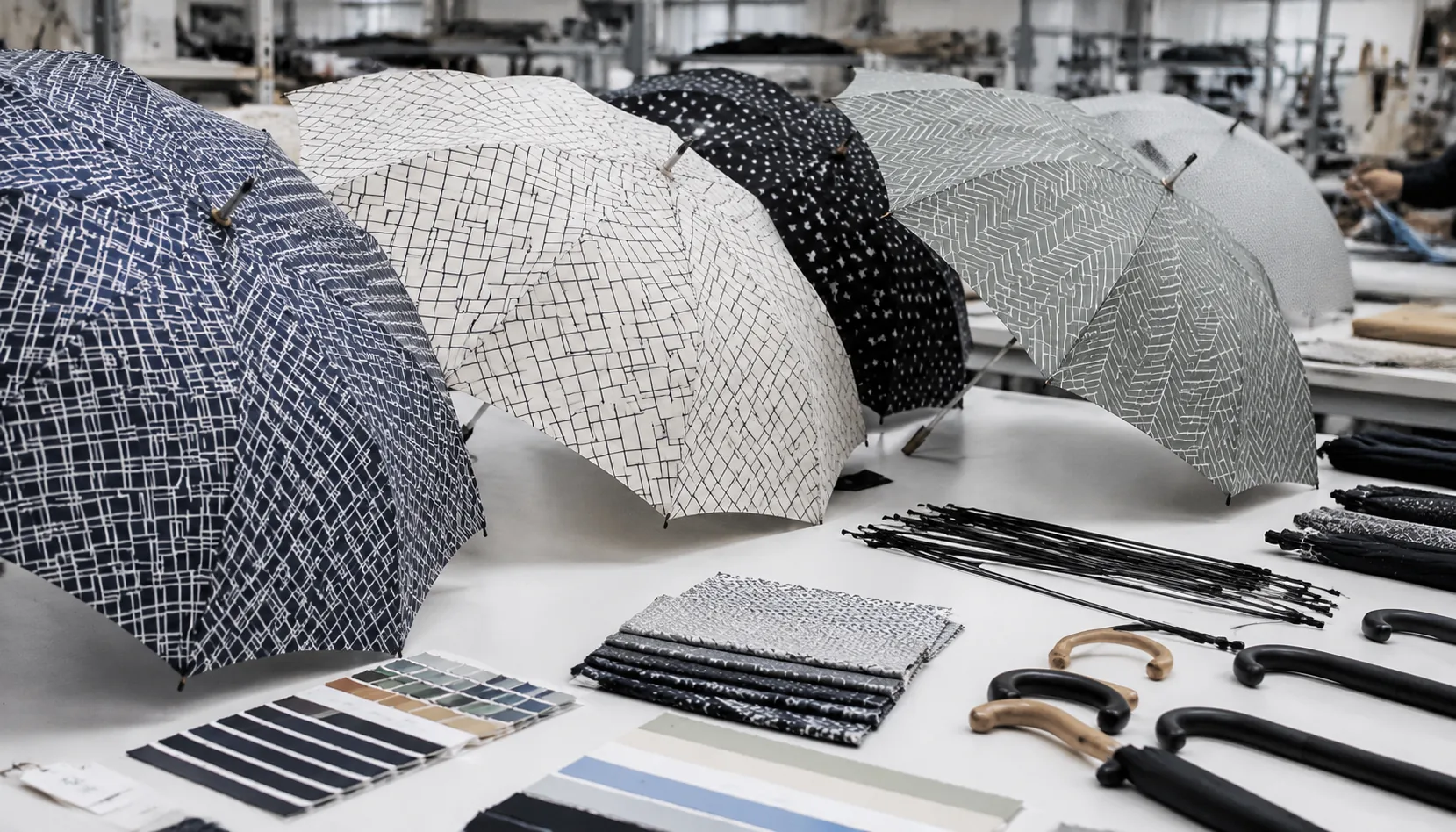
Repeat Pattern Umbrella Printing for Retail Collections
Plan repeat-pattern umbrella canopies for retail lines with panel layout, fabric choice, color control, sampling, MOQ, a...
Read More »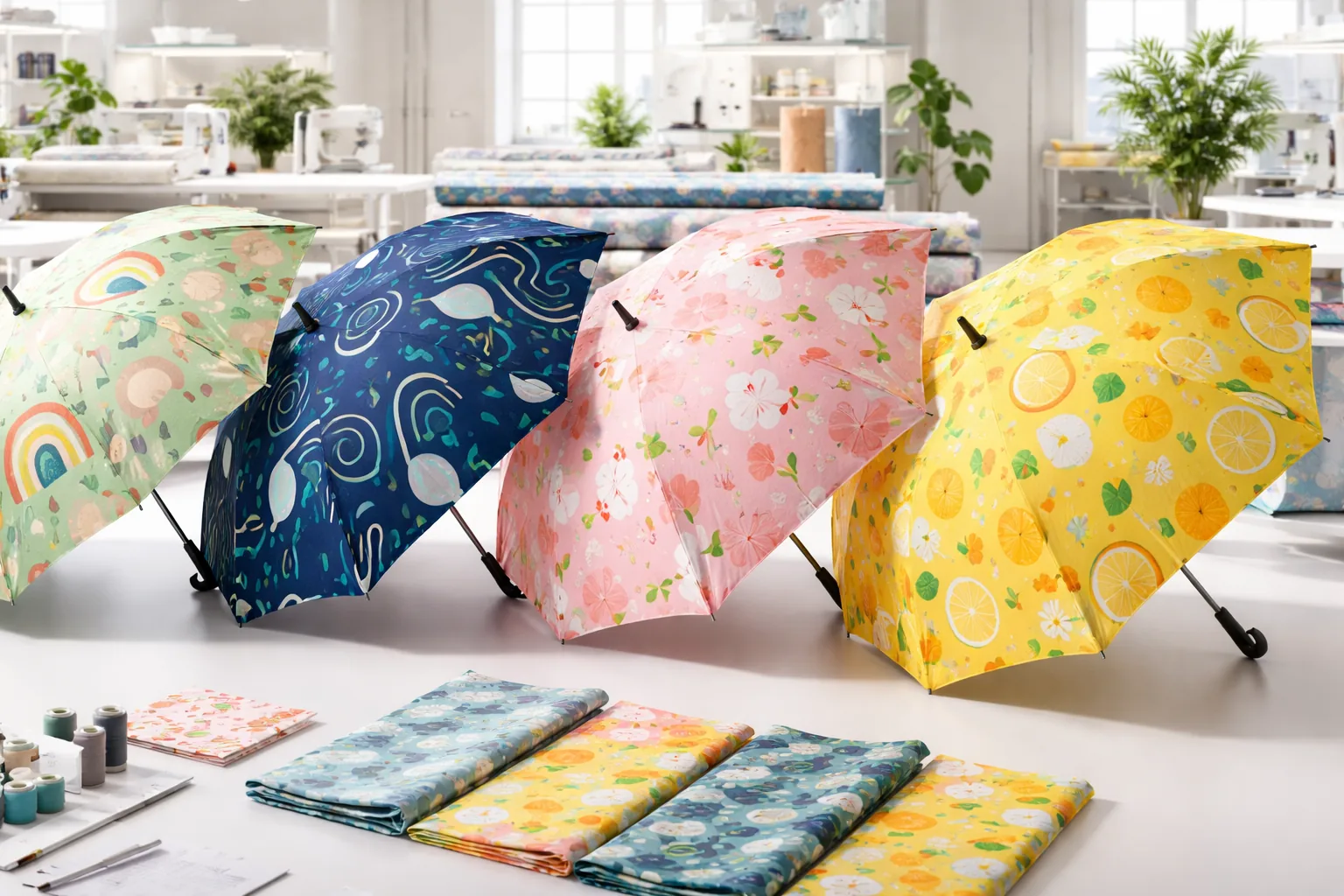
All-Over Pattern Umbrellas for Private Label Branding
Develop all-over pattern umbrellas with repeat artwork, panel matching, fabric specs, and QC controls for private label ...
Read More »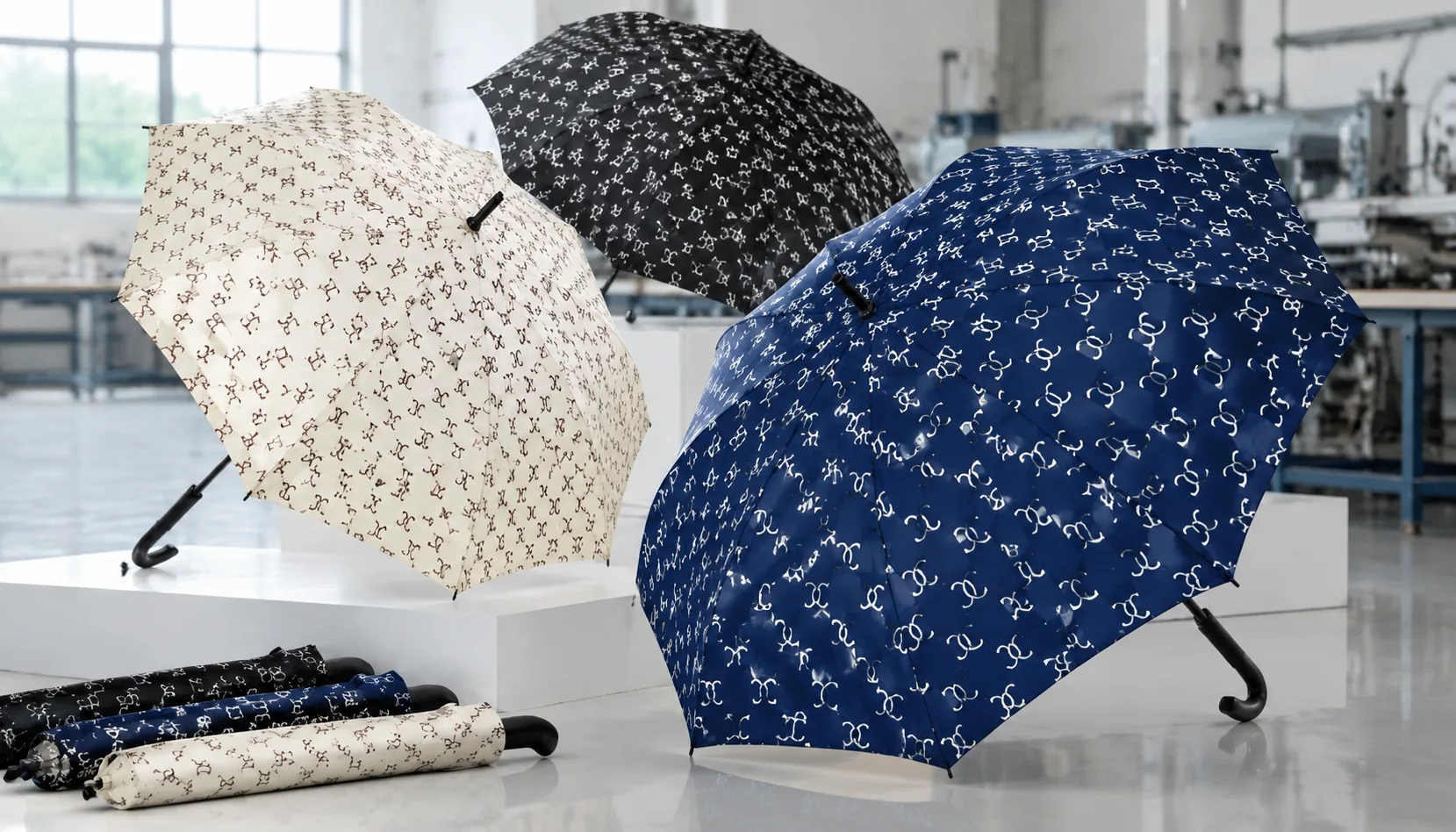
All-Over Logo Patterns for Retail Branded Umbrellas
Build all-over logo umbrella patterns with repeat sizing, panel registration, and fabric specs that reduce distortion, s...
Read More »