All-Over Pattern Umbrellas for Retail Brand Collections
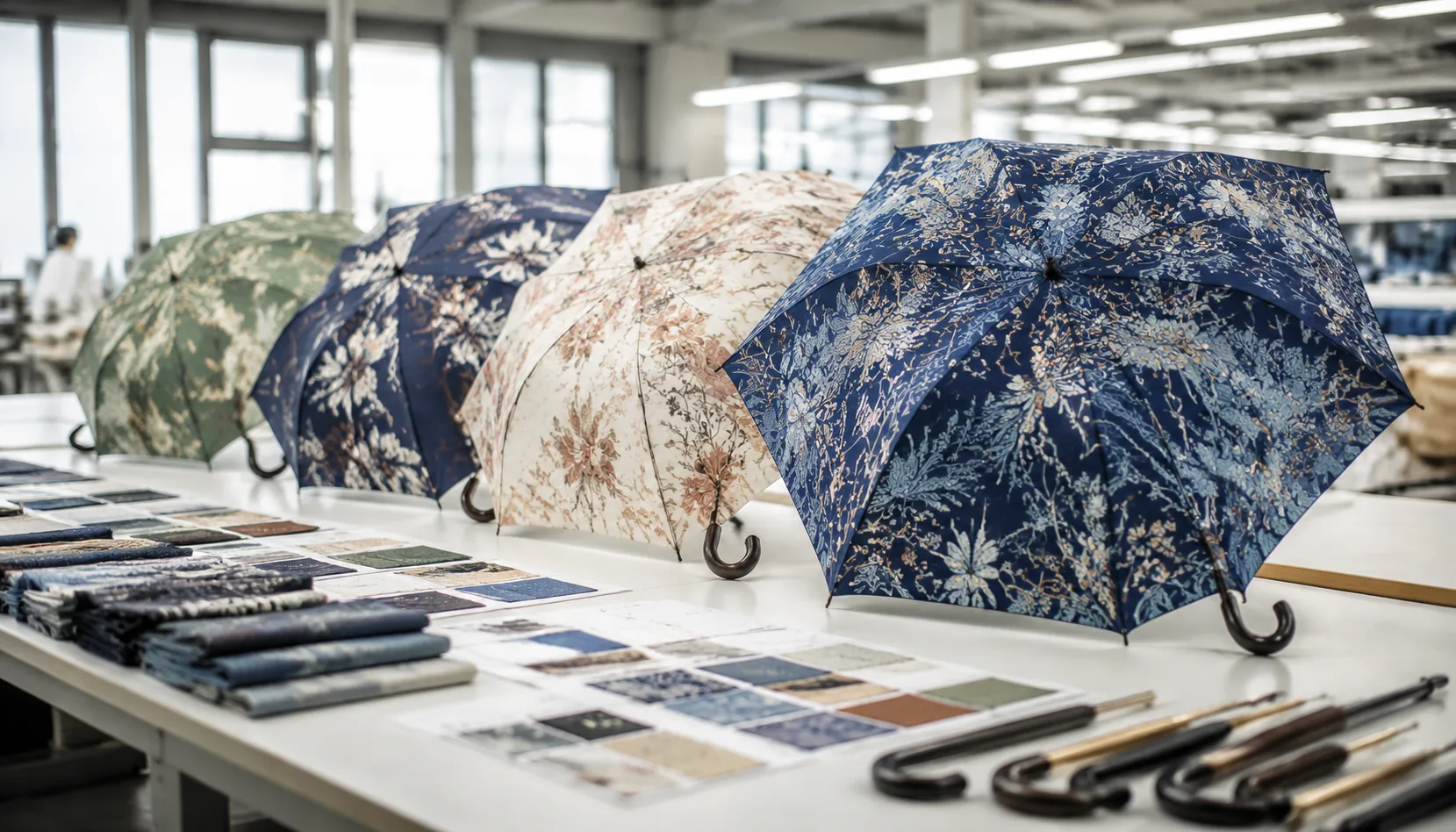
Retail buyers often approve a bold canopy artwork on screen, then lose impact when repeats break at panel seams, colors shift between 190T and 210T pongee, or the sample no longer matches bulk production. On our Songxia factory floor, all over pattern umbrellas are planned around panel cutting direction, print registration, rib alignment, and QC checkpoints from strike-off to pre-shipment, so the collection looks consistent on the rack and in the customer’s hand.
Pattern Strategy: Repeat, Engineered, or Panel-by-Panel
Seamless repeat artwork is the safest choice when the umbrella must look consistent from every angle on a retail wall, especially for fashion prints, kids’ graphics, florals, checks, and small icon systems. On 190T or 210T pongee, we usually keep the repeat large enough that it does not turn into visual noise after cutting; a 6–10 inch repeat works better than a tiny 1–2 inch repeat on a 23 inch straight umbrella. For all over pattern umbrellas, the hidden issue is not printing capability but panel geometry: each gore is a tapered triangle, so a perfect square repeat on the fabric roll becomes interrupted at every seam. On an 8K frame, the eight wider panels give the print more breathing room, but the seam break is more obvious. On a 16K frame, the pattern wraps more smoothly around the canopy, yet each panel is narrower, so oversized motifs can be chopped before the customer understands the design.
Centered motifs and engineered artwork should be used when the brand wants one strong image, not just surface decoration. A crest, mascot, slogan, monogram, or collection emblem must be positioned relative to the panel centerline, rib seams, and the front viewing angle; otherwise the logo lands half on a seam and half on a fold line. For branded patterned umbrellas, I prefer engineered placement on 8K layouts when logo readability matters, because each panel has enough width for a 3–5 inch mark without fighting the ribs. On 16K umbrellas, a centered motif needs either a smaller logo, a vertical composition, or a deliberate multi-panel spread. Umbrella panel printing also changes by method: screen printing is stable for bold one- or two-color motifs, heat transfer handles detailed logos, and sublimation is best when the entire canopy carries a photographic or tonal pattern. Registration tolerance should be agreed before sampling, usually within 2–3 mm on cut panels.
Alternating panel artwork is the practical middle ground for a retail umbrella collection that needs shelf impact without the cost and risk of a fully engineered canopy. Common layouts include four printed panels plus four solid panels on an 8K umbrella, or repeating A/B artwork across a 16K canopy for stripes, color blocking, brand icons, or seasonal capsule themes. The benefit is control: logos can sit on selected panels, while plain panels reduce visual overload and make the umbrella easier to merchandise beside bags, raincoats, or footwear. As an ODM umbrella manufacturer, our standard practice is to mock up the canopy as a flattened panel map before strike-off, because a pretty square artwork file tells you almost nothing about seam interruption, rib alignment, or fold visibility. For all over pattern umbrellas sold at retail, I would approve the print only after checking an open sample, a closed folded sample, and barcode-side display orientation; many designs fail when the umbrella is wrapped and only two panels are visible.
Fabric and Print Method Selection
Fabric choice decides whether all over pattern umbrellas look like retail merchandise or cheap giveaway stock. For most branded patterned umbrellas, 190T pongee is the practical baseline: tight enough for clean umbrella panel printing, light enough to fold neatly, and cost-efficient for 21-inch compact, 23-inch stick, and 27-inch golf models. On a 190T polyester pongee canopy, small geometric repeats, stripes, dots, and two- or three-color logos hold acceptable edge definition if the artwork is trapped correctly and the sewing allowance is respected. The hand feel is slightly thinner and crisper than 210T, which can be good for auto-open-close folders where bulk at the tips and runner matters. If the buyer wants a softer retail touch, richer black, or a premium shelf feel, 210T pongee is usually worth the upgrade, especially on 8K or 10K fiberglass frames where the product is positioned above basic promotional pricing.
210T pongee gives better saturation because the yarn density supports more even ink coverage and reduces the “grainy” look that sometimes appears on pale 190T fabric after coating. It also drapes better on larger 27-inch and 30-inch canopies, so the pattern does not look stretched over the ribs after final tensioning. The tradeoff is weight, drying time after finishing, and cost; a retail umbrella collection with 12 SKUs can feel the difference quickly when freight is calculated by carton volume and gross weight. For UPF 50+ or Teflon-coated programs, we normally confirm whether the coating is applied before or after printing, because the wrong sequence can reduce color fastness or water repellency. As an ODM umbrella manufacturer, our standard practice is to test one dark, one light, and one high-detail print strike-off before approving bulk fabric cutting.
Screen printing is still the right method for simple repeats, spot-color logos, checker patterns, and low-color artwork where the same design runs across 1,000 to 5,000 pieces. It gives strong opacity, stable colors, and lower unit cost once screens are made, but registration across eight panels must be controlled; a 2 mm shift at each seam becomes obvious on continuous lines. Digital printing is better for gradients, watercolor effects, detailed illustrations, photographic artwork, and all over pattern umbrellas with many SKUs or seasonal colorways. Sublimation on white pongee is especially useful for vivid fashion prints, but buyers should understand it cannot print true white and is less ideal on dark base fabric. For retail orders, I prefer digital sampling first, then a bulk pre-production canopy checked under AQL 2.5 before frame assembly, because print defects are far cheaper to catch before sewing and tip installation.
Artwork Files, Cutting Direction, and Seam Control
For all over pattern umbrellas, artwork control starts before fabric ever reaches the cutting table. I prefer vector files for logos, stripes, icons, and geometric repeats, with Pantone references and a separate layered PDF showing the intended scale on each umbrella panel. Raster artwork can work for sublimation, but it should be at least 150 dpi at full print size; anything lower will look soft on 190T or 210T pongee after coating and heat setting. A proper panel template must show the gore shape, rib line, tip allowance, top notch, bleed, and safe area. On an 8K 23-inch umbrella, a 5 mm bleed around each panel is usually enough, but complex repeats should allow 8–10 mm because fabric can shift during stacking, laser cutting, or hand trimming. Registration marks at the top, bottom, and rib-side edges help the sewing team align the print to the frame instead of guessing from the visual pattern.
Cutting direction matters more than many retail buyers expect. Woven pongee has a grain, and if one panel is rotated 180 degrees to save fabric, the color reflection and water-shedding behavior can look slightly different under store lighting. For branded patterned umbrellas, we normally keep the warp direction running from the top cap toward the tips, especially on 23-inch and 27-inch straight umbrellas where panel length makes distortion more visible. With POE, PVC, and EVA canopies, direction is less about woven grain and more about print stretch, gloss, and welding behavior. For umbrella panel printing by screen, heat-transfer, or sublimation, the factory should mark cutting direction directly on the production template and confirm whether the repeat is continuous around the canopy or simply centered panel by panel. A true continuous repeat across seams requires more fabric waste and slower sewing; it should not be quoted like a standard random repeat.
Seam control should be realistic, not promised like a luxury scarf. On mass production for a retail umbrella collection, a good ODM umbrella manufacturer should hold ordinary seam deviation around 2–3 mm, while complicated stripe matching or circular motifs may need an agreed tolerance of 3–5 mm at the rib seam. At the top cap, the visual error can look larger because eight or ten panels converge into a small area, so artwork should avoid placing faces, text, or perfect circles there unless the buyer accepts variation. Our standard practice at ZheBrella is to photograph the pre-production sample fully open, half open, and closed with the tie wrap fastened, because some patterns look fine open but become awkward when folded into eight stacks. Closed photos also reveal whether the brand mark is hidden under the overlap, whether stripes spiral unintentionally, and whether the sleeve print aligns with the canopy direction before AQL 2.5 inspection begins.
Frame Specs That Support Retail Positioning
Frame choice is what separates a pattern program from a pile of printed umbrellas. For value retail lines, I usually specify a 23" or 27" straight umbrella with 8K steel ribs, a steel shaft, manual or basic auto-open runner, and 190T pongee canopy. That build keeps cost controlled for supermarket, museum shop, and seasonal promo racks, while still giving enough panel area for repeat florals, checks, animal prints, or licensed artwork. On all over pattern umbrellas, the print must wrap cleanly across eight triangular panels, so the frame cannot twist badly after opening; cheap ribs with loose rivets make the pattern look misaligned even when the sewing is correct. For entry-tier branded patterned umbrellas, matte plastic J handles or EVA crook handles can be matched to one dominant Pantone from the canopy, which makes a low-cost product look planned instead of assembled from stock parts.
Premium retail umbrella collection work needs a stronger frame because customers judge the print and the hand feel together. Fiberglass ribs, fiberglass or aluminum shafts, and double-canopy vented windproof construction are the better choice for 23" compact golf styles, 27" walking umbrellas, and 30" golf umbrellas aimed at department stores or outdoor lifestyle brands. A good 8K fiberglass frame can survive typical 35–45 mph gust testing, while a reinforced 10K or 16K windproof build with flexible tips and a vented canopy can be engineered for 50+ mph performance depending on size and rib section. The 16K layout also changes the visual density: instead of eight large artwork panels, the canopy becomes sixteen narrower wedges, which suits small geometrics, tartans, and radial motifs. For all over pattern umbrellas with photographic or complex artwork, we normally check strike-off panels before bulk cutting because 16K umbrella panel printing magnifies repeat-registration mistakes.
Commuter ranges sit between value and premium, and the mechanism matters as much as the ribs. A 21" or 23" 3-fold auto-open-close umbrella with fiberglass-reinforced ribs, black electroplated shaft, 210T pongee canopy, and Teflon water-repellent finish is a practical SKU for office workers and travel retail. Auto-open straight umbrellas still work well for boutique collections, but auto-open-close compact frames need tighter QC on spring force, runner lock, and closing fatigue; our standard inspection uses function cycling plus AQL 2.5 final checks before export cartons are sealed. As an ODM umbrella manufacturer, we treat handle color coordination as part of the frame spec, not decoration: soft-touch handles, wooden crooks, rubberized grips, wrist straps, tips, ferrules, and sleeve piping should all support the same retail story. That detail helps umbrella panel printing read as a designed collection rather than a logo slapped onto stock inventory.
MOQ, Lead Time, and Inspection Checklist
MOQ should be set by the printing process, not by a sales slogan. For screen-printed umbrella panel printing, a practical factory MOQ is usually 500–1,000 pcs per artwork because each color needs separate film, screen setup, and ink adjustment; below that, the setup cost gets ugly. Heat-transfer logos can start around 300–500 pcs when the repeat pattern is limited to selected panels, but full-canopy transfer normally needs 800–1,200 pcs to control waste. Digital sublimation on 190T or 210T pongee is the most flexible for all over pattern umbrellas, often workable from 300 pcs per design if the buyer accepts CMYK color tolerance and pays the higher unit cost. For PVC, POE, and EVA canopies, MOQ depends more on film thickness and roll width, commonly 1,000–3,000 pcs. A retail umbrella collection with 3–6 patterns should lock shared frame specs first: 23 inch 8K auto-open, 21 inch compact auto-open-close, or 27 inch golf frame, then vary print artwork only.
A realistic timeline starts with artwork checking, not cutting fabric. We normally need 2–3 days to review repeat files, Pantone targets, panel layout, handle color, woven label, barcode, and export carton marks. Strike-off or pre-production samples take 7–10 days for sublimation, 10–14 days for screen printing, and 12–18 days if a custom molded handle, special ferrule, or matching sleeve fabric is involved. After sample approval, bulk production for branded patterned umbrellas is typically 25–35 days for 500–3,000 pcs, and 35–50 days when the order includes 10K or 16K frames, double-canopy vented windproof construction, UPF 50+ coating, Teflon water-repellent finish, or multiple retail pack variants. FOB Ningbo or Shanghai shipment can move shortly after final inspection, while DDP delivery needs extra time for booking, customs data, duties, and last-mile routing. Our standard practice at ZheBrella is to freeze artwork, frame BOM, packaging layout, and carton marks before fabric printing starts, because late changes after cutting create mismatched panels and dead stock.
Inspection needs to catch visual defects and mechanical failures before cartons leave Songxia, especially for all over pattern umbrellas where a small registration shift repeats across every panel. For AQL 2.5 final inspection, the checklist should include print position tolerance between panels, color consistency against the approved sample, ink bleeding, white streaks, ghosting, fabric stains, oil marks, loose threads, canopy seam puckering, and tip alignment. Mechanical checks should open and close every sampled umbrella several times, confirming runner movement, spring response, rib alignment, shaft straightness, safety cap fit, and no broken fiberglass or bent steel ribs. For compact models, auto-open-close force should be consistent; for golf umbrellas, the inspector should check rib tension, vent stitching, and windproof frame recovery after inversion. Packaging review is just as important for an ODM umbrella manufacturer: sleeve match, hangtag, barcode scan, silica gel if required, polybag warning text, inner carton quantity, master carton weight, shipping marks, PO number, destination label, and carton drop condition for FOB or DDP delivery.
Frequently Asked Questions
Can one all-over pattern be used across folding and golf umbrellas?
Yes, but it must be re-scaled for each panel template. A 21-inch 8K folding umbrella and a 30-inch 8K golf umbrella need separate strike-offs to check motif size and seam placement.
Is digital printing better for retail pattern collections?
Digital printing is usually better for multi-color artwork, gradients, and low-SKU testing. Screen printing can be more cost-effective for high-volume simple repeats with limited colors.
Can engineered patterns be aligned across umbrella panels?
Yes, engineered layouts can be aligned at key panel joins, but exact matching depends on canopy size, rib count, fabric stretch, and cutting tolerance. For retail orders, expect a small positional tolerance of about 3–5 mm unless a stricter QC standard is agreed before sampling.
What artwork files are needed for all-over pattern umbrella sampling?
Factories typically need AI, PDF, or PSD files with Pantone or Lab color references, repeat size, logo placement, and a panel template if the pattern is engineered. A digital mockup can be made first, followed by a strike-off or full umbrella sample for color and join approval.
What MOQ should retail buyers expect for branded patterned umbrellas?
MOQ commonly starts around 500–1,000 pieces per design for standard 190T or 210T pongee umbrellas, depending on frame type and printing method. If each colorway uses different artwork, suppliers may count each colorway as a separate design for MOQ and setup costs.
Looking to Launch Your Custom Umbrella Line?
ZheBrella is a Zhejiang-based OEM/ODM umbrella manufacturer with 17 years of export experience. Free design, low MOQ from 100 pieces, windproof construction, full-color print.
Get Free Quote Now »People Also Search For
Related Articles
All-Over Pattern Printing for Retail Umbrella Collections
Build retail umbrella patterns with clean repeats, controlled panel alignment, and fabric choices that keep logos sharp ...
Read More »
All-Over Pattern Printing for Branded Umbrella Programs
Build repeat-pattern umbrella programs with print-ready artwork, panel planning, fabric choices, and QC steps that prote...
Read More »
Repeat Pattern Umbrella Printing for Branded Collections
Plan repeat logo, monogram, or pattern umbrellas with clear rules for panel layout, fabric choice, sampling, MOQ, and pr...
Read More »