Repeat Pattern Umbrella Printing for Branded Collections
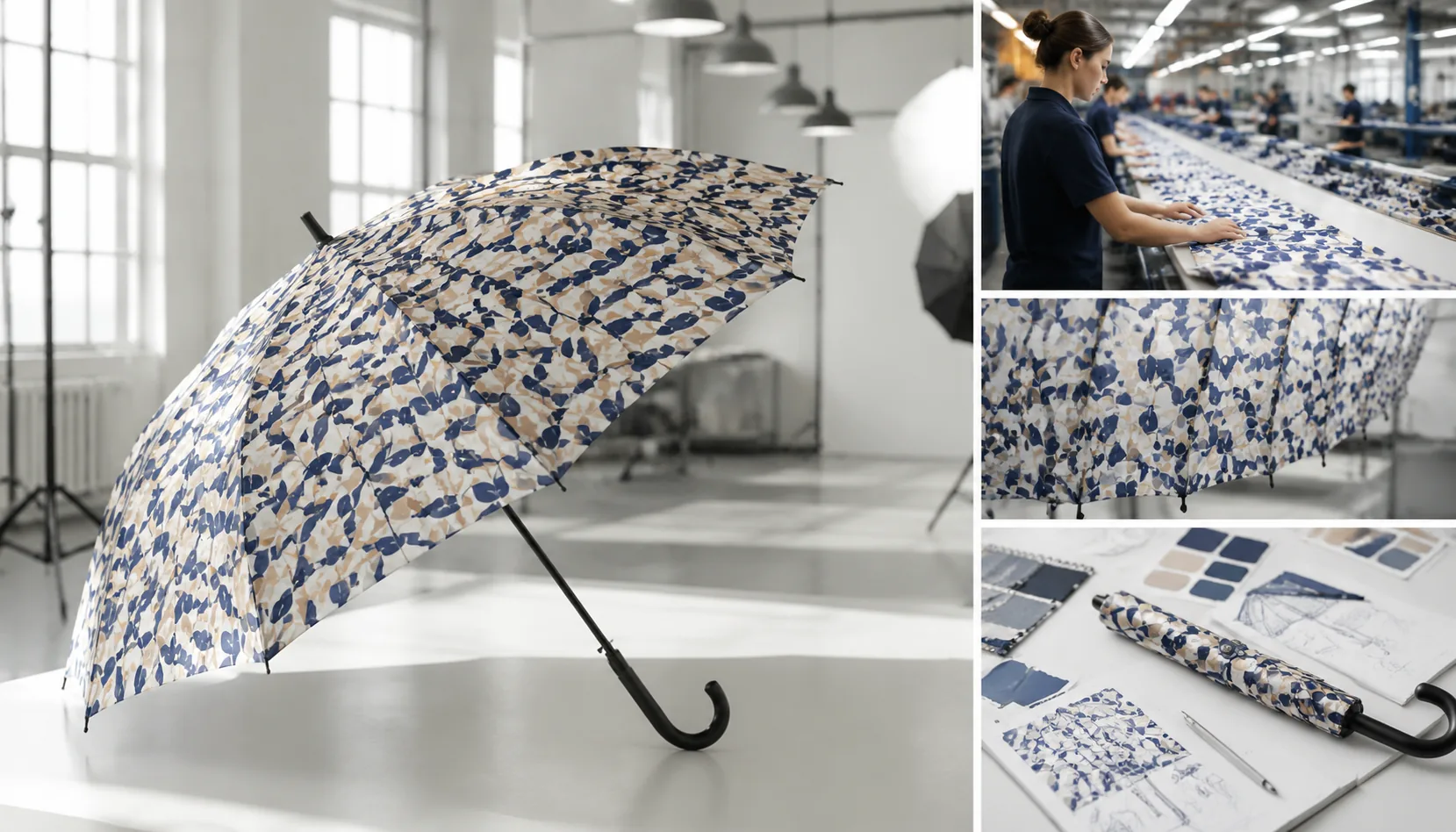
For branded collections, repeat pattern umbrella printing looks simple on a mockup but gets complicated once the artwork is cut into eight panels, sewn on bias, and stretched over ribs. A logo repeat that is not scaled, registered, and checked against fabric shrinkage can drift at seams or disappear under the tie strap. On our Songxia factory floor, we plan the print, fabric, sample, MOQ, and inspection points together so buyers approve a design that can actually run cleanly in bulk.
Designing Repeat Patterns Around Umbrella Panels
The first mistake in repeat pattern umbrella printing is treating the canopy like a flat poster. An 8K umbrella has eight triangular panels, so every branded umbrella pattern is cut into wedges and interrupted by eight sewn seams sitting over ribs. A 16K frame doubles that interruption: the panels are narrower, the arc looks smoother when opened, but the artwork has 16 chances to drift if the repeat is not engineered. On a standard 23 inch stick umbrella, each panel may be roughly 17 to 19 inches along the bottom edge but tapers sharply toward the top notch, so a motif that looks continuous in a CAD square can pinch, rotate, and break near the cap. For retail umbrella design, we normally build the repeat from the panel template outward, not from a generic fabric roll repeat. That means checking the visual flow across seam allowances, rib pockets, tie wrap placement, and the top ferrule area before sampling.
Scale decides whether an all over umbrella print looks intentional or cheap. Small monograms, dots, mini florals, and micro icons are forgiving because a 2 to 4 mm sewing tolerance at the seam does not destroy the visual logic. Large geometric repeats are much less forgiving: a 40 mm stripe, checker, diamond, or herringbone can visibly jump when two panels are sewn with even slight fabric stretch or operator variation. On 190T or 210T pongee, sublimation gives clean custom canopy graphics, but the fabric still moves during cutting, especially if the factory stacks too many layers under the cutting knife. Screen printing can be more stable for simple one- or two-color repeats, but registration across separate panels still needs panel-by-panel positioning marks. If the buyer wants a bold luxury pattern, I push for either intentional seam breaks or a radial design, not a fake continuous repeat that depends on perfect sewing.
Safe zones matter because ribs and seams are not just lines on a drawing; they are raised structures that distort print visibility. I keep critical logos, readable text, and recognizable icons at least 15 to 20 mm away from rib seams, and more on heavy frames such as 27 inch golf umbrellas with 8K fiberglass ribs or double-canopy windproof construction. Near the outer hem, allow for 8 to 12 mm folding and stitching loss; near the top, avoid tight detail because the fabric is compressed under the cap and runner tension. For 16K branded collections, the safer approach is a smaller repeat with no single hero element crossing multiple panels. At ZheBrella, our standard practice is to print a paper panel proof first, then run one opened canopy sample before bulk cutting, because AQL 2.5 inspection will catch stains and broken stitches, but it will not rescue a pattern that was mathematically wrong from the start.
Choosing Fabric and Print Method for Pattern Clarity
Pattern clarity starts with fabric density, not the printer. For repeat pattern umbrella printing, 190T pongee is the safe commercial baseline: tight enough for clean custom canopy graphics, light enough to fold well on 21" and 23" compact umbrellas, and stable under heat-transfer or digital print curing. 210T pongee gives a smoother hand and slightly sharper edges, especially on fine geometric branded umbrella patterns, but it costs more and can show sewing tension if the cutting and panel matching are careless. Standard polyester is cheaper, but the yarn texture is rougher; small type, thin outlines, and diagonal repeats can feather after coating. Recycled PET pongee has improved a lot, but batch consistency matters because recycled yarn can vary in whiteness and absorbency, which changes color depth across panels. For retail umbrella design, I ask buyers to approve fabric swatches and a printed strike-off before locking Pantone targets.
Digital printing is the better choice when the artwork has gradients, photographic elements, watercolor effects, or complex repeats that must run across all eight panels without obvious breaks. Sublimation on white polyester or pongee gives strong penetration and keeps the canopy soft, making it suitable for an all over umbrella print where the design wraps from tip to edge. Heat-transfer digital printing can handle rich color on smaller MOQs, often 300 to 500 pieces, but heavy ink areas may slightly stiffen the canopy if the transfer film is too thick. For UPF 50+ or Teflon-coated canopies, print order matters: printing before final water-repellent finishing usually gives better adhesion, while printing over aggressive coatings risks weaker rub resistance. Our standard practice at ZheBrella is to test wet crocking, dry rubbing, and fold-line cracking before bulk production.
Screen printing still wins when the repeat uses one to four solid colors and the order is large enough to absorb screen setup costs. On 190T or 210T pongee, a well-made screen can produce very clean logo repeats, stripes, dots, and monogram layouts with strong opacity, especially on black, navy, or red canopy fabric where digital color can look muted. The limitation is registration: each umbrella panel is cut on a bias curve, so fine multi-color alignment across seams is harder than it looks on a flat artwork file. For 8K and 10K frames, panel distortion is manageable; on larger 27" or 30" golf umbrellas, the print area grows and seam-to-seam matching becomes more visible. For volume orders above 1,000 to 3,000 pieces, screen printing often gives the best unit cost and durability, while digital remains the practical route for complicated repeats, seasonal collections, and lower-risk sample runs.
Managing Color Consistency Across Multi-SKU Lines
Color control in repeat pattern umbrella printing starts before artwork is stepped into panels. A buyer should provide Pantone TCX or TPX references for fabric color and Pantone C/U references for printed ink, because coated-paper logo colors often shift when they hit 190T or 210T pongee. For retail umbrella design, I ask for a master color sheet that separates ground color, logo color, trim color, handle color, sleeve print, strap label, hangtag, and carton mark. Lab dips are useful for dyed canopy fabric, but they are not enough for an all over umbrella print; you still need a strike-off on the actual canopy material with the chosen coating, whether Teflon water-repellent, black UV backing, or UPF 50+ silver coating. Coatings change color temperature. A navy on plain pongee can look acceptable, then turn slightly gray once a UV layer is added underneath.
Tolerance expectations should be written by color type, not treated as one generic approval. Dark colors such as black, navy, bottle green, and burgundy usually hide minor Delta E movement, but they show poor ink coverage, pinholes, and panel-to-panel shade bands under daylight inspection. Light colors like ivory, pale yellow, mint, and sky blue are less forgiving because the steel or fiberglass rib shadow can show through thin fabric, especially on 21" and 23" compact umbrellas. Saturated canopy colors—orange, royal blue, red, and purple—need the most discipline because sublimation, screen printing, and heat transfer each hit a different gamut. For branded umbrella patterns, I normally recommend approving under D65 daylight plus one indoor light source, then locking a signed strike-off as the production reference.
Matching across canopy, sleeve, strap, and packaging is where many multi-SKU programs drift. The sleeve is often cut from the same printed roll, so it should match closely, but woven straps, rubberized handles, EVA pouches, paper belly bands, and kraft cartons will never match the canopy exactly. For custom canopy graphics, the practical approach is to define priority: canopy first, sleeve second, visible retail packaging third, shipping carton last. Our standard practice at ZheBrella is to keep approved lab dips, strike-offs, and bulk cuttings together in the QC file, then check incoming fabric, first-piece sewing, and final AQL 2.5 inspection against the same references. If a line includes 8K stick umbrellas, 10K auto-open models, and 16K windproof double-canopy versions, each SKU should still be checked from its own production roll, not assumed correct from the first approved item.
Sampling, MOQ, and Lead Time Planning
Repeat pattern umbrella printing needs tighter sampling discipline than a single-panel logo because every panel seam can expose a layout mistake. The first step is artwork review: we check file format, color mode, repeat tile size, bleed, and whether the motif should align across 8K, 10K, or 16K panels. For pongee 190T/210T, polyester, or POE/PVC/EVA canopies, the print method also changes the artwork limits; sublimation handles full-color all over umbrella print well, while screen printing is cleaner for 1–3 solid colors. After review, we issue a digital mockup showing rib position, panel direction, top cap area, and handle orientation. For branded umbrella patterns, I always recommend approving both the flat canopy layout and a 3D view, because a nice rectangle repeat can look crowded once cut into triangular panels.
A printed strike-off is the next serious checkpoint, and it should not be skipped for retail umbrella design. A strike-off confirms color, line sharpness, coating reaction, and fabric hand feel before we build the full umbrella. Dark grounds on 190T pongee may need heavier ink coverage, while UV UPF 50+ or Teflon-coated fabric can shift color slightly after finishing. Once the strike-off is signed, we make a pre-production sample using actual frame parts: 21 inch or 23 inch compact, 27 inch golf, or 30 inch oversize; steel ribs, fiberglass ribs, or double-canopy vented windproof construction; manual, auto-open, or auto-open-close mechanism. This sample checks not just custom canopy graphics, but also seam placement, rib binding, tips, runner movement, sleeve print, carton marks, and barcode labeling if the order is for retail.
MOQ depends on fabric, frame, and printing method. For repeat pattern umbrella printing on standard pongee with existing 8K or 10K frames, a practical MOQ is often 300–500 pieces per design; custom POE dome umbrellas, 16K fashion frames, Pantone-dyed fabric, or exclusive molded handles usually push MOQ to 1,000 pieces or more. Approval cycles are usually longer than logo umbrellas: artwork review and mockup take 1–3 days, strike-off 5–7 days, pre-production sample 7–12 days, and bulk production 25–40 days after approval, depending on season and order size. Our standard practice at ZheBrella is to inspect bulk goods under AQL 2.5 for critical visual and functional points: print registration, stains, broken stitches, loose tips, bent ribs, opening force, water repellency, and carton drop condition. For export planning, add 3–5 days for final QC and booking before FOB Ningbo or Shanghai, and more buffer for DDP shipments.
Production Checks That Prevent Visible Pattern Errors
The biggest visible failures in repeat pattern umbrella printing usually start before ink touches fabric: panel orientation and seam matching. A standard 8K umbrella has eight wedge panels, and every panel must be cut from the roll with the motif direction marked at the notch, otherwise logos, stripes, or floral repeats can rotate panel by panel and look cheap when opened. For branded umbrella patterns, we require a printed strike-off plus a full-size paper cutting marker, not just a PDF mockup, because a 23" canopy and a 30" golf umbrella distort the same artwork differently near the top cap. On 190T or 210T pongee, a 2-3 mm seam allowance can hide small registration drift, but geometric all over umbrella print layouts need tighter control. Before bulk cutting, the sewing supervisor opens one complete canopy and checks the center point, ferrule area, panel-to-panel repeat, and whether any text or mascots land upside down when the umbrella is held in normal walking position.
Frame interference is the second check buyers underestimate, especially on auto-open and auto-open-close umbrellas. The ribs are not invisible: steel ribs can create hard pressure lines under the canopy, while fiberglass ribs flex more smoothly but still affect how custom canopy graphics appear under tension. On 8K and 10K frames, we check whether important motifs sit directly over rib tips, runner contact points, or the tie-wrap position; on 16K fashion umbrellas, the smaller panels make repeat scale even more sensitive. Auto-open frames need an open-close cycle test before final approval because the canopy snaps into tension and can reveal skewed seams that looked acceptable on the sewing table. Double-canopy vented windproof styles add another risk: the upper vent layer must align visually with the lower canopy, and the overlap cannot cut through faces, logos, QR codes, or retail umbrella design elements. Our standard practice at ZheBrella is to inspect the vent gap while the frame is locked open, not flat on the bench.
Print defects need to be judged under production conditions, not only under office lighting. For screen printing, we watch for pinholes, ink buildup along seam allowances, and color shift after water-repellent or Teflon coating; for heat-transfer and sublimation, we check ghosting, edge blur, and heat press marks near the panel tips. POE, PVC, and EVA transparent canopies have different risks because dust, roller scratches, and trapped static show immediately, while dark pongee can hide small flaws until the umbrella is opened against daylight. Final inspection should follow AQL 2.5 for major defects, with opened-canopy checks pulled from packed cartons, not only loose samples. For FOB and DDP shipments, packing is part of quality control: each umbrella must be dried, sleeved without twisting the pattern, labeled by SKU, and carton-packed so rib tips do not crush neighboring canopies during 30-45 days of ocean transit. A clean repeat at the sewing line means little if the pattern arrives creased, rubbed, or distorted in retail cartons.
Frequently Asked Questions
Can a repeat pattern line up perfectly across every umbrella panel?
Not usually. Umbrella panels are cut and sewn with curved seams, so buyers should allow controlled breaks at ribs and avoid designs that require exact cross-panel registration.
Is 190T or 210T pongee better for branded repeat prints?
210T pongee generally gives a smoother, denser surface for sharper graphics, while 190T can be more cost-effective for promotional runs. The right choice depends on print detail, target price, and order volume.
How do you keep a repeat pattern aligned across umbrella panels?
We map the artwork to the panel template before sampling so seam breaks and repeats land in the correct positions. For most 8-panel canopies, the print file is adjusted per panel, and we confirm one physical sample before mass production.
What MOQ is typical for branded umbrella pattern orders?
For repeat pattern or all-over printed umbrellas, MOQ is often 500-1,000 pieces per design, depending on canopy fabric, print method, and frame type. If the design uses custom colors or multiple sizes, the minimum may be higher.
Which print method is best for dense logo or monogram patterns?
Sublimation works well on polyester for full-coverage graphics and fine repeats, while screen printing is better for simpler spot patterns. We usually recommend a pre-production sample to check color density, seam visibility, and ink bleed before approval.
Looking to Launch Your Custom Umbrella Line?
ZheBrella is a Zhejiang-based OEM/ODM umbrella manufacturer with 17 years of export experience. Free design, low MOQ from 100 pieces, windproof construction, full-color print.
Get Free Quote Now »People Also Search For
Related Articles
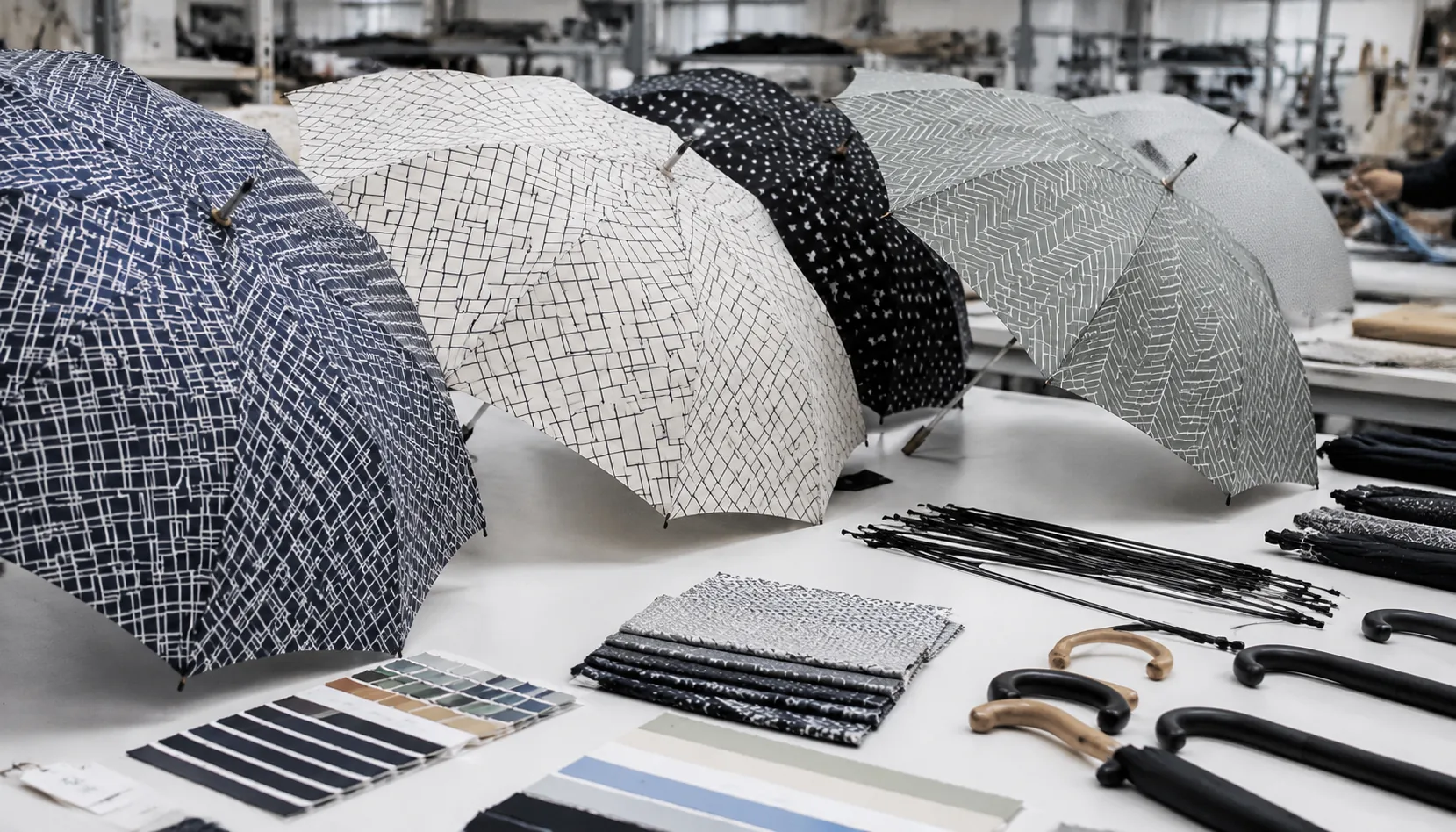
Repeat Pattern Umbrella Printing for Retail Collections
Plan repeat-pattern umbrella canopies for retail lines with panel layout, fabric choice, color control, sampling, MOQ, a...
Read More »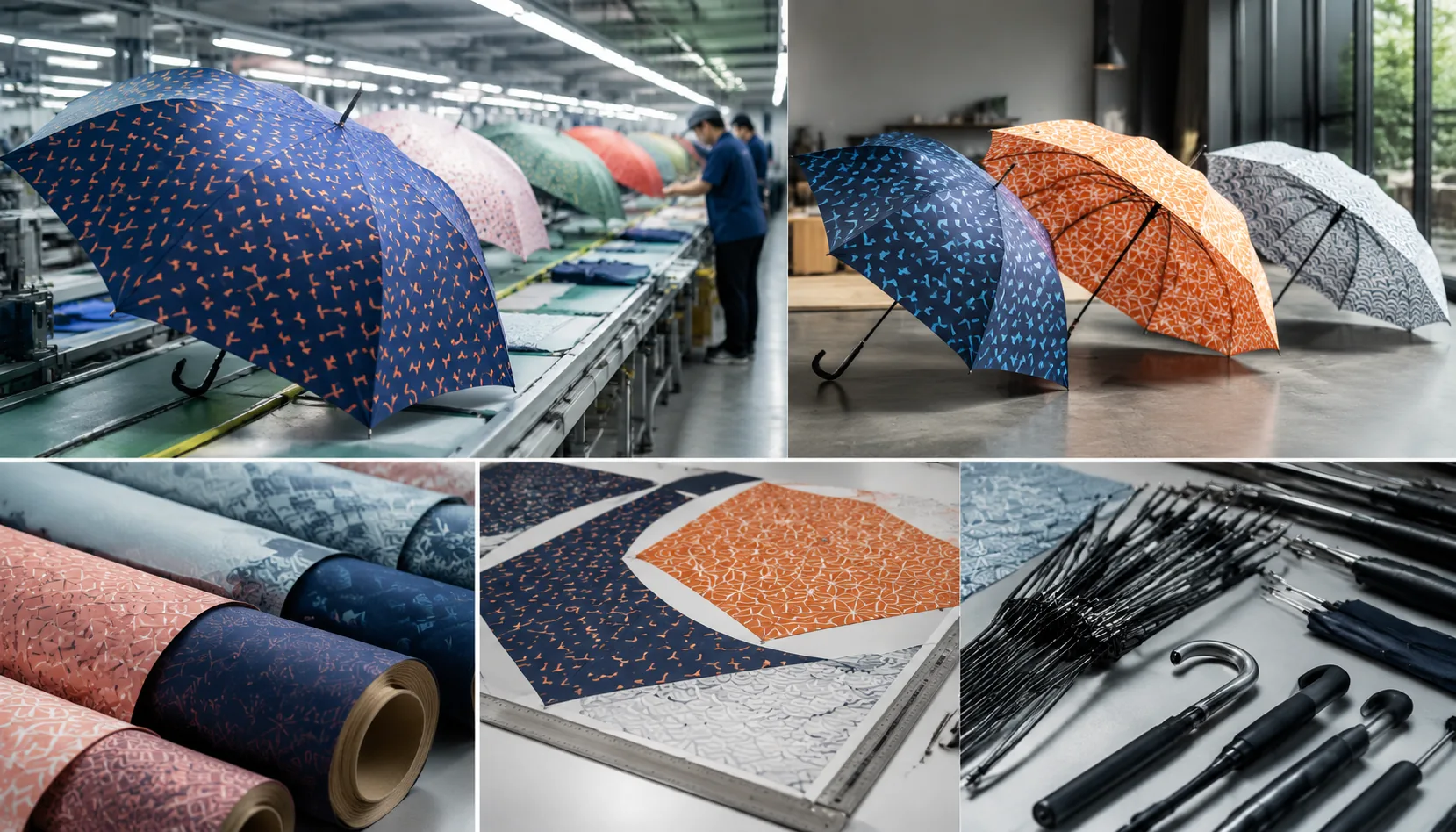
All-Over Pattern Printing for Branded Umbrella Programs
Build repeat-pattern umbrella programs with print-ready artwork, panel planning, fabric choices, and QC steps that prote...
Read More »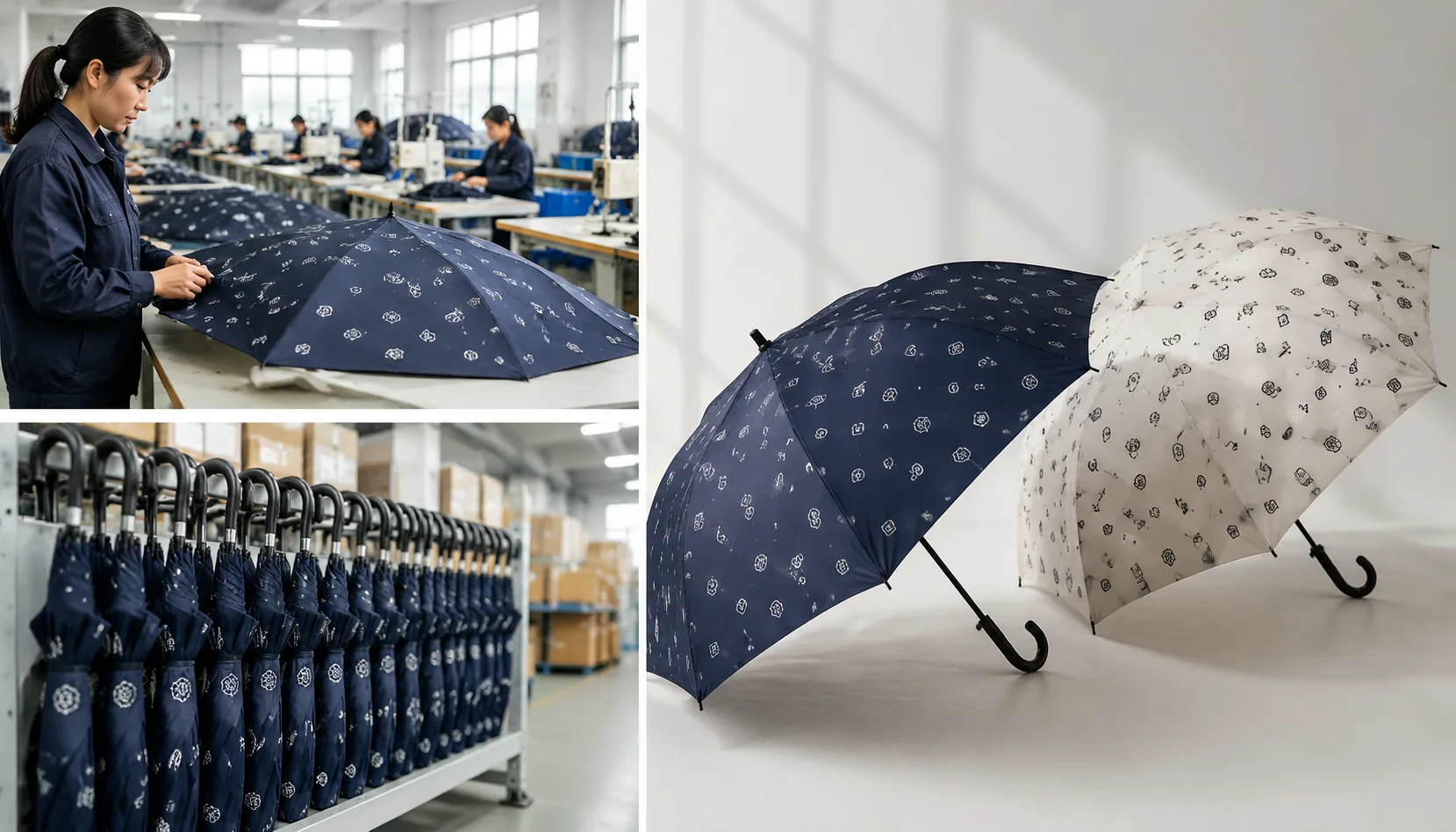
Repeat Logo Pattern Printing for Branded Umbrella Lines
Plan repeat logo umbrella prints with panel layout, fabric choice, sampling, and QC controls for retail, promo, and priv...
Read More »