Gradient Umbrella Printing for Retail and Event Branding
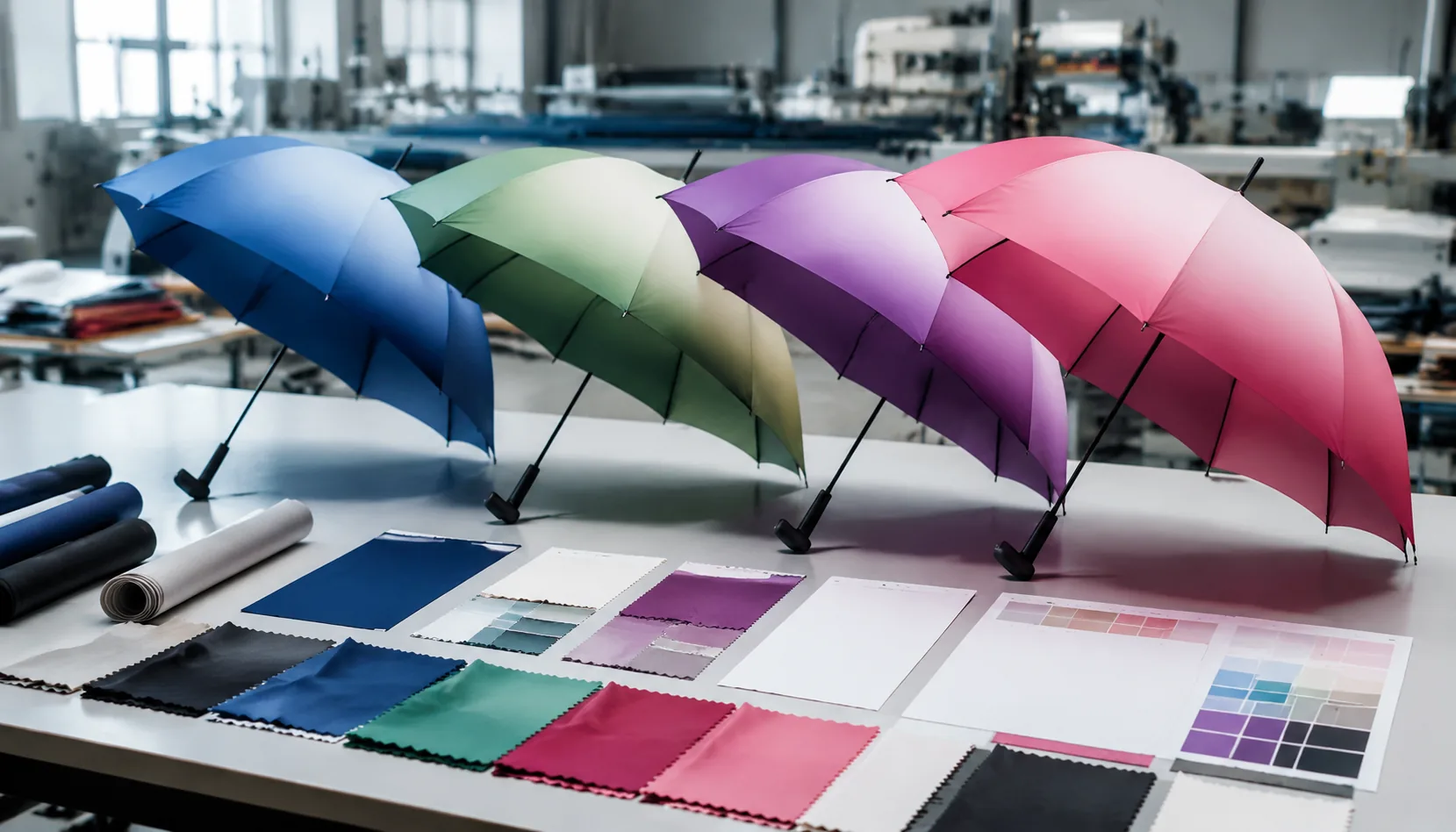
For retail launches and event giveaways, a gradient canopy can look premium in a mockup but fail fast if the artwork, fabric coating, and panel alignment are not controlled together. On our Songxia production floor, gradient umbrella printing is treated less like a standard logo job and more like a color-management process, with attention to ink limits, seam placement, and how the shade shifts once the canopy is stretched on the frame.
When Gradient Branding Makes Sense
Gradient branding makes the most sense when the umbrella is part of a color story, not just a logo carrier. For retail umbrella color design, I like gradients on 21" and 23" compact models for fashion drops, resort collections, and seasonal merchandising where the canopy has to sit beside apparel, bags, or drinkware without looking like a cheap promo item. A soft navy-to-sky fade on 190T pongee with a small woven label can feel more retail-ready than a full-panel logo repeat. For spring launches, pastel transitions work well on 8K fiberglass frames; for outdoor and travel lines, darker edge fades hide dirt better and photograph cleaner after real use.
Event umbrella branding is different: the umbrella has to read from 20 to 50 feet away and survive handling by people who did not buy it. Sponsor activations, music festivals, golf days, and city pop-ups usually need stronger contrast, larger logo zones, and a clear top-view composition for drone or balcony photos. This is where gradient umbrella printing can move from subtle brand fades into high-impact multi-color campaign graphics. On a digital print umbrella canopy, we can run full-panel CMYK gradients, but I still recommend reserving clean logo space on at least two opposite panels so the mark does not disappear across a busy transition.
Branded gradient umbrellas are also useful when several sponsors or product lines need to share one item without making the canopy look like a trade-show backdrop. A controlled two-color fade can carry the master brand, while handle color, sleeve print, or a single heat-transfer panel identifies the event or collection. For retail, we normally sample gradients under daylight and indoor LED because purple, teal, and orange shifts can look different after water-repellent coating. For events, I would prioritize a 23" or 27" auto-open frame with 210T pongee, AQL 2.5 inspection, and pre-production strike-off approval before cutting bulk fabric.
Best Umbrella Specs for Smooth Gradients
The cleanest gradient umbrella printing starts with the fabric, not the artwork. For most retail and event programs, I prefer 190T or 210T pongee because the weave is tight enough to hold fine tonal steps but still light enough for regular 21", 23", and 27" frames. A white base fabric gives the ink room to build color accurately; printing a sunset fade or two-color corporate blend on navy, black, or red stock panels usually muddies the middle tones. Dark fabric absorbs the lower-density ink areas, so the gradient looks like a hard band instead of a smooth transition. If the order is for branded gradient umbrellas with a premium retail finish, 210T pongee is worth the small upcharge because it feels denser in hand and reduces pinhole sparkle under strong light.
Digital printing is usually the better process for a digital print umbrella canopy when the design has soft fades, photographic clouds, radial color bursts, or multiple brand colors crossing each panel. Screen printing is still excellent for solid logos, one- to three-color marks, and large event umbrella branding, but it struggles with smooth 0–100% tonal ramps unless you accept visible halftone dots. Heat transfer can work for smaller panels or logo zones, yet full-panel gradients can feel slightly heavier and may show edge marks if the press temperature is not controlled. Our standard practice at ZheBrella is to print test strips across the warp and weft direction before bulk cutting, because the same artwork can shift slightly once eight 8K panels are sewn into a dome.
Coatings need to be decided before color approval because they change how the eye reads depth. A UPF 50+ treatment, especially silver or black UV backing, can make colors look richer from the outside but may reduce light transmission, so pale gradients appear less luminous than on uncoated white pongee. Teflon or other water-repellent finishes also affect ink laydown; if applied before printing, they can resist ink and weaken saturation, while post-print finishing must be controlled so it does not haze the surface. For retail umbrella color design, I ask buyers to approve a coated fabric strike-off, not a paper proof or uncoated swatch. On production orders, we check panel-to-panel shade under D65 light and again after water-spray testing, because a gradient that looks clean dry can reveal uneven finishing after rain exposure.
Artwork Setup for Multi-Panel Color Flow
The artwork file should be built panel by panel, not as one flat circle with a gradient thrown over it. On an 8K canopy, each of the eight triangular panels has a clear centerline, two seam edges, and a rib sitting directly under the sewn join; that rib will visually interrupt color flow even when the print registration is good. For gradient umbrella printing, we normally ask for vector logos plus a layered AI/PDF layout showing the gradient split by panel, with each panel extended 8–12 mm beyond the cut line for bleed and 6–8 mm pulled back from the stitch line as a practical safe zone. A digital print umbrella canopy can carry smoother tonal transitions than screen print, but the sewing operation still decides whether the final umbrella looks continuous or chopped.
Seam allowance is where many branded gradient umbrellas fail. If a light-to-dark fade crosses a seam at a steep angle, even a 2 mm sewing tolerance can create a visible step once the canopy is tensioned on fiberglass or steel ribs. Keep critical logo details, QR codes, small type, faces, skyline edges, and product silhouettes at least 25–35 mm away from seam lines, especially near the crown where panels narrow and the fabric is pulled hard around the top notch. For event umbrella branding, I prefer placing the main logo in the belly of one or two panels, then letting the gradient travel through the background across adjacent panels. That gives the buyer a strong photo-facing mark without depending on perfect seam matching in mass production.
The rib count changes the whole color strategy. An 8K 23-inch umbrella gives wider panels, so the gradient has more room to breathe and retail umbrella color design can use broad ombré bands, sunrise fades, or two-color diagonal movement. A 16K canopy has twice as many seams and ribs, which makes the umbrella look more premium in shape but breaks the artwork into narrower slices; gradients should be slower, softer, and less dependent on exact edge-to-edge alignment. Our standard practice at ZheBrella is to run a paper panel proof first, then a fabric strike-off on the chosen 190T or 210T pongee before bulk cutting, because coating, heat, and fabric tension can shift the perceived color by one or two Pantone steps after assembly.
Color Proofing and Tolerance Expectations
Gradient umbrella printing should be approved in two steps: a calibrated digital proof first, then a fabric strike-off on the actual canopy material. The digital proof is useful for layout, logo position, gradient direction, and checking whether the fade band is too narrow for sewing tolerances, but it is not a contract color standard by itself. A 190T pongee canopy absorbs dye differently than 210T pongee with Teflon finish, and POE/PVC transparent panels shift color again because ink sits on or near the surface. For branded gradient umbrellas, we normally ask buyers to approve a 30 x 30 cm strike-off or one full panel before bulk cutting. If the umbrella uses 8K or 10K panels, each panel must be checked after hemming and seam allowance, because a gradient that looks smooth on flat fabric can appear stepped once the ribs divide the canopy.
Color evaluation should happen under D65 light, not under office LEDs, warehouse skylight, or a phone camera. D65 is the standard daylight condition most retail umbrella color design teams use because it reduces arguments caused by warm or cool lighting. For solid logo areas on a digital print umbrella canopy, a reasonable target is usually Pantone coated or uncoated reference within Delta E 2.0 to 3.0 if the fabric and ink system can support it. For gradient fields, the expectation must be wider: Delta E 4.0 to 6.0 across transition zones is often realistic, especially where cyan, magenta, yellow, and black overlap at low ink percentages. Our standard practice at ZheBrella is to mark three to five checkpoints on the gradient—start color, midpoint, end color, and any brand-critical transition—rather than pretending every millimeter can match a Pantone chip.
Gradients cannot be matched like a single solid Pantone color because there is no single color to match. A Pantone callout works for a logo red printed at 100% coverage, but a sunset fade from orange to violet may contain hundreds of tonal steps, each affected by dot gain, fabric texture, coating, heat pressure, humidity, and batch-to-batch ink behavior. Event umbrella branding often looks good from two meters away but shows micro-banding up close if the artwork file is low resolution or the gradient is built from compressed JPG data. For production, vector gradients or 300 dpi artwork at final canopy size are safer, and the buyer should define whether the priority is brand-color accuracy at the logo, smooth visual transition, or overall retail shelf impact. The cleanest approval documents state acceptable tolerance by zone, not just “match artwork,” because that phrase creates disputes after AQL 2.5 inspection.
Production Planning, MOQ, and Delivery Terms
A realistic lead time for gradient umbrella printing is 25–45 days after artwork approval, deposit, and sample confirmation, but event deadlines need more buffer. For event umbrella branding, the dangerous mistake is counting only mass production days and forgetting the approval chain: artwork adjustment, strike-off printing, sample sewing, courier transit, buyer review, and final PO confirmation can easily add 7–14 days. If the event date is fixed, I prefer locking the Pantone references, logo position, rib count, handle type, and packing method before the sample is made, not negotiating them afterward. Our standard practice at ZheBrella is to treat gradients as print-controlled production, so we check panel sequence, seam alignment, open-close function, water repellency, and carton drop risk before shipment. Air DDP can rescue a late order, but it may cost more than the umbrellas themselves on 27" or 30" models. For seasonal retail launches, book earlier and ship FOB by sea whenever possible.
Frequently Asked Questions
Are gradients better printed on white or colored umbrella fabric?
White pongee usually gives the cleanest gradient and most predictable color. Printing gradients over dark or saturated fabric can dull the fade and reduce contrast.
Can a gradient design continue perfectly across all umbrella panels?
It can be aligned closely, but seams, rib spacing, and cutting tolerance mean small transitions are normal. A pre-production sample is recommended for any full-canopy gradient program.
What artwork format is best for gradient umbrella canopy printing?
Vector files such as AI or PDF are preferred for logos, while gradient backgrounds should be supplied as high-resolution CMYK artwork at 150–300 dpi at actual print size. Include Pantone references if the gradient must match brand colors closely.
Which umbrella fabrics give the smoothest gradient print results?
Pongee polyester is commonly used for branded gradient umbrellas because it supports clean digital printing and good color saturation. For premium retail programs, 190T or higher-density pongee is usually recommended over basic polyester.
What is a typical MOQ and lead time for custom gradient umbrellas?
For digital print gradient umbrellas, MOQ commonly starts around 500–1,000 pieces depending on frame style and fabric. Sampling usually takes 7–10 days after artwork approval, with bulk production around 25–40 days.
Looking to Launch Your Custom Umbrella Line?
ZheBrella is a Zhejiang-based OEM/ODM umbrella manufacturer with 17 years of export experience. Free design, low MOQ from 100 pieces, windproof construction, full-color print.
Get Free Quote Now »People Also Search For
Related Articles
Gradient Color Umbrella Canopies for Retail Brand Lines
Build gradient umbrella designs with realistic color control, panel matching, fabric choices, and approval steps for ret...
Read More »
Gradient Umbrella Printing for Retail and Event Campaigns
Plan gradient and photo umbrella prints with realistic color control, fabric selection, panel alignment, sampling steps,...
Read More »
Gradient Color Umbrella Canopies for Branded Campaigns
Specify gradient umbrella canopies with the right print method, fabric, color approval, and QC plan for bold branded cam...
Read More »