Gradient Color Umbrella Canopies for Retail Brand Lines
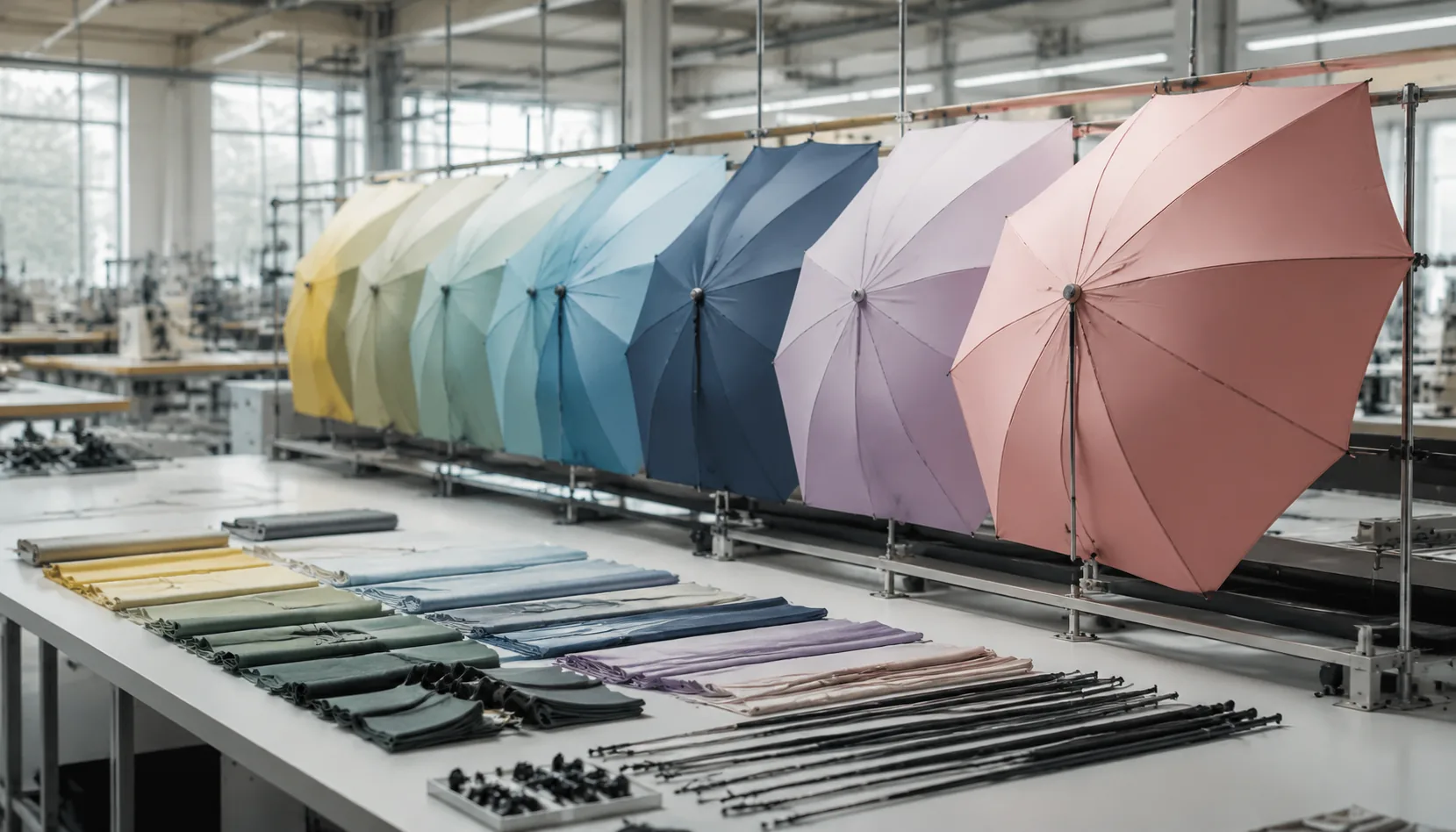
For retail and private-label umbrella lines, a gradient that looks clean on a flat proof can shift panel by panel once it is printed, cut, sewn, and tensioned on the frame. On our Songxia factory floor, gradient umbrella canopy printing starts with fabric selection, ink behavior, seam layout, and strike-off approval, because smooth color flow depends as much on production control as on artwork.
When Gradient Canopies Fit a Brand Range
Gradient canopies make sense when the umbrella is part of a seasonal story, not just a rain tool with a logo. For spring retail drops, a pale blue-to-mint fade on 190T pongee can sit beside apparel, drinkware, and tote bags without fighting the shelf. For summer resort merchandise, coral-to-sunset orange or teal-to-navy works well on 23" and 27" straight umbrellas because the color area is large enough for the fade to read from 10-15 feet away. This is where gradient umbrella canopy printing earns its cost: it turns the canopy into the main design element, while the logo can stay small, usually 60-90 mm wide on one panel or centered across two panels. Solid Pantone matching is better for corporate uniforms and bank promotions; gradients are better when the buyer wants emotion, seasonality, and a stronger visual hook.
I do not recommend gradients when the brief is only “match our brand blue” or “make every panel a different color.” Pantone-matched solid panels are cleaner for franchise programs, insurance giveaways, or strict retail planograms where Delta E tolerance matters more than mood. Simple contrast panels, such as alternating black and white on an 8K frame, are also easier to control in bulk because sewing alignment hides fewer sins. Ombre umbrella printing is less forgiving: the artwork must be mapped to the canopy pattern, usually 8K or 10K triangular panels, so the fade does not jump at the seams. On digital print umbrellas, we check panel order before sewing and run a wet-rub and dry-rub test, especially on dark-to-light gradients where ink migration or uneven heat pressure can show.
Lifestyle brands, boutique hotels, beach clubs, and influencer kits are the strongest fit for gradient branded umbrellas because the buyer is selling a photographable object. A 21" auto-open-close compact with a lavender-to-sky gradient feels like a beauty launch item; a 30" fiberglass golf umbrella with navy-to-black looks more premium for outdoor apparel or golf retail. For retail umbrella color design, we usually ask for the product palette first, then build the canopy gradient around the hero SKU instead of forcing the logo color to dominate. At ZheBrella, our standard practice is to produce a printed strike-off before pre-production, then inspect bulk under AQL 2.5 for color banding, panel matching, seam puckering, and frame function. Typical MOQ for custom gradient work starts around 500-1,000 pcs per design, with sampling in 7-10 days and bulk lead time around 25-35 days depending on printing method.
Designing Gradients Around Umbrella Panel Geometry
Panel count decides whether a gradient looks intentional or broken. On an 8K umbrella, each panel covers a wider wedge, so a left-to-right ombre can jump noticeably at the seam if the color stop crosses from one panel to the next without compensation. On a 16K frame, the artwork is divided into narrower slices, which gives smoother circular color movement but doubles the number of seam alignments the sewing line must control. For retail umbrella color design, I do not approve artwork from a flat circle mockup alone; the file must be split into real panel geometry with seam allowance, top notch, grain direction, and center cap position marked. On 190T or 210T pongee, even a 2–3 mm sewing offset can make a soft gradient look like a printing defect, especially in pale blue-to-white or pink-to-lavender transitions.
Radial gradients are usually the safest choice for gradient umbrella canopy printing because the color naturally moves from the top cap toward the outer tips, so panel seams carry similar tones on both sides. Vertical gradients, such as dark outer edge fading to a lighter crown, can work well for fashion and lifestyle lines, but the cutting layout must keep all panels oriented the same way; one reversed panel will stand out immediately after assembly. Panel-by-panel gradients are more aggressive: each wedge may shift from navy to teal, or from warm gray to cream, creating a faceted umbrella effect rather than a continuous ombre. That can be attractive for gradient branded umbrellas, but buyers should sign off on a sewn sample, not only a digital proof, because canopy tension changes the perceived color after the ribs are attached.
Digital print umbrellas give the best control for ombre umbrella printing when the order needs photographic or multi-stop gradients, but the factory still needs a color-managed workflow: coated fabric profile, printed strike-off, steamed or heat-fixed process if required, and ΔE tolerance agreed before bulk. Screen printing can handle simpler two-color fades, but fine gradient dots may band on darker pongee and are not ideal for large retail runs where every canopy must match on shelf. Our standard practice at ZheBrella is to print one full canopy set, sew it onto the intended 8K or 16K frame, then inspect it under D65 light and at a 1.5-meter viewing distance before releasing bulk cutting. For AQL 2.5 inspection, seam color mismatch, upside-down panels, and abrupt color breaks should be listed as major defects, not cosmetic preferences.
Fabric, Coating, and Print Method Considerations
Digital printing is usually the right method when the artwork needs a clean fade from navy to sky blue, coral to peach, or black to transparent gray. Screen printing can hit solid Pantone blocks well, but it struggles with soft transitions unless you accept visible dot patterns, extra screens, and higher setup waste. For gradient umbrella canopy printing, we normally use reactive or disperse digital print depending on fabric composition, then control the ICC profile, ink limit, and drying temperature so the ombre does not band across the 8 panels. On retail lines, I also prefer printing the full panel layout before cutting when the gradient must align from tip to edge; printing after cutting saves fabric but makes panel-to-panel matching harder, especially on 23 inch and 27 inch stick umbrellas.
190T pongee is lighter, cheaper, and common for promotional gradient branded umbrellas, but 210T pongee gives a denser hand feel and usually better color depth because the weave accepts a smoother ink laydown. The difference is easy to see in dark-to-light ombre umbrella printing: 190T can look slightly flatter in saturated burgundy, forest green, or deep violet, while 210T holds richer color and reduces light leakage under store lighting. For digital print umbrellas, we check both dry color and wet color because some coatings shift the shade after water-repellent finishing. A buyer should not approve retail umbrella color design from a screen photo; request a strike-off on actual pongee, under the intended coating, with ΔE tolerance agreed before bulk cutting.
Coating has to be tested with the print, not treated as a separate spec line. A Teflon-style water-repellent finish improves beading, but too much heat in curing can dull gradients or slightly yellow pale pastel areas. For UPF 50+, darker gradients normally pass more easily, while pale yellow, blush, mint, and sky-blue areas may need UV absorber treatment or a silver/black underside layer to reach the claimed rating. Our standard practice at ZheBrella is to run AATCC spray testing, basic crocking checks, and UV transmittance testing on the printed-and-coated sample before confirming mass production. For retail orders, I would also include 24-hour wet transfer, folding abrasion at rib contact points, and an AQL 2.5 visual inspection standard for banding, panel mismatch, and color contamination.
Sampling for Color Continuity and Retail Approval
Color continuity has to be approved twice: first on flat printed panel proofs, then on a fully assembled pre-production umbrella. A gradient that looks smooth on a 190T pongee panel can shift once eight 23-inch panels are sewn into a dome, because seam allowance removes 6–8 mm per side and changes where the ombre transition lands. For gradient umbrella canopy printing, I require the artwork to be laid out as a full canopy map, not eight isolated triangles, with rib lines, logo safe zones, and top-cap position marked. On digital print umbrellas, especially sublimation on 190T/210T polyester pongee, the proof should show the lightest tint, darkest tint, and mid-transition area because banding usually appears in the 20–40% tone range, not in the saturated edge color.
A proper pre-production sample should be built with the exact production frame, not a leftover stock frame from the sample room. A 23-inch 8K auto-open umbrella and a 27-inch 10K golf umbrella stretch the canopy differently, so the same retail umbrella color design can look clean on one and slightly broken on the other. For gradient branded umbrellas, we check whether adjacent panels meet within visual tolerance at the seams, whether the fade direction stays consistent from panel to panel, and whether the logo remains readable over the transition area. Some buyers use Delta E targets, typically ΔE under 2.0–3.0 for key brand colors, but gradients also need a daylight cabinet visual check because numeric readings from a soft fade can miss obvious panel-to-panel steps.
For retail approval, our standard practice at ZheBrella is to lock the approved pre-production sample with signed fabric swatches, print files, and assembly notes before bulk cutting starts. During AQL 2.5 inspection, we treat visible banding, reversed panel direction, seam misalignment over 5 mm, dirty transfer marks, and shade variation between panels as major defects because they are obvious on a store rack. Ombre umbrella printing also needs batch control: panels from different print runs should not be mixed on the same canopy, and roll ends should be separated if coating or heat history changes the color pickup. Final inspection should include open-canopy viewing at 1 meter, closed-roll appearance, top notch alignment, and comparison against the approved sample under D65 light, not only warehouse lighting.
Cost, MOQ, and Delivery Planning for Collections
Gradient canopies cost more than solid-color 190T pongee because the factory is not just buying dyed fabric and cutting panels. For gradient umbrella canopy printing, the artwork must be separated by panel shape, color transition, rib alignment, and seam allowance; otherwise the ombre shifts badly after sewing. Sublimation works best on polyester pongee 190T/210T for smooth retail color, while heat transfer can handle shorter runs but adds hand-feel and higher rejection risk at panel edges. For POE, PVC, or EVA clear canopies, gradients usually require screen or UV-compatible digital methods, with stricter ink adhesion checks. Buyers should expect plate, film, or digital setup charges, plus extra sampling rounds if Pantone-to-gradient matching is critical. A solid navy 23-inch auto-open umbrella may pass approval in one sample; a sunset gradient on an 8K fiberglass frame often needs two rounds to correct banding, seam jumps, or color density under indoor retail lighting.
MOQ should be planned by colorway, not only by umbrella model. A practical retail order for gradient branded umbrellas is often 500–1,000 pieces per colorway for 21-inch folding or 23-inch stick umbrellas, with higher efficiency at 2,000 pieces because fabric nesting, printing calibration, and sewing line setup become more stable. If a collection has four gradients—blue-to-green, pink-to-orange, black-to-gray, and beige-to-brown—treat them as four production lots, even if they share the same 8K steel shaft, fiberglass ribs, EVA handle, and carton spec. Small mixed-color orders usually raise unit cost because each colorway needs its own print proof, cutting control, and AQL 2.5 inspection record. Our standard practice at ZheBrella is to lock one approved physical sample per colorway before bulk cutting, especially for retail umbrella color design where shelf consistency matters more than promotional giveaway tolerance.
Build the launch calendar backward from the selling date, not the purchase order date. For ombre umbrella printing, allow 7–10 days for digital artwork adjustment and strike-off, 10–15 days for a pre-production sample including frame assembly, and 30–45 days for bulk production after sample approval and deposit. Add 5–7 days for final inspection, carton marking, barcode labeling, and export booking. FOB Ningbo or Shanghai works when the buyer controls freight and wants tighter cost visibility; DDP is better for retailers that need landed cost by SKU and delivery into a warehouse, but it requires earlier confirmation of HS codes, carton dimensions, and destination compliance documents. Digital print umbrellas for seasonal launches should not be ordered at the last minute: sea freight to the U.S. or Europe can add 25–40 days, while air freight protects the launch date but can erase the margin on a mid-price retail umbrella.
Frequently Asked Questions
Can gradient umbrellas match exact Pantone colors?
They can target Pantone start and end points, but the transition area is a digital blend and should be approved from a printed sample rather than a screen proof only.
Are gradient canopies more expensive than solid-color umbrellas?
Usually yes, because they require digital artwork setup, print sampling, and stricter panel matching. The final cost depends on fabric, number of panels, order volume, and inspection requirements.
How accurate can gradient colors be across multiple umbrella panels?
Digital printing can control gradient transitions closely, but panel cutting and seam alignment may create slight shifts. For retail programs, buyers should approve a printed strike-off and one full assembled sample before bulk production.
What fabric works best for ombre umbrella printing?
Pongee polyester is commonly used for retail umbrellas because it prints cleanly, dries quickly, and supports color gradients well. For sharper artwork, 190T or 210T pongee is usually preferred over lower-density polyester.
What MOQ and lead time should buyers expect for gradient branded umbrellas?
A typical MOQ for custom gradient canopy printing is around 500–1,000 pieces per design, depending on frame style and fabric. Sampling usually takes 7–14 days, with bulk production often requiring 30–45 days after sample approval.
Looking to Launch Your Custom Umbrella Line?
ZheBrella is a Zhejiang-based OEM/ODM umbrella manufacturer with 17 years of export experience. Free design, low MOQ from 100 pieces, windproof construction, full-color print.
Get Free Quote Now »People Also Search For
Related Articles
Gradient Umbrella Printing for Retail and Event Branding
Learn when gradient umbrella prints work best, how digital files should be prepared, and which canopy specs support smoo...
Read More »
Gradient Color Umbrella Canopies for Branded Campaigns
Specify gradient umbrella canopies with the right print method, fabric, color approval, and QC plan for bold branded cam...
Read More »
Gradient and Photographic Umbrella Prints for Brand Campaigns
Plan photo, gradient, and all-over digital umbrella prints with file specs, 190T/210T fabric choices, panel seams, lead ...
Read More »