Gradient Color Umbrella Canopies for Branded Campaigns
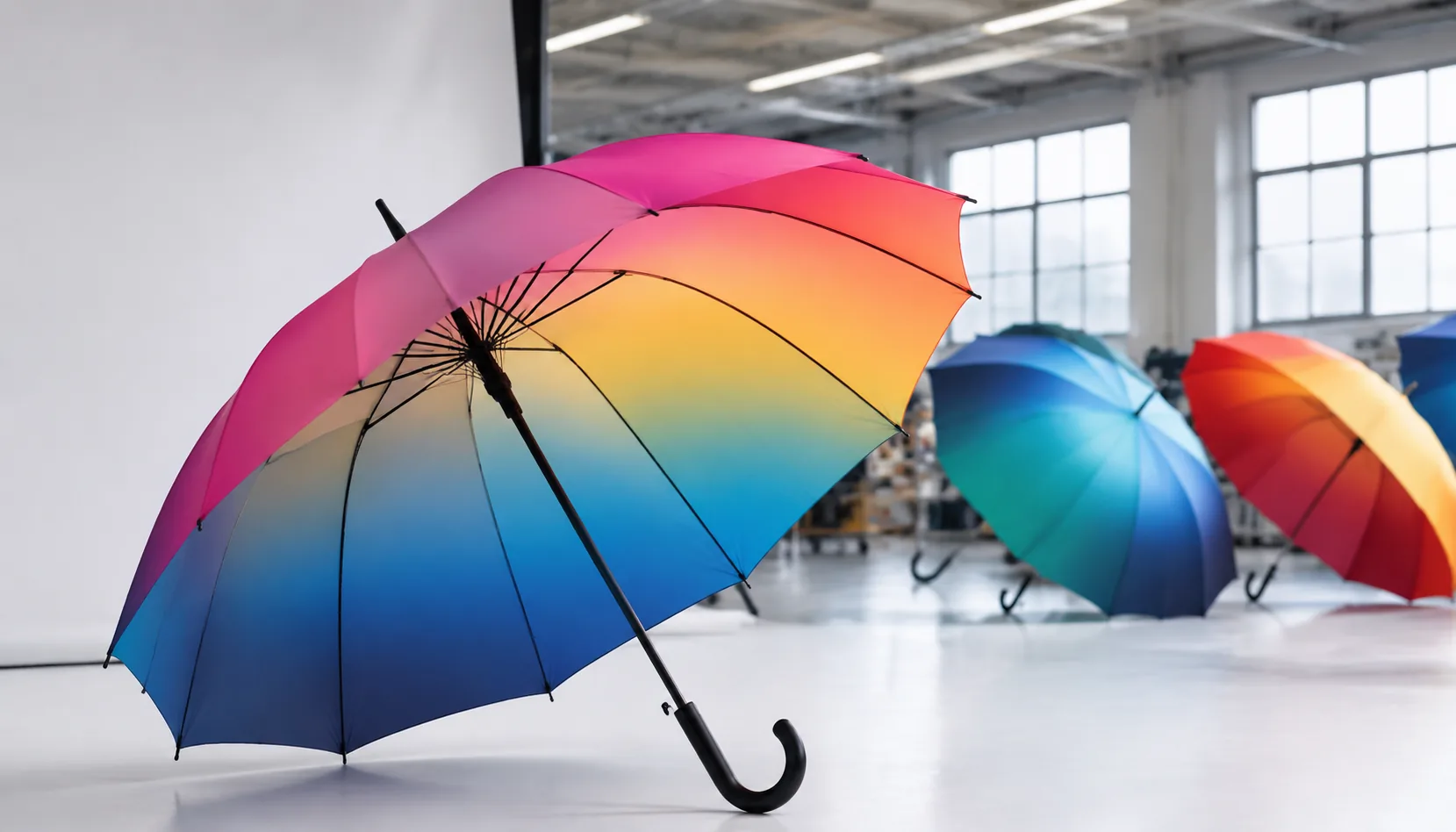
A gradient canopy looks simple on a campaign mockup, but on the cutting table it becomes a fight between ink behavior, panel matching, fabric coating, and brand color tolerance. For gradient umbrella canopy printing, buyers need to lock the print method, fabric base, strike-off approval, and QC points before bulk production, or the finished umbrellas can show banding, mismatched seams, or dull retail shelf impact.
Where Gradient Canopies Add Brand Value
Gradients add the most brand value when the umbrella is treated as a moving billboard, not just a rain item with a logo dropped on one panel. For product launches, a controlled color fade umbrella design can mirror packaging, app screens, sneaker colorways, or limited-edition labels across all 8 panels of a 23" auto-open stick umbrella or a compact 21" auto-open-close model. Beauty brands use soft blush-to-nude or violet-to-blue transitions because they photograph well under event lighting and avoid the flat, cheap look of single-color promotional umbrella printing. Beverage campaigns often go brighter: citrus yellow to green, cola red to black, or beer gold to amber on 190T or 210T pongee. With gradient umbrella canopy printing, the fabric choice matters because pongee holds smoother tones than low-grade polyester, while sublimation gives cleaner fades than screen print for full-canopy artwork.
Sports teams and destination retail buyers usually want stronger contrast and more distance visibility. A 27" golf umbrella with a double-canopy vented windproof frame, fiberglass ribs, and 8K or 10K construction gives enough surface area for stadium stripes, sunset coastlines, mountain silhouettes, or city skyline fades. For retail shops in airports, resorts, museums, and theme parks, gradient branded umbrellas can carry a location mood without turning every panel into a cluttered postcard. Digital print umbrellas are especially useful here because each panel can continue the same horizon line or tonal shift, but the artwork must be matched at seams during cutting and sewing. If the print crosses rib lines, we normally allow a 3-5 mm tolerance because fabric stretch, hemming, and rib tension can shift the visual alignment after assembly.
The mistake I see often is letting the gradient fight the logo. The best layouts reserve one or two clean logo zones with high contrast: white logo on navy-to-black, black logo on pale mint-to-sky, or a solid badge over a red-to-orange fade. Metallic inks and tiny serif text usually perform poorly on textured pongee, especially after Teflon coating or UPF 50+ treatment, so procurement teams should approve a strike-off before bulk production. Our standard practice at ZheBrella is to check gradient smoothness, logo edge sharpness, and panel-to-panel color consistency under AQL 2.5 inspection, with pre-production samples taking about 7-10 days and bulk lead time commonly 25-35 days depending on MOQ, frame stock, and FOB or DDP packing requirements. For serious campaigns, keep the logo simple and let the canopy carry the emotion.
Digital Printing Versus Panel Color Blocking
True gradient digital printing is the right choice when the artwork needs a smooth fade across panels, a sunset blend, a retail-style ombré, or a brand campaign where the canopy must match a visual identity rather than just carry a logo. With digital print umbrellas, we print directly onto white 190T or 210T pongee before cutting, then align the panels so the color transition reads correctly after sewing. This is where gradient umbrella canopy printing earns its cost: CMYK artwork can move from navy to cyan, red to orange, or full-spectrum color without the hard edges you get from fabric blocks. Screen printing is poor for this job because each spot color needs a separate screen, and halftone fades on curved umbrella panels often show banding, dot texture, or inconsistent density after drying and water-repellent finishing. For a 23" auto-open 8K umbrella, I would only use screen printing for solid logos or simple two-color marks, not for a smooth color fade umbrella design.
Sewn color blocking is a different tool: cheaper, stronger visually from a distance, and easier to control in mass production. Instead of printing a gradient, the factory cuts panels from pre-dyed solid pongee colors, such as alternating black/gray, blue/white, or four corporate colors around an 8K or 16K frame. This approach reduces ink cost, avoids digital print setup time, and keeps shade consistency more stable on large-volume promotional umbrella printing orders, especially above 3,000 to 5,000 pieces. The tradeoff is obvious on the canopy: the color changes at the seam, not gradually across the fabric. For gradient branded umbrellas where the buyer mainly wants “movement” or a two-tone campaign look, panel blocking can be a smart value-engineered option. Our standard practice at ZheBrella is to quote both routes when the brief allows it: digital printing for premium campaign visuals and color-block pongee for budget-sensitive FOB orders with tight delivery windows of 25 to 35 days.
Fabric, Coating, and Color Performance
Fabric choice decides whether a gradient looks smooth or cheap before the first logo is printed. For most branded rain umbrellas, 190T pongee is the practical baseline: tight enough for clean digital print umbrellas, light enough for 21" and 23" folding models, and stable under normal water-repellent finishing. When the artwork has a long color fade umbrella design from pale blue to navy or yellow to orange, I prefer 210T pongee because the denser weave holds finer tonal steps and reduces the banding you sometimes see on lower-grade polyester. Polyester does not absorb ink like cotton; the color sits in or bonds to the fiber depending on whether we use sublimation, heat transfer, or coated-panel printing. That is why pre-production strike-offs matter. A gradient umbrella canopy printing sample should be checked dry, wet, folded, and backlit, not just photographed flat on a cutting table.
Coating changes both hand feel and color performance. Standard promotional umbrella printing usually uses a water-repellent finish that beads rain without making the canopy stiff, but heavy coating can slightly mute bright gradients, especially pink, lime, turquoise, and pale gray transitions. For retail-grade gradient branded umbrellas, our standard practice at ZheBrella is to confirm the print after coating, not before, because the buyer cares about the shipped canopy, not the raw printed fabric. For sun umbrellas, a silver, black, or UV-coated underside can reach UPF 50+, but that construction affects opacity and perceived shade of the top print. A white-to-pastel gradient over UV fabric may look cleaner outdoors, while a deep red-to-black gradient can gain visual depth but also show dust, crease marks, and panel-to-panel cutting variation more clearly.
Darker gradient zones need special attention because they change logo visibility and heat absorption. A white logo over navy, charcoal, or burgundy usually reads well from 10 to 20 feet, but a black, dark green, or low-contrast metallic logo can disappear once the canopy is curved on an 8K or 10K frame. I advise buyers to place critical brand marks across mid-tone areas or add a thin keyline when the gradient passes through deep colors. Dark panels also absorb more heat in direct sun, which matters for café, golf, beach, and event umbrellas in 27", 30", and larger sizes. If the campaign is for summer outdoor use, test the canopy under real sunlight and specify UPF 50+ plus a lighter inner coating. A beautiful fade is not enough; the umbrella still has to keep the user cooler, keep the logo readable, and pass AQL 2.5 inspection without color claims at shipment.
Frame Choices That Support the Visual Design
Rib count changes the artwork more than most buyers expect. An 8K frame gives you eight wider canopy panels, so a color fade umbrella design has more visual breathing room and fewer seam interruptions. That is usually better for large radial gradients, sunset effects, or a brand color transitioning from the crown to the edge. A 16K frame divides the canopy into sixteen narrow panels, which looks refined and rounder when opened, but the gradient must be mapped more carefully because every seam can slightly break the color flow. For gradient umbrella canopy printing, we normally check the digital layout against the actual panel pattern, not a flat circle mockup, because the fabric is cut into curved gores before sewing.
For branded campaigns, fiberglass ribs are the safer choice when the umbrella will be used outdoors rather than handed out as a cheap one-day gift. Fiberglass flexes under gust load and returns better than steel, especially on 23-inch and 27-inch straight umbrellas where leverage is higher. A good fiberglass 8K frame with a steel shaft can survive 40–50 mph wind-tunnel testing depending on canopy size and venting, while full steel ribs are cheaper but more likely to bend permanently after inversion. Steel still has a place in budget promotional umbrella printing, particularly compact 21-inch auto-open models, but it adds weight and can make premium gradient branded umbrellas feel less balanced in the hand.
If the campaign needs a premium outdoor model, use a double-canopy vented construction before spending extra money on cosmetic details. The vent lets wind pass between the upper and lower canopy layers, reducing inversion risk and protecting the print from distorted pulling at the seams. This matters for digital print umbrellas using 190T or 210T pongee, because a smooth gradient depends on stable fabric tension after sewing. A 16K fiberglass double-canopy frame gives the most elegant dome shape for retail or golf-event use, while an 8K fiberglass vented frame is usually the better cost-performance option for corporate gifts. Our standard practice at ZheBrella is to proof the gradient on the selected rib count before bulk cutting, then inspect panel alignment under AQL 2.5 so the fade does not drift from panel to panel.
Sampling, MOQ, and Bulk QC for Color Fades
Sampling is where most color-fade jobs either become controllable or become expensive. For gradient umbrella canopy printing, we start with digital strike-offs on the actual canopy fabric, not a paper proof, because 190T pongee, 210T pongee, POE, PVC, and EVA all absorb or reflect ink differently. A smooth color fade umbrella design should be built around Pantone anchor colors at the light end, midpoint, and dark end, with tolerance agreed before bulk cutting. I like to approve strike-offs under D65 daylight first, then check again under common indoor LED lighting around 4000K, because some blues, violets, and fluorescent tones shift badly indoors. For high-visibility event umbrellas, the buyer should also confirm logo contrast after the gradient is applied; a white logo that looks clean on a navy edge may disappear across a pale cyan center panel.
A proper pre-production sample should use the final rib count, panel size, and print layout, because gradient branded umbrellas are assembled from separate cut panels, not printed as one perfect circle. A 23-inch 8K auto-open umbrella and a 30-inch 10K golf umbrella have different panel geometry, so the fade curve must be adjusted before mass production. For digital print umbrellas, our normal MOQ is usually 300–500 pieces per design when using polyester pongee, while PVC/POE transparent gradient work often starts higher because setup waste is less forgiving. Sampling normally takes 5–7 days after artwork confirmation; bulk lead time is commonly 25–35 days, depending on canopy material, frame type, and whether the order ships FOB Ningbo/Shanghai or DDP to the buyer’s warehouse. Rush promotional umbrella printing is possible, but color approval should never be compressed into a screenshot review.
Bulk QC for gradients is stricter than for solid-color umbrellas because small defects become visible across a fade. Under AQL 2.5, inspectors should check opened umbrellas from multiple cartons for banding, print streaks, ink misting, panel-to-panel shade variation, and obvious mismatch at the sewn seams. I also recommend comparing finished canopies against the approved pre-production sample at arm’s length and from 2 meters away, because a gradient may pass close-up color measurement but still look uneven in a retail display or sponsor photo. Critical defects include reversed panel order, logo misregistration over the fade, ink cracking after folding, and transfer marks caused by stacking before full curing. For export orders, final inspection should happen before polybagging and again after packing checks, since tight cartons can sometimes create pressure marks on coated UPF 50+ or Teflon-treated fabric.
Frequently Asked Questions
Can a gradient run smoothly across all umbrella panels?
Yes, but each panel must be printed and cut with controlled orientation. Small shade shifts can appear at seams, so buyers should approve an assembled pre-production sample before bulk production.
Are gradient umbrellas more expensive than solid-color branded umbrellas?
Usually yes, because digital printing, sampling, and color QC add cost. For very large orders, a simplified two- or three-color panel design may reduce unit price and lead time.
Which print method is best for a smooth gradient umbrella canopy?
Digital sublimation is usually the best choice for smooth color fades, photo effects, and edge-to-edge graphics on polyester pongee. Screen printing is better for solid logos or simple spot colors, but it can show banding in complex gradients.
Can Pantone colors be matched accurately in a gradient design?
Pantone targets can be used for key brand colors, but gradients should be approved with a printed strike-off because fabric, coating, and heat transfer can shift tones. For retail or campaign orders, buyers typically approve a physical sample before bulk production.
What QC checks should be used for gradient printed umbrellas?
QC should include panel-to-panel color consistency, gradient alignment across seams, logo position tolerance, rub fastness, water repellency, and open-close inspection. For bulk OEM orders, AQL inspection is commonly applied before shipment.
Looking to Launch Your Custom Umbrella Line?
ZheBrella is a Zhejiang-based OEM/ODM umbrella manufacturer with 17 years of export experience. Free design, low MOQ from 100 pieces, windproof construction, full-color print.
Get Free Quote Now »People Also Search For
Related Articles
Gradient Color Umbrella Canopies for Retail Brand Lines
Build gradient umbrella designs with realistic color control, panel matching, fabric choices, and approval steps for ret...
Read More »
Gradient Umbrella Printing for Retail and Event Branding
Learn when gradient umbrella prints work best, how digital files should be prepared, and which canopy specs support smoo...
Read More »
Gradient and Photographic Umbrella Prints for Brand Campaigns
Plan photo, gradient, and all-over digital umbrella prints with file specs, 190T/210T fabric choices, panel seams, lead ...
Read More »