Gradient and Photographic Umbrella Prints for Brand Campaigns
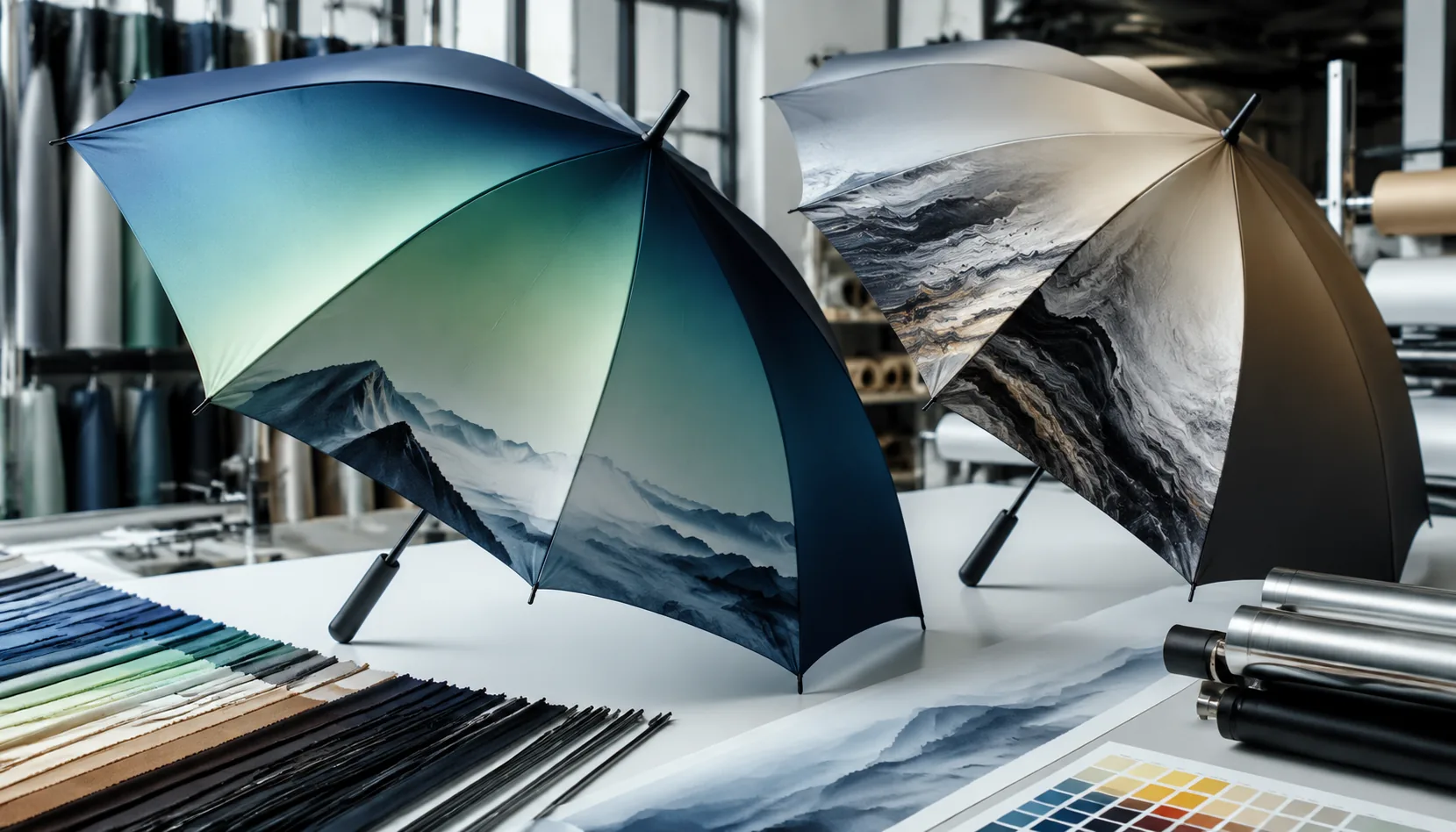
For brand campaigns, a good-looking umbrella render can fail fast once artwork hits curved panels, sewn seams, and wet fabric. When buyers source photo print umbrellas wholesale, the real questions are file resolution, 190T versus 210T fabric behavior, gradient banding, panel matching, and whether the launch schedule leaves enough time for strike-offs, drying, inspection, and rework. On our Songxia factory floor, these details decide whether the finished canopy looks premium or patched together.
When Digital Printing Beats Spot-Color Logos
Digital printing beats spot-color work when the artwork has continuous tone: skyline photos, product renderings, fashion gradients, watercolor textures, camouflage, or campaign visuals that cannot be separated cleanly into 1–4 Pantone inks. Screen printing is still my first choice for a simple white logo on a navy 190T pongee panel, because it is fast, opaque, and cheap at volume. But once a buyer asks for gradient umbrella printing across 8 panels, or wants photographic canopy artwork matched from an agency file, screen setup becomes slow and registration risk goes up. Heat transfer can handle detail, but on a large curved canopy it often feels like applying stickers panel by panel; edge marks and hand feel become obvious, especially on 23" and 27" umbrellas. For photo print umbrellas wholesale orders, digital print lets us keep the image continuous before sewing, then control panel alignment during cutting.
Short retail runs are where digital printed umbrellas make the most commercial sense. If a museum shop needs 300 pieces with a painting reproduction, or a beverage brand wants 500 full color branded umbrellas for a summer launch, paying separate screens for every color is wasteful. With sublimation on white 190T or 210T polyester pongee, the ink becomes part of the fabric, so the canopy stays soft and folds properly around steel or fiberglass ribs. For transparent POE, PVC, or EVA canopies, we use different digital UV or transfer processes because dye sublimation will not behave the same way on plastic film. Our standard practice at ZheBrella is to check the file at full size, print a strike-off, and inspect color shift under D65 light before bulk cutting; a nice image on a monitor can turn muddy after coating, stitching, and water-repellent finishing.
Digital is not magic, and a buyer should know the limits before locking the PO. Very dark photographic prints on thin 190T fabric can show light transmission when held against the sun, while small facial details may distort when split across 8K or 10K canopy panels. If the design must wrap across seams, we build extra bleed into each panel and mark the cutting direction, because one rotated panel will ruin the whole campaign. For premium retail, I prefer fiberglass ribs and a 23" auto-open or 27" golf frame with a double-canopy vent if wind performance matters; the print is only useful if the umbrella survives real use. For photo print umbrellas wholesale projects, realistic planning is usually 7–10 days for artwork proof and sample, then 25–35 days for bulk production depending on MOQ, printing queue, and AQL 2.5 inspection requirements.
Artwork Files and Color Expectations
A printed fabric swatch is cheap insurance before bulk production, especially for photo print umbrellas wholesale programs where 1,000 or 10,000 pieces must look consistent under daylight and store lighting. A digital mockup can show placement, but it cannot show dot gain, fabric texture, seam interruption, or the way a double-canopy vent casts shadow on a photographic design. For brand campaigns, we normally recommend a strike-off on the actual canopy material, coating, and print method, then buyer approval under D65 daylight or a controlled light box. If the artwork includes a vector logo overlay on a photo background, approve both the logo color and the surrounding image density, because contrast can drop after sewing and folding. Once the swatch is approved, lock the file version, panel template, ink settings, and AQL 2.5 color tolerance notes before bulk cutting starts; changing artwork after fabric printing is far more expensive than correcting it at sampling stage.
Panel Layout on 8K and 16K Umbrellas
Panel layout is the first technical decision for photo print umbrellas wholesale because an umbrella canopy is not one flat poster; it is a set of wedge-shaped panels sewn into a shallow cone. On a standard 23" or 27" 8K umbrella, the artwork is usually divided into eight curved triangular panels, each with its own grain direction, seam allowance, and rib position. For gradient umbrella printing, this is forgiving if the color flow is radial or alternates by panel, but photographic canopy artwork needs a proper template with center cap, ferrule hole, seam lines, and safe zones marked before any sampling starts. Our standard practice at ZheBrella is to keep critical logos, faces, product shots, and QR codes at least 15–20 mm away from stitched seams, because a 6–8 mm sewing allowance plus fabric stretch can eat more image than buyers expect.
Bleed is not optional on digital printed umbrellas; it is what prevents white slivers and broken color where panels meet. For 190T or 210T pongee, I normally ask for 10–15 mm bleed beyond the cut line, with seam overlap planned separately from the visible artwork. Sublimation on white pongee gives the cleanest full color branded umbrellas, while heat transfer can work for smaller photographic elements but becomes stiff on large continuous images. The hard part is that fabric moves: cutting tension, sewing pull, and rib-tip binding can shift a photo by 2–4 mm from panel to panel. That sounds small on paper, but across a skyline, face, car, or product edge, the viewer will see the break immediately. A pre-production sample is worth more than a perfect PDF when the campaign depends on image continuity.
A 16K umbrella gives a rounder canopy and a premium look, but it can make panoramic images harder to align, not easier. Sixteen ribs mean sixteen narrow panels, sixteen seam joins, and twice as many chances for the horizon line or building edge to step up and down. On 8K frames, each panel has enough width to carry a meaningful section of the photo, so the eye accepts some segmentation. On 16K, the same panoramic artwork gets sliced into thin wedges, and any mismatch becomes a repeated zipper effect around the canopy. For photo-real campaigns, I prefer either an 8K layout, a radial composition, or a designed panel-repeat system where each seam is hidden by clouds, water, foliage, or abstract gradient bands. If a buyer insists on 16K for photographic work, we tighten AQL 2.5 visual checks around seam matching and approve a signed sample before bulk cutting.
Fabric, Frame, and Construction Choices
For photographic canopy artwork, fabric choice decides whether the umbrella looks like a retail-quality campaign item or a blurry giveaway. I prefer 210T pongee when buyers need sharper gradients, skin tones, city skylines, or product photography because the tighter weave holds dye edges better and gives a smoother hand feel after heat-transfer or sublimation printing. 190T pongee is still workable for gradient umbrella printing, especially for large color fades, logos, and simple lifestyle imagery, but fine text below 8 pt and high-contrast photo details can soften after sewing tension and water-repellent finishing. For photo print umbrellas wholesale programs, we normally ask for CMYK artwork at actual panel size, 300 dpi, with 5-8 mm bleed per panel because an 8K umbrella has eight separate trapezoid print zones, not one flat poster.
UPF 50+ coating is useful, but buyers should not treat it as magic armor for every full color branded umbrella. A silver UV coating or black glue layer can help block more than 98% of UV under lab conditions, but it also changes fabric weight, hand feel, folding thickness, and sometimes the final print shade if the process is not controlled. On outside-printed digital printed umbrellas, the coating is usually applied to the inner side; on inside-photo umbrellas, the artwork and coating sequence must be planned before sampling. Dark photographic backgrounds naturally improve shade performance, while pale gradients can show more light transmission. I would not promise identical color between coated and uncoated samples without a strike-off, especially on 210T pongee where the surface is smoother and color differences are more visible.
For higher-value brand campaigns, spend the money on fiberglass ribs and a vented double-canopy frame before adding decorative extras. Steel ribs are cheaper and acceptable for short-term event handouts, but they bend permanently after gusts; fiberglass ribs flex back, reduce return claims, and pair better with auto-open 23 inch or 27 inch golf umbrellas. A double-canopy windproof structure lets pressure escape through the vent instead of flipping the umbrella inside out, and a good 8K or 10K fiberglass frame can pass practical wind testing around 45-55 mph when the runner, tips, and rib joints are properly riveted. At ZheBrella, our standard practice for photo print umbrellas wholesale orders is to check print alignment, canopy tension, open-close function, and rib symmetry under AQL 2.5 before packing, because one twisted panel ruins an otherwise expensive campaign piece.
Production Controls for Launch Deadlines
For launch-date work, MOQ and sampling discipline matter more than the artwork itself. For photo print umbrellas wholesale orders, I usually tell buyers to separate two numbers: sampling MOQ and production MOQ. A digitally printed sample can be made from 1–3 pieces, but bulk production is normally 300–500 pieces per design for 21" folding umbrellas and 500–1,000 pieces for 23" or 27" straight umbrellas, because canopy cutting, panel matching, and print setup all consume line time. Digital print sampling takes 5–7 days after final AI/PDF/TIFF artwork, and add 2–3 days if the buyer needs a physical color card matched to Pantone or a previous campaign asset. Gradient umbrella printing needs extra proofing because smooth fades show banding faster than logo repeats; a sunset, skin tone, or product photo across 8K panels is much less forgiving than a flat two-color brand mark.
Bulk lead time depends on frame type, fabric, and inspection intensity, not just print capacity. For digital printed umbrellas on 190T or 210T pongee, standard bulk production is 25–35 days after sample approval for 1,000–5,000 pieces; 10,000 pieces usually needs 35–45 days, especially if the order uses fiberglass ribs, auto-open-close mechanisms, or double-canopy vented windproof construction. POE, PVC, and EVA canopies require different ink adhesion checks and longer drying or curing control, so I do not put them on the same calendar as pongee without a buffer. Our standard practice at ZheBrella is to lock the approved sample, print profile, fabric roll batch, and rib count before cutting bulk panels. Changing from 8K to 10K or from 23" to 27" after proof approval can shift photographic canopy artwork at the seams and force a new sample.
AQL 2.5 inspection for full color branded umbrellas should include print defects that generic umbrella checklists miss. We check panel-to-panel misalignment at the crown and tips, color banding in gradients, ghosting on high-contrast photo edges, ink cracking after opening and closing, and obvious shade variation between canopy panels. For retail launches, I recommend a mid-production check at 20–30% completion and a final random inspection before packing, because finding a gradient banding issue after 3,000 packed cartons is expensive and slow. FOB Ningbo or Shanghai is cleaner if your forwarder already controls vessel space, but timing must include 3–7 days for warehouse handoff and customs closing. DDP is easier for event planners because one supplier owns freight, customs, and final delivery, but air DDP still needs 7–12 days and sea DDP to the U.S. or EU commonly needs 35–55 days after goods are ready.
Frequently Asked Questions
Can one continuous photo wrap around the entire umbrella?
It is possible, but seams, panel curvature, and rib positions will interrupt the image. The best layouts keep faces, logos, and key product details away from seams and panel tips.
Are gradients more expensive than simple logo prints?
Usually yes, because gradients require digital printing or sublimation-style processes rather than one-color screen printing. Cost depends on canopy size, panel count, fabric, and total order quantity.
What artwork files are best for photographic umbrella printing?
Use vector files for logos and high-resolution TIFF, PSD, AI, or PDF files for photo artwork. For full-canopy photographic prints, provide artwork at actual size or scaled with at least 150–300 DPI, plus a panel layout showing image position across seams.
Will the photo or gradient line up perfectly across umbrella seams?
Panel seams can create small alignment shifts, usually within 2–5 mm depending on fabric stretch and sewing tolerance. For campaign artwork, avoid placing faces, text, QR codes, or critical details directly across panel joins.
What is the typical lead time for full-color digital printed umbrellas?
Sampling usually takes 7–12 days after artwork approval, and bulk production is commonly 30–45 days depending on order quantity, fabric stock, and print complexity. Add extra time before launch for strike-off approval, color matching, and pre-shipment inspection.
Looking to Launch Your Custom Umbrella Line?
ZheBrella is a Zhejiang-based OEM/ODM umbrella manufacturer with 17 years of export experience. Free design, low MOQ from 100 pieces, windproof construction, full-color print.
Get Free Quote Now »People Also Search For
Related Articles
Gradient and Photo-Print Umbrellas for Brand Campaigns
Specify gradient and photo-print umbrellas with realistic color control, fabric choices, sample approvals, and productio...
Read More »
Gradient and Photographic Umbrella Prints for Retail Brands
Build retail umbrella prints with photo clarity, correct fabric specs, sample approvals, and QC checks for gradients, ar...
Read More »
Gradient and Photo Prints on Branded Umbrella Canopies
Plan gradient and photo-print umbrella artwork with realistic fabric, color, sampling, MOQ, and lead-time expectations f...
Read More »