Gradient Printing Specs for Branded Umbrella Canopies
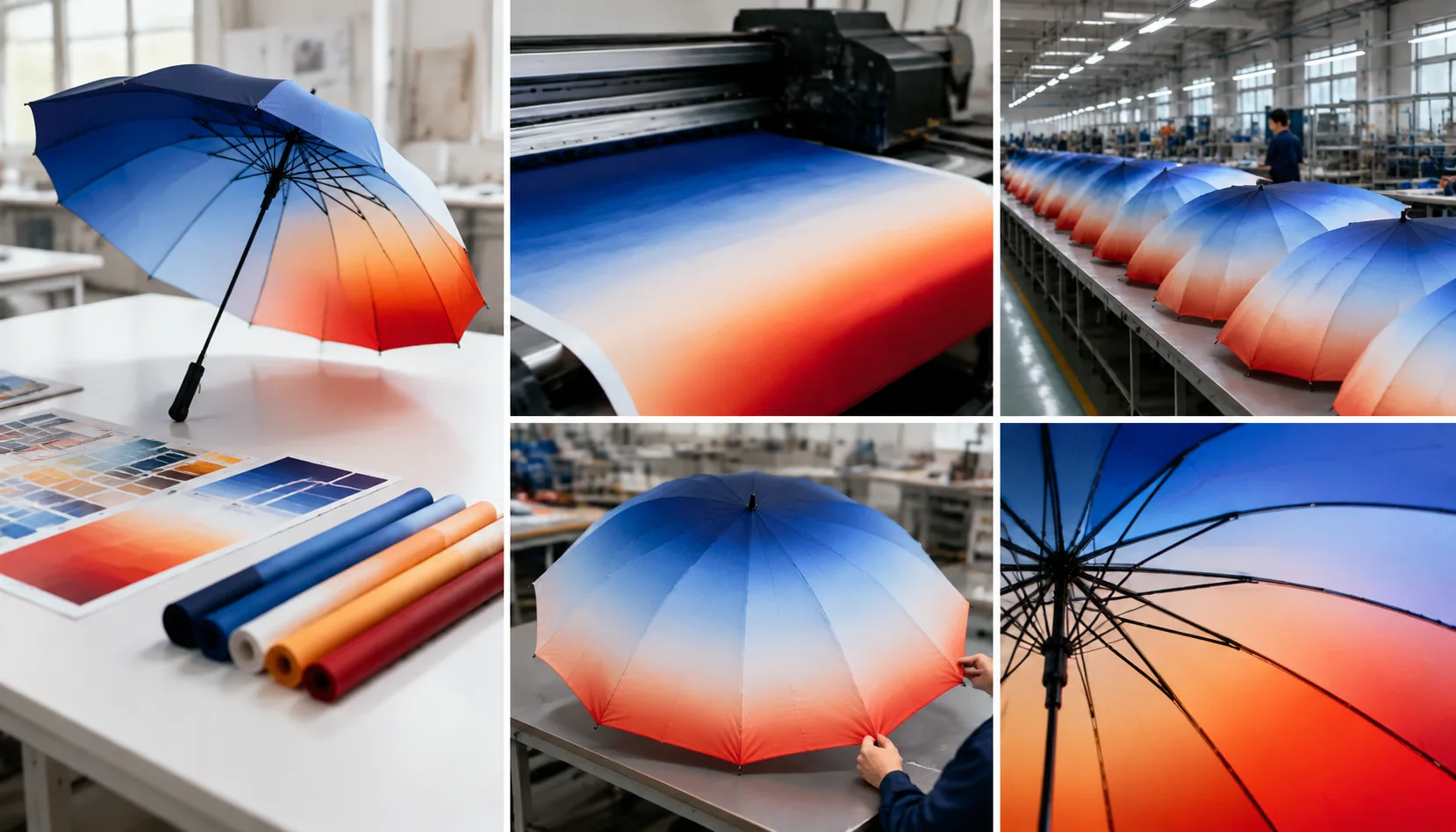
A gradient canopy looks simple on a buyer’s rendering, but on the cutting table it can drift panel by panel if fabric coating, ink load, and seam direction are not controlled. For gradient umbrella printing across 8K, 16K, and UV models, the real risk is not one bad sample—it is a full OEM run where color bands shift after heat setting, lamination, or assembly. We plan proofs, panel matching, and AQL checks around those failure points before bulk production starts.
When Gradient Printing Works Best for Umbrella Branding
Gradient umbrella printing works best when the canopy is part of the product story, not just a surface for a logo. For retail capsule collections, a sunrise fade on 190T or 210T pongee can make a 23" auto-open stick umbrella feel seasonal without changing the frame tooling, handle mold, or carton spec. We see this used for spring color drops, city-series merchandise, and fashion collaborations where buyers want shelf impact from three meters away. A solid Pantone panel is cleaner for strict corporate identity, but it often looks flat on a large 8K canopy. A controlled gradient gives movement across the arc of the umbrella, especially on double-canopy vented models where the top layer can carry the main fade and the lower vent can hold a darker stabilizing tone.
Event themes are another strong fit, especially when the brief has atmosphere: music festivals, product launches, sports finals, weddings, or tourism campaigns. Digital umbrella printing handles soft transitions better than screen printing, because screen work needs halftone dots and separate films that can show banding on curved panels after sewing. For 21" folding umbrellas, gradients should stay simple because each panel is narrow and seam loss can break the fade; on 27" or 30" golf umbrellas, there is enough canopy area to run a horizon blend, radial glow, or brand-color wash cleanly. Our standard practice at ZheBrella is to request OEM umbrella printing specs with CMYK or LAB targets, fabric choice, rib count, and coating requirements before sampling, because Teflon water-repellent finish and UPF 50+ UV coating can shift perceived color.
Gradients outperform simple logo prints when the buyer wants the umbrella to be photographed, carried, and kept. Resort merchandise is a good example: ocean-to-sand, dusk-to-night, or mountain-mist fades sell better than one-color logo panels because the design connects to the location. The logo can stay small on one or two panels, while the canopy itself carries the emotional value. Umbrella color proofing is critical here; we normally run a strike-off on the actual pongee or POE/PVC/EVA canopy material, then check it under D65 light and outdoor daylight before bulk cutting. For AQL 2.5 inspection, the key risks are panel-to-panel shade mismatch, seam alignment, and visible print banding. If the order needs a strict Pantone 186C corporate red, use solid panels; if the goal is mood, retail differentiation, or premium gift value, gradient umbrella printing is usually the stronger choice.
Fabric and Canopy Specs That Affect Gradient Smoothness
Fabric density is the first thing I check when a buyer asks for smooth gradient umbrella printing, because the same artwork behaves differently on 190T and 210T pongee. A 190T pongee canopy is lighter, cost-efficient, and common for promotional 21" and 23" umbrellas, but the looser weave can show tiny step changes in pale-to-dark transitions, especially on large panels with sky, sunset, or corporate fade backgrounds. A 210T pongee has a tighter yarn count and flatter print surface, so digital umbrella printing usually holds softer mid-tones and cleaner edge blending. Standard polyester is acceptable for simple two-color fades, but it tends to absorb ink less evenly than good pongee, and cheap polyester can create a grainy look after heat transfer. For branded umbrella canopies where the gradient is the main visual feature, I would rather reduce rib count or handle cost than downgrade the fabric below stable 190T pongee.
Coatings change the print result more than many OEM buyers expect. UPF 50+ black glue, silver coating, Teflon water-repellent finish, and PU layers all affect ink anchoring, heat behavior, and final color depth. A UV-coated canopy is excellent for sun protection, but if the coating sits on the print side, sublimation and heat-transfer gradients can lose smoothness or look slightly waxy under angled light. Our standard practice at ZheBrella is to confirm whether the coating is face-side or back-side before locking OEM umbrella printing specs, because a back-side UPF 50+ coating usually gives better print clarity while keeping the shade rating. For outdoor retail umbrellas, 210T pongee with back-side black UV coating is a strong option, but the artwork needs compensation: highlights often need to be lifted 5–10% in the file so the finished canopy does not look muddy after cutting, sewing, and tensioning on the frame.
Dark base colors are the hardest environment for gradients because the fabric color fights the ink instead of supporting it. White or light gray 190T/210T pongee gives the cleanest fade, while navy, forest green, burgundy, and black can swallow mid-tones and make banding more visible. If the brand requires a dark canopy, I normally suggest a white underbase for heat transfer, or moving to digital print on white fabric and then printing the full dark background as part of the artwork. That approach costs more and may raise MOQ, but it gives better umbrella color proofing because the lab dip and strike-off match production more closely. For gradient umbrella printing, never approve from a screen PDF alone; request a panel-size proof on the exact fabric, coating, and base color. A 10 x 10 cm swatch can hide banding that becomes obvious across a 23" or 27" umbrella panel after assembly.
Digital Print Setup, Proofing, and Color Control
Gradient umbrella printing fails most often at the panel seam, not in the printer. For branded umbrella canopies, I ask buyers for vector logos plus raster gradient artwork at 300 dpi at final print size, or at least 150 dpi if the canopy is very large and the fade is soft. Each panel should be built on the factory template, not a flat circle, because an 8K umbrella uses eight wedge panels while a 16K golf or fashion model uses sixteen narrower wedges with different seam behavior. We normally add 10–15 mm bleed on each cut edge, keep critical logos 25–30 mm away from seams, and mark the top notch, rib line, and runner direction. For digital umbrella printing on 190T or 210T pongee, RGB files are converted into the print RIP profile, but final approval should be based on a CMYK or Lab-referenced proof target, not a monitor screenshot.
A soft proof is useful for layout checking, but it is not a production approval for gradients. Monitors hide banding, fabric absorption, and the slight color lift that happens after heat fixation or calendaring. For serious OEM umbrella printing specs, the approval sample should be a strike-off on the actual canopy material: 190T pongee, 210T pongee, recycled PET pongee, or POE/PVC/EVA if the design uses a transparent canopy. At ZheBrella, our standard practice is to print at least one full panel strike-off, and for difficult gradients we print two adjacent panels so the buyer can see whether the fade crosses the seam cleanly. A black-to-navy fade, skin-tone sunset, or light gray corporate gradient should never be approved from a small A4 swatch, because the eye reads those colors differently across a 23 inch, 27 inch, or 30 inch canopy arc.
Color tolerance should be written before sampling, not argued after bulk production. For umbrella color proofing, I usually set solid brand colors at Delta E ≤2.0 to 3.0 against the approved Lab value, while gradient zones are judged by smooth transition, no visible banding at arm’s length, and no sudden hue jump between neighboring panels. On 8K layouts, we check the gradient from panel 1 through panel 8 after sewing because one mis-rotated panel can break the flow completely. On 16K layouts, the tolerance is tighter visually because the panels are narrower; a small RIP or cutting offset repeats sixteen times and looks like a striped canopy. Bulk inspection should include a pre-production canopy, inline print checks every 300–500 panels, and final AQL 2.5 inspection under D65 lighting, with the approved strike-off kept beside the line for comparison.
Frame Choices That Support the Printed Design
Frame choice changes the artwork more than most buyers expect, because the canopy is not a flat poster after sewing and tensioning. A 23" straight umbrella gives the cleanest read for gradient umbrella printing: eight large panels, a stable arc, and enough distance from the shaft for logos or color transitions to breathe. On 27" and 30" golf frames, the visible print area is larger, but the panel curve is stronger, so gradients must be extended 8–12 mm past the stitch line to avoid pale edges after hemming. Compact 21" auto-open models are less forgiving. The short ribs create a steeper canopy pitch, and the folds cut through the artwork every time the umbrella is closed. For branded umbrella canopies with a soft fade from one color to another, I usually keep key brand colors away from the outer fold lines and avoid small text near the tips.
Rib material affects both durability and color perception. Steel ribs are cheaper and hold a sharp canopy shape, but they create harder shadow lines under 190T or 210T pongee, especially with light gradients, yellow, sky blue, or pastel corporate colors. Fiberglass ribs flex more evenly and reduce permanent deformation after wind loading; on 8K and 10K frames they also make the canopy sit smoother after opening, which helps digital umbrella printing look less banded across panel seams. A 16K frame can look premium, but it doubles the number of rib lines and panel breaks, so artwork with a continuous radial gradient needs careful panel mapping. Our standard practice at ZheBrella is to review the artwork on the actual rib count before confirming OEM umbrella printing specs, not just on a flat AI or PDF template.
Double-canopy windproof frames add another print variable because the top vent layer hides part of the lower canopy and creates an overlap shadow. On a vented 23" or 27" umbrella rated around 50+ mph in wind-tunnel testing, the upper canopy usually takes the hero artwork while the lower layer is better for secondary color, repeat logos, or a controlled fade that will not look broken when the vent lifts. For umbrella color proofing, I recommend one strike-off on the chosen frame, not only on loose fabric, because rib shadows, vent gaps, Teflon coating, and UV UPF 50+ treatment can all shift perceived color by a few Delta E points. Manual frames keep panel tension more predictable, while auto-open and auto-open-close mechanisms snap the canopy into shape faster, sometimes exposing minor registration errors at the rib tips.
MOQ, Lead Time, and Inspection Points for Bulk Orders
Inspection for OEM umbrella printing specs must happen before FOB or DDP shipment, because gradient defects are expensive to sort at the destination warehouse. Under AQL 2.5, we pull cartons by lot size and check print defects such as banding, ghosting, ink spots, weak transfer edges, and color drop-off near the panel seams. Panel mismatch is treated as a major defect when the gradient jump is visible from 1 meter on an open canopy; for 8K umbrellas the seam tolerance should stay within 3–5 mm, and for 16K styles we tighten the visual check because smaller panels multiply alignment errors. We also check stains from sewing tables, oil marks from frame assembly, canopy skew, top notch alignment, runner smoothness, and whether the closed umbrella rolls evenly without one printed panel twisting outward. For export, the final report should include open/close function, water-spray check, carton drop condition, barcode or hangtag scan, and packed quantity confirmation before booking FOB Ningbo or arranging DDP delivery.
Frequently Asked Questions
Can a gradient be matched exactly to Pantone colors?
The start and end colors can be targeted to Pantone references, but the transition itself is usually controlled by digital proofing and strike-off samples. Buyers should approve a physical canopy sample before bulk production.
Is gradient printing suitable for UPF 50+ umbrellas?
Yes, but the UV coating can change color appearance and reduce ink absorption. A pre-production sample is recommended to confirm both the printed look and UPF 50+ fabric performance.
Which umbrella fabrics work best for gradient printing?
190T pongee and polyester are commonly used for digital gradient printing because they hold color smoothly and dry consistently. For UV umbrellas, silver-coated or black-coated fabric may affect color brightness, so a printed proof is recommended before bulk production.
How is color consistency checked across 8K, 16K, and UV umbrella models?
Factories usually approve one master color proof, then compare bulk panels under standard lighting before stitching. For mixed models such as 8K, 16K, and UV canopies, buyers should specify Pantone targets, acceptable Delta E tolerance if available, and AQL inspection requirements.
What proofing steps should be included before a large OEM gradient umbrella order?
A typical process includes digital artwork confirmation, fabric print strike-off, assembled pre-production sample, and bulk pre-shipment inspection. Sampling often takes 5–10 days, while mass production for OEM printed umbrellas is commonly 30–45 days depending on quantity and season.
Looking to Launch Your Custom Umbrella Line?
ZheBrella is a Zhejiang-based OEM/ODM umbrella manufacturer with 17 years of export experience. Free design, low MOQ from 100 pieces, windproof construction, full-color print.
Get Free Quote Now »People Also Search For
Related Articles
Gradient Umbrella Printing for Branded Campaign Canopies
Plan gradient and photo-print umbrella canopies with the right fabric, proofing, MOQ, lead time, and QC steps for campai...
Read More »
Gradient Color Umbrella Canopies for Retail Brand Lines
Build gradient umbrella designs with realistic color control, panel matching, fabric choices, and approval steps for ret...
Read More »
Gradient and Photo Prints on Branded Umbrella Canopies
Plan gradient and photo-print umbrella artwork with realistic fabric, color, sampling, MOQ, and lead-time expectations f...
Read More »