Gradient and Photographic Umbrella Prints for Retail Brands
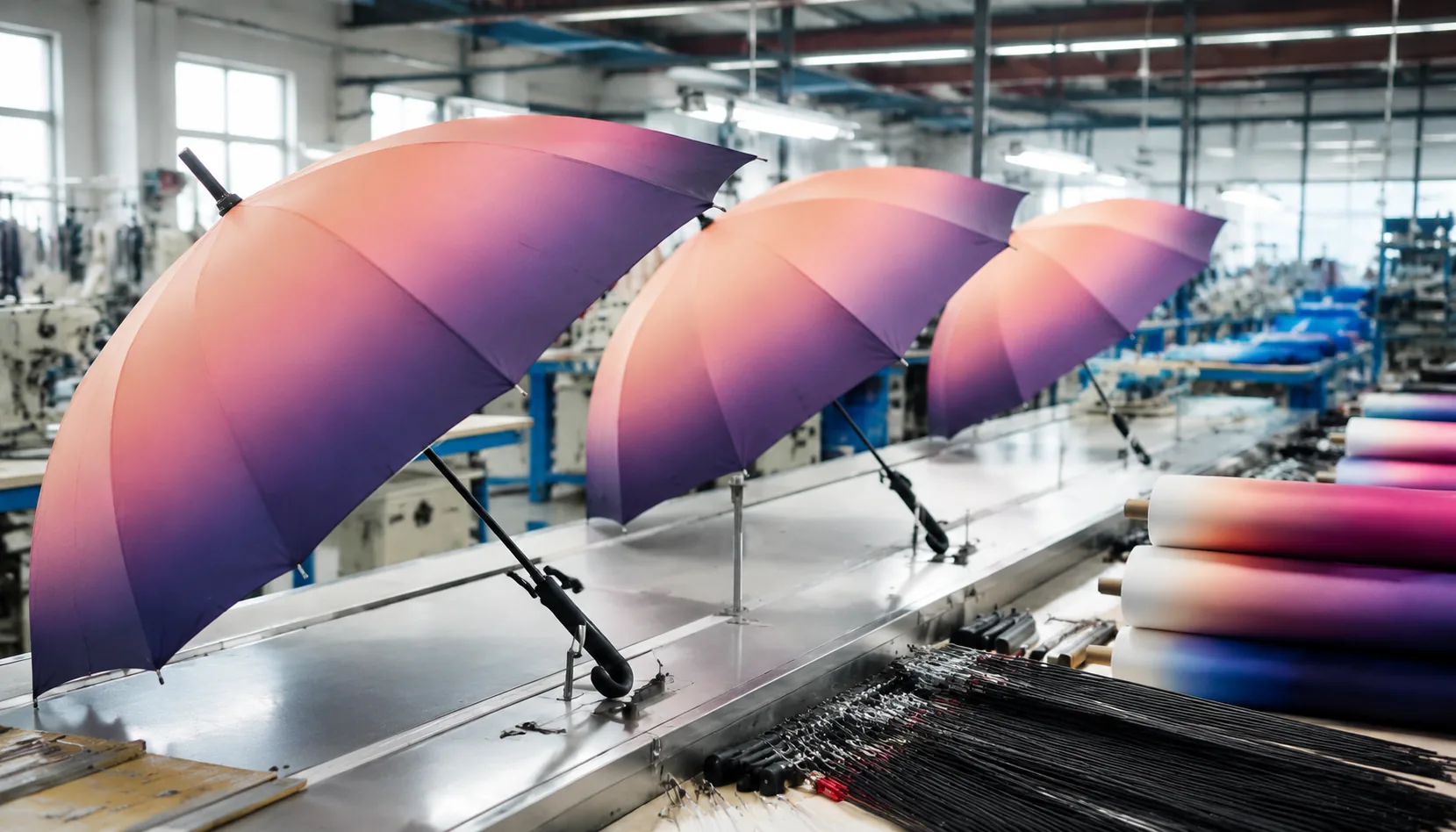
Retail buyers can approve a beautiful gradient on screen and still receive umbrellas with banding, muddy shadows, or mismatched panels if the artwork, fabric, and print method are not controlled from the start. On our Songxia production floor, photo print umbrellas are checked through fabric coating selection, strike-off samples, panel alignment, and color consistency tests before bulk cutting, because small errors become very visible once the canopy is sewn and opened.
When Photo and Gradient Prints Fit the Product Line
Photo print umbrellas work when the umbrella itself has to carry a story, not just a logo. That is why I recommend them for fashion drops, museum shops, travel retail, licensed art programs, and destination merchandise where the buyer is selling mood, memory, or identity. A plain chest logo on a 23" canopy disappears in a crowded retail environment; a full photographic canopy printing layout can turn the product into a walking display. Gradient umbrella printing helps even more when the brand wants a softer transition, a sunset effect, or a color wash that feels closer to apparel and lifestyle packaging than to corporate swag. In practice, these retail brand umbrellas sell best when the artwork is already part of the merchandising concept, not added as an afterthought.
For retail brands, the technical advantage is control. Digital printed umbrellas let us place high-resolution imagery across panels, so a skyline, exhibition detail, map fragment, or licensed illustration still reads after the canopy is cut and sewn. That matters on pongee 190T or 210T, where panel seams, grain, and panel distortion can ruin low-quality art if the artwork is not prepared correctly. Photo print umbrellas are stronger than logo-only branding because they support a collection story: one print can tie together a scarf, a tote, a box sleeve, and the umbrella itself. At ZheBrella, we see this especially in museum and travel programs, where the umbrella is not just a utility item but a souvenir with enough visual value to justify a higher retail price.
The best results usually come from brands that understand the umbrella as merchandise, not an ad surface. A licensed art print can use the full canopy, while a gradient umbrella printing treatment can keep the product calmer for mainstream retail or premium resort shops. If the line includes multiple colorways, the same frame can carry different graphics across 21", 23", or 27" sizes without changing the structural tooling, which keeps the program efficient. This is why photo print umbrellas fit retail storytelling better than simple logo-only branding: they create shelf impact, support repeat purchase, and make the umbrella feel intentional within the collection instead of generic. For buyers, that usually means stronger sell-through and a product that looks designed for the venue, the destination, or the artist, not just branded for exposure.
Artwork Resolution and Panel Mapping Requirements
Artwork resolution is the first thing I check before accepting photo print umbrellas for retail production, because a canopy is not a flat poster. For full photographic canopy printing, supply master artwork at 300 dpi at final print scale whenever possible; for very large golf umbrellas, 150–200 dpi can pass if the source image is sharp and not upscaled from web files. A 23" straight umbrella usually needs a print diameter around 100–105 cm before trimming, while a 30" golf umbrella can require 130–140 cm of usable artwork. Vector logos should stay vector, and raster gradients should be built in 16-bit color if the designer wants smooth tonal transitions without banding. For digital printed umbrellas, we ask for layered AI, PSD, or PDF files with embedded color profiles, plus a flattened JPG proof so prepress can compare the intended layout against the separated panel files.
Panel mapping must be done panel by panel, not by throwing one round image across the whole canopy and hoping the sewing line fixes it. An 8K umbrella has eight triangular panels, typically with 8–12 mm seam allowance on both sides and 15–20 mm extra at the bottom hem; those areas either disappear into stitching or fold under binding. A 16K construction has narrower panels, so each image slice is smaller and alignment tolerance becomes tighter, usually within 2–3 mm at the rib seam if the brand expects clean continuity. For gradient umbrella printing, we extend color beyond the cut line by at least 5 mm bleed to avoid white edges after cutting. At ZheBrella, our standard practice is to provide a numbered panel map showing top notch, rib direction, handle orientation, seam allowance, safe logo zone, and expected image match points before mass cutting.
Image continuity is where retail brand umbrellas either look premium or look like a rushed promotional job. Straight horizontal horizons, faces, architecture, and product photos should not be placed directly over rib lines unless the buyer accepts distortion, because fabric tension pulls differently after sewing and frame mounting. On 8K frames, each panel is wider, so a large face or landscape has fewer seam breaks but more visible stretching from center cap to tips. On 16K frames, the canopy is rounder and more stable in wind, but the same photograph is cut into twice as many slices, making rib-line registration more demanding. Fiberglass ribs flex differently than steel ribs, so windproof double-canopy retail brand umbrellas can shift artwork slightly when opened under tension. For photographic designs, I recommend approving one printed strike-off and one fully assembled sample before confirming bulk production under AQL 2.5.
Fabric and Print Method Choices
For photo print umbrellas, 190T pongee is the practical baseline when the artwork has soft gradients, skyline photos, or full-panel lifestyle images. It feeds cleanly through digital print preparation, cuts with predictable shrinkage, and gives better hand feel than low-cost plain polyester. The tradeoff is density: 190T can look slightly less saturated after water-repellent finishing, especially in pale blue, skin-tone, and sunset gradient areas. 210T pongee costs more but holds photographic canopy printing better because the weave is tighter and smoother, so fine detail in faces, buildings, and product shots does not break up as quickly across stitched seams. For retail brand umbrellas, I usually push buyers toward 210T when the canopy is part of the shelf appeal, not just a giveaway item.
Standard polyester is still useful for budget digital printed umbrellas, but it is less forgiving when the artwork uses large gradient fields. The yarn texture can create tiny banding or a duller surface compared with pongee, and color matching under D65 light becomes harder once the fabric is coated. Gradient umbrella printing also exposes panel variation: eight panels cut from different roll positions can show slight shade shifts after heat fixation. In production, we control this by printing panels in the same direction, keeping ICC profiles locked, and checking pre-production samples before bulk cutting. Our standard practice at ZheBrella is to approve one full assembled umbrella, not only a flat fabric swatch, because seam tension changes how the image reads on a 23-inch or 27-inch canopy.
UPF 50+ coatings, black backing, and double-canopy windproof construction all change the print decision. A silver or black UV backing improves sun protection and makes the umbrella feel more premium, but it can reduce perceived color brightness because less light passes through the canopy; reds and yellows need compensation in the print file. Black backing is excellent for retail shade umbrellas but less ideal when the buyer wants a luminous photographic effect. Double-canopy vented designs help wind resistance, often surviving 50+ mph frame tests when paired with fiberglass ribs, but registration is more demanding because top and lower vents must align after sewing. On 8K or 10K frames this is manageable; on 16K canopies, every extra seam increases the chance that a face, logo, or horizon line crosses a stitch and looks distorted.
Sampling, Color Proofs, and Buyer Approval
For photo print umbrellas, sampling has to separate three approvals: print strike-off, sewn pre-production sample, and bulk go-ahead. The strike-off is usually a 30 x 30 cm or full-panel swatch printed on the actual canopy fabric, not a paper proof, because 190T pongee, 210T pongee, POE, and coated polyester all absorb ink differently. For gradient umbrella printing, I look first for banding in the light-to-dark transition, especially in blue skies, sunset tones, and skin-color backgrounds. A clean gradient should not show hard steps at normal viewing distance of 1 meter; under close inspection, very slight dithering is acceptable, but a visible 5-10 mm color band across multiple panels is a reject before sewing starts.
A pre-production sample proves more than color. It confirms panel alignment after cutting, seam loss, top cap placement, runner clearance, and whether the image still reads correctly on an 8K, 10K, or 16K frame. Photographic canopy printing can look accurate on a flat panel but become distorted after sewing because each triangular panel removes 6-10 mm at the seam allowance. For retail brand umbrellas, we normally photograph the pre-production sample open, closed, and from the top under D65 or 5500K controlled lighting, with a gray card in frame. Buyer approval photos should not be taken under warm office LEDs or beside a window, because those conditions hide cyan shifts and make red or orange gradients look cleaner than they really are.
Pantone references help anchor brand colors, but they do not fully define photographic output. A Pantone 186C logo can be checked separately, while a full photographic sunset or product lifestyle image depends on CMYK/RGB conversion, ICC profile, ink limit, fabric whiteness, and coating. For digital printed umbrellas, I recommend setting a practical tolerance before mass production: Delta E 3-5 for solid brand areas where measurable, and visual approval for complex photographic zones where spectrophotometer readings are not meaningful. Our standard practice at ZheBrella is to keep the approved strike-off, signed pre-production sample, and lighting-condition photos together with the QC file, so bulk inspection can compare production against the same reference instead of arguing from a screen image.
Bulk QC, Packing, and Shipping Considerations
For photo print umbrellas, bulk QC has to start with the canopy before anyone talks about cartons. Under AQL 2.5, I want inspectors pulling opened umbrellas under 6000K light and checking for banding, ink spots, ghosting, color shift against the approved pre-production sample, and hard registration errors at the panel seams. Gradient umbrella printing is less forgiving than a logo repeat because a 3 mm panel mismatch can create a visible step line across the crown. On photographic canopy printing, we also check whether faces, product shots, or skyline details are distorted after sewing tension is applied. Stain marks from handling, oil on the sewing table, loose threads, skipped stitches, and needle holes near the tips are recorded as major or minor depending on visibility from 1 meter. For retail brand umbrellas, I also require sleeve labeling, hangtag barcode, care label, and carton marks to match the buyer’s packing file, not just the artwork sheet.
Frame and function inspection should be separate from print inspection because a beautiful canopy still fails at retail if the umbrella feels cheap in hand. For 23 inch and 27 inch stock, AQL 2.5 checks normally include broken ribs, bent stretchers, loose tips, weak runner locks, sharp burrs, and handle scratches. Auto-open and auto-open-close samples should be cycled at least 10 times during inspection; if the spring hesitates, the button sticks, or the shaft does not fully extend, that is a major defect. For digital printed umbrellas with fiberglass ribs, the canopy tension must be balanced so the image does not twist around the frame. Steel ribs are cheaper but need closer rust checks, especially if the shipment moves by sea during humid months. Our standard practice at ZheBrella is to open every inspected umbrella fully, shake it twice, close it into the sleeve, and verify the sleeve fit before carton packing approval.
MOQ and lead time planning are where many retail orders lose margin. For all-over photographic prints, realistic MOQ is usually higher than a simple one-color logo umbrella because sublimation paper, color profiling, cutting layout, and panel sorting create setup loss; 500 to 1,000 pieces per design is more practical than 100 pieces if the buyer wants stable unit cost. Normal production lead time is 35 to 50 days after artwork approval and deposit, with the longer end applying to custom handles, UPF 50+ coatings, Teflon finishing, or multiple SKU assortments. FOB Ningbo or Shanghai is cleaner when the buyer controls freight, but DDP is useful for retail buyers who need landed cost by unit before issuing a PO. The comparison should include duty, carton volume, peak-season freight, Amazon or warehouse labeling, and damage allowance. Photo print umbrellas pack bulky, so a 2% carton cube error can change the shipping quote noticeably.
Frequently Asked Questions
Are photographic prints suitable for compact umbrellas?
Yes, but complex images lose impact on small panels and tight folds. Compact models work best with bold crops, centered subjects, and fewer critical details near seams.
Can one artwork be used across stick, folding, and golf umbrellas?
Not without adjustment. Each frame size, rib count, and canopy arc needs a separate panel map to keep faces, logos, and horizon lines aligned.
What fabric specs matter most for photographic canopy printing?
For photo-heavy artwork, buyers should confirm canopy fabric denier, weave tightness, coating, and ink compatibility before sampling. A smoother, tighter fabric usually reproduces gradients and fine detail more clearly, while water-repellent coatings can affect color saturation.
How should retail brands approve gradient umbrella printing before mass production?
Request a lab dip or strike-off, then a sewn pre-production sample that matches the final canopy panel layout. Most buyers approve color against Pantone references under daylight lighting, and production only starts after the sample is signed off.
What QC checks are important for digital printed umbrellas?
Common checks include color deviation, image sharpness, panel-to-panel alignment, seam registration, and ink cracking after folding. Retail programs also often verify carton labeling, barcode accuracy, and sample-to-bulk consistency before shipment.
Looking to Launch Your Custom Umbrella Line?
ZheBrella is a Zhejiang-based OEM/ODM umbrella manufacturer with 17 years of export experience. Free design, low MOQ from 100 pieces, windproof construction, full-color print.
Get Free Quote Now »People Also Search For
Related Articles
Gradient and Photographic Umbrella Prints for Brand Campaigns
Plan photo, gradient, and all-over digital umbrella prints with file specs, 190T/210T fabric choices, panel seams, lead ...
Read More »
Gradient and Photographic Prints for Branded Umbrellas
Use digital printing for photo and gradient umbrella designs with realistic expectations for fabric, color, seams, sampl...
Read More »
Gradient and Photo-Print Umbrellas for Brand Campaigns
Specify gradient and photo-print umbrellas with realistic color control, fabric choices, sample approvals, and productio...
Read More »