Photo-Quality Umbrella Printing for Campaign Artwork
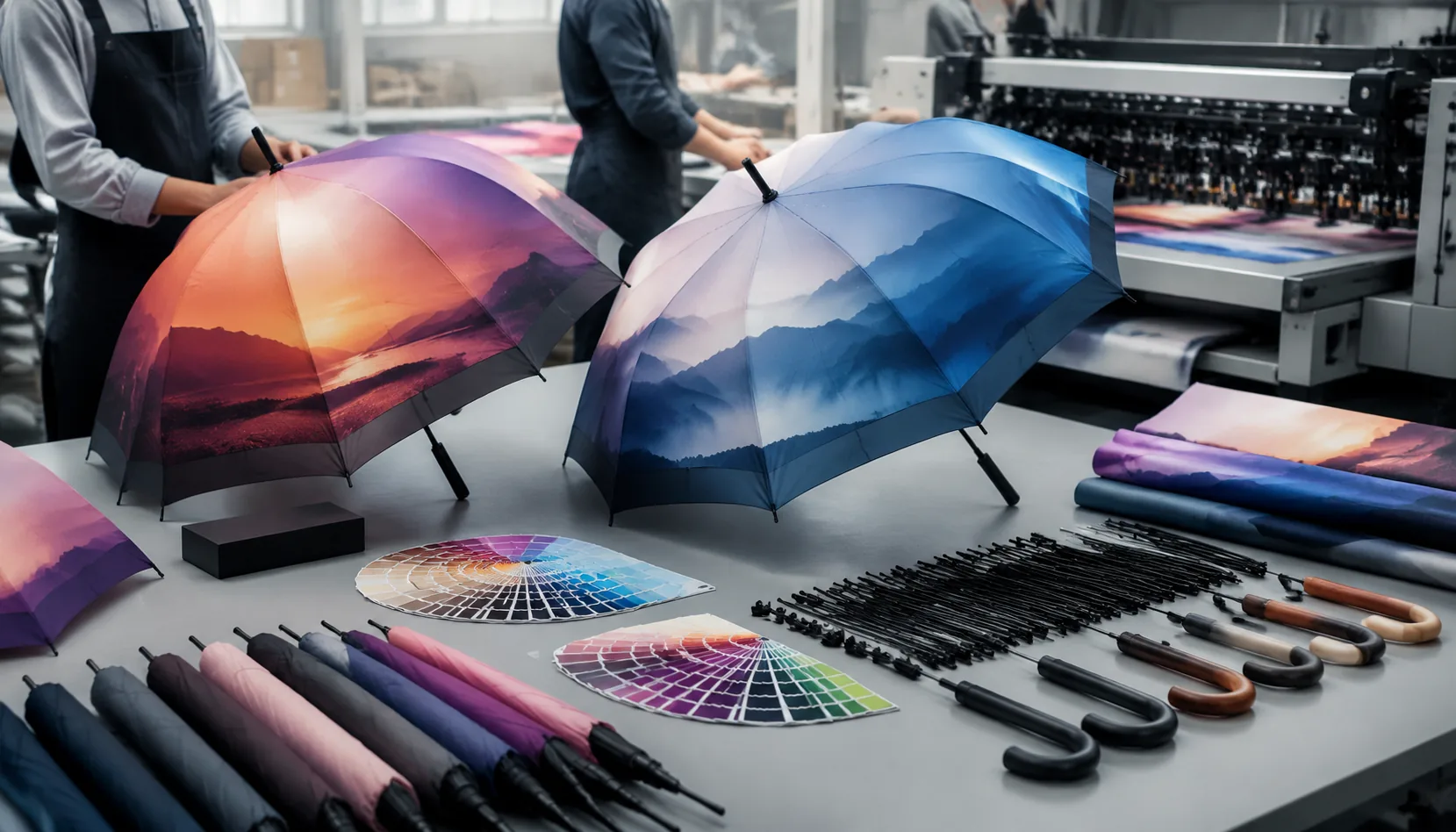
Full-color campaign artwork can look sharp on a screen but lose detail fast when it hits pongee, polyester, or coated canopy panels. For photo print umbrellas, buyers need to lock the image resolution, panel layout, ink method, fabric hand feel, and sampling path before approvals start slipping. On our Songxia production floor, most delays come from avoidable file gaps, color expectations, or late changes after the first strike-off.
What Photo-Quality Printing Can and Cannot Reproduce
Photo-quality printing can reproduce campaign photography better than most buyers expect, but an umbrella is not a flat poster. With digital umbrella printing on 190T or 210T pongee, we can hold smooth sky gradients, product highlights, and most natural skin tones if the supplied file is built in CMYK at panel scale, not pulled from a web banner. On white pongee, a full color canopy print has the widest gamut; on dark fabric, color sits flatter unless we add a white underbase or switch the design approach. Shadows need special attention because water-resistant coatings, Teflon treatment, and fabric texture reduce deep black separation. A face that looks warm on a monitor can print slightly red or gray after heat fixation, so we always recommend a strike-off panel before mass production for branded campaign umbrellas.
The hard limits come from the canopy geometry. An 8K umbrella divides the image into eight triangular panels, while a 16K canopy uses narrower segments with twice as many seams and rib lines. Those seams interrupt continuous artwork, especially across faces, logos, product edges, horizons, and diagonal typography. Panel curvature also stretches the outside edge more than the center, so a circle can look slightly oval once tensioned over fiberglass or steel ribs. Photo print umbrellas work best when the main subject is placed inside one or two panels, away from seam allowances and the top cap area. If the image must wrap around all panels, expect visual breaks at every stitch line; that is construction reality, not a printing defect under AQL 2.5 inspection.
Fine text and QR codes are where I push back hardest on promotional umbrella artwork. Text under about 8–10 pt, thin serif fonts, gray-on-color captions, and legal copy placed near seams will not read cleanly after cutting, sewing, and canopy tensioning. QR codes should be high contrast, preferably black on white, with a quiet zone and a finished printed size of at least 30–35 mm per panel area; curved 23 inch and 27 inch canopies scan better when the code sits on one panel rather than crossing a rib. At ZheBrella, our standard practice is to simplify artwork before production: enlarge key logos, remove unnecessary background detail, avoid faces split by ribs, and keep the campaign message readable from 6–10 feet away in real outdoor use.
Choosing Fabric and Canopy Color for Image Clarity
Coatings change color more than many buyers expect. A UPF 50+ treatment often uses a silver, black, or UV-blocking layer on the underside, and that layer can darken the perceived canopy face, especially when sunlight passes through the fabric. Teflon-style water-repellent finishing is usually safer for color, but heavy PU or UV coating can reduce fabric absorbency and make heat-transfer film sit differently on the surface. Dark dyed fabrics create a second problem: even if the top print looks acceptable indoors under D65 lighting, it may shift outdoors when the canopy is backlit. Our standard practice at ZheBrella is to make a printed strike-off on the actual 190T or 210T pongee, with the chosen coating and canopy color, before cutting bulk panels. That sample tells the truth faster than any PDF proof, especially for promotional umbrella artwork with gradients, faces, or small sponsor logos.
Artwork File Specs for Full-Color Umbrella Orders
Clean artwork files prevent most full-color umbrella problems before fabric ever reaches the cutting table. For logos, send vector AI, EPS, or PDF files with fonts outlined; a JPEG logo pulled from a website will not hold a sharp edge on 190T or 210T pongee, especially across a 23" or 27" canopy. For photographic designs, use 300 dpi raster files at final print size, preferably TIFF, PSD, or high-quality PDF in CMYK. This matters for photo print umbrellas because the image is not printed on a flat poster board; it is split across 8K, 10K, or 16K panels, then sewn into a curved canopy where rib seams interrupt the artwork. For digital umbrella printing, we normally ask buyers to confirm whether the design is panel-repeat, full-canopy wrap, or a single-position logo before quoting, because each layout changes cutting waste, setup time, and proofing risk.
Every full color canopy print should be built on the factory’s panel template, not guessed from a circular umbrella sketch. A typical 23" straight umbrella panel needs bleed beyond the cut line, usually 10–15 mm, and a safe zone of at least 20–30 mm from rib seams, panel tips, and the top notch near the cap. Fine text, QR codes, faces, and product images should not sit directly on stitch lines because sewing tolerance, fabric stretch, and frame tension can shift placement by several millimeters. On double-canopy vented windproof models, artwork also has to account for overlap between upper and lower vents. Promotional umbrella artwork with a skyline, group photo, or sponsor wall should be reviewed panel by panel so no person’s face lands under a rib pocket or at the ferrule point. That is the difference between branded campaign umbrellas that look intentional and umbrellas that look assembled from mismatched triangles.
Color proofing needs to be treated as a production checkpoint, not a courtesy screenshot. Buyer-side checklist items should include Pantone references for brand colors, CMYK artwork files, linked images embedded, fonts outlined, panel template version confirmed, and written mockup approval before sampling. Pantone matching is still useful even when using digital umbrella printing, but buyers should understand that coated paper, backlit screens, and woven polyester fabric will not reflect color the same way. For photo print umbrellas, request a printed fabric strike-off or pre-production sample when skin tones, gradients, or retail packaging consistency matter. Our standard practice at ZheBrella is to lock the approved mockup, print method, canopy fabric, coating such as Teflon or UPF 50+, and AQL 2.5 inspection points before bulk production. That avoids arguments later about whether a color shift came from the file, the proof, the fabric batch, or the buyer’s monitor.
Sampling, Inspection, and Color Control
For photo print umbrellas, sampling has to prove two things before bulk cutting starts: the artwork is sharp enough at canopy size, and the seam breaks do not ruin the image. We normally start with a strike-off on the actual fabric, not a paper proof, because 190T pongee, 210T pongee, POE, and PVC all absorb or reflect ink differently. A 30 cm x 30 cm strike-off is enough to check skin tones, gradients, small text, QR codes, and dark solid areas. For digital umbrella printing, I want the buyer to approve this under D65 light, TL84 store light, and warm indoor light if the campaign will be used at retail events. Once the strike-off is signed, we make a full pre-production sample in the final structure: 23" auto-open, 27" golf, 30" double-canopy vented, or whatever the order specifies. That sample is the real production reference, including rib count, fabric batch, coating, handle, sleeve, and carton mark.
Image alignment across seams is where weak factories lose control on full color canopy print orders. A canopy is not one flat poster; it is usually 8 panels on an 8K frame, sometimes 10K or 16K, and each panel stretches slightly during cutting, sewing, and top-stitching. For promotional umbrella artwork with faces, buildings, vehicles, or diagonal logos, we add registration marks outside the visible cut line and check panel matching after sewing, not only after printing. Acceptable seam offset depends on artwork, but for international brand buyers I usually set 2 mm as the working target and 3 mm as the rejection limit for critical image joins. Border logos and repeated patterns are more forgiving; portrait campaigns are not. If the design wraps over the crown, we also inspect the top cap area because fabric tension around the notch can distort circular graphics. ZheBrella’s standard practice is to photograph the opened pre-production sample from top view and side view before releasing bulk fabric.
Bulk inspection should combine AQL 2.5 workmanship checks with a separate color-control routine, because AQL alone will not catch a campaign color drifting from Coca-Cola red to orange-red. During production, inspectors pull printed panels from the line and compare them in a light booth against the approved strike-off and pre-production sample. For most branded campaign umbrellas, a Delta E tolerance of 2.0 to 3.0 is realistic on polyester pongee; tighter than Delta E 2.0 can be expensive and unstable unless the buyer locks fabric, ink, coating, and curing conditions. We also check print defects such as banding, ghosting, pinholes, ink migration, panel mix-up, and coating contamination before frames are assembled. Final AQL 2.5 inspection covers open-close function, frame symmetry, rib tips, seam strength, waterproofing, logo position, sleeve printing, barcode labels, and carton packing. For photo print umbrellas shipped FOB or DDP, I recommend keeping one approved sample at the factory and one with the buyer so disputes can be judged against the same physical standard, not a backlit screen image.
MOQ, Lead Time, and Shipping Considerations
For photo print umbrellas, digital printing is the practical route when the artwork has gradients, faces, landscapes, or tight CMYK color transitions that screen print cannot hold cleanly. In our factory planning, digital umbrella printing usually starts at 100–300 pieces per design for 190T or 210T pongee canopies, while screen print MOQs are commonly 500–1,000 pieces because every color needs a film, screen, ink setup, and press washout. If the job is a simple 1–2 color logo on one or two panels, screen print is still cheaper at volume. But for promotional umbrella artwork with full-bleed photos, sponsor collages, or multi-panel campaign visuals, digital print avoids the cost explosion of 6–10 screen colors and keeps registration more stable across curved canopy panels.
Sample timing depends less on the printing machine and more on artwork approval. A clean vector dieline or 300 dpi panel file can move into a strike-off in 5–7 days; a full umbrella sample with frame, sewn canopy, and handle branding normally takes 7–12 days. For bulk, digital printed branded campaign umbrellas are usually 18–30 days after sample approval for 500–3,000 pieces, while screen printed bulk orders often run 20–35 days when screens, Pantone matching, and drying time are included. Add 3–5 days if the canopy needs Teflon water-repellent coating after printing, and do not approve bulk production from a phone photo. Ask for a physical sample or at least a lightbox-checked color report, because a full color canopy print shifts visibly between polyester lots.
FOB Ningbo or Shanghai is cleaner when your forwarder already controls consolidation, customs, and delivery appointments; it also gives buyers better visibility on ocean versus air freight decisions. DDP is safer for event planners with a fixed handout date because the supplier owns export, import, duty, and final-mile delivery, but the quote must state whether it is by air, sea, or rail-truck combination. For retail launches, I prefer backing up from the shelf date: 10–12 days for sampling, 25–35 days for bulk, 7 days for AQL 2.5 inspection and packing corrections, then freight. Air DDP can land in the U.S. or EU in 7–12 days, but sea freight often needs 30–45 days door to door. Late artwork approval is the usual killer, not sewing capacity.
Frequently Asked Questions
Can a photo print cover every umbrella panel continuously?
Yes, but the artwork must be separated into panel templates, and minor image breaks at seams are normal. A pre-production sample is the safest way to confirm continuity before bulk production.
Is digital printing better than screen printing for photo artwork?
Digital printing is usually better for gradients, photos, and many colors. Screen printing is stronger for solid logos, limited colors, and larger repeat orders where ink density and cost matter.
What artwork files are needed for photo-quality umbrella printing?
For best results, provide AI, PDF, PSD, or TIFF files at actual print size with 150–300 dpi resolution. Artwork should include bleed for each panel and CMYK color references if exact brand color matching is required.
Which umbrella fabrics work best for full-color campaign artwork?
Pongee polyester is commonly used for sharper photo detail and a smoother retail finish, while polyester is a cost-effective choice for large promotional runs. For all-over photo printing, buyers usually approve a fabric swatch or printed panel sample before bulk production.
How long does sampling take for digitally printed campaign umbrellas?
A digital print sample typically takes 7–12 days after artwork approval, depending on fabric, frame style, and print coverage. Bulk production is commonly 25–45 days after sample approval and deposit, with longer timelines during peak promotional seasons.
Looking to Launch Your Custom Umbrella Line?
ZheBrella is a Zhejiang-based OEM/ODM umbrella manufacturer with 17 years of export experience. Free design, low MOQ from 100 pieces, windproof construction, full-color print.
Get Free Quote Now »People Also Search For
Related Articles
Gradient and Photographic Umbrella Prints for Brand Campaigns
Plan photo, gradient, and all-over digital umbrella prints with file specs, 190T/210T fabric choices, panel seams, lead ...
Read More »
Gradient and Photo Prints on Branded Umbrella Canopies
Plan gradient and photo-print umbrella artwork with realistic fabric, color, sampling, MOQ, and lead-time expectations f...
Read More »
Gradient and Photo-Print Umbrellas for Brand Campaigns
Specify gradient and photo-print umbrellas with realistic color control, fabric choices, sample approvals, and productio...
Read More »