Gradient and Ombre Canopy Printing for Branded Umbrellas
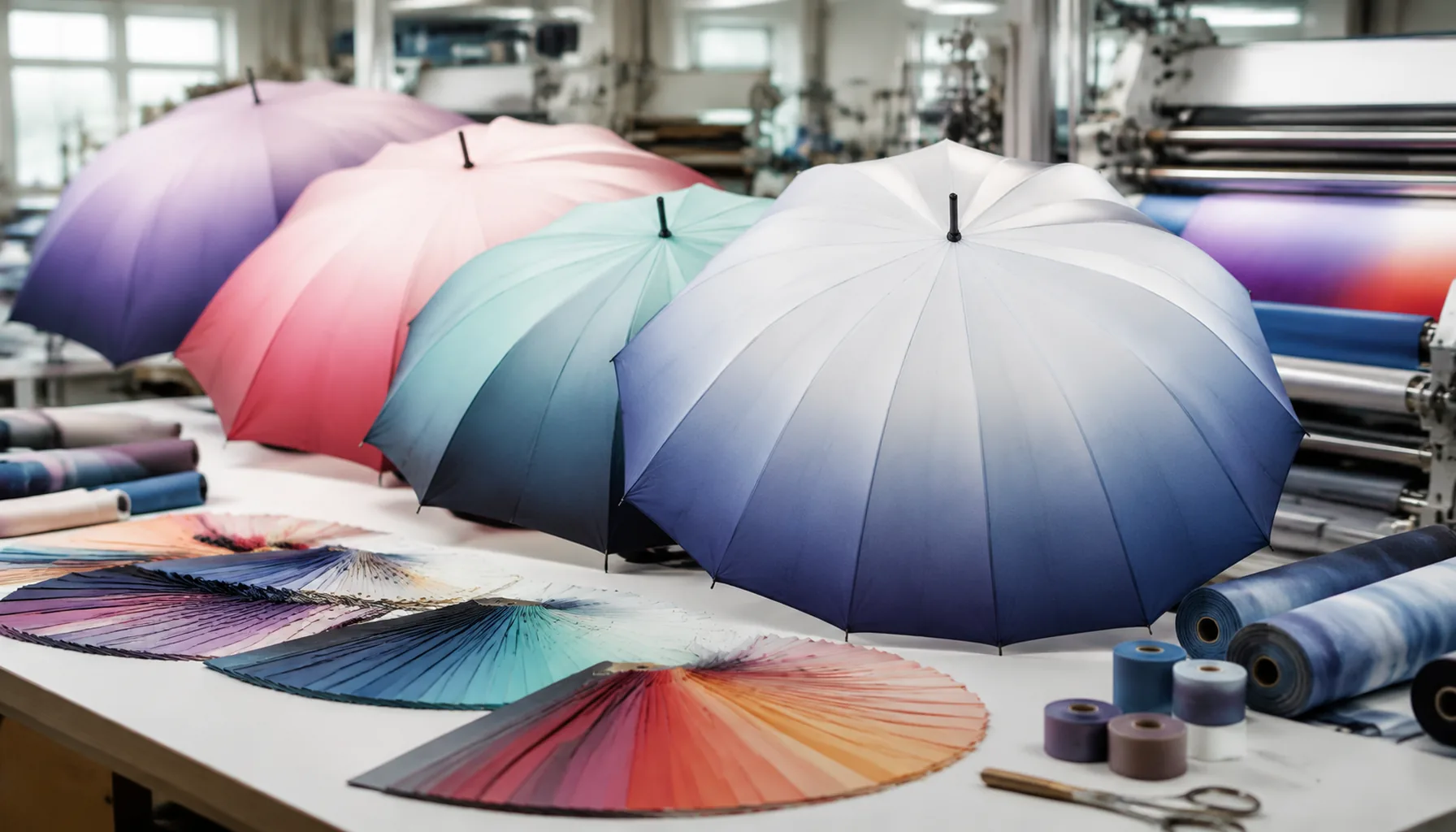
A gradient that looks smooth on a monitor can turn banded, muddy, or misaligned once it is stretched across umbrella panels, seams, and different fabric lots. In gradient umbrella printing, the real risk for buyers is not the artwork file but controlling ink absorption, panel direction, heat setting, and repeatability from the first sample to 8K or 16K production. On our Songxia factory floor, we check color flow panel by panel before bulk cutting, not after finished umbrellas are packed.
When Gradient Printing Fits a Brand Program
Gradient umbrella printing fits best when the umbrella has to sell the story before anyone reads the tag. For retail capsules, an ombre canopy print can connect seasonal color palettes better than a flat navy, black, or red canopy, especially on 23" straight umbrellas and compact 21" auto-open-close models displayed near apparel or travel accessories. I have seen buyers underestimate this: a two-color fade from sand to ocean blue looks ordinary on a PDF, but on 190T pongee umbrellas under store lighting it reads as a lifestyle item, not a commodity rain tool. For resort merchandise, beach clubs, cruise programs, and hotel gift shops, gradients also photograph well because the canopy creates a larger color field than a logo alone. That matters for social media and guest photos, where the umbrella is often seen from 10 to 20 feet away.
Product launches and event campaigns are another good fit because gradient canopies can borrow directly from branded umbrella artwork, packaging, app screens, or campaign key visuals. A cosmetics brand may use a rose-to-lavender fade, a beverage launch may use citrus-to-teal, and a tech event may choose a dark-to-electric-blue transition on a double-canopy vented windproof frame. Digital umbrella printing is usually the cleanest route for short runs, complex color transitions, or photographic backgrounds, while screen printing works only when the gradient is simplified into halftones and the buyer accepts less smooth blending. For a launch order of 500 to 3,000 pieces, I would normally test one full-size strike-off before mass cutting, because gradients shift visually across 8K, 10K, or 16K panel layouts and can look different after sewing tension pulls the pongee into shape.
Gradient umbrella printing is less useful when the program is driven only by lowest unit cost, strict Pantone solids, or a conservative corporate uniform look. The extra value appears when the umbrella is part of a campaign environment: retail window displays, influencer seeding, VIP event kits, outdoor festivals, or resort point-of-sale racks. In production, the main controls are artwork resolution, panel matching marks, color tolerance, and coating compatibility; a Teflon water-repellent finish or UV UPF 50+ treatment can slightly change the perceived depth of darker fades. Our standard practice at ZheBrella is to review the gradient direction panel by panel before sampling, because a radial sunset effect, vertical fade, and edge-to-center ombre all require different nesting and sewing discipline. If those details are controlled, a gradient canopy gives a branded umbrella more shelf impact and photo value than another flat-color giveaway.
Fabric and Print Method Requirements
Fabric choice decides whether a fade looks premium or muddy before the artwork ever reaches the printer. On 190T pongee umbrellas, the weave is tight enough for clean branded umbrella artwork but still has slight yarn texture, so digital umbrella printing needs controlled ink laydown and proper ICC profiling to avoid banding in pale gradients. 210T pongee gives a smoother face and usually holds an ombre canopy print better, especially when the design moves from navy to sky blue or black to gray. Plain polyester can be cheaper, but if the yarn is coarser or the fabric has uneven heat-setting, the gradient will show streaks after tensioning on 8K or 10K frames. For gradient umbrella printing, I prefer testing the actual bulk fabric, not just a lab swatch, because different dye lots can shift the mid-tones by 5–10% visually under daylight.
Sublimation is the cleanest method for full-panel fades on white or very light polyester-based pongee because the dye bonds into the fiber instead of sitting on top. It is not suitable for dark fabric, and it behaves poorly on heavy water-repellent finishes because heat transfer can flatten the coating or create patchy absorption. Digital direct printing can handle shorter runs and complex artwork, but the pre-treatment must be even; otherwise, soft transitions become grainy near the 20–40% color range. Screen printing can create fade effects with halftone dots or wet-on-wet blending, but it is less forgiving on umbrella panels because each gore is cut on a bias and then sewn under tension. For 190T pongee umbrellas, a screen-printed gradient is practical for simple two-color promotional designs, not photographic ombre.
UPF 50+ fabrics add another constraint because UV coatings, silver backing, black glue layers, and Teflon-type water repellency change surface energy and heat behavior. A silver-coated canopy may protect well, but the print side must be defined clearly; printing over the coated face often causes poor adhesion, cracking at fold lines, or a dull fade. Blackout-coated polyester can also trap heat during sublimation, so temperature, dwell time, and pressure need adjustment to avoid ghosting at the panel edges. Our standard practice at ZheBrella is to run a strike-off on the final fabric construction, then check color under D65 light, rub fastness, water repellency, and folding marks before bulk cutting. A good ombre canopy print is not only a file issue; it is a fabric, coating, ink, and sewing-tension issue combined.
Panel Layout on 8K and 16K Frames
The first production risk in gradient umbrella printing is not the printer; it is the panel map. An 8K umbrella has eight triangular canopy panels, so a color fade must be split into eight wedge-shaped files with seam allowance, usually 7–10 mm depending on the sewing line and fabric stretch. If the ombre canopy print is designed as one smooth circle in Illustrator and then chopped without compensating for the stitched overlap, the shade will jump at every seam. On 190T pongee umbrellas, the fabric has enough surface texture to hide very small dot transitions, but it will not hide a 3%–5% color mismatch between adjacent panels. For branded umbrella artwork, I prefer to place logos away from the seam line unless the buyer accepts a tolerance of roughly 2–3 mm after sewing and tensioning on the frame.
A 16K frame looks more premium because the canopy is rounder, but it is less forgiving for digital umbrella printing. Sixteen narrow panels mean twice as many seam crossings, smaller printable wedges, and more chances for the gradient direction to drift after cutting. On 8K frames, a left-to-right fade can often be mapped panel by panel with broad color zones; on 16K umbrellas, each rib line becomes visually important because the eye reads the canopy as a continuous dome. Artwork must be nested with exact rib positions, top cap center, panel grain direction, and the final arc length after hemming. If the factory uses fiberglass ribs, the frame flexes slightly under wind load, so the canopy tension changes more than on a stiff steel frame. That is why sampling one physical pre-production piece matters before approving bulk, especially for retail programs where color continuity is inspected under store lighting.
Double-canopy windproof umbrellas add another alignment problem because there are two fabric layers moving around the same frame. The outer vent panel, inner lower canopy, overlap gap, and rib tips all need separate artwork references; treating the style like a normal single canopy usually creates broken gradients near the vent. On a 23" auto-open 8K vented model, the upper canopy may cover only part of the visual field, while a 27" golf umbrella with 16K ribs exposes much more of the lower canopy when viewed from the side. For gradient umbrella printing, we normally mark top-layer and bottom-layer panels with numbered cut bundles, then sew a pilot canopy before bulk cutting to check whether the ombre flow still reads correctly after assembly. AQL 2.5 inspection can catch stains, skipped stitches, and obvious registration errors, but it cannot rescue poor mapping decisions made before printing.
Sampling, Color Tolerance, and AQL Checks
For gradient umbrella printing, I do not trust a PDF proof by itself; the first control point should be a strike-off on the actual canopy fabric, not a generic polyester swatch. On 190T pongee umbrellas, dye absorption, coating, and heat pressure can shift the mid-tone area more than the dark or light end of an ombre canopy print. Our standard practice at ZheBrella is to print a 30 x 30 cm strike-off with the full gradient ramp, logo area, and at least one seam-crossing reference line, then review it under D65 light and normal indoor light. If the order uses digital umbrella printing, we also check for banding at 10%, 25%, 50%, 75%, and 90% tone transitions because smooth artwork on screen can become stepped after RIP processing or ink limiting.
The pre-production sample should be a complete umbrella, usually 23 inch or 27 inch depending on the order, using the approved frame, ribs, canopy fabric, coating, and handle. For branded umbrella artwork, the critical issue is not only color but panel-to-panel continuity: an 8K umbrella gives eight seam breaks, while 16K creates more alignment points and more risk of visible mismatch. I normally set Delta E tolerance at 3.0 for solid logo colors and 4.0 to 5.0 for gradient zones, because measuring a blended area is less exact than measuring a Pantone block. For retail buyers, visual tolerance still matters: when the umbrella is opened at arm’s length, the gradient should flow without a hard jump, reverse panel, or logo drifting more than 2 to 3 mm across adjacent seams.
Inspection should include practical abuse tests, not just a pretty open-canopy photo. We run dry and wet rub tests on printed areas, especially dark-to-light transitions, because excess ink on 190T pongee can transfer onto the storage sleeve or user’s hand. For heat-transfer gradients, we check edge cracking after opening and closing the umbrella 20 to 30 cycles; for sublimation, we inspect ghosting and double-image marks near seam allowances. Final shipment should follow AQL 2.5 for major defects, with specific checks for color banding, ink streaks, panel misalignment, off-center logo placement, contaminated light zones, and incorrect artwork direction. In my view, gradient umbrella printing needs more disciplined sampling than solid-color logo printing because a small print drift can make the whole canopy look cheap even when the frame and sewing are acceptable.
MOQ, Lead Time, and Shipping Planning
Digital all-panel work needs a higher MOQ than a one-position logo because every canopy panel must be printed, cut, matched, and sewn in sequence. For gradient umbrella printing, I normally treat 500 pieces per design as the practical starting point for stable cost, with 1,000 pieces giving better fabric utilization and color-control consistency. Some factories will quote 100–300 pieces, but the unit price often looks ugly because the print setup, RIP file adjustment, panel nesting, and waste allowance are spread across too few umbrellas. On 190T pongee umbrellas, an ombre canopy print also needs extra tolerance for panel alignment; if the gradient crosses seams, we usually add 3–5% fabric waste compared with a solid-color canopy. For retail programs, lock the final Pantone targets, rib count, size, and handle material before sampling, because changing from a 23 inch 8K auto-open to a 27 inch golf frame can shift the visible gradient balance.
A realistic sample lead time is 7–10 days after approved branded umbrella artwork, assuming the factory already has the frame, handle, tips, and pongee fabric in stock. Digital umbrella printing samples are slower than screen-print logo samples because the first job is not just printing a logo; it is checking gradient banding, seam continuity, color density after water-repellent treatment, and whether the artwork still reads correctly on a curved canopy. Bulk production usually runs 30–45 days after sample approval and deposit, with the lower end possible for standard 21 inch or 23 inch frames and the upper end more likely for 27 inch or 30 inch golf umbrellas, custom handles, UPF 50+ coating, or double-canopy windproof construction. Our standard practice at ZheBrella is to build in-line checks before final AQL 2.5 inspection, because a gradient defect caught after sewing is much more expensive than a logo defect caught on a single printed panel.
FOB makes sense when the buyer already has a freight forwarder, is consolidating umbrellas with other China-made goods, or needs control over sailing schedule and import paperwork. For a planned retail launch, I like FOB Ningbo or Shanghai when the order is 1,000 pieces or more and the buyer can tolerate ocean freight timing, usually 25–40 days on the water depending on destination and congestion. DDP is better for promotional distributors, event planners, or small brand teams that want one landed cost and do not want to manage customs, duties, or last-mile delivery. The trade-off is simple: DDP is easier to budget but gives less visibility into freight components. For gradient umbrella printing tied to a launch date, approve samples at least 60–75 days before the in-hand deadline for ocean shipments, or 35–45 days if using air freight for part of the order.
Frequently Asked Questions
Can a gradient print match exact Pantone colors?
The start and end colors can be matched closely, but the transition zone is usually controlled by approved sample rather than a single Pantone value. Buyers should approve a printed strike-off on the final fabric.
Are gradient prints suitable for windproof double-canopy umbrellas?
Yes, but artwork needs separate mapping for the outer and inner canopy layers. Factories should check vent overlap, seam direction, and logo visibility before bulk production.
What artwork files are best for gradient or ombre umbrella canopies?
Vector files such as AI or PDF are preferred for logo placement, while gradient backgrounds should be supplied as high-resolution raster artwork at actual panel scale. For 8K and 16K umbrellas, each panel should be checked for alignment so the color fade continues smoothly around the canopy.
Can gradient colors be matched to a brand Pantone color?
Yes, but gradients require tolerance control because the color transitions across multiple tones. A factory sample or printed strike-off is recommended before bulk production, especially when the gradient includes a key brand color at the top, edge, or panel center.
What is the typical sample and bulk lead time for ombre canopy printing?
A printed sample usually takes about 7–12 days after artwork confirmation. Bulk production commonly takes 30–45 days depending on order quantity, printing method, canopy size, and whether the order uses 8K or 16K panel construction.
Looking to Launch Your Custom Umbrella Line?
ZheBrella is a Zhejiang-based OEM/ODM umbrella manufacturer with 17 years of export experience. Free design, low MOQ from 100 pieces, windproof construction, full-color print.
Get Free Quote Now »People Also Search For
Related Articles
Gradient and Photo Printing Specs for Branded Umbrellas
Set buyer-ready specs for photo and gradient umbrella prints, from file resolution and pongee fabric to digital sampling...
Read More »
Gradient Umbrella Printing for Retail and Event Campaigns
Plan gradient and photo umbrella prints with realistic color control, fabric selection, panel alignment, sampling steps,...
Read More »
Gradient Color Umbrella Canopies for Retail Brand Lines
Build gradient umbrella designs with realistic color control, panel matching, fabric choices, and approval steps for ret...
Read More »