Gradient and Photo Printing Specs for Branded Umbrellas
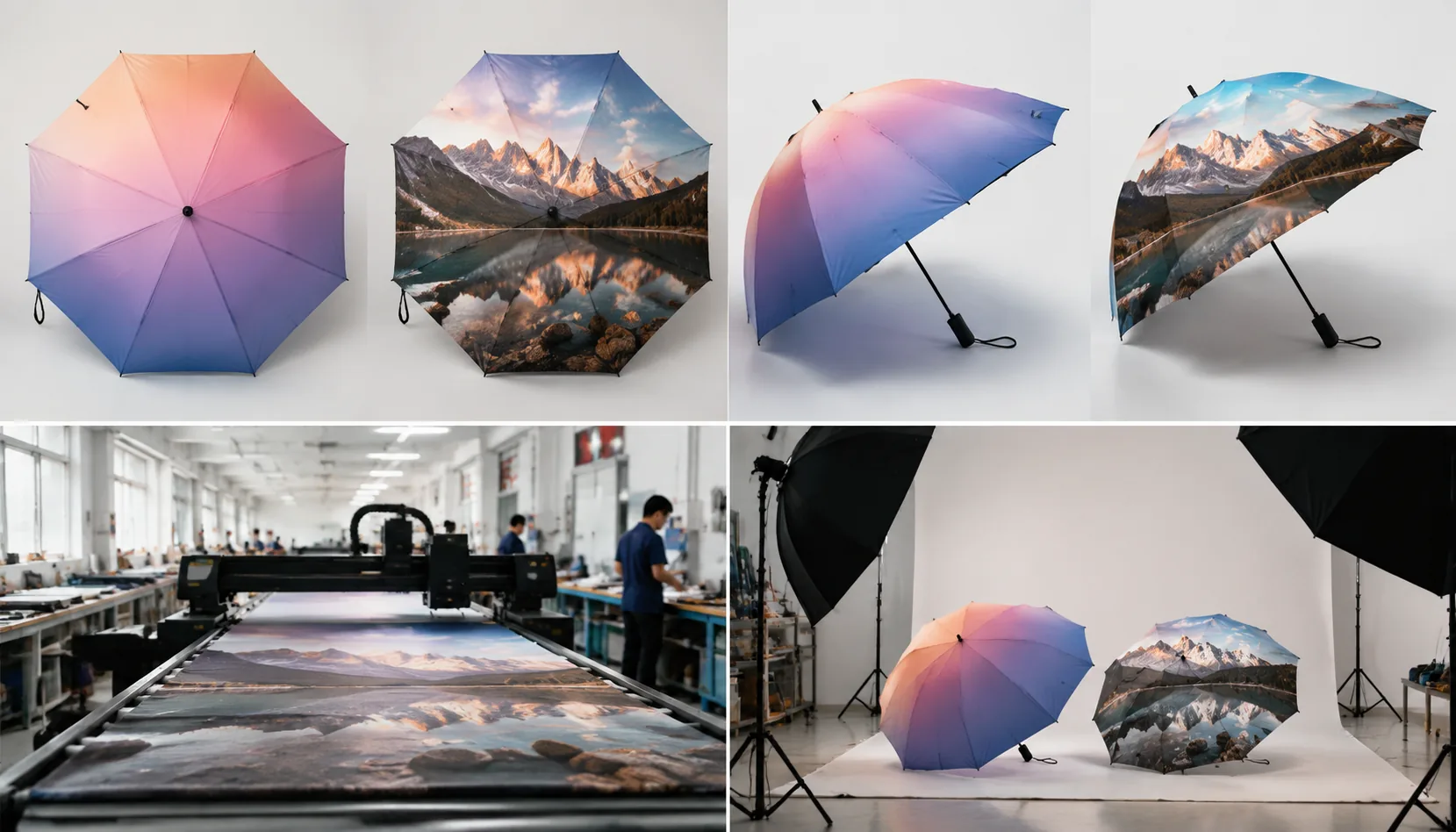
Photo and gradient artwork can look sharp on a monitor but shift badly once it hits curved umbrella panels, coated pongee, and repeat production. For photo print umbrellas, buyers need specs that control file resolution, color targets, panel alignment, sampling, and QC before price, FOB/DDP terms, and lead time are locked. On our Songxia factory floor, most rework starts from unclear artwork files or unapproved strike-offs—not from the printing machine itself.
When Photo and Gradient Printing Makes Sense
Photo and gradient work makes sense when the umbrella is expected to carry an image, not just a logo. Tourism retail, museum shops, city gift programs, resort merchandise, destination weddings, and outdoor festivals are the right fit because buyers want a skyline, painting detail, beach sunset, map, or landmark to feel recognizable from 2–3 meters away. For these projects, photo print umbrellas usually use a full-panel custom photo canopy on 190T or 210T pongee, with the image split across 8K or 10K panels and matched at the seams during sewing. I would avoid this route for a simple one-color corporate mark; screen printing is cleaner and cheaper there. But for a national park, Van Gogh exhibition, hotel opening, or marathon sponsor backdrop, digital printed umbrellas give the retail shelf much more visual value than a flat spot print.
Digital printing is usually preferred over screen printing because photographic color transitions do not behave well through mesh screens. A sunset gradient, watercolor wash, or building reflection may need hundreds of tone steps; screen printing turns that into halftone dots, registration risk, extra screens, and higher setup cost. Gradient umbrella printing by sublimation or direct digital print lets us hold smoother fades, sharper small details, and better CMYK blending across curved canopy panels. On white polyester pongee, sublimation is our standard recommendation because the ink bonds into the fiber, keeps the hand feel soft, and avoids a heavy ink layer that can crack along fold lines. For POE, PVC, or EVA clear umbrellas, the process changes because heat and ink adhesion behave differently; we normally run print trials before quoting mass production.
The artwork still has to be engineered like a product component, not dropped into a template at the last minute. Branded umbrella artwork should be supplied at full size or a reliable scale, ideally 150–300 dpi at final panel dimensions, with bleed added beyond each rib seam and no critical faces, text, or logos sitting on the fold line. For a 23 inch 8K umbrella, each panel may look narrow in the flat file but becomes visually wider once tensioned over steel or fiberglass ribs, so we check mockups on an actual frame before approval. Our standard practice at ZheBrella is to make one pre-production sample, inspect color under D65 lighting, and confirm seam matching before bulk cutting. For retail or campaign orders, plan 7–10 days for sampling and roughly 25–35 days for mass production after artwork approval, depending on MOQ, coating, and FOB or DDP packing requirements.
Artwork Resolution, Color Mode, and Panel Layout
Artwork for photo print umbrellas should be built at 300 dpi at the final print size, not enlarged from a 1,200 px website image after the PO is signed. For a standard 23" umbrella with 8 panels, each printable panel is usually around 430–470 mm wide at the outer edge, narrowing toward the crown, so we supply editable AI/PDF templates with the actual cut shape, grain direction, bleed, safe zone, and rib position marked. Keep logos, faces, QR codes, and small text at least 15–20 mm inside the stitch line because 5–8 mm can disappear into seam folding, binding, or tension after the canopy is sewn. For a custom photo canopy across multiple panels, the image must be split on the template, not simply dropped as one circle, because every seam interrupts the picture.
Color mode is where many branded umbrella artwork files fail. Most digital printed umbrellas start from RGB photography, but production output is CMYK or expanded ink depending on the machine profile, fabric, and coating. Bright blues, neon greens, and saturated sunset gradients often shift duller on 190T or 210T pongee than they look on a backlit monitor. Gradient umbrella printing is especially sensitive because banding can appear if the file is low bit-depth, compressed JPEG, or built with short tonal transitions. We prefer layered PSD, AI, PDF, or TIFF files with embedded profiles, plus a flattened reference JPG so the prepress operator can catch missing fonts, clipping masks, or transparency issues before RIP processing.
Proofing should be treated as a production control step, not a formality. Our standard practice at ZheBrella is to provide a digital layout proof showing panel order, seam alignment, logo placement, and approximate CMYK output before bulk printing; for retail programs or photo print umbrellas above 500–1,000 pcs, a physical strike-off is the safer choice. A strike-off on the actual canopy fabric shows ink density, edge sharpness, gradient smoothness, and color shift after water-repellent or UV coating. Buyers should approve under D65 or neutral daylight conditions, not yellow office lighting. If exact brand colors matter, send Pantone references, but understand that photographic CMYK printing on textile is tolerance-based, typically Delta E 3–5 for solid brand colors and wider for gradients or skin tones.
Fabric, Coating, and Frame Compatibility
For photo print umbrellas, fabric choice decides whether the image looks like a retail product or a cheap giveaway. 190T pongee is the common promotional baseline: it is lighter, folds cleanly on 21" and 23" compact umbrellas, and keeps unit cost under control for MOQ runs of 500–1,000 pcs. The tradeoff is opacity and color depth. On large gradient umbrella printing, especially pale-to-dark fades, 190T can show more light transmission and slight rib shadowing when opened under sun. 210T pongee has a tighter weave and smoother hand, so digital printed umbrellas usually show better saturation, sharper skin tones, and less see-through effect. It also drapes better on 27" and 30" golf umbrellas because the panels hold tension without looking papery. In our factory checks, 210T is easier to keep consistent across 8 panels because the fabric stretches less during cutting and sewing.
Coatings change both print behavior and buyer positioning. A standard water-repellent finish is fine for basic branded umbrella artwork, but a Teflon treatment improves beading and gives the canopy a more premium hand feel. UPF 50+ coating is useful when the umbrella is sold as sun-and-rain protection, but buyers should understand that silver or black UV backing can mute a custom photo canopy if printed after coating or if the fabric is too thin. For clean photo reproduction, we normally print first, then apply the appropriate finishing route, or choose pre-tested coated pongee that holds ink without migration. Sublimation works well on polyester pongee for full-panel photos and gradients, while heat transfer is better for smaller logos or localized artwork. Screen printing is not my first choice for full-photo work because halftones and smooth gradients are harder to control at AQL 2.5 inspection.
The frame should match the artwork value. Steel ribs keep cost low and work for manual or auto-open 23" promotional umbrellas, but they add weight and bend more permanently after wind abuse. Fiberglass ribs cost more, yet they are the right match for premium photo print umbrellas, double-canopy vented windproof models, and 27" or 30" golf sizes expected to survive 50+ mph wind-tunnel claims. An 8K frame is standard; 10K gives a rounder canopy and better panel tension for photo alignment, while 16K looks elegant but increases sewing time, rib cost, and the risk of artwork distortion if the file is not separated correctly. Double-canopy construction also raises cost because there are more panels, vents, and binding operations, but it supports higher retail pricing and fewer complaints from corporate buyers. For DDP programs, the added carton weight from fiberglass and 210T fabric should be calculated before quoting.
Sampling and Bulk Color Control
For photo print umbrellas, a digital strike-off is not optional; it is the only honest way to see how the image behaves on the actual canopy fabric, not on a flat screen file. Gradient umbrella printing is where problems show up first: smooth sky fades, skin tones, and dark-to-light transitions can shift once the panel is cut, sewn, and tensioned over the frame. A strike-off on the exact pongee, POE, or polyester base lets you compare the ink laydown, saturation, and edge sharpness before you commit to production. Branded umbrella artwork should be checked against the real panel shape and seam allowance, because a design that looks clean in layout can drift after panel matching and heat setting.
A full assembled sample matters even more than the strike-off because digital printed umbrellas change appearance when the canopy is opened, stretched, and viewed at different angles. A custom photo canopy must be approved in its finished state so the buyer can inspect seam alignment, image continuity across panels, and any visible banding where gradients cross stitch lines. We usually define approval with a visual tolerance plus a color tolerance, often using ΔE targets for key brand colors and skin-tone areas. For most branded work, a practical agreement is tighter on logos and focal elements than on background fades, since the eye catches logo drift faster than a subtle shift in a blue-to-white sky gradient.
Color approval should be done under controlled lighting, not under mixed warehouse fluorescents and daylight at the same time. Standard practice is to review strike-offs and assembled samples under D65 or a comparable neutral light source, then confirm the same sample in retail-like ambient lighting to catch metamerism. Once the sample is signed off, bulk production still needs AQL 2.5 checks for print registration, panel consistency, and obvious shade variation across cartons. That is especially important on photo print umbrellas, where a tiny shift in cyan density or a missed seam match can turn a premium order into a reject pile. If the buyer wants a strict match, the approval sheet should state the lighting condition, ΔE limit, and what counts as acceptable visual variation before mass printing starts.
MOQ, Pricing, and Shipping Terms for Buyers
Digital print changes the MOQ conversation because the expensive part is not a screen frame; it is file preparation, color proofing, fabric waste during calibration, and printer time. For standard one-color logo printing on 190T or 210T pongee, a factory can often start at 300–500 pcs per color because the setup is simple and repeatable. For photo print umbrellas, I normally quote 500 pcs as a practical floor, with 1,000 pcs giving much better unit cost because the RIP setup, ICC color matching, and first-article approval are spread over more pieces. Gradient umbrella printing also needs tighter control at panel seams; a smooth blue-to-purple fade looks cheap if the eight canopy panels shift by 3–5 mm. Buyers should send branded umbrella artwork as layered AI/PDF plus a 300 dpi raster file at final print scale, not a low-resolution mockup pulled from a presentation deck.
Unit cost for digital printed umbrellas is usually higher than standard logo work, but not because the ink is magic. The cost comes from slower throughput, more inspection, and higher rejection risk on visible photo areas. A 23 inch 8K auto-open umbrella with steel shaft and fiberglass ribs may only need a small screen-printed logo on one panel; add a full custom photo canopy and the sewing line must keep panel order, print direction, and seam matching under control. Our standard practice at ZheBrella is to run a strike-off first, then a pre-production sample before bulk cutting, adding 3–7 days before mass production. Normal logo umbrellas can ship in 20–30 days after deposit and artwork approval; all-over gradient or photo jobs usually need 30–45 days, especially during March–June when seasonal inventory orders fill the printing schedule.
FOB and DDP terms should be chosen based on launch risk, not just freight price. FOB Ningbo or Shanghai works well for importers with their own forwarder, especially when consolidating umbrellas with other outdoor or promotional goods. DDP is cleaner for event planners, Amazon sellers, and retail brands that need landed cost certainty; it should include carton dimensions, HS code review, duty assumptions, and realistic port-to-door timing. For retail launches, I suggest approving artwork 60–75 days before the shelf date for sea freight, or 35–45 days if using air or express on a smaller batch. Photo print umbrellas packed in individual sleeves and retail cartons take more CBM than bulk promotional umbrellas, so freight can swing the landed cost by more than the print charge itself. AQL 2.5 inspection before shipment is worth budgeting because color banding, panel misalignment, and handle scratches are easier to fix in Zhejiang than after goods arrive at a distribution center.
Frequently Asked Questions
Can photographic artwork print clearly on umbrella fabric?
Yes, if the file is high resolution and the fabric is suitable for digital printing. Fine facial details and small text should be tested on a strike-off before bulk production.
Do gradients look the same on UPF 50+ umbrellas?
They can, but UV coatings may change color depth and fabric hand feel. Buyers should approve a coated fabric sample, not only a digital mockup.
What artwork files should buyers provide for photo or gradient umbrella panels?
Provide AI, PDF, PSD, or TIFF files with embedded colors and images at 150–300 dpi at actual panel size. For multi-panel canopy prints, include panel layout, bleed allowance, logo position, and Pantone references if brand colors must be matched.
Is digital printing suitable for bulk umbrella orders with gradient artwork?
Yes, digital printing is usually preferred for gradients, photos, and complex full-color artwork because it avoids screen separation limits. Bulk MOQ often starts around 500–1,000 pieces per design, with a printed sample typically taking 7–10 days before mass production.
What quality checks are important for photo printed umbrella canopies?
QC should confirm color consistency, image alignment across panels, fabric defects, water repellency, seam strength, and print rub resistance. For export orders, buyers can request pre-production samples, inline inspection, and final AQL inspection before FOB or DDP shipment.
Looking to Launch Your Custom Umbrella Line?
ZheBrella is a Zhejiang-based OEM/ODM umbrella manufacturer with 17 years of export experience. Free design, low MOQ from 100 pieces, windproof construction, full-color print.
Get Free Quote Now »People Also Search For
Related Articles
Gradient and Photographic Umbrella Prints for Brand Campaigns
Plan photo, gradient, and all-over digital umbrella prints with file specs, 190T/210T fabric choices, panel seams, lead ...
Read More »
Gradient Umbrella Printing for Retail and Event Campaigns
Plan gradient and photo umbrella prints with realistic color control, fabric selection, panel alignment, sampling steps,...
Read More »
Gradient Canopy Printing for Branded Umbrella Campaigns
Plan gradient umbrella canopies with realistic color transitions, panel alignment, fabric choices, sampling steps, and Q...
Read More »