Gradient Canopy Printing for Branded Umbrella Campaigns
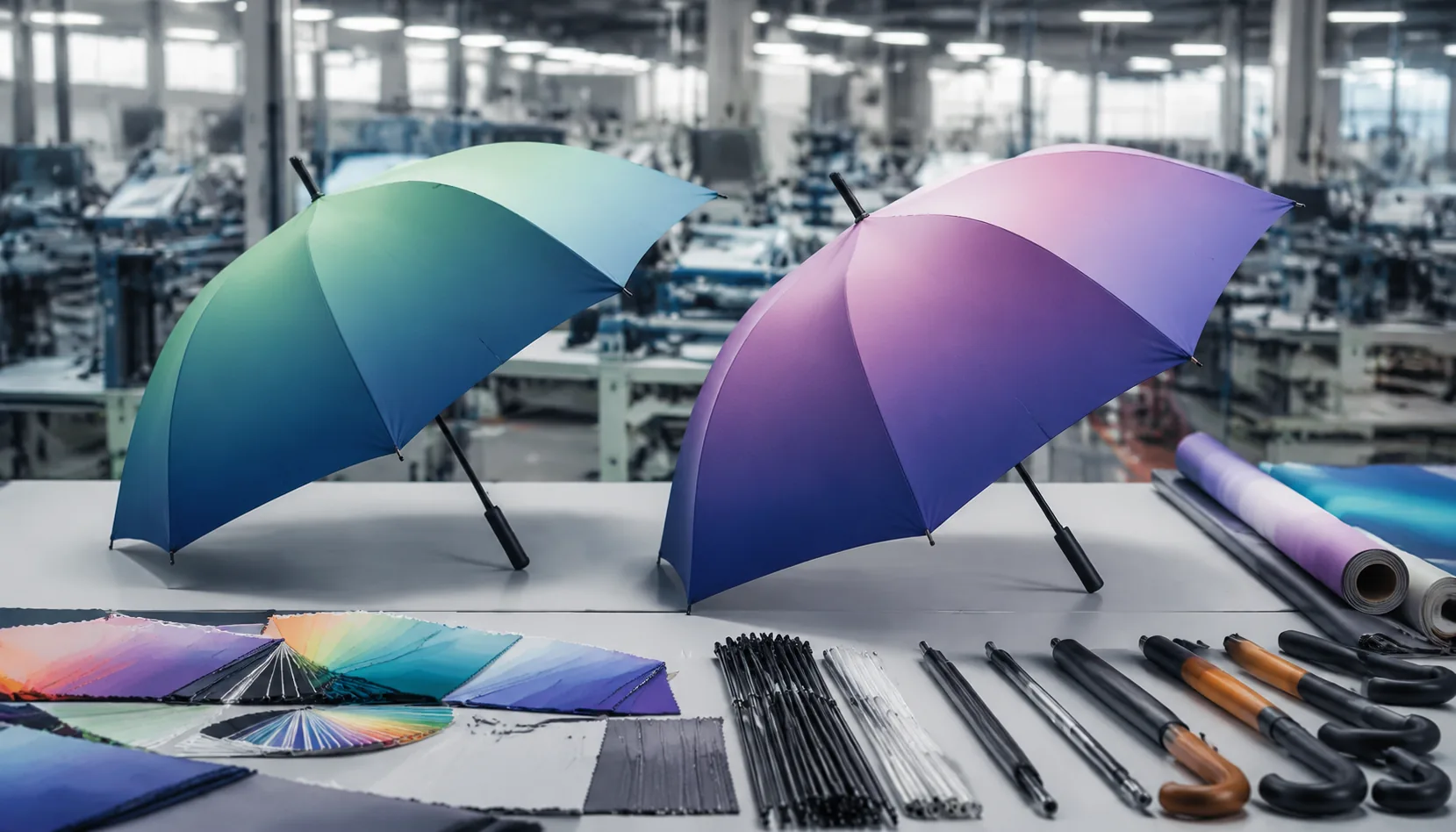
A smooth gradient on an umbrella looks simple on a mockup, but on the sewing floor it has to survive fabric stretch, panel cutting, seam allowances, and color shift after coating. For campaign orders, gradient printed umbrellas need artwork planned around the canopy’s eight-panel geometry, not just a flat circle, or the brand color can break at every rib. We check transitions through strike-off sampling, panel alignment, and wet-rub QC before mass production starts.
When Gradients Add Brand Value
Gradients add brand value when the umbrella is part of a visual campaign, not just a rain tool. For product launches, a custom gradient umbrella canopy can echo a phone colorway, beverage flavor range, cosmetics palette, or automotive paint finish better than a flat PMS panel. At sports events, branded canopy gradients work well when they follow team colors from center cap to edge, so the crowd shot reads as one coordinated block without needing every logo to face the camera. Tourism promotions use the same logic: sunrise-to-sea, mountain-to-sky, or city-night gradients create an immediate destination cue. In retail collections, gradient printed umbrellas justify a higher shelf price because the canopy feels designed, especially on 190T or 210T pongee with an 8K or 10K frame and a clean matching sleeve. The buyer should treat the gradient as the main graphic field, with the logo sized and positioned after the background is approved, not before.
A gradient supports recognition when the brand already owns a color transition or when the campaign image relies on atmosphere: festival lighting, resort sunsets, running events, wellness launches, or fashion drops. Digital print umbrellas are the right method for soft transitions, photographic blends, and multi-color artwork because screen printing will usually show banding or require halftone compromises. Sublimation on white pongee gives the smoothest color movement, while heat transfer can work for smaller panels but is less forgiving on large 23-inch or 27-inch canopies. Umbrella artwork proofing matters more than usual here: we check gradient direction, seam alignment, panel repeat, and whether the darkest section lands under the logo. A factory proof should include a full open-canopy mockup plus one printed panel sample when the order volume justifies it, because a gradient that looks rich on a monitor can flatten after fabric absorption and water-repellent finishing.
A solid canopy is still the better choice when logo readability is the campaign’s first job. If the umbrella will be photographed from 10 to 30 feet away, used by staff at an outdoor activation, or handed out as a sponsor item with several small logos, a single navy, black, white, red, or PMS-matched canopy gives cleaner contrast and lower inspection risk. Gradients can also fight with reflective inks, small QR codes, thin serif lettering, or one-color corporate marks that have strict brand rules. My rule on the production floor is simple: use gradient printed umbrellas when the color story is memorable even without reading the logo; use a solid canopy when the logo must be read instantly. For mixed needs, keep the outer panels gradient and reserve one or two panels as solid logo zones, which reduces visual noise while still giving the campaign a custom look.
Best Print Methods for Smooth Color Transitions
Screen printing can produce strong solid logos, but it is the weakest option for true gradients unless the design is simplified into halftone dots or limited color steps. A four-color process screen print on umbrella fabric sounds economical, but the curved panel geometry, rib seams, and water-resistant coating make registration harder than on T-shirts or paper. For promotional orders with a simple dark-to-light fade behind a logo, screen printing may still work if the gradient area is small and the buyer accepts visible dot texture at close range. For a custom gradient umbrella canopy that must match a brand guide, I would not approve bulk production from a PDF alone. Umbrella artwork proofing should include Pantone or LAB targets, fabric base color, coating sequence, panel layout, and a printed strike-off viewed both indoors and outdoors. AQL 2.5 inspection should check color variance between panels, misalignment at seams, ink cracking after folding, and whether the fade remains smooth after water-repellent finishing.
Panel Layout and Rib Count Considerations
Gradient seams are not a Photoshop problem; they are a cutting-table problem. On an 8K umbrella, the canopy is usually eight triangular panels, so a left-to-right fade becomes eight separate wedges with stitch allowance, grain direction, and rib alignment all affecting the final visual flow. If the artwork is supplied as one flat circle, the gradient often jumps at the seam because the printer, cutter, and sewer are each making small practical decisions. For gradient printed umbrellas, we map the design panel by panel, including 8–12 mm seam allowance, center cap clearance, and the exact rib positions. A 23 inch auto-open umbrella with steel ribs gives less tolerance than a 27 inch golf umbrella with fiberglass ribs because the longer panel exaggerates any color shift or registration error. Good umbrella artwork proofing should show every panel numbered, rotated correctly, and matched to the frame direction before bulk fabric is printed.
Rib count changes the whole rhythm of branded canopy gradients. A 16K umbrella has narrower panels, so the gradient breaks more often, but each break is smaller and can look smoother from a distance if the layout is engineered correctly. An 8K canopy has fewer seams, but each panel is wider, so a diagonal fade or radial glow can visibly kink where the stitching crosses the color transition. With digital print umbrellas, especially on 190T or 210T pongee, we normally ask for vector logo layers plus a high-resolution gradient file at full panel scale, not a compressed mockup pulled from a catalog template. For a custom gradient umbrella canopy, the safest workflow is to lock the frame spec first: 8K, 10K, or 16K; manual, auto-open, or auto-open-close; 21 inch folding, 23 inch stick, 27 inch golf, or 30 inch oversized. Changing rib count after artwork approval means the gradient must be rebuilt, not simply stretched.
Double-canopy windproof construction adds another layer of control because the upper vent canopy and lower main canopy are different pattern sets. On a vented 27 inch golf model rated for 50+ mph in a wind tunnel, the top canopy may cover only the crown area while the bottom canopy carries most of the brand image, so the two files cannot be treated as one continuous graphic. Branded canopy gradients can work well on double-canopy umbrellas, but the proof must define which color appears through the vent gap, how the overlap looks when the umbrella is open, and whether the underside is plain, matched, or printed separately. Our standard practice at ZheBrella is to issue separate print files for top layer, bottom layer, tie wrap, and sleeve when needed, then inspect first pieces under AQL 2.5 before approving bulk. This prevents a clean digital proof from turning into mismatched panels after sewing, especially on UPF 50+ coated or Teflon-treated fabric where reprinting waste is expensive.
Logo Placement Over Gradient Backgrounds
Logo placement on gradient printed umbrellas should start with a contrast map, not with the logo file. On a 190T or 210T pongee canopy, a navy-to-black gradient may look premium in the artwork proof, but a dark blue logo will disappear once the fabric is stretched over 8K fiberglass ribs and viewed outdoors. I like to mark each panel as a light, mid, or dark contrast zone before locking position. Put white, silver, or pale logos over the darker third of the custom gradient umbrella canopy, and put black, charcoal, or deep brand colors over the lighter third. Avoid placing fine type, QR codes, or thin icon lines across the transition band where density changes quickly; that is where digital print umbrellas most often fail visual approval even when the print itself is technically within tolerance.
White keylines are useful, but they should be specified as production features, not left to the designer’s eye. For screen printing over branded canopy gradients, a 1.0–1.5 mm white keyline around a logo can separate the mark from mixed background tones without making it look like a sticker. For heat-transfer logos, the edge can be cleaner, but the film hand-feel becomes more noticeable on lightweight folding umbrellas. On sublimation panels, white cannot be printed directly, so any white logo area depends on the base fabric staying unprinted; that needs tight panel registration during cutting and sewing. If the brand color must sit over a dark gradient, specify a white underbase for transfer or screen print, then run the color layer on top. Without that underbase, red, orange, and green logos usually dull down badly on saturated backgrounds.
Auto-open folding models need extra attention because the visible advertising area changes when the umbrella is closed, carried, or sleeve-packed. A 21 inch or 23 inch 3-fold umbrella exposes narrow triangular strips when wrapped, so a logo centered only for the open canopy may land partly hidden in the folds. During umbrella artwork proofing, ask for both open-canopy and closed-wrap mockups, especially if the campaign relies on commuter visibility. On 8-panel folding frames, I prefer placing the main logo on one full panel away from the strap seam, then using a simplified repeat mark on the opposite panel if budget allows. Do not run one large logo across two high-variation gradient panels unless the factory confirms sewing tolerance; even a 3–5 mm panel shift can make the mark look broken after rib assembly.
Approval Workflow and Bulk QC
Approval must lock color before the factory buys bulk fabric, not after 5,000 panels are already cut. For gradient printed umbrellas, I start with a digital proof that shows panel-by-panel layout, seam allowance, logo position, handle orientation, and the gradient direction across all 8K or 10K panels. A custom gradient umbrella canopy is unforgiving because a 3 mm artwork shift can make the color transition look broken at the seam. The proof should include Pantone, CMYK, or LAB targets, but buyers need to understand that 190T/210T pongee, POE, PVC, and EVA do not reflect color the same way as paper. Dark navy fading into sky blue on coated pongee can look flatter after water-repellent or Teflon treatment, while transparent POE may look lighter once stretched on the frame.
After the PDF proof, we make a fabric strike-off, usually one or two printed panels, before building the pre-production sample. This is where digital print umbrellas either pass or waste money: we check banding in the gradient, ink bleeding at logo edges, color stepping, and whether sublimation heat has distorted the fabric grain. For branded canopy gradients, the approved strike-off becomes the color target for bulk inspection, not the buyer’s monitor screenshot. Our standard practice at ZheBrella is to keep one signed strike-off in the QC room and one sealed with the production file. A pre-production sample then confirms the full umbrella: 21 inch, 23 inch, 27 inch, or 30 inch size; manual, auto-open, or auto-open-close mechanism; fiberglass or steel ribs; shaft finish; tips; runner; and packing method.
Bulk QC should compare finished goods against the approved color target under consistent light, then inspect printing and umbrella function under AQL 2.5 unless the buyer specifies tighter limits. For umbrella artwork proofing, I want inspectors to record gradient banding, panel-to-panel misalignment, stains, pinholes, ghosting, dirty seams, off-center logos, loose stitching, rib deformation, weak stretchers, runner jams, failed auto-open-close action, and canopy tension problems. A typical MOQ for gradient printed umbrellas is 300–500 pieces for digital print and higher for some screen or transfer processes, depending on fabric and frame stock. Lead time is normally 7–10 days for proof and strike-off, 10–15 days for a pre-production sample, and 25–40 days for bulk after approval. FOB Ningbo or Shanghai is straightforward; DDP needs extra time for carton labeling, HS code review, and destination customs documents.
Frequently Asked Questions
Can a gradient wrap continuously around the whole umbrella?
Yes, but it must be built as separate panel artwork with seam allowance. A physical sample is needed because rib seams interrupt the visual flow.
Which umbrella fabric is best for gradient printing?
White or light 190T/210T pongee is usually the safest base for clean gradients. Dark fabric may require a different print process or white underbase, increasing cost and sampling time.
How should artwork be prepared for a gradient umbrella canopy?
Submit vector logo files plus a high-resolution gradient layout mapped to the umbrella panel template. For 8-panel umbrellas, allow bleed at each panel edge and mark any continuous color transitions that must align across seams.
Can gradient colors be matched exactly to Pantone references?
Solid logo areas can usually be matched closely to Pantone colors, but gradients may shift slightly after printing on polyester or pongee fabric. A printed strike-off or pre-production sample is recommended before bulk production.
What QC checks are important for branded gradient umbrella orders?
Key checks include panel-to-panel gradient alignment, logo position tolerance, color consistency under daylight, ink adhesion, water repellency after printing, and seam distortion after canopy assembly. For campaign orders, buyers often approve one sealed sample before mass production.
Looking to Launch Your Custom Umbrella Line?
ZheBrella is a Zhejiang-based OEM/ODM umbrella manufacturer with 17 years of export experience. Free design, low MOQ from 100 pieces, windproof construction, full-color print.
Get Free Quote Now »People Also Search For
Related Articles
Gradient and Photographic Umbrella Prints for Brand Campaigns
Plan photo, gradient, and all-over digital umbrella prints with file specs, 190T/210T fabric choices, panel seams, lead ...
Read More »
Gradient Umbrella Printing for Branded Color Campaigns
Learn how to specify gradient umbrella prints with realistic color transitions, fabric choices, sampling steps, and prod...
Read More »
Gradient and Photo Printing Specs for Branded Umbrellas
Set buyer-ready specs for photo and gradient umbrella prints, from file resolution and pongee fabric to digital sampling...
Read More »