Gradient Canopy Printing for Branded Umbrella Collections
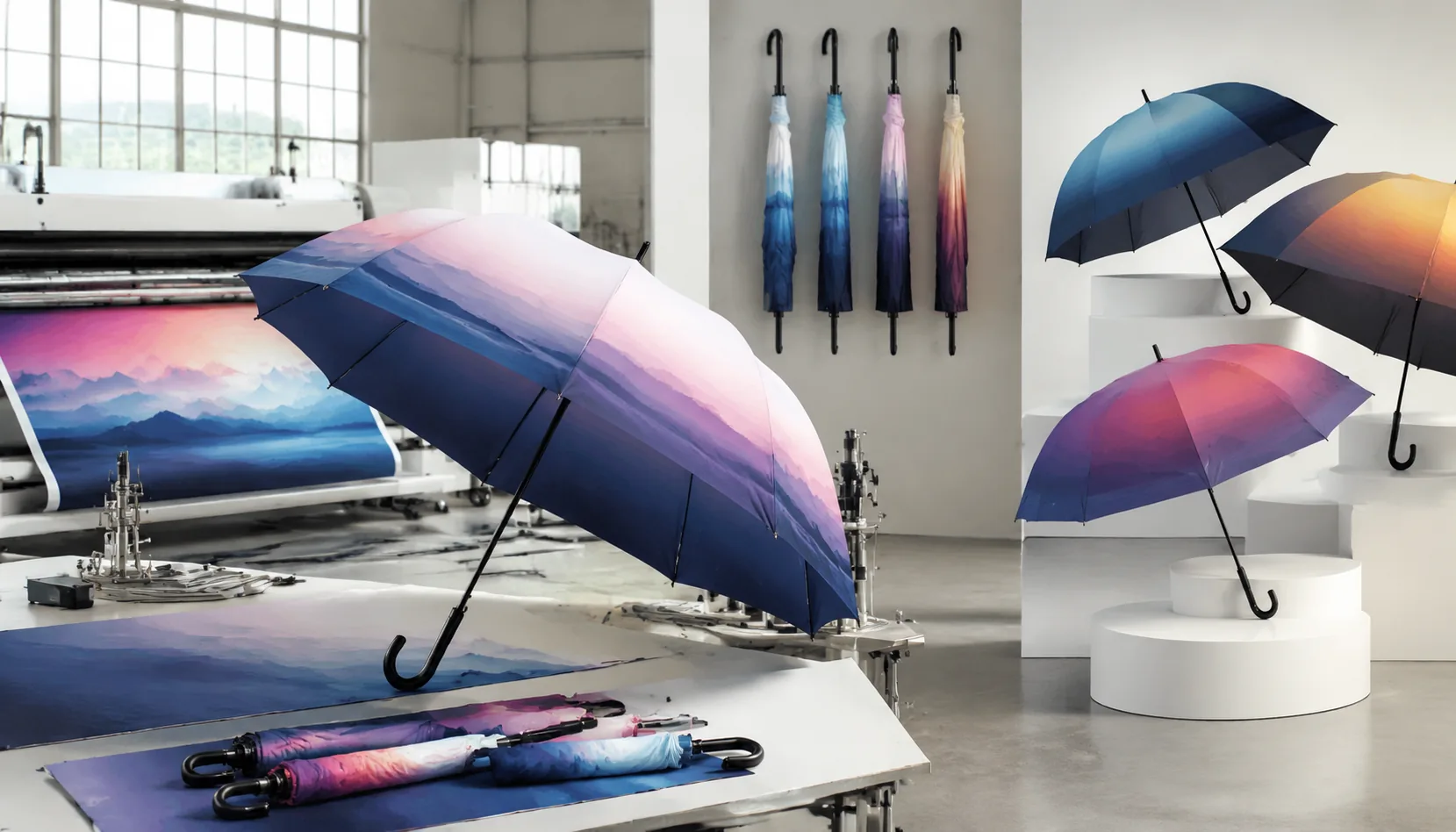
Gradient printed umbrellas look simple on a buyer’s mood board, but on the cutting table the color transition has to survive panel layout, fabric absorption, seam matching, and frame tension. In our Songxia workshop, most problems appear before mass production: wrong artwork scale, mismatched ribs, or a fabric that shifts tone after coating and heat setting. A solid specification should lock print method, canopy fabric, sample approval steps, and carton terms before the PO is released.
Where Gradient Canopies Add Brand Value
The practical rule is to design the gradient around the finished umbrella shape, not a flat rectangle on a screen. Each gore panel narrows toward the top notch, so a radial fade, diagonal wash, or horizon-style band must be mapped before bulk cutting; otherwise the color jump at the seam looks cheap. For retail umbrella design, we normally proof one full assembled sample, not just a printed fabric swatch, then check color under daylight and warehouse LED because blues and violets can drift after Teflon water-repellent or UV UPF 50+ coatings. For campaigns needing speed, sublimation on white pongee can land samples in 7–10 days and bulk in 25–35 days after approval, with AQL 2.5 inspection covering print defects, seam matching, opening function, and sleeve consistency before FOB or DDP shipment.
Print Methods for Smooth Color Transitions
Digital canopy printing is the safest method when a buyer wants photographic fades, multiple color stops, or exact placement across a full 8K or 16K layout. For gradient printed umbrellas, we usually print the artwork panel by panel on 190T or 210T pongee, then cut with registration marks so the fade continues cleanly rib to rib. The advantage is control: cyan-to-navy, sunset orange-to-pink, or retail umbrella design with a logo sitting inside the fade can be adjusted in the RIP before production. The risk is banding if the file is built too small, compressed, or converted badly from RGB to CMYK. I ask for full-size vector gradients or 300 dpi raster files, plus a physical strike-off, because a screen proof cannot show how ink density changes once the canopy is stretched on a 23" or 27" frame.
Sublimation gives the smoothest hand feel because the dye bonds into suitable polyester fibers instead of sitting heavily on the surface. It works well for ombre canopy umbrellas on white or very light 190T pongee, especially when the order needs edge-to-edge color without thick ink affecting water repellency. The limitation is deep color: black, burgundy, and dark navy often look flatter than buyers expect, and sublimation cannot print light colors onto dark fabric. Ink penetration is better than pigment digital printing, but shade consistency still depends on heat press temperature, dwell time, and fabric lot. At ZheBrella, our standard practice is to approve one printed panel set before cutting bulk fabric, because a two-degree heat variation can shift gray gradients toward green or purple.
Multi-screen printing is still useful for simpler fades, but buyers should not confuse it with true digital canopy printing. A two-color or three-color screen fade can look clean on promotional branded umbrella collections, especially with bold corporate colors and large open panels, but it has mechanical limits. The screen mesh, squeegee pressure, and ink viscosity decide how soft the transition looks; too much pressure creates a hard line, while too little gives weak coverage and poor wash resistance. Matching gradients across 16K panels is harder than across 8K because every seam interrupts the artwork and every narrow panel magnifies alignment error. For gradient printed umbrellas with logos crossing seams, I recommend tolerance drawings showing acceptable mismatch, usually 2-3 mm, and AQL 2.5 inspection should include panel order, shade direction, and logo position, not only fabric defects.
Fabric, UV, and Frame Considerations
For gradient printed umbrellas, fabric choice decides whether the color transition looks intentional or cheap. 190T pongee is acceptable for promotional runs where price matters, but the weave is slightly more open, so very soft ombre transitions can show minor banding after digital canopy printing, especially in pale blue, beige, or gray gradients. 210T pongee gives a tighter surface, smoother ink laydown, and a better handfeel when buyers compare samples side by side. In our factory sampling, 210T also handles darker edge-to-center fades with less show-through when panels are cut from the same printed roll. For branded umbrella collections aimed at retail shelves, I usually push 210T pongee unless the customer is chasing a strict giveaway budget. If the canopy is POE, PVC, or EVA, gradients become more transparent and glossy, which can work for fashion designs but needs stronger artwork control because every rib shadow is visible.
Sun umbrella gradients need coating decisions before artwork approval, not after mass production starts. A UPF 50+ coating changes both fabric stiffness and color depth; silver coating can dull a pastel gradient, while black UV coating makes outside colors appear richer but slightly heavier in hand. Teflon water-repellent treatment is still useful for rain models, but it should be tested with the print system because some sublimation and heat-transfer gradients lose surface crispness if the finishing sequence is wrong. For ombre canopy umbrellas sold as summer or beach products, we normally request a lab dip plus one full assembled sample, not just a flat printed swatch, because the curve of a 23-inch or 27-inch canopy changes how the fade reads under sunlight. Retail umbrella design teams should also lock panel direction early; a radial gradient across 8K panels is less forgiving than a simple top-to-bottom fade.
Frame specification should match the buyer’s selling claim, not just the artwork. Steel ribs keep cost down and give a firm opening feel, but they bend more easily after inversion; fiberglass ribs cost more but recover better in wind and are the safer choice for branded umbrella collections that advertise durability. An 8K frame is standard for compact and 23-inch straight umbrellas, while 10K or 16K makes sense when the canopy is large, dense, or positioned as premium. Auto-open mechanisms are fine for most 21-inch and 23-inch models, but auto-open-close compact frames need tighter AQL 2.5 inspection because spring force, runner smoothness, and handle fit affect return rates. For gradient printed umbrellas used at resorts, golf events, or outdoor retail displays, a double-canopy vented windproof structure is worth the extra sewing time; a properly balanced fiberglass frame can survive 50+ mph wind-tunnel tests without turning the printed canopy into a warranty problem.
Artwork Setup and Sample Evaluation
Artwork quality decides whether gradient printed umbrellas look intentional or look like mismatched fabric scraps sewn around a frame. For ombre canopy umbrellas, I ask buyers for vector logos in AI, EPS, or PDF, plus the gradient artwork as a high-resolution raster file at final canopy scale, preferably 300 dpi or higher. A tiny JPEG pulled from a catalog will band badly in digital canopy printing, especially across 23" or 27" panels. The panel map should show rib positions, top cap location, panel numbers, grain direction, and whether the design must flow clockwise, mirror, or repeat. Seam allowance is not decoration; we usually need 8-12 mm hidden in the seam, and critical color transitions or logo edges should stay at least 15-20 mm away from stitch lines and rib tips.
For branded umbrella collections, the first sample should be a real strike-off on the intended canopy cloth, not only a paper proof. 190T pongee absorbs color differently from 210T pongee, and a UV-coated or Teflon-treated fabric can shift gradients slightly duller after finishing. On the strike-off, check panel-to-panel continuity by opening the umbrella fully and viewing it from the top, not just one loose fabric panel on a table. The common failure is a smooth blue-to-purple file becoming eight visible wedges because each panel was printed with a slightly different start point. Our standard practice at ZheBrella is to mark panel one at cutting, sewing, and inspection so the gradient sequence does not rotate during assembly.
Sample evaluation should include daylight, indoor LED, and a quick wet-surface check because color drift shows up differently under each condition. Rib shadowing also matters: steel ribs can create darker visual lines under pale gradients, while fiberglass ribs are less reflective but still visible under very light yellow, gray, or pastel areas. Put the logo over both light and dark zones during proofing, then decide whether it needs a white underbase, keyline, or alternate one-color version. For retail umbrella design, I prefer approving one open sample, one close-up print swatch, and one folded-view photo before bulk production. The AQL 2.5 inspection standard should include color tolerance, logo registration, seam matching, and any unacceptable banding across the canopy.
Production Risk, MOQ, and Delivery Terms
Gradient work costs more setup time because the factory is not just placing a 1-color logo on 190T pongee; we are controlling a full canopy transition across 8 panels, seam allowances, rib positions, and cutting direction. For gradient printed umbrellas, the artwork has to be separated with panel templates, bleed zones, and color reference points so the ombre does not jump visibly at the seams. On digital canopy printing or sublimation, we still need fabric profiling, ink density testing, heat-press calibration, and shrinkage checks before bulk cutting. On screen printing, gradient effects require halftone mesh work and more trial pulls, so it is usually less flexible for smooth retail umbrella design. That is why MOQ often moves from 300–500 pcs for a simple logo order to 1,000–3,000 pcs per design or colorway, especially when the buyer wants 23-inch auto-open, 27-inch golf, or double-canopy vented models in matching branded umbrella collections.
Pre-production sample approval is not optional on ombre canopy umbrellas. I want the buyer to sign off on a physical sample under daylight, office LED, and wet-canopy conditions because gradients can look 5–10% darker after coating, especially with Teflon water repellent or UV UPF 50+ finishing. Our standard practice at ZheBrella is to check the sample against a Pantone target or approved digital proof, then lock fabric batch, print profile, shaft color, handle finish, and packing artwork before mass production. During bulk inspection, AQL 2.5 should cover print defects such as banding, ghosting, pinholes, ink migration, panel mismatch, and color drift between lots. For a retail program, I also recommend a tighter internal check before final AQL: open 32–50 umbrellas across cartons, view them from 1.5 meters, and reject obvious left-to-right shade breaks that a customer will see immediately on display.
Delivery terms should be chosen from the launch calendar, not from habit. FOB Ningbo or Shanghai is usually better when the buyer has a forwarder, wants cost control, and can accept ocean transit of roughly 25–40 days to North America or Europe after 30–45 days production. DDP is safer when the promotion date is fixed, the buyer lacks import handling, or the order includes mixed branded umbrella collections going directly to event sites or retail warehouses. The tradeoff is that DDP quotes must include duty, customs risk, last-mile delivery, and sometimes remote-area surcharges, so they need cleaner carton marks and earlier packing data. For gradient printed umbrellas tied to a seasonal launch, approve the pre-production sample before booking vessel space; losing 7 days on color approval can force air freight, and air freight on 23-inch or 30-inch umbrellas is painful because cartons cube out before they weigh out.
Frequently Asked Questions
Can a gradient print continue perfectly across umbrella seams?
It can be planned closely, but seams, panel cutting, and rib tension create small visual breaks. A panel map and pre-production sample are essential before confirming bulk production.
Are gradient umbrellas suitable for UPF 50+ sun protection?
Yes, if the fabric and coating are specified for UPF 50+ and the printing process is compatible. Confirm UV test requirements before sampling, especially for retail or outdoor-event programs.
Which print method works best for smooth gradient umbrella canopies?
Digital sublimation is usually best for smooth ombre effects because it supports continuous color transitions across polyester panels. For large retail orders, sampling should confirm color banding, seam alignment, and logo sharpness before bulk production.
What MOQ should buyers expect for gradient printed umbrella collections?
A typical MOQ is 500 to 1,000 pieces per colorway for custom gradient canopies, depending on frame type, fabric, and packaging. Lower quantities may be possible for sampling or stock-frame projects, but unit cost is higher.
How should artwork be prepared for gradient canopy production?
Provide vector logo files plus high-resolution gradient artwork mapped to each canopy panel, with Pantone or CMYK references. A pre-production sample usually takes 7 to 12 days after artwork approval, and bulk lead time is commonly 30 to 45 days.
Looking to Launch Your Custom Umbrella Line?
ZheBrella is a Zhejiang-based OEM/ODM umbrella manufacturer with 17 years of export experience. Free design, low MOQ from 100 pieces, windproof construction, full-color print.
Get Free Quote Now »People Also Search For
Related Articles
Gradient Color Umbrella Canopies for Retail Brand Lines
Build gradient umbrella designs with realistic color control, panel matching, fabric choices, and approval steps for ret...
Read More »
Gradient Umbrella Printing for Retail and Event Branding
Learn when gradient umbrella prints work best, how digital files should be prepared, and which canopy specs support smoo...
Read More »
Custom Umbrella Pattern Printing for Retail Brand Collections
Plan repeat patterns, panel joins, and fabric choices for branded umbrellas that look consistent across retail assortmen...
Read More »