Custom Umbrella Pattern Printing for Retail Brand Collections
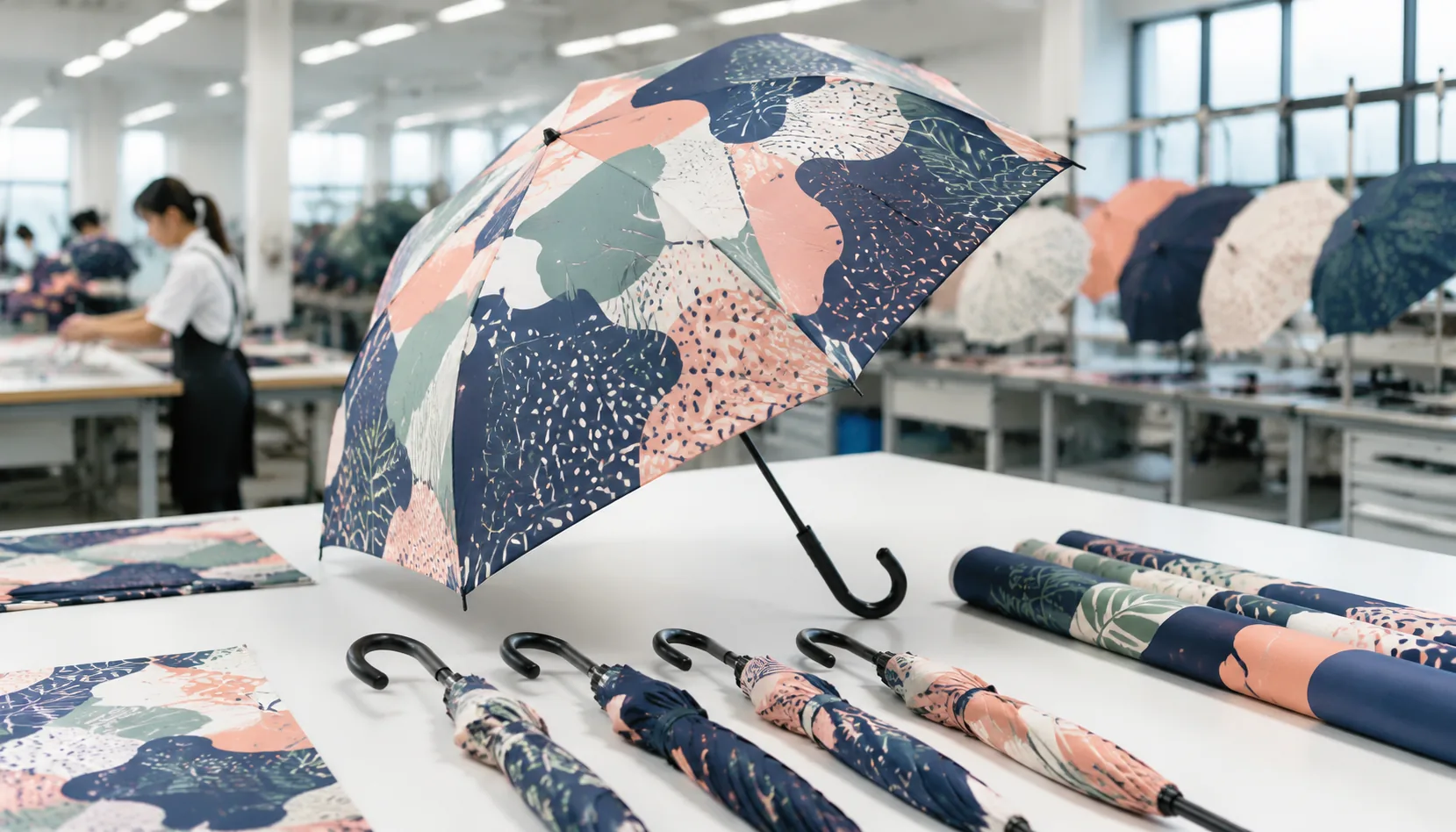
Retail buyers often approve a print on a flat artwork file, then discover on the sample that repeats drift across panels, logos land in awkward seams, or launch colors shift between polyester lots. In custom umbrella pattern printing, the real control starts before screens or digital files are made: panel mapping, fabric shrinkage, rib alignment, and reorder color standards all need to be locked together on the factory floor.
Define the Pattern Goal Before Artwork Setup
The pattern goal should be fixed before anyone opens Illustrator, because an umbrella canopy is not a flat poster; it is 8, 10, or 16 curved panels stitched into a moving dome. All-over repeats are best for retail collections where the umbrella must feel like a SKU family, not a giveaway item. Small florals, geometric dots, plaid, animal prints, and tone-on-tone monograms work well as repeat pattern umbrellas because panel-to-panel misalignment is less obvious after sewing. Scattered icons are better for campaign merchandise, tourism programs, college stores, and kids’ ranges where the buyer wants charm and recognition rather than textile discipline. Stripes are the least forgiving: if the artwork crosses seams, we need to plan panel cutting direction, seam allowance, and rib position carefully or the finished canopy looks cheap even when the print itself is clean.
Seasonal graphics need a different mindset from permanent branded canopy patterns. A Christmas snowflake, summer fruit, Halloween motif, or spring botanical can be louder because the sell-through window is short and the retail umbrella design must catch attention on a rack or in an online thumbnail. For department stores and fashion brands, I usually push clients toward controlled negative space, especially on 190T or 210T pongee with digital sublimation, because a dense layout on every panel can turn muddy once the canopy curves downward. For promotional retail, custom umbrella pattern printing can carry more logos, but the repeat still needs breathing room: 30–50 mm between small marks is often safer than filling every gap. On POE or PVC transparent umbrellas, the outside environment becomes part of the design, so scattered icons or border prints usually read better than heavy full-coverage graphics.
Logo scale changes sharply by umbrella size and viewing distance. On a 21-inch folding umbrella, the canopy is usually seen from 1–3 meters away, often while folded in a bag or opened at chest height, so logos around 35–60 mm wide can be enough if contrast is strong. On a 27-inch golf umbrella, the canopy is viewed across a sidewalk, tournament tee box, or event entrance; a 90–140 mm logo may be appropriate, especially on alternating panels. Negative space also scales differently: a compact 21-inch auto-open-close umbrella can look premium with one restrained logo and a quiet repeat, while a 27-inch or 30-inch double-canopy umbrella can carry larger seasonal graphics without feeling crowded. Our standard practice at ZheBrella is to proof umbrella digital printing artwork on the actual panel template, not just a square repeat file, because seam lines, rib shadows, and handle orientation decide whether the pattern looks intentional when opened.
Match Pattern Complexity to the Right Print Method
Pattern complexity should decide the print method before you quote the umbrella, not after the artwork is approved. For simple repeat pattern umbrellas—1 to 3 solid colors, geometric repeats, stripes, dots, monograms, or large logo tiles—screen printing is still the cleanest and most cost-stable choice. A properly exposed screen gives dense color on 190T pongee, especially on 23 inch and 27 inch canopies where each panel has enough space for repeat alignment. The limitation is registration: every added color means another screen, another setup, and another chance for small drift across the 8 panels. If your retail umbrella design uses tight outlines, small icons under 5 mm, or repeats that must cross panel seams, we normally request a full-size panel layout and a tolerance discussion before sampling.
Digital printing is the better route when custom umbrella pattern printing involves gradients, watercolor effects, fine illustrations, photo-style artwork, or many SKUs with the same frame but different canopies. Umbrella digital printing removes screen setup costs and handles branded canopy patterns with dozens of colors, but the fabric and coating matter. 190T pongee is enough for most promotional patterns and mid-market retail collections; it balances print sharpness, weight, and FOB cost. For premium lines, 210T pongee gives a smoother hand feel, tighter weave, and better perceived value when paired with fiberglass ribs, auto-open frames, or 10K windproof construction. At ZheBrella, our standard practice is to check artwork at panel scale, then sample under both indoor light and daylight because dark navy, charcoal, and red can shift noticeably after water-repellent finishing.
Control Panel Joins, Rib Breaks, and Repeat Direction
Panel count changes the artwork problem before it changes the umbrella price. An 8K umbrella gives you eight large triangular panels, so repeat pattern umbrellas can breathe, but every join is a hard visual break because the rib sits directly under the stitched seam. A 16K layout uses narrower panels, often on fashion or golf styles, and it can make a dense branded canopy pattern look more refined from a distance; the tradeoff is more seams, more chances for motif cutoff, and higher sewing tolerance pressure. On a standard 23 inch straight umbrella, I normally reserve 8-12 mm per side for seam allowance, depending on fabric and seam type. That means a graphic crossing one join can lose 16-24 mm after sewing, before you even account for needle walking on slippery 190T or 210T pongee.
The safest rule in custom umbrella pattern printing is to treat every rib line as a no-logo zone, not just a construction line. Put small logos, monograms, faces, QR codes, and licensed characters at least 25 mm away from stitched seams and 35-50 mm below the top cap, because the cap washer, notch, and canopy tension distort artwork near the crown. On POE or PVC clear canopies, the seam tape and rib shadow are visible, so interruption is even more obvious than on dark pongee. For retail umbrella design, we usually mark a radial template with bleed, safe area, rib centerline, and cap exclusion area before any strike-off is approved. If the buyer wants one hero logo per panel, center it on the panel axis; if they want a continuous repeat, let the repeat break intentionally at seams instead of trying to force perfect alignment around the full circle.
Umbrella digital printing and sublimation can hold fine artwork better than screen printing, but neither process cancels sewing reality. Fabric panels are cut, stacked, printed or printed then cut depending on the workflow, and then sewn by operators who must manage stretch, grain direction, and tip alignment. A 2 mm sewing drift at each panel can become a visible rotation error by the eighth seam, especially on geometric stripes, plaids, checkerboards, and border prints. At ZheBrella, our standard practice for branded canopy patterns is to proof the repeat direction with arrows showing crown-to-tip orientation on every panel, then run a pre-production sample before bulk cutting. For AQL 2.5 inspection, I do not reject every tiny mismatch at the seam, but I do reject logos split by stitching, inverted panel direction, and border artwork that climbs unevenly around the canopy edge.
Build a Color Standard for Multi-SKU Collections
A retail collection needs one color standard before artwork moves to production, especially when the same motif runs across 21", 23", and 27" umbrellas or across manual, auto-open, and auto-open-close frames. For custom umbrella pattern printing, I do not accept “match the PDF” as a production instruction. The tech pack should list Pantone Solid Coated or TCX references for every key color, plus CMYK/RGB values only as supporting data. Pongee 190T and 210T, recycled PET, POE, PVC, and EVA all absorb or reflect ink differently, so a navy ground on 210T pongee will not read the same as the same file printed on transparent POE. For repeat pattern umbrellas, define the master repeat size, motif spacing, logo orientation, and seam alignment tolerance before sampling. If the collection includes multiple branded canopy patterns, lock the core palette first, then adapt artwork around it instead of correcting color SKU by SKU after cutting.
Lab dips and strike-off samples are where most retail umbrella design problems either get solved or become expensive. A lab dip is useful for dyed solid canopy fabric, but umbrella digital printing needs a strike-off on the actual canopy substrate, with the real coating stack, because ink sits differently on water-repellent pongee than on uncoated test cloth. Our standard practice at ZheBrella is to review at least one A4 or full-panel strike-off before bulk printing, then keep an approved signed sample beside the printing line and final AQL 2.5 inspection table. For screen printing, I want wet ink drawdowns and cured samples; for heat transfer, I check edge sharpness, hand feel, and cracking after folding. For sublimation, red, orange, and deep blue need extra attention because heat, dwell time, and fabric whiteness can push them off standard faster than buyers expect.
Color tolerance should be written in practical terms, not just “exact match.” Across canopy lots, I usually set a Delta E target when the buyer has measurement equipment, but I also insist on visual approval under D65 daylight because umbrellas are judged outdoors, not under a yellow warehouse lamp. Dark grounds make small shifts more visible: black can swallow low-contrast logos, deep green can turn muddy after Teflon treatment, and burgundy can look brown when printed over a warm fabric base. UV coatings and UPF 50+ fabrics are another trap; the coating improves performance but can cool down whites, flatten fluorescents, or add a slight gray cast to pastel branded canopy patterns. Review strike-offs both open and folded, because rib shadows and double-layer vented canopies change perceived color. If a collection ships in staggered FOB or DDP batches over 45-60 days, reserve fabric and ink lots early to reduce drift between first delivery and replenishment.
Approve Samples, MOQ, and Production Timing
Approval discipline matters more than the printing method when a retail launch has fixed shelf dates. For custom umbrella pattern printing, I like a five-step gate: artwork check, print strike-off, pre-production sample, bulk production, then AQL 2.5 final inspection. The artwork check should confirm repeat size, seam position, panel orientation, Pantone or CMYK targets, and whether the logo crosses rib lines. A print strike-off is normally one or two canopy panels, not a finished umbrella, and it is where we catch color drift, muddy gradients, or a repeat pattern that looks good on screen but awkward on an 8-panel canopy. For umbrella digital printing, especially full-surface branded canopy patterns on 190T or 210T pongee, expect 3 to 5 days for file checking and strike-off after usable artwork is received. Screen printing is cheaper for simple 1- or 2-color repeats, but it needs tighter registration control and usually a higher setup commitment.
The pre-production sample should be built with the real frame, fabric, handle, tips, sleeve, hangtag, and carton marks because retail umbrella design failures often come from the non-print parts. A 23-inch auto-open stick umbrella with steel shaft and fiberglass ribs behaves differently from a 21-inch auto-open-close folding umbrella with 8K ribs, even if the canopy artwork is identical. Our standard practice at ZheBrella is to approve the pre-production sample before fabric cutting, then keep a sealed sample on the inspection table for comparison during sewing and packing. Typical MOQ for repeat pattern umbrellas is 500 pieces per design for digital print, 1,000 pieces when custom-dyed fabric or special handles are involved, and 2,000 to 3,000 pieces if the buyer wants exclusive molded parts or a private-label mechanism. Sampling usually takes 7 to 12 days after strike-off approval, while bulk production runs 25 to 40 days depending on rib count, print coverage, and factory season.
FOB versus DDP pricing changes launch planning because the risk point and calendar buffer are different. FOB Ningbo or Shanghai is cleaner for experienced importers: the buyer controls freight, insurance, customs entry, and destination charges, so the factory quote stays focused on the umbrella, export carton, and local port handling. DDP is easier for promotional-product distributors and smaller retail programs, but the supplier must price ocean or air freight, duty, customs brokerage, last-mile delivery, and possible congestion. A full-container FOB order may sail predictably, while a 600-piece DDP order can lose a week waiting for consolidation. Before mass production, lock carton dimensions, HS code, incoterm, delivery address, and whether the launch requires split shipments. Final AQL 2.5 inspection should check opening force, print alignment, water repellency, loose threads, broken tips, barcode scans, and carton drop condition before balance payment or release to forwarder. That is the last cheap moment to catch mistakes.
Frequently Asked Questions
Can a repeat pattern continue perfectly across all umbrella panels?
Not perfectly on most sewn umbrellas because each panel is cut and stitched separately. A factory can align major visual elements, but small shifts around seams, ribs, and the top cap should be allowed in the artwork tolerance.
Is digital printing better than screen printing for branded patterns?
Digital printing is better for complex repeats, gradients, and many colors. Screen printing is usually more cost-effective for simple patterns with limited colors and larger MOQs.
How should artwork be prepared so repeat patterns align across umbrella panels?
Provide vector or high-resolution artwork with the repeat tile, Pantone or Lab color references, and a panel layout showing the intended pattern direction. For 8-panel umbrellas, allow 5-10 mm bleed per panel because seams and cutting tolerance can slightly shift the pattern.
Which printing method is best for retail umbrella collections with multiple pattern colors?
Digital printing is usually best for low-to-medium MOQ collections, gradients, and many colorways because there is no screen setup per color. Screen printing can be more cost-effective for large runs with simple 1-4 color repeats.
Can reorder runs match the original branded canopy patterns?
Yes, but the factory should keep the approved strike-off, fabric specification, ink profile, and Pantone references on file. For reorders, buyers should expect a small color tolerance, commonly Delta E 2-3, especially if fabric lots change.
Looking to Launch Your Custom Umbrella Line?
ZheBrella is a Zhejiang-based OEM/ODM umbrella manufacturer with 17 years of export experience. Free design, low MOQ from 100 pieces, windproof construction, full-color print.
Get Free Quote Now »People Also Search For
Related Articles
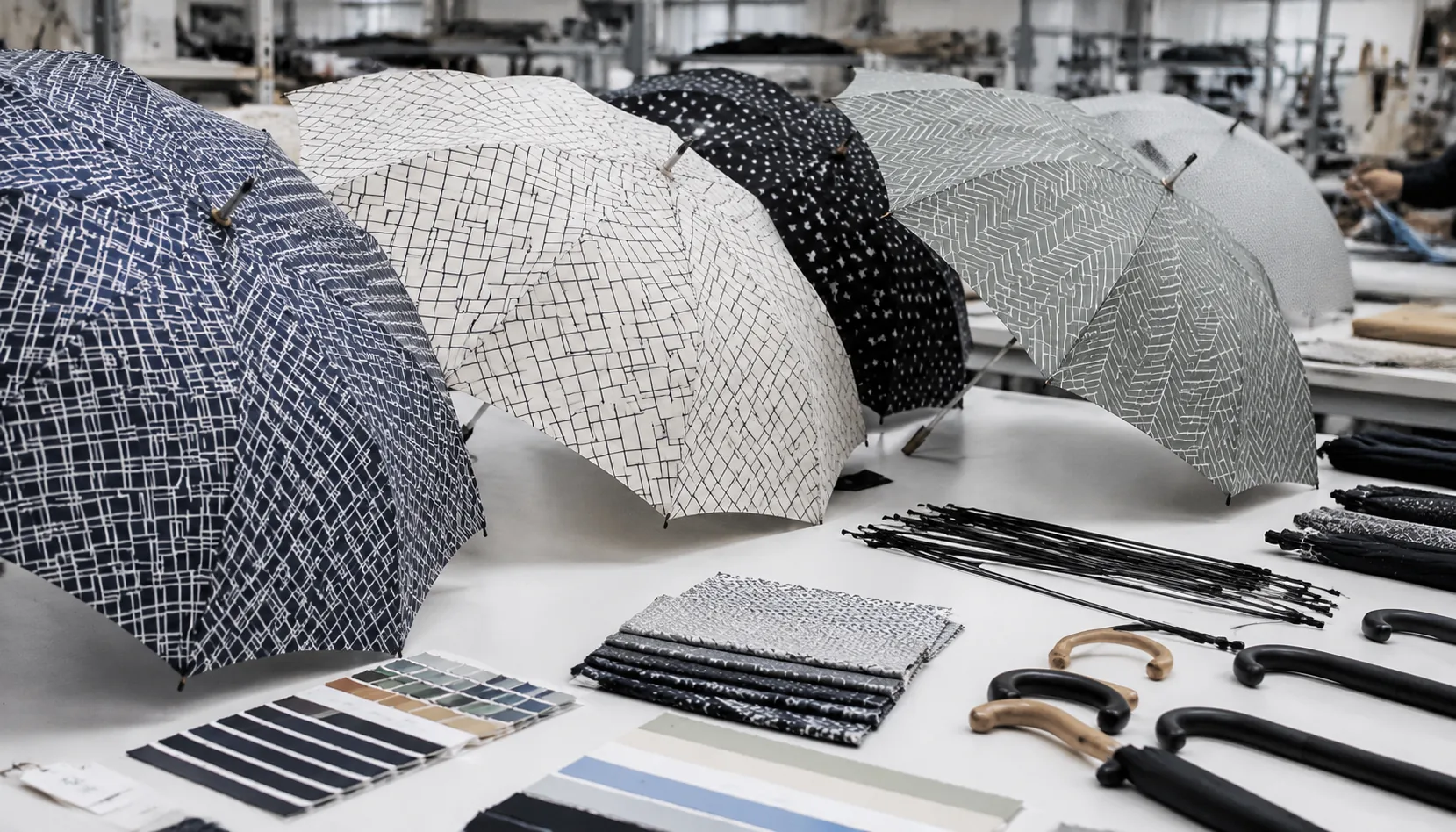
Repeat Pattern Umbrella Printing for Retail Collections
Plan repeat-pattern umbrella canopies for retail lines with panel layout, fabric choice, color control, sampling, MOQ, a...
Read More »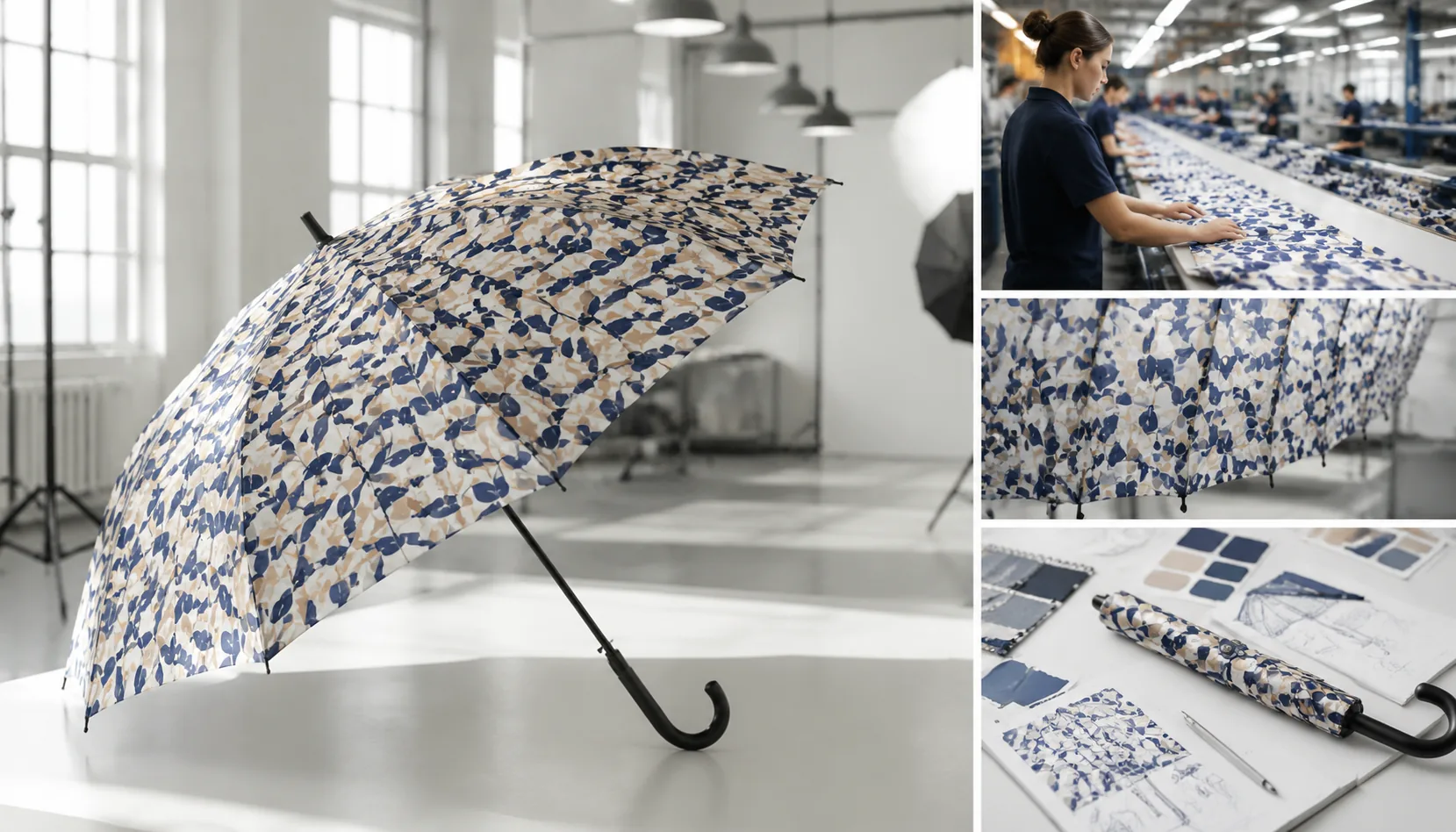
Repeat Pattern Umbrella Printing for Branded Collections
Plan repeat logo, monogram, or pattern umbrellas with clear rules for panel layout, fabric choice, sampling, MOQ, and pr...
Read More »
Repeat Pattern Printing on Umbrellas for Brand Campaigns
Build repeat-pattern umbrellas with practical advice on artwork repeats, panel breaks, fabric selection, print methods, ...
Read More »