Reflective Commuter Umbrellas: OEM Safety Spec Guide
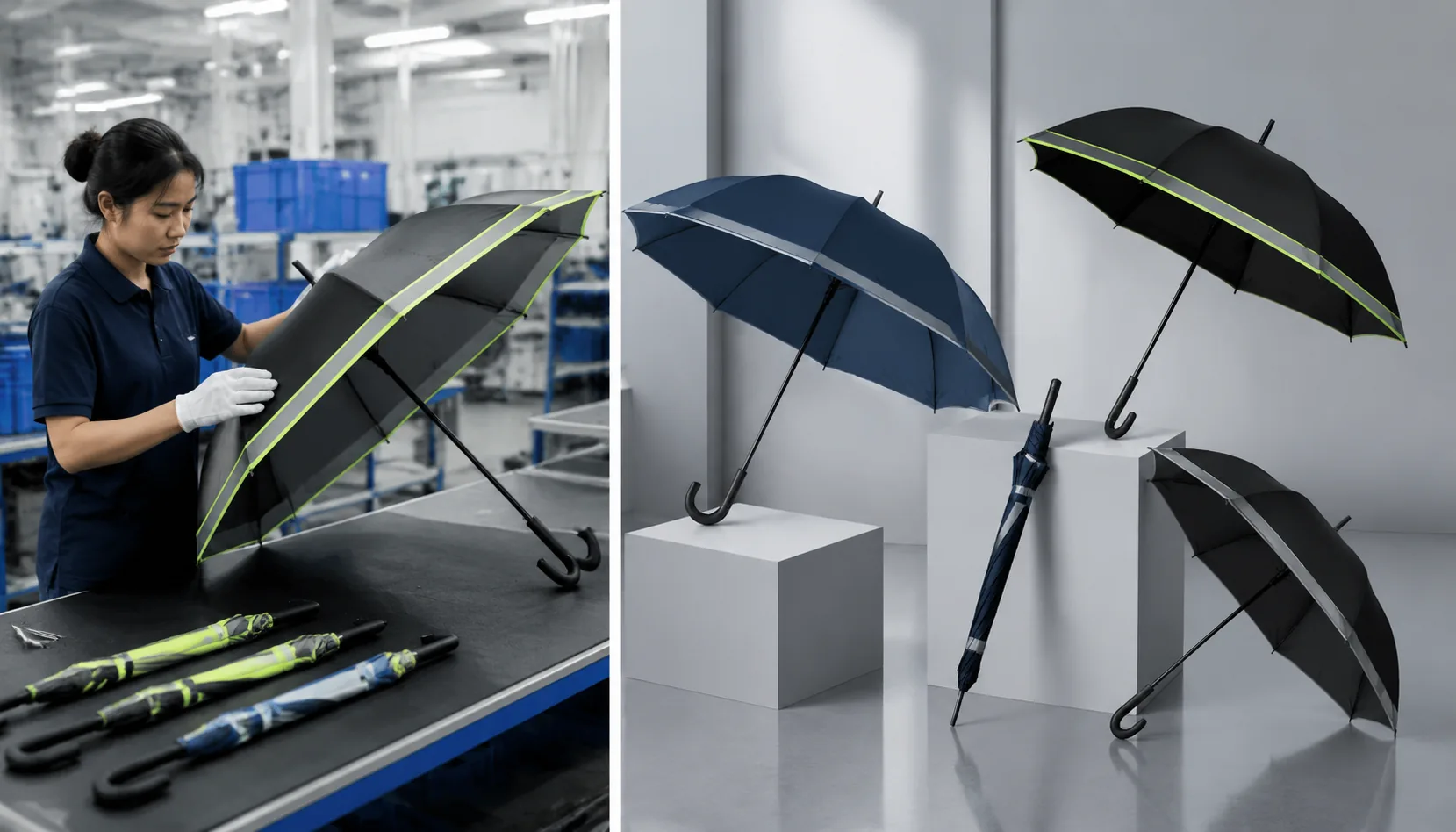
For retail and corporate programs, reflective commuter umbrellas can fail in the details: trim that peels after folding, ribs that torque in crosswinds, or fabric that looks good in sampling but leaks after coating variance. On our Songxia factory floor, we check 190T pongee shade consistency, fiberglass rib recovery, reflective tape adhesion, stitch tension, and packed-carton pressure before a spec becomes a repeatable order.
Define the Commuter Use Case First
The commuter use case should be defined before frame, fabric, or logo placement, because a subway rider and a night-shift security team do not abuse umbrellas the same way. Urban commuters need compact carry, fast deployment at building exits, and enough canopy depth to cover a backpack without poking other pedestrians. Campus staff and facilities teams usually walk longer open routes between buildings, so they benefit from brighter edge visibility and stronger ribs. Transit promotions need low unit cost, consistent branding, and packaging that survives bulk handout. For reflective commuter umbrellas, I would normally start with 21 inch or 23 inch folding models for daily bags, or 23 inch to 25 inch straight umbrellas when the user has a locker, vehicle, or dispatch room.
Size selection is not cosmetic; it changes safety, durability, and complaint rate. A 21 inch 3-fold auto-open-close umbrella is convenient for office commuters, but the short shaft and compact rib geometry are less forgiving in gusts. A 23 inch folding umbrella gives better shoulder coverage while still fitting a tote or laptop backpack. For a windproof commuter umbrella, I prefer fiberglass ribs over painted steel ribs when the program budget allows it, especially on 8K or 10K frames. Straight umbrellas in 23 inch or 25 inch sizes can use a longer runner stroke, stronger shaft, and larger reflective tape area, which makes them better for parking attendants, campus patrols, plant workers, and shuttle teams.
Reflective details should match the walking environment, not just look good in a product rendering. Reflective trim umbrellas can use 10–15 mm piping around the canopy edge, reflective panels on alternating gores, or a reflective logo print facing traffic. For safety umbrellas used near roads, I like high-contrast canopy colors such as black with silver trim, navy with silver trim, or yellow with gray reflective tape; tone-on-tone reflective printing often looks premium indoors but disappears under rain glare. As an OEM umbrella supplier, our standard practice is to confirm the user route, carry method, opening mechanism, and visibility requirement before quoting MOQ, because a 5,000-piece transit giveaway and a 500-piece night-shift safety issue should not share the same spec sheet.
Choose Reflective Placement and Materials
Reflective placement should start with how a commuter is actually seen: from the side by turning cars, from the rear by scooters, and from the front under streetlights. Reflective piping around the canopy ribs gives a clean outline and works well on 23" and 27" stick umbrellas, but it adds sewing difficulty because the cord must sit evenly between pongee 190T or 210T panels without twisting. Panel strips are more visible from a distance, especially when placed on two opposite canopy panels, but wide strips can stiffen the fabric and affect folding on compact 21" auto-open-close models. Edge tape gives 360-degree visibility and is popular for safety umbrellas, though it takes more wear because it touches the ground, bags, and hands during closing. Logo accents are the weakest for safety but useful for brand compliance when the buyer wants reflective commuter umbrellas that still look retail-friendly in daylight.
Material choice matters more than most catalog photos suggest. Cheap reflective tape can crack after 300 to 500 folding cycles, especially where it crosses a seam allowance or sits near a rib tip. For reflective trim umbrellas, I prefer segmented or knitted-back reflective tape instead of a stiff PET film when the design uses curved panel seams, because it follows the canopy tension without puckering. Silver reflective tape gives the strongest night response, while gray, black, and colored reflective films look better in retail but usually return less light. If the umbrella is positioned as a windproof commuter umbrella, do not let the reflective strip interfere with double-canopy vents or the flex point of fiberglass ribs; on 8K and 10K frames, the strip should sit between rib lines, not directly over the highest stress path.
Every OEM umbrella supplier should test reflective parts after sewing, not just approve a swatch on the table. Our standard practice at ZheBrella is to run wet-rub checks, repeated folding, and open-close cycling before confirming bulk production, because reflective tape that looks fine dry can delaminate once the adhesive backing absorbs moisture. For a serious spec, require no peeling, cracking, or heavy silver loss after wet rubbing, then fold the umbrella while damp and inspect the seam intersections. On screen-printed or heat-transfer logo accents, confirm the reflective layer does not bleed under Teflon coating or UV UPF 50+ finishing. For AQL 2.5 inspection, add a functional checkpoint: open the umbrella, rotate it under a flashlight at 10 to 15 meters, and reject panels where reflective visibility is broken by wrinkles, skipped stitches, or tape lifting at the edge binding.
Specify Frame Strength for Daily Wind
Frame strength matters more than canopy size on reflective commuter umbrellas because commuters fight gusts at subway exits, between high-rise buildings, and on bike paths where wind direction changes fast. For most daily-use models, I specify 8K fiberglass ribs as the practical baseline: lighter than steel, less likely to permanently bend, and flexible enough to recover after inversion. A 23" stick umbrella or 21" compact with 8 fiberglass ribs can handle normal city wind if the rib joints, stretchers, and runner are not underbuilt. For buyers targeting a slightly tougher windproof commuter umbrella, 10K fiberglass gives better canopy tension and spreads wind load more evenly, especially on 23" and 27" arc sizes. I do not recommend jumping to 16K unless the retail story justifies the extra weight and cost; many 16K commuter umbrellas feel overbuilt in the hand and slow down auto-open-close mechanisms.
Steel still has a place when cost control is the priority, but it should be used carefully. A steel shaft with fiberglass ribs is a common compromise for safety umbrellas in corporate, school, and transit promotions because the shaft keeps FOB cost down while the ribs provide the flex needed for gust resistance. Full steel rib builds are cheaper, but they are easier to deform after one hard inversion, and that becomes a complaint issue when the umbrella carries reflective tape or reflective piping as a safety feature. If the SKU is manual-open, a steel shaft is usually acceptable; for auto-open or auto-open-close, I prefer a stronger center rod, clean spring travel, and reinforced notch because the mechanism adds impact load every time the umbrella fires. Ask the OEM umbrella supplier to confirm rib material, stretcher thickness, and joint pin quality, not just quote “windproof” in the spec sheet.
For higher-end retail SKUs, double-canopy vented construction is worth the extra sewing and inspection time. A double canopy lets wind bleed through the upper vent instead of loading the full pongee panel, which is why a well-made 23" 10K fiberglass umbrella can survive 50+ mph wind-tunnel testing better than a heavier single-canopy frame. On reflective trim umbrellas, vent design also protects the visibility feature: reflective binding or tape near the outer edge gets less violent whipping when pressure escapes through the top. The tradeoff is production complexity. The vent overlap must be consistent, usually 2.5-4 cm depending on panel shape, or rain will push through during angled storms. Our standard practice at ZheBrella is to combine vented canopies with AQL 2.5 checks on rib alignment, runner lock strength, and open-close cycling, because windproof claims fail first at assembly points, not in the fabric roll.
Select Canopy Fabric and Opening Mechanism
Fabric choice should start with the channel, not the catalog photo. For promotional reflective commuter umbrellas, 190T pongee is usually the right baseline because it balances printability, water repellency, and cost without feeling cheap in the hand. It takes screen print and heat-transfer logos cleanly, dries faster than polyester taffeta, and packs well for 21" and 23" folding models used in subway, campus, and event programs. If the order is for retail shelves or a corporate gift with higher perceived value, I prefer 210T pongee because the yarn density gives a smoother hand feel, tighter canopy surface, and better drape over 8K or 10K frames. The difference is visible when reflective tape is sewn near the canopy edge: 210T lies flatter, while thin fabrics can pucker if the sewing tension is not controlled.
Reflective trim umbrellas need fabric and tape tested together, because the seam is where many low-cost safety umbrellas fail. A 10–15 mm reflective strip on the canopy edge is common, but wider tape adds stiffness and can distort a compact canopy if the fabric is too light. For commuter use, I would pair 190T pongee with a fiberglass-and-steel mixed frame for budget programs, or 210T pongee with full fiberglass ribs for a windproof commuter umbrella rated around 40–50 mph in practical wind-tunnel checks. Coatings also matter: standard water-repellent treatment is enough for most transit giveaways, while Teflon coating improves roll-off and stain resistance for retail. If the umbrella is marketed for daytime visibility as well as rain, specify black or navy pongee with silver reflective trim, or add UPF 50+ coating for sun exposure claims that can be supported during inspection.
Opening mechanism is where OEM buyers often over-spec and then complain about cost. Auto-open is the better choice for one-hand transit use because the customer can open the umbrella while holding a phone, bag, or train pass; it works well on 23" stick umbrellas and 21" or 23" 3-fold models, but the spring, runner, and shaft must be tested for smooth release and no hand pinch. Manual-open is lighter, cheaper, and more forgiving for MOQ-sensitive programs, especially when the main requirement is reflective branding rather than premium function. As an OEM umbrella supplier, our standard practice is to confirm mechanism choice before frame tooling, then run pre-production checks for opening force, rib symmetry, canopy tension, and AQL 2.5 workmanship defects. For reflective commuter umbrellas, that prevents the common mismatch: a nice safety concept attached to a weak frame or a stiff, awkward runner.
Set QC, MOQ, and Shipping Expectations
QC for reflective commuter umbrellas should be written like a safety product spec, not a normal rain umbrella checklist. Use AQL 2.5 for major defects and define critical defects separately: loose reflective tape, missing reflective panels, sharp rib tips, failed runner lock, or canopy detachment should be zero-tolerance items. Reflective alignment needs its own check because crooked trim looks cheap and reduces visibility at night. On a 23" or 27" windproof commuter umbrella, I would allow no more than 2–3 mm deviation from the seam line on reflective piping, and printed reflective logos should stay within ±1.5 mm of the approved artwork position. Inspectors should also verify reflectivity under angled light, not only under factory ceiling lamps, because some gray trims look bright indoors but perform poorly beside headlights.
Opening-cycle testing is where many safety umbrellas fail before shipment. For manual and auto-open models, test at least 100 open-close cycles from each production lot; for auto-open-close compact umbrellas, 150 cycles is safer because the spring, shaft lock, and runner take more stress. If the item is sold as a windproof commuter umbrella, specify fiberglass ribs or a fiberglass-steel hybrid frame, double-canopy venting if required, and a practical wind test such as surviving repeated inversion at 45–50 mph without rib cracking. Carton drop testing should be included before release: one corner, three edges, and six faces from roughly 76 cm for export cartons under 15 kg. After the drop, check handle scuffing, sleeve damage, bent tips, and whether reflective trim umbrellas still present cleanly for retail or corporate gifting.
Set commercial expectations early so the OEM umbrella supplier does not quote a fantasy timeline. A realistic MOQ for reflective commuter umbrellas is usually 500–1,000 pcs per color for stock 190T/210T pongee with reflective trim, and 1,000–3,000 pcs if the buyer needs custom mold handles, special POE/PVC/EVA panels, UPF 50+ coating, or full custom reflective printing. Pre-production samples normally take 5–7 days for available frames and 10–15 days when new trim, heat-transfer logos, or handle tooling is involved. Bulk production is commonly 25–35 days after sample approval and deposit, longer in March–June peak season. Our standard practice at ZheBrella is to quote both FOB Ningbo/Shanghai and DDP options, because promotional buyers often need landed cost clarity while retail importers usually control their own freight and customs clearance.
Frequently Asked Questions
Can reflective umbrellas still carry a printed logo?
Yes. Logos are usually printed on non-reflective pongee panels, while reflective tape is placed on edges or selected ribs. Buyers should confirm print position before sampling.
Does reflective trim affect folding performance?
It can if the tape is too stiff or placed across high-fold areas. Ask for a pre-production sample and folding test before bulk approval.
What reflective trim options are commonly used for commuter umbrellas?
Most OEM programs use reflective piping on canopy edges, reflective tape panels, or logo-area reflective printing. For retail safety positioning, 360-degree edge piping is usually preferred because it remains visible from multiple angles.
What specifications should we request for a windproof commuter umbrella?
A typical spec includes 190T pongee fabric, fiberglass ribs, a steel or fiberglass shaft, reinforced tips, and a vented or flexible frame design. Buyers should also request wind cycle testing, rib recovery checks, and opening/closing durability tests.
What is a practical MOQ and lead time for OEM reflective commuter umbrellas?
For custom color, reflective trim, and logo printing, a practical MOQ is usually 1,000–3,000 pieces per style. Sampling often takes 7–10 days, with bulk production around 30–45 days after sample approval and deposit.
Looking to Launch Your Custom Umbrella Line?
ZheBrella is a Zhejiang-based OEM/ODM umbrella manufacturer with 17 years of export experience. Free design, low MOQ from 100 pieces, windproof construction, full-color print.
Get Free Quote Now »People Also Search For
Related Articles
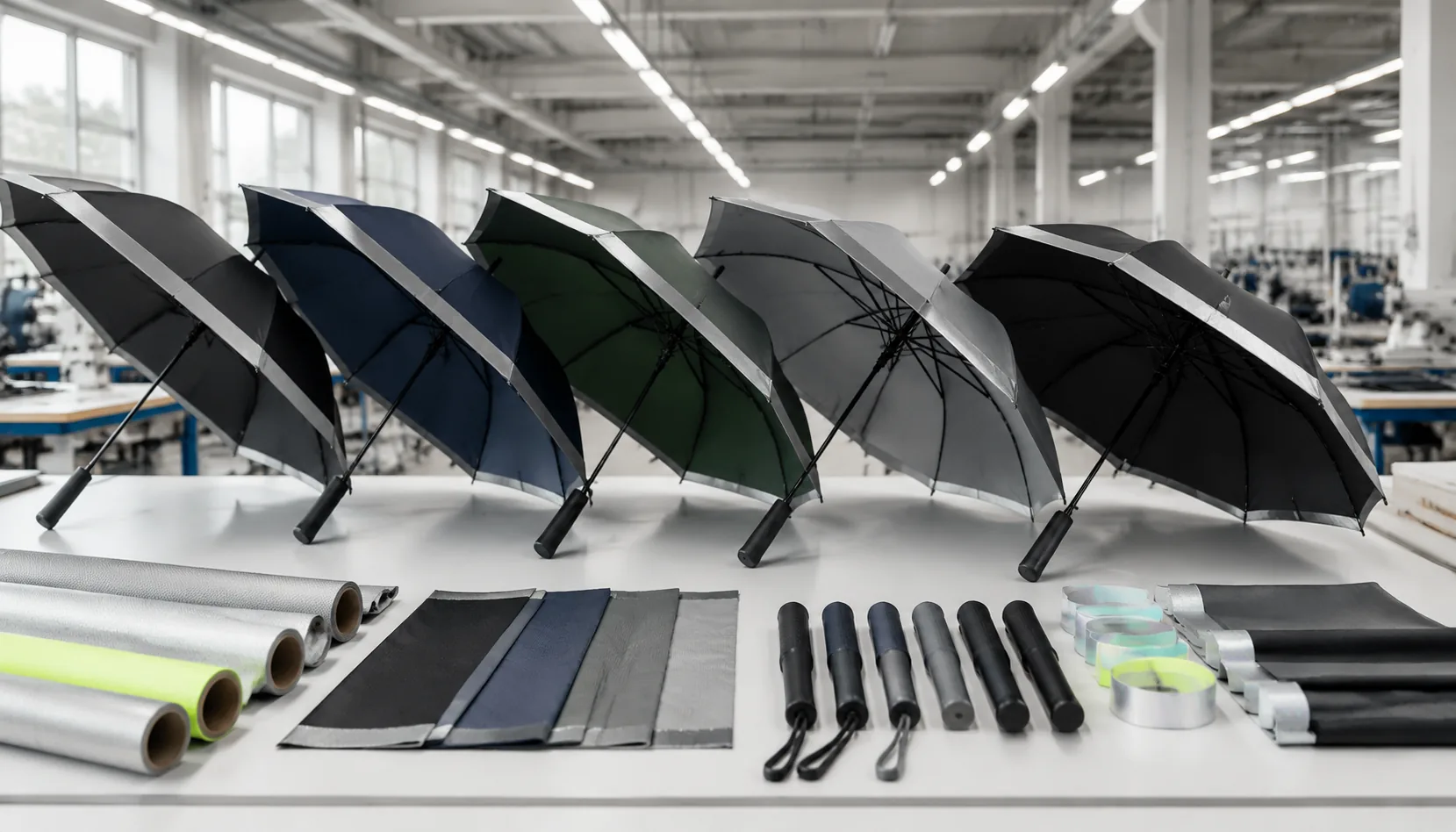
Reflective Safety Umbrellas: Spec Guide for Commuter Lines
Source reflective commuter umbrellas with the right tape, print layout, windproof frame, pongee canopy, AQL checks, MOQ,...
Read More »
Reflective Safety Umbrellas: OEM Buyer Spec Guide
Source reflective safety umbrellas with the right tape, print layout, pongee fabric, ribs, and QC specs for commuter, sc...
Read More »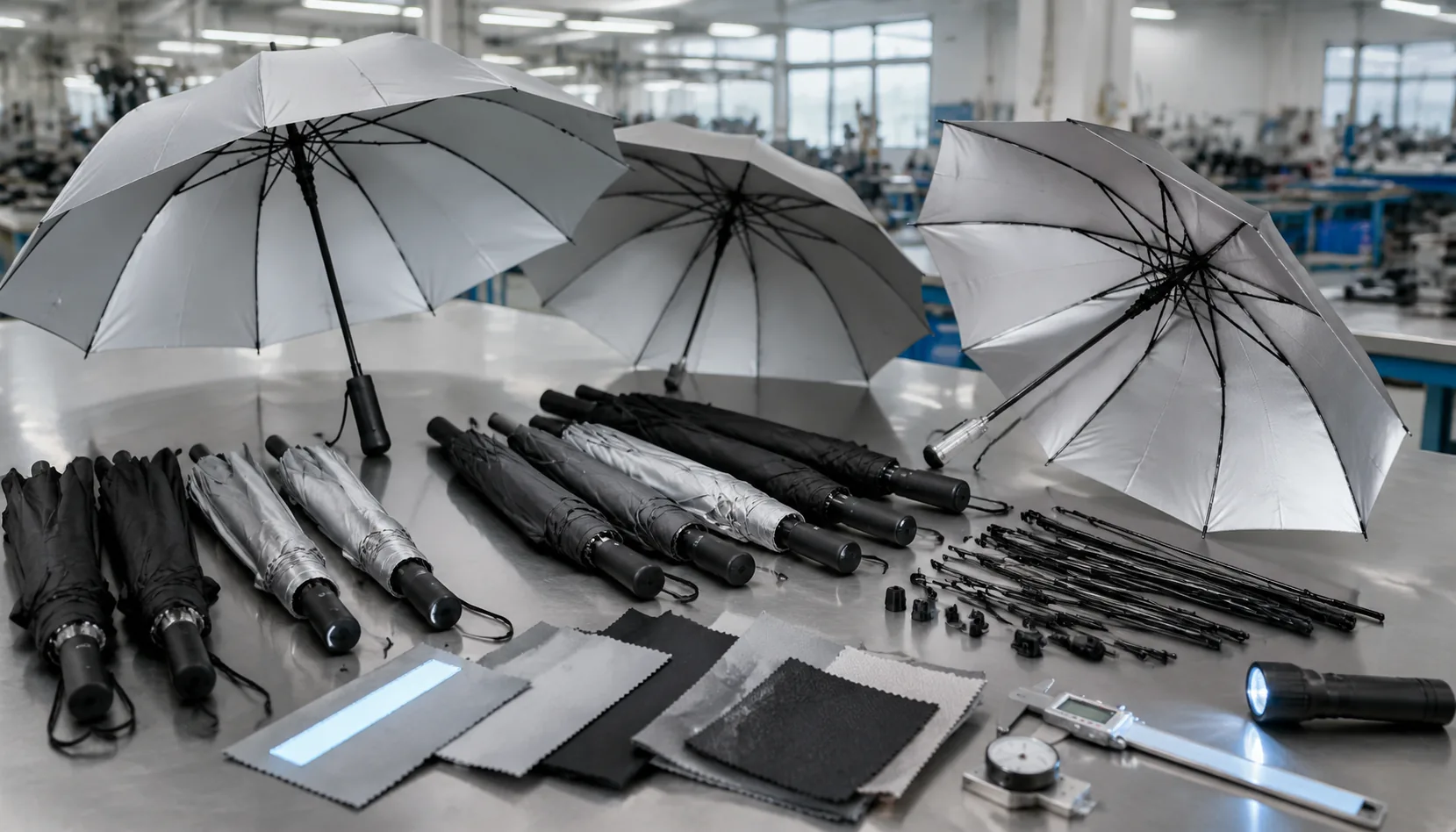
Reflective Umbrellas for Commuters: Buyer Spec Guide
Specify reflective commuter umbrellas with the right fabric, rib count, print placement, and QC checks for safer retail ...
Read More »