Reflective Safety Umbrellas: Spec Guide for Commuter Lines
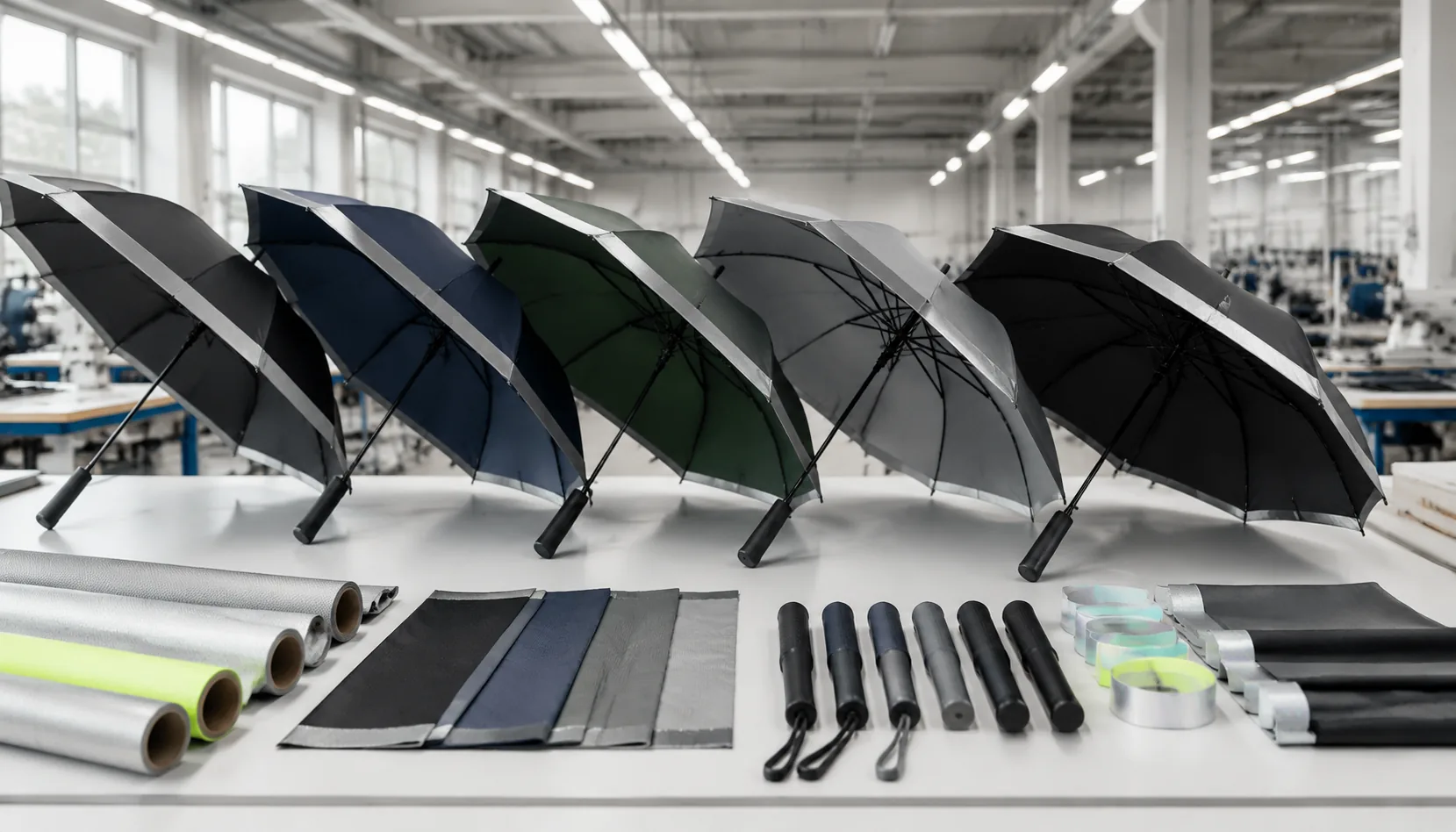
For commuter umbrella programs, the risk is not just poor visibility—it is reflective tape that cracks after folding, logos that crowd the safety band, and frames that fail during the first windy season. When buyers source reflective safety umbrellas bulk, we check the tape grade, stitching tension, pongee coating, rib structure, and AQL points together on the line, because one weak spec can turn a safety product into a return problem.
Use Cases for Reflective Umbrellas in Commuter Programs
Transit retailers, metro gift shops, bus operators, and railway-adjacent convenience chains are usually the first buyers for reflective commuter umbrellas because their customers are already walking in low-light rain. For this channel, I would not start with novelty prints; I would start with a 21" or 23" compact auto-open model, 190T or 210T pongee canopy, reflective edge tape or segmented reflective panels, and a frame that survives daily bag carry without bent ribs. A commuter umbrella supplier should also think about counter display cartons, barcode labeling, and mixed-color assortments because these umbrellas often sell fast during storm weeks. When buyers ask for reflective safety umbrellas bulk, the real spec question is not “how bright is the logo,” but whether the reflective material remains visible after repeated wet folding, abrasion inside backpacks, and 24-hour drying cycles in poor ventilation.
Insurance campaigns, bank loyalty programs, road-safety agencies, and corporate wellness teams buy reflective umbrellas for risk reduction, not fashion. Their end users walk from parking lots, bus stops, campuses, and office towers where drivers see movement before they see color. A reflective umbrella OEM should place high-visibility tape on the canopy perimeter or alternating gores, not only on a sleeve that stays in the bag. For safety umbrella sourcing, I recommend testing reflective placement under headlights at 30 to 50 meters, then confirming the print does not crack when the canopy is folded across the reflective seam. Manual-open umbrellas are cheaper for mass giveaways, but auto-open is usually worth the upgrade for commuters carrying a phone, coffee, or laptop bag. If the program uses a logo, keep it away from the reflective band so screen printing or heat transfer does not reduce visibility.
Schools, campus security teams, factory guards, hotel doormen, delivery supervisors, and outdoor workers need umbrellas that can be identified quickly and survive harsher handling than a retail souvenir. For these groups, windproof commuter umbrellas with fiberglass ribs, 8K or 10K frames, and double-canopy venting are more useful than complex artwork. Steel ribs lower cost but deform after gusts; fiberglass returns better after inversion, especially on 23" and 27" models. Our standard practice at ZheBrella is to pair reflective elements with UPF 50+ or water-repellent coating only after checking adhesion, because some coatings reduce bonding strength on reflective tape. For reflective safety umbrellas bulk orders, specify AQL 2.5 inspection for frame function, seam leakage, reflective alignment, logo position, and packed weight. A practical commuter program usually needs 30–45 days production after sample approval, with FOB Ningbo/Shanghai or DDP options depending on the buyer’s import setup.
Reflective Materials: Tape, Piping, and Printed Logos
Reflective edge piping is the cleanest specification for commuter lines because it sits on the canopy perimeter where headlights catch it first. For a 23" or 27" windproof commuter umbrella, I normally spec 5 mm or 7 mm reflective piping sewn into the hem; 10 mm looks brighter but can make the edge stiff and harder to close neatly. Panel tape gives stronger visibility from the side, especially when placed as two vertical strips on opposite panels or as a broken ring 40–60 mm above the hem. Tape widths of 15–25 mm are practical; below 10 mm the visibility drops fast after rain and fabric wrinkling, while 30 mm tape adds bulk on folds. For reflective safety umbrellas bulk orders, buyers should decide whether they need “seen by a car at 30–50 meters” commuter visibility or a higher-risk roadside/event use case, because the material grade and placement density are different.
Heat-transfer reflective logos work well for brand marks on 190T or 210T pongee, but they are not a substitute for perimeter safety detailing. A logo on one panel may face the wrong direction when the user walks, so I treat it as secondary visibility. Keep heat-transfer logos away from rib tips, folded creases, and the main closing wrap; 60–120 mm wide marks usually survive better than large solid blocks. Screen-printed reflective ink is cheaper and flexible for repeat graphics, but reflectivity is lower and depends heavily on ink laydown, curing temperature, and fabric coating. On Teflon-coated pongee, adhesion must be tested because poor pretreatment can cause cracking after 100–200 open-close cycles. A serious commuter umbrella supplier should run wet rub, dry rub, and fold-line abrasion checks before confirming mass production, not after the first shipment fails retail inspection.
The biggest failure point is abrasion where reflective material crosses seams, fold valleys, and canopy contact points during packing. Panel tape should stop 8–12 mm before a sewn seam or be reinforced with a clean stitch path; tape laid across a bulky seam often lifts after carton compression and repeated closing. Reflective piping avoids most surface abrasion, but the sewing tension must be balanced or the hem puckers and the umbrella closes like a cheap giveaway. For reflective umbrella OEM projects, I prefer a mixed layout: 5–7 mm edge piping for 360-degree recognition, plus 15–20 mm panel tape on four alternating panels for stronger side flash. That layout fits manual, auto-open, and auto-open-close frames, including fiberglass 8K or 10K windproof commuter umbrellas rated around 45–55 mph when the frame design is right. In safety umbrella sourcing, ask for pre-production samples tested after folding, soaking, and rubbing, then inspect under AQL 2.5 with nighttime visual checks included.
Frame and Canopy Specs for Daily Urban Use
For daily urban umbrellas, I recommend fiberglass ribs over all-steel ribs unless the buyer is chasing the absolute lowest FOB price. Steel ribs look strong on a spec sheet, but after repeated gust loading at subway exits or between high-rise buildings, they take a set, bend, and stop closing cleanly. Fiberglass ribs flex and rebound, which is why we use them on most windproof commuter umbrellas above the basic promotional tier. For compact 21" and 23" folding models, an 8K frame is usually the right balance: light enough for a backpack, stable enough for rain plus moderate wind, and not too bulky for auto-open-close hardware. For 27" stick umbrellas or 30" golf-style commuter formats, 16K fiberglass or fiberglass-plus-steel hybrid ribs spread the load better across the canopy and reduce rib twisting in side gusts.
Canopy fabric matters as much as the frame when sourcing reflective safety umbrellas bulk for commuter lines. A 190T pongee is acceptable for budget manual or auto-open compact umbrellas, but 210T pongee gives a tighter hand feel, cleaner logo printing, and better resistance to seepage after long rain exposure. For reflective umbrella OEM orders, reflective piping should be stitched into the panel seams or outer edge, not just heat-pressed as a narrow strip that can peel after abrasion. Silver reflective tape in the 1.5–2.0 cm range is common, but wider placement on alternating panels improves visibility from vehicle headlights. Water-repellent treatment should be specified as a durable coating, with optional Teflon finish for better beading and faster drying in office or transit environments.
For higher-end safety umbrella sourcing, a double-canopy vented structure is worth the extra cost, especially on 23" folding and 27" stick umbrellas sold to commuters in windy cities. The upper canopy lets trapped air escape instead of inverting the frame, and when paired with fiberglass ribs, a quality sample should survive repeated wind-tunnel testing around 50+ mph without permanent rib deformation. Our standard practice at ZheBrella is to test opening force, runner lock strength, rib rebound, seam leakage, and reflective trim alignment before pre-production approval. If you are comparing a commuter umbrella supplier, ask for exact rib material, shaft diameter, fabric density, coating type, and AQL 2.5 inspection criteria instead of accepting “windproof” as a loose marketing word. For reflective safety umbrellas bulk, these details decide whether the product lasts through one season or becomes a repeat corporate and retail item.
Size, Mechanism, and Carry Format Decisions
For commuter programs, the 3-fold auto-open/auto-close model wins on carry efficiency, but it must be engineered tighter than a giveaway folding umbrella. A typical 21" or 23" 3-fold uses a telescopic steel or aluminum shaft around 53–58 cm open length, closing to roughly 28–32 cm, with a realistic finished weight target of 360–430 g when using 190T or 210T pongee plus reflective piping or heat-transfer reflective panels. If the buyer asks for windproof commuter umbrellas in this format, I prefer fiberglass ribs with a steel center shaft, 8K rib count, and a vented double-canopy only when the weight budget allows it; otherwise the folded diameter becomes too fat for side backpack pockets. Auto-open-close springs must be cycle-tested because reflective trim adds seam stiffness, especially near rib tips. For reflective safety umbrellas bulk orders, I would not approve a sample unless the runner slides cleanly after 300–500 open-close cycles and the canopy folds without fighting the sleeve.
Straight stick auto-open umbrellas are less convenient on a crowded subway, but they give better structure, cleaner branding, and stronger perceived retail value. A 23" stick model usually has an 85–90 cm shaft length and a closed length near 86–92 cm, while 27" golf-style commuter versions reach 96–102 cm closed and are too long for most office backpacks. Weight targets are different: 450–550 g is acceptable for a 23" steel shaft stick umbrella, while a fiberglass shaft and ribs can land closer to 520–650 g depending on handle material. The main advantage is rib geometry. An 8K or 10K straight frame has fewer hinge weak points than a 3-fold frame, so it handles gusts better and can be rated around 45–55 mph in a controlled wind-tunnel setup if the canopy tension is correct. For a reflective umbrella OEM project with large reflective edge binding, the stick model also keeps the reflective line flatter and more visible at driver headlight angle.
Carry details decide whether the product is actually used every day. Folding models need a wide-mouth sleeve, preferably 1–1.5 cm larger than the compressed canopy diameter, because commuters will not carefully roll a wet 210T pongee canopy on a train platform. A wrist strap should be bar-tacked into the handle or end cap, not only glued, and a 16–18 cm loop is enough for most adult hands without dangling into turnstiles. Stick models need a longer sleeve with a shoulder strap only if the retail channel wants it; for corporate safety umbrella sourcing, a simple matching sleeve with reflective logo patch is usually cleaner and cheaper. Backpack-friendly packaging means no oversized gift box: use a slim OPP bag, recycled paper belly band, or 300–350 gsm tuck-end carton sized close to the folded umbrella. As a commuter umbrella supplier, our standard practice is to confirm carton packing early, such as 24 or 36 pcs per export carton, because DDP freight cost can change more than the umbrella price when packaging is bulky.
Quality Control and Import Planning
Reflective adhesion is the first QC gate I would not compromise on for commuter programs, because a strip that looks bright in the showroom can peel after 200 wet folds. For reflective safety umbrellas bulk orders, we test heat-transfer reflective tape or printed reflective ink with cross-hatch adhesion, 3M tape pull, wet rub, and 24-hour room-temperature recovery after folding. On 190T or 210T pongee, the canopy panels must be tensioned before application, otherwise the reflective band wrinkles near the rib tips. Seam alignment is checked panel by panel: reflective arcs should match within 3 mm across adjacent seams, and center cap placement must not twist the visual line when the umbrella is open. For PVC or POE clear canopies, we also check haze, cold-crack risk, and whether reflective trim bonds cleanly without edge lifting.
Mechanical testing should match commuter use, not just catalog claims. A 21" or 23" folding umbrella with auto-open-close should pass at least 500 open/close cycles before bulk approval; stick models in 23", 27", or 30" sizes usually get 300 manual cycles plus runner-lock inspection. For windproof commuter umbrellas, fiberglass ribs are preferred over thin black steel ribs because they recover better after inversion; our standard practice at ZheBrella is to inspect rib rivets, stretcher joints, tips, and shaft straightness before canopy attachment. A double-canopy vented design should survive 50+ mph wind-tunnel testing if the frame geometry is right, but I still want a real-world inversion test after wetting the canopy. Leakage checks include spray testing along seams, top notch, sewn reflective bands, and any logo print area where needle holes or coating damage can create drip points.
Import planning starts with approved pre-production samples, not a pretty render. A commuter umbrella supplier should lock the reflective material, rib count such as 8K or 10K, fabric weight, handle, sleeve, carton marks, and packaging before issuing the PI. Typical MOQ for reflective umbrella OEM production is 1,000–3,000 pieces per color, with 7–10 days for sampling and 30–45 days for bulk after deposit and artwork approval; complex sublimation or custom molded handles can add another week. Final inspection should use AQL 2.5 for major defects and tighter judgment on safety-critical reflective failures, with carton drop testing if shipping DDP to Amazon, retail DCs, or event warehouses. For safety umbrella sourcing, quote both FOB Ningbo/Shanghai and DDP landed cost early, because bulky 27" and 30" cartons can shift freight math more than the unit price.
Frequently Asked Questions
Can reflective logos replace reflective edge tape?
Reflective logos improve brand visibility but usually do not provide the same 360-degree visibility as edge piping or panel tape. For safety-focused programs, combine both when the budget allows.
Does reflective tape affect folding umbrella durability?
It can if placed across high-crease areas or stitched with poor tension. Buyers should request pre-production samples and check tape cracking, peeling, and fold-line wear before approving bulk production.
What reflective tape width is typically used on commuter umbrellas?
Most commuter umbrella programs use 5 mm to 15 mm reflective tape, depending on the visibility target and canopy layout. Wider tape improves daytime visibility, but it also needs careful placement so it does not interfere with panel printing or logo position.
What MOQ is common for reflective safety umbrella orders?
For OEM/ODM production, MOQ is often 500 to 1,000 pieces per color or design, with higher minimums for complex panel prints. If the order includes multiple canopy colors or custom handles, suppliers may require separate MOQs by variant.
What inspection standard should a buyer ask for?
A common request is AQL 2.5 for major defects and AQL 4.0 for minor defects, with checks for frame opening, tape adhesion, print alignment, and canopy tension. For export orders, buyers usually confirm pre-shipment photos, carton drop test requirements, and final random inspection rules before shipment.
Looking to Launch Your Custom Umbrella Line?
ZheBrella is a Zhejiang-based OEM/ODM umbrella manufacturer with 17 years of export experience. Free design, low MOQ from 100 pieces, windproof construction, full-color print.
Get Free Quote Now »People Also Search For
Related Articles
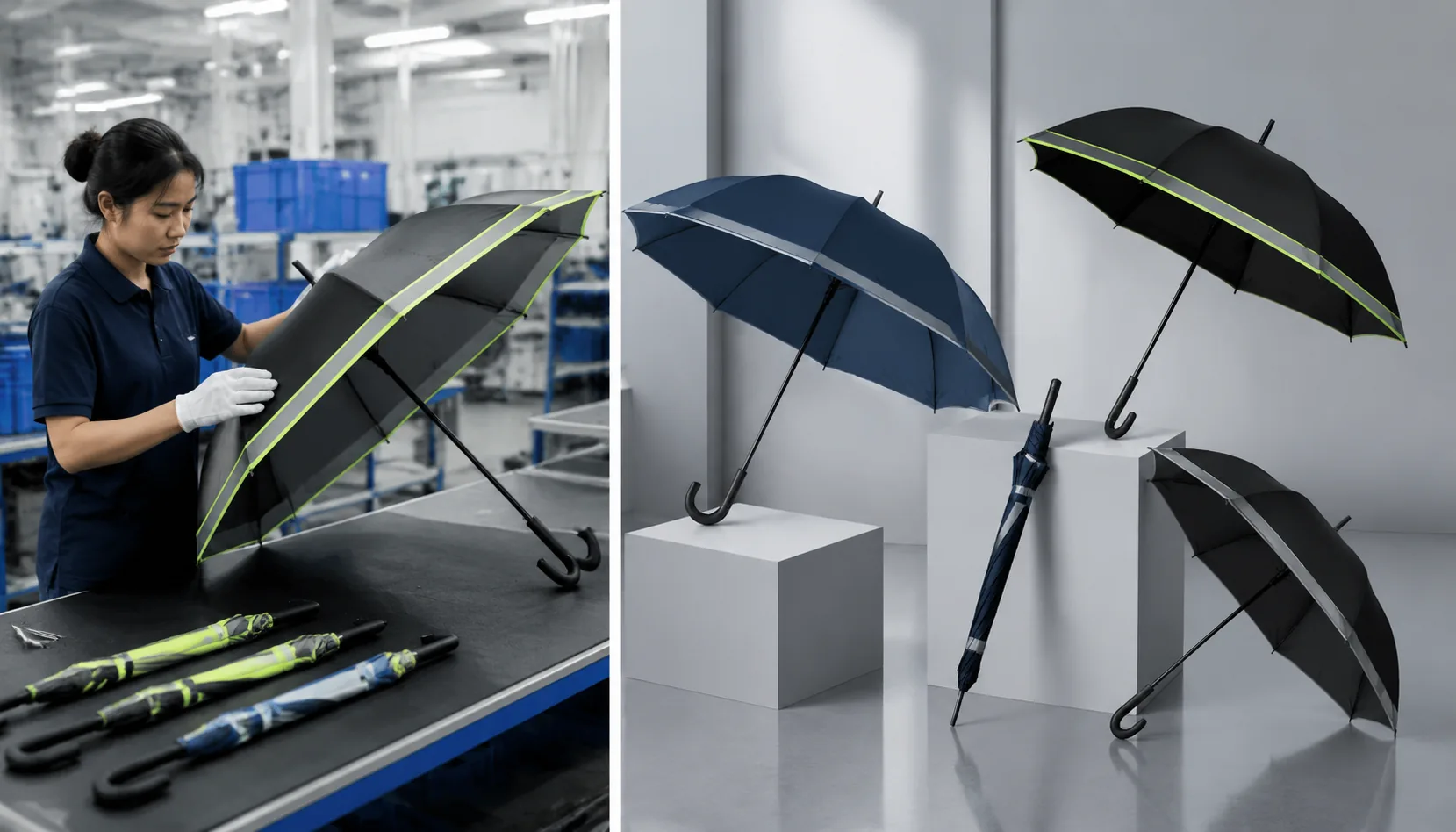
Reflective Commuter Umbrellas: OEM Safety Spec Guide
Specify reflective commuter umbrellas with 190T pongee, fiberglass ribs, safety trim, and QC points for retail or corpor...
Read More »
Reflective Safety Umbrellas: OEM Buyer Spec Guide
Source reflective safety umbrellas with the right tape, print layout, pongee fabric, ribs, and QC specs for commuter, sc...
Read More »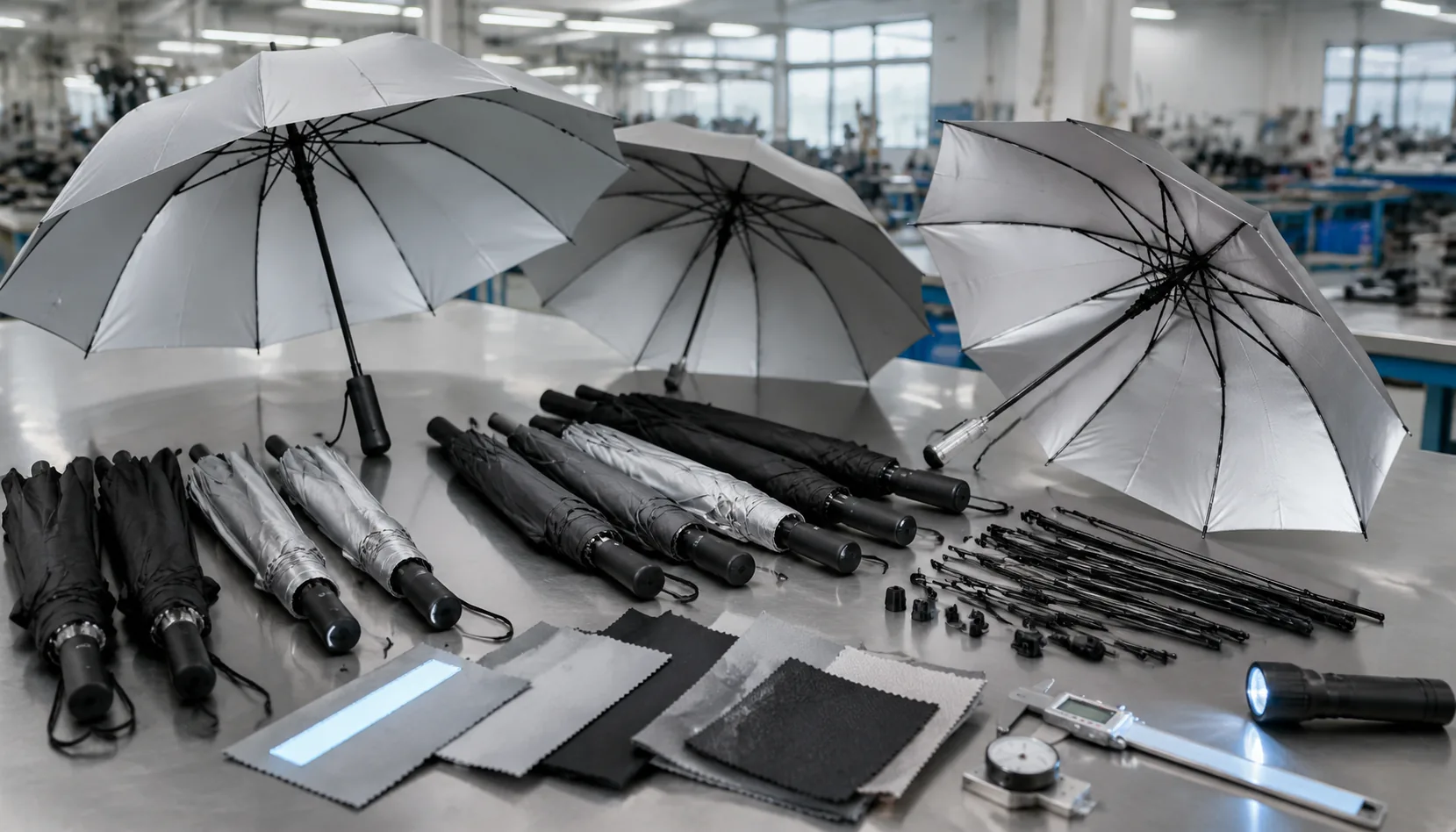
Reflective Umbrellas for Commuters: Buyer Spec Guide
Specify reflective commuter umbrellas with the right fabric, rib count, print placement, and QC checks for safer retail ...
Read More »