Reflective Safety Umbrellas: Sourcing Guide for Brands
For commuter promos, school tenders, and night-event kits, reflective safety umbrellas can fail buyers in small details: tape that cracks after folding, panels that pucker under heat transfer, or ribs that pass a sample check but twist in bulk packing. On our Songxia production floor, we confirm reflective material grade, canopy fabric, rib gauge, print method, carton pressure, MOQ, and delivery window before cutting fabric, because these choices decide both safety visibility and landed cost.
Match Reflective Umbrella Type to End Use
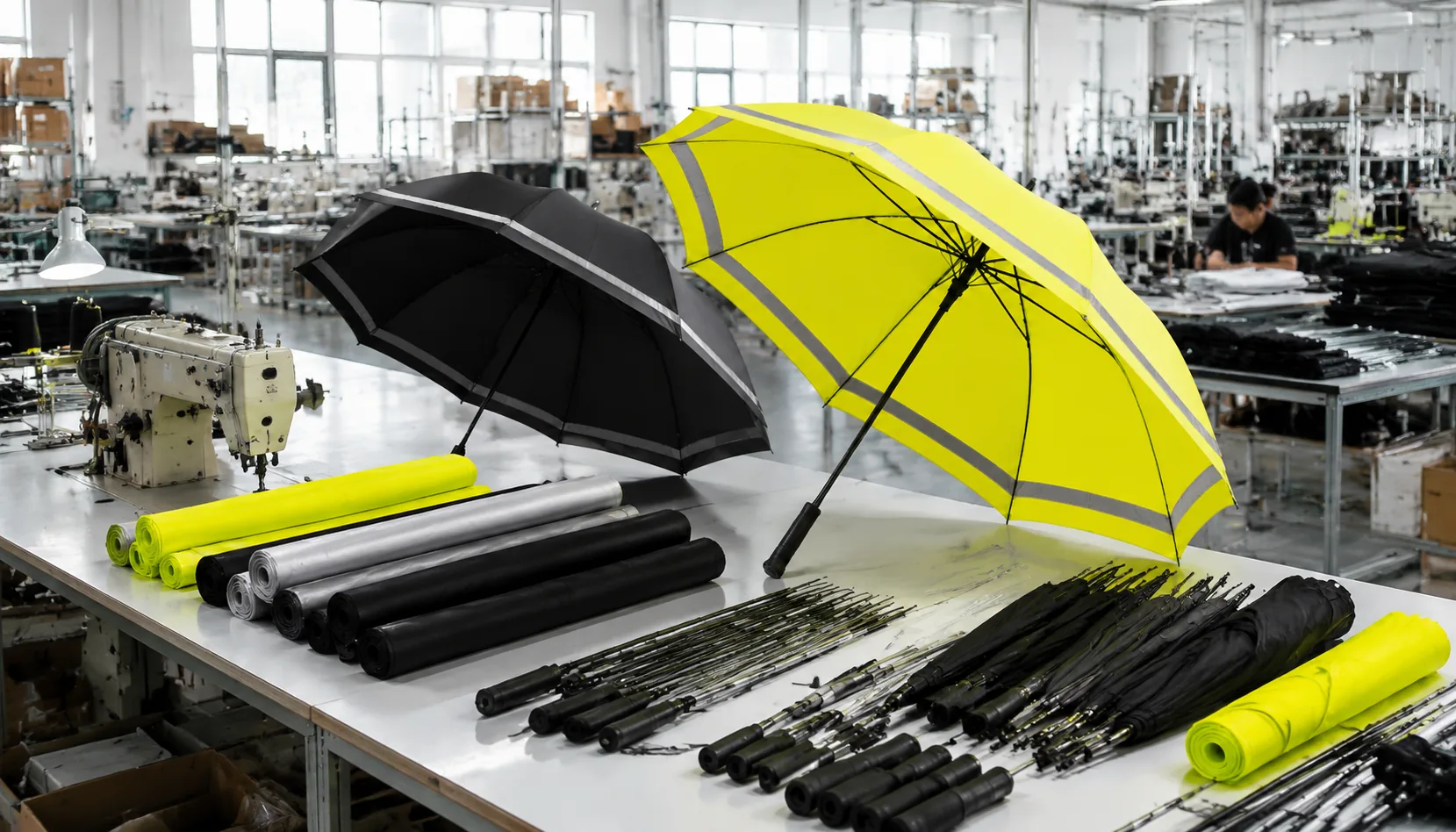
For daily commuting, I would not start with the cheapest folding frame; I would match the umbrella to the route. A 21 inch or 23 inch three-fold auto-open-close model fits a backpack, car door pocket, or corporate welcome kit, but the frame must be tight: fiberglass ribs or fiberglass-reinforced tips, a 190T or 210T pongee canopy, and reflective umbrella piping sewn evenly around the panel seams or outer edge. For metro users, a compact 8K frame is usually enough if the shaft is not too thin and the runner locks cleanly. For cyclists, night-shift workers, or school programs, high visibility umbrellas should use wider reflective bands plus bright canopy colors like safety yellow, orange, or fluorescent green; a black canopy with only narrow piping looks stylish but gives less side visibility in rain and headlights.
Stick umbrellas are better when the user walks longer distances or needs more coverage, so I usually specify 23 inch or 25 inch canopies for custom commuter umbrellas sold by insurers, utilities, construction firms, and outdoor retail brands. A 23 inch 8K stick umbrella with fiberglass ribs and a steel shaft is a good cost-performance build; it can survive normal gusts if the canopy tension is balanced. Move to 16K ribs when the buyer wants a rounder canopy profile, stronger visual quality, or better distribution of load in wind, but do not assume 16K automatically means windproof. Rib material, stretcher thickness, ferrule alignment, and sewing tension matter more than rib count alone. For a premium safety SKU, a 23 inch or 25 inch double-canopy vented design with reflective edge tape can be rated for 50+ mph in wind-tunnel testing when the frame is properly tooled.
Event giveaway models are a different calculation: they need visibility, fast production, and controlled cost, not lifetime durability. For marathons, campus safety campaigns, trade shows, and municipal road-safety programs, 21 inch manual folding umbrellas or 23 inch straight umbrellas keep MOQ and carton volume reasonable while leaving enough canopy area for screen printing or heat-transfer logos. For OEM safety umbrellas, confirm whether the reflective element is true reflective tape, reflective yarn piping, or silver-look decorative trim; I have seen buyers approve samples under office lighting and then reject bulk goods because the trim did not return enough light under headlights. Our standard practice at ZheBrella is to check reflective placement after canopy sewing, then include open-close cycling, rib symmetry, and AQL 2.5 appearance inspection before packing. For FOB China orders, typical lead time is 25–35 days after artwork approval; DDP programs need extra time for carton labeling and destination compliance checks.
Choose Canopy Fabric and Reflective Placement
For reflective safety umbrellas, start with 190T or 210T pongee before you argue about strip layout. 190T pongee is lighter and cost-efficient for promotional runs, especially 21" and 23" auto-open commuter models, but it feels thinner in hand and shows panel tension errors more easily after printing. 210T pongee is my safer choice for retail-grade custom commuter umbrellas because the weave is denser, the hand feel is better, and the canopy holds a cleaner dome on 8K or 10K frames. Both fabrics should use a real waterproof treatment, not just a soft water-repellent finish; our standard practice at ZheBrella is to test spray resistance after sewing because needle holes and seam tension are where cheap umbrellas fail first. For rain-only programs, Teflon coating is enough. For outdoor staff, school crossings, or security teams, specify UPF 50+ with black coating for shade or silver coating when heat reflection matters more than a premium interior look.
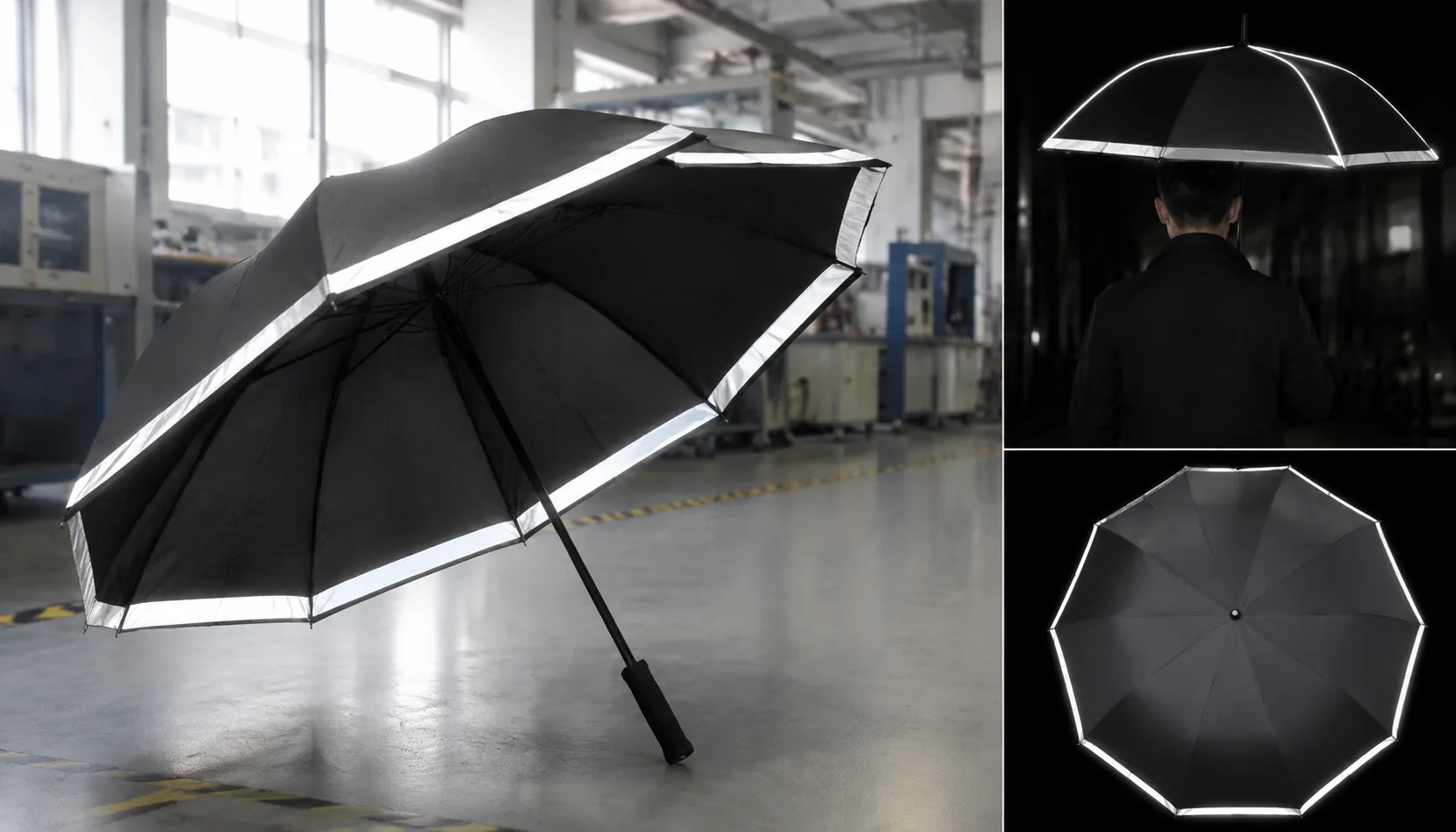
Reflective placement changes the umbrella more than most buyers expect. Reflective umbrella piping along the outer canopy edge is the cleanest option because it gives 360-degree visibility without disturbing artwork, and it adds little sewing complexity if the binding tape is specified before sampling. Reflective panel strips are more visible from a distance, but they need careful alignment across the canopy ribs; on a 23" 8K umbrella, a 10–15 mm strip near the lower third of each alternating panel is usually cleaner than wide center strips that wrinkle during folding. For high visibility umbrellas used by road crews or event marshals, I prefer edge piping plus two or four vertical reflective strips, not all eight panels, because too much reflective tape makes the canopy stiff and harder to close neatly. On double-canopy vented windproof designs, keep reflective tape away from vent overlap seams or it will lift after repeated wet folding.
Logo visibility at night is limited by physics, not printing skill. Screen-printed white or light gray logos on navy, black, or fluorescent yellow pongee look sharp in daylight, but they do not reflect unless printed with reflective ink or placed beside reflective tape. Heat-transfer logos can sit near reflective panel strips, but leave at least 8–12 mm clearance so the transfer press does not mark the tape surface. For OEM safety umbrellas, I tell buyers to separate the safety function from the branding function: use reflective piping or strips for vehicle-headlight return, then place the logo on a non-reflective panel where it remains readable in daylight and photos. If the brand insists on a night-visible logo, sample it first under phone flash and car headlights, because reflective ink often looks dull in daylight and can fail AQL 2.5 appearance checks if the coating is uneven across panels.
Specify Frame Strength for Daily Commuting
For daily commuting, frame strength matters more than the canopy artwork. I would not specify all-steel ribs unless the buyer is chasing the lowest FOB price, because steel 8K frames bend after repeated side gusts and add noticeable weight in a briefcase or backpack. Fiberglass ribs cost more, but they flex and recover better; for custom commuter umbrellas, an 8K fiberglass frame is the minimum I would quote, while 10K gives a rounder canopy and better load distribution. A steel center shaft is strong but heavy, so many retail programs use an aluminum shaft with fiberglass ribs to keep a 23" auto-open umbrella around 430–520 g. For reflective safety umbrellas, do not let the supplier hide behind the word “windproof” unless they define the rib material, stretcher material, shaft diameter, and joint construction.
Double-canopy construction is worth specifying for exposed train platforms, harbor walks, campus routes, and corporate shuttle stops where wind comes from below and sideways. A vented double canopy releases pressure before the ribs invert, especially on 27" and 30" golf-style high visibility umbrellas. In our factory practice at ZheBrella, we test vent overlap carefully because a loose top layer can flap, while a tight vent does nothing in a gust. A well-built fiberglass 8K or 10K vented model should survive repeated 45–50 mph wind-tunnel runs without permanent rib deformation; premium 16K builds can go higher, but they become heavier and more expensive. If reflective umbrella piping is sewn around the panel edge, check that the piping does not stiffen the seam so much that the canopy pulls unevenly during inversion recovery.
Auto-open is practical for commuters carrying a laptop bag, but it introduces failure points that buyers should test before approving OEM safety umbrellas. Run at least 500 open-close cycles on pre-production samples, then inspect the runner spring, top notch, lower notch, rib tips, and plastic cap where the stretcher pivots. Cheap auto-open buttons jam when the plating burrs are not polished, and weak springs give a lazy canopy that does not fully tension 190T or 210T pongee. For compact auto-open-close models, the center rod and internal spring are the common warranty headache; ask for drop tests from 1 m, wet-cycle testing, and packed-carton compression checks. The best specification is not just “auto-open,” but manual, auto-open, or auto-open-close matched to size, rib count, user age group, and expected abuse level.
Plan Branding, Color, and Compliance Checks
Compliance checks should be written into the purchase order, not discussed after the shipment is packed. For high visibility umbrellas, our standard practice at ZheBrella is AQL 2.5 inspection for critical appearance and function points: reflective alignment panel to panel, skipped stitching, seam puckering, loose piping ends, crooked heat-transfer logos, and ink bleeding after a wet wipe. Inspectors should open every sampled umbrella fully, rotate it under angled light, and check whether reflective sections line up across all 8K or 10K ribs; a 3 mm offset may pass on a fashion umbrella but looks careless on safety merchandise. Also confirm that dark logo ink does not cover too much reflective surface, especially on commuter promotions where the safety claim is part of the selling point. If the order includes UPF 50+ coating, Teflon water repellent, or auto-open frames, test those separately so reflective approval is not hiding unrelated quality problems.
Confirm MOQ, Lead Time, and Shipping Terms
For custom reflective safety umbrellas, the first number to lock is MOQ, because reflective materials change the costing more than ordinary logo printing. A realistic factory MOQ is 500–1,000 pieces per design when you use reflective umbrella piping, reflective tape panels, or a custom handle logo. At 500 pieces, expect fewer fabric color choices and standard frame options such as 23" auto-open straight umbrellas or 21" auto-open-close folding umbrellas. At 1,000 pieces, you can usually specify 190T or 210T pongee, fiberglass ribs instead of steel, 8K or 10K frame construction, and a more controlled PMS match. If the buyer wants OEM safety umbrellas with a molded handle, custom shaft color, retail hangtag, or individual printed sleeve, the practical MOQ may move to 1,500–3,000 pieces because tooling, injection setup, and packing materials need to be amortized.
Sampling should be treated as a technical approval step, not just a photo opportunity. A plain pre-production sample using stock fabric and standard reflective piping normally takes 5–7 days after artwork confirmation. If the design includes full-panel printing, heat-transfer reflective logos, sublimation graphics, or a special UPF 50+ coating, allow 7–10 days because the canopy fabric, print adhesion, and sewing shrinkage need checking before bulk cutting. For high visibility umbrellas, I recommend asking for night photos under vehicle headlights and a close-up of the seam where reflective tape crosses the rib tips; that area fails first when the operator stretches the canopy too tightly. Bulk production is usually 25–45 days after sample approval and deposit, depending on season, frame availability, and whether AQL 2.5 inspection is booked before shipment.
FOB Ningbo or FOB Shanghai works best when the buyer already has a forwarder consolidating multiple China shipments. The unit price is cleaner, export documents are straightforward, and the brand controls ocean freight, insurance, customs clearance, and final delivery. For distributor programs, DDP is often easier because the umbrella factory or trading partner quotes a landed cost to a U.S. or EU warehouse, including freight, duty, customs entry, and last-mile trucking. The tradeoff is transparency: DDP hides some logistics detail, and urgent air shipments can become expensive fast because umbrellas are bulky even when lightweight. For custom commuter umbrellas tied to a launch date, my practical rule is to approve samples at least 60–75 days before the event if shipping by sea, or 35–45 days if using air or rail-sea combined service.
Frequently Asked Questions
Can reflective umbrellas replace certified safety apparel?
No. Reflective umbrellas improve visibility for pedestrians, but they usually are not certified PPE unless tested to a specific reflective safety standard requested by the buyer.
Is reflective piping better than reflective printing?
Reflective piping is more durable on folded edges, while reflective printing allows larger visibility areas. Many OEM orders combine edge piping with one or two printed reflective panels.
What reflective materials should buyers specify for safety umbrellas?
Common options include reflective piping, reflective tape panels, and reflective logo printing. For commuter and school programs, buyers usually specify reflective piping around the canopy edge because it improves 360-degree visibility while keeping the umbrella lightweight.
What MOQ is typical for custom reflective safety umbrellas?
MOQ often starts around 500 to 1,000 pieces per design for custom reflective umbrellas, depending on fabric, frame, handle, and logo method. More complex OEM designs with custom molds or special reflective placement may require higher quantities.
What quality checks are important before shipping reflective umbrellas?
Buyers should confirm reflective brightness, stitching strength on the piping, canopy waterproofing, frame open-close testing, and logo durability. A practical inspection plan includes checking 2.5 AQL for major defects and testing random samples for wind resistance and water leakage.
Looking to Launch Your Custom Umbrella Line?
ZheBrella is a Zhejiang-based OEM/ODM umbrella manufacturer with 17 years of export experience. Free design, low MOQ from 100 pieces, windproof construction, full-color print.
Get Free Quote Now »People Also Search For
Related Articles
Reflective Safety Umbrellas: Specs for Night Visibility
Learn how to specify reflective safety umbrellas with visible trim, durable frames, compliant printing, MOQ planning, an...
Read More »
Reflective Umbrellas for Corporate Safety Programs
Specify reflective umbrellas for safety campaigns with 190T pongee, reflective tape placement, windproof frames, MOQ, le...
Read More »
Reflective Umbrellas for Commuters: Buyer Spec Guide
Specify reflective commuter umbrellas with the right fabric, rib count, print placement, and QC checks for safer retail ...
Read More »