Reflective Umbrellas for Commuters: Buyer Spec Guide
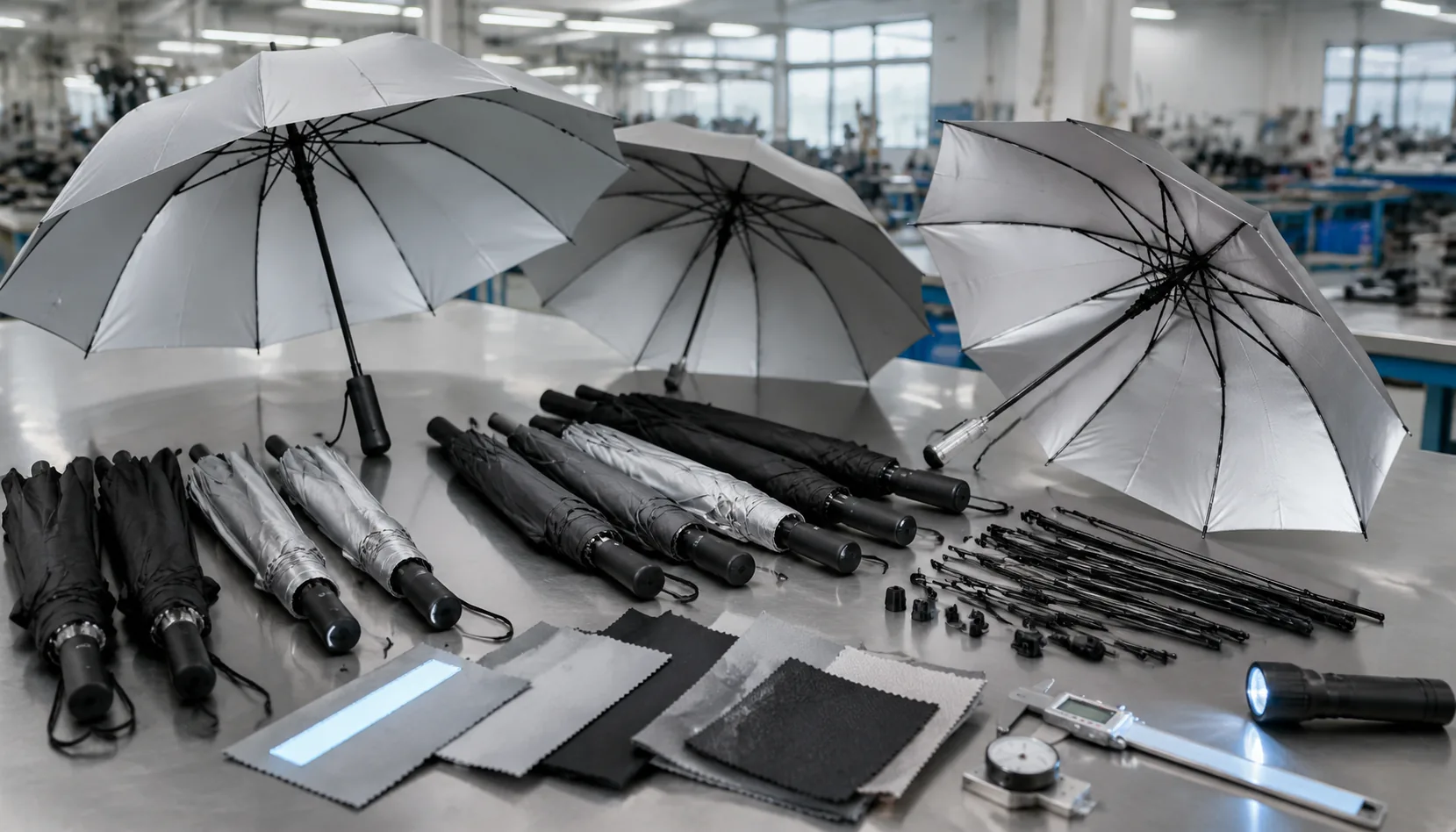
Commuter umbrellas fail buyers in small details: reflective tape that cracks after folding, ribs that twist in wind, logos placed where headlights never catch them, and QC plans that only check appearance. On our Songxia production floor, reflective commuter umbrellas are specified by fabric coating, rib strength, reflective print position, and repeatable low-light inspection so retail and promo orders arrive safer, cleaner, and easier to approve.
Visibility Features Buyers Should Specify
The first spec I push buyers to lock is reflective width, because thin decoration looks good in a PDF but disappears in rain. For reflective commuter umbrellas, use reflective umbrella piping or edge tape at 8-12 mm finished width on the canopy perimeter; below 5 mm, the sewing tolerance and panel curvature eat too much visibility. Silver-gray 3M-style microprismatic tape gives the strongest headlight return, but white or lime reflective tape on navy, black, charcoal, or deep red 190T/210T pongee umbrella canopy fabric gives better daytime contrast. Avoid tone-on-tone gray unless the umbrella is only for executive gifting. On a 23" auto-open stick umbrella, the outer edge is the highest-value location because it moves as the user walks and sits near car headlight height when angled forward.
Panel-level visibility is useful, but it should be engineered, not scattered. I prefer reflective prints on two opposite panels for city commuters, or four alternating panels for event safety umbrellas where crowd visibility matters from several angles. Heat-transfer reflective film works well on pongee if the press temperature and dwell time are controlled; poor factories overheat the coating and leave shiny rectangles around the logo. Screen-printed reflective ink is cheaper for large runs, but it usually reflects less sharply than tape and needs abrasion testing at fold lines. For double-canopy vented windproof models, do not hide the reflective area under the vent flap. Put it on the upper exposed panel or along the lower perimeter where rain runoff and folding stress are predictable.
Sleeve logos are often forgotten, but they matter in retail and corporate issue programs because the umbrella is carried closed more hours than open. Specify a reflective logo or 8-10 mm vertical reflective strip on the sleeve, plus a contrast pull tab so the product is visible in subway exits, parking lots, and building lobbies. As an OEM umbrella supplier, our standard practice is to review artwork on an opened sample from 10 meters and a closed sleeve from 5 meters under low-angle light before mass production. For procurement, add AQL 2.5 checks for tape alignment, skipped stitches, delamination after wet folding, and color contrast against the approved canopy fabric. Visibility matters most at the canopy edge, walking-direction front panels, sleeve, and any strap that hangs outside a backpack or briefcase.
Frame Choices for Daily Urban Use
For daily city use, the cheapest strong-looking frame is still a steel shaft with steel ribs, but that is not the same as good bend recovery. Steel gives a firm hand feel and keeps FOB pricing down, especially on 23" straight umbrellas and 21" folding models, but once a rib takes a hard side load from a subway exit gust, it tends to stay bent. Fiberglass ribs cost more, usually adding a few tenths of a dollar depending on size and rib count, yet they flex back after inversion much better. My practical spec for reflective commuter umbrellas is a steel center shaft for stiffness, fiberglass ribs for recovery, and zinc-plated or black electrophoresis-coated stretchers to control rust from wet storage. If the canopy is 190T or 210T pongee with reflective umbrella piping sewn into the edge, the frame must track evenly; twisted ribs make the reflective line look wavy and cheap under headlights.
An 8K frame is enough for most commuter safety umbrellas when the canopy diameter stays around 21" to 23" folding or 23" straight, because fewer ribs mean lower weight, faster assembly, and fewer sewing alignment points. A well-made 8K fiberglass rib frame with a good runner, tight rivets, and clean rib-tip tension will outperform a sloppy 10K steel frame in wind. For buyers ordering promotional quantities from an OEM umbrella supplier, I would put budget into fiberglass ribs, a stable auto-open mechanism, and AQL 2.5 inspection before paying for a high rib count just for the catalog photo. On a 23" auto-open umbrella, an 8K layout can still pass a sensible 35–45 mph wind check if the canopy tension is balanced and the runner does not wobble.
Move to 16K when perceived durability matters more than unit weight: retail commuters, corporate gifts above the basic tier, 27" golf-style city umbrellas, or designs where the reflective trim must form a very round silhouette. Sixteen ribs distribute load more evenly across the pongee umbrella canopy, reduce panel flutter, and give the customer that dense, premium opening feel. The tradeoff is real: more ribs add labor, more rib-tip sewing, more inspection points, and more chance of mismatch if the cutting and sewing teams are not disciplined. Our standard practice at ZheBrella is to treat 16K reflective commuter umbrellas as a controlled-production item, not a rush-job frame swap; sampling normally needs 5–7 days, and bulk lead time is typically 25–35 days depending on printing, reflective tape sourcing, and whether the order ships FOB Ningbo or DDP.
Canopy Fabric, Coatings, and Color Control
Printing limits must be written before sampling, not argued after bulk production. On pongee, screen printing is stable for one- to three-color logos, heat transfer works for gradients and small reflective-style marks, and sublimation is best on white or light panels, not dark commuter colors. For reflective commuter umbrellas, I avoid placing fine logos across seams or within 12 to 15 mm of reflective piping because sewing tension and panel curvature can move registration by 2 to 4 mm even on a well-controlled line. A practical spec is logo position tolerance of plus or minus 5 mm on compact umbrellas and plus or minus 7 mm on 27" or 30" golf umbrellas. If the buyer wants reflective ink plus reflective piping, test both after folding abrasion for at least 500 open-close cycles. For OEM umbrella supplier quotations, ask for fabric GSM, coating type, color tolerance, print method, AQL 2.5 inspection criteria, and whether pre-production samples are made from actual bulk fabric or only stock sample cloth.
Mechanisms, Handles, and User Convenience
For commuters carrying a laptop bag, coffee, or a child’s hand, auto-open is usually worth the extra mechanism cost. A 23" or 27" stick umbrella with a one-touch auto-open shaft can be deployed before stepping out of a subway exit, which reduces the awkward half-wet moment that damages bags and printed documents. Manual open is still the most reliable choice for low-cost programs and heavy-duty 30" golf styles because the runner, spring, and button assembly have fewer failure points, but it demands two hands and slower operation. For reflective commuter umbrellas, I prefer auto-open on stick models and auto-open-close on 21" compact models only when the frame is built with fiberglass ribs and a tested center rod, not cheap thin-wall steel that bends after a few hard closings.
Handle choice affects actual daily use more than many buyers expect. A straight EVA or rubberized PP grip works well on 23" stick umbrellas because it slides cleanly into backpack side pockets and does not hook on turnstiles, railings, or shopping bags. Curved J handles look classic but add bulk and are less convenient in crowded buses. Compact safety umbrellas should include a wrist strap fixed with bartack stitching, not a loose cord through a weak plastic cap. On reflective umbrella piping designs, the handle color should stay dark or neutral so the reflective edge remains the visual safety feature at night. If branding is needed, place the logo on the handle end cap or sleeve instead of overcrowding the pongee umbrella canopy.
Sleeve fit is a small detail that prevents big complaints. A 21" three-fold umbrella with 190T or 210T pongee should have a sleeve opening at least 5–8 mm wider than the folded canopy diameter, because commuters will not roll the fabric perfectly after use. Tight sleeves look tidy in a showroom but fail in real train-station behavior. For wet storage, specify a sleeve with a side slit, mesh panel, or coated inner layer so trapped water does not sit against the reflective trim. As an OEM umbrella supplier, ZheBrella usually checks packed sleeve fit during pre-shipment inspection, alongside button function, runner smoothness, rib alignment, and AQL 2.5 appearance defects. For commuter programs, I would rather accept a slightly larger sleeve than a beautiful tight sleeve that users abandon after the first rainy week.
MOQ, QC, and Shipment Planning
MOQ planning for reflective commuter umbrellas depends less on the umbrella body and more on how the reflective material is applied. For simple reflective umbrella piping sewn into the canopy seam, a realistic MOQ is usually 500–1,000 pcs per color because the trim is stocked in common silver-gray widths around 8–12 mm. Reflective panels, logo strips, or custom heat-transfer reflective tape push MOQ closer to 1,000–3,000 pcs because cutting loss, tape positioning jigs, and print testing add setup cost. If the buyer wants a 23" auto-open stick umbrella with 190T pongee umbrella canopy, fiberglass ribs, and reflective edging, production is straightforward. A 21" auto-open-close folding model with 8K or 10K ribs needs tighter testing because the reflective seam adds thickness at folded points. For retail private label or large promo programs, our standard practice at ZheBrella is to lock reflective trim samples before bulk fabric approval, not after, because brightness, wash resistance, and seam flexibility vary by supplier batch.
QC should be written into the PO, not negotiated after production starts. For safety umbrellas, I recommend AQL 2.5 for major defects and AQL 4.0 for minor defects, with inspection focused on reflective continuity, skipped stitches at piping, canopy tension, frame symmetry, runner lock strength, and open-close cycling. On reflective commuter umbrellas, inspectors should check visibility under direct light at 10–20 meters, especially around tips and panel joins where low-grade reflective tape tends to curl. For a 23" umbrella, rib length tolerance should stay within roughly ±3 mm, and the canopy should not twist after 20 open-close cycles. If the model uses steel ribs, rust marks near reflective seams are a common failure point after humidity exposure. Fiberglass ribs cost more but reduce return risk for commuter use, especially when paired with a double-canopy vented design rated around 50+ mph in wind-tunnel testing.
Lead time is normally 30–45 days after deposit, artwork approval, and confirmed reflective trim sample, but promo buyers should add buffer for export handling. A plain stock-color pongee canopy with standard silver piping can often ship near the 30-day side; custom-dyed 210T pongee, branded reflective panels, or mixed carton assortments usually need 40–45 days. FOB Ningbo or Shanghai works best when the buyer or distributor already controls freight, customs, and final-mile delivery. DDP is safer for fixed event dates because one supplier coordinates trucking, export declaration, ocean or air freight, duty, and delivery to the warehouse, but the buyer must approve carton marks and delivery windows early. For hard promo deadlines, I advise booking production backward from the in-hands date: 7–10 days for sampling and approvals, 30–45 days for bulk, 3–7 days for inspection and export pickup, then realistic transit time based on air, express, LCL, or full-container routing. Never promise a launch date using factory lead time alone.
Frequently Asked Questions
Can reflective material be printed directly on umbrella panels?
Yes, but reflective ink usually needs testing for adhesion and flexing on pongee. For stronger performance, many buyers choose reflective piping or tape sewn into panel seams.
Do reflective umbrellas cost more than standard commuter umbrellas?
Usually yes, because reflective tape, edge piping, and extra sewing steps add cost. The increase depends on trim width, panel count, and whether the order uses 8K or 16K ribs.
What reflective placement works best for commuter umbrella orders?
Most buyers specify reflective piping around all panel edges or a 360-degree reflective band near the canopy perimeter for visibility from multiple angles. For logo visibility, keep branding on 1–2 panels and avoid printing directly over reflective tape.
Which canopy fabric is recommended for reflective commuter umbrellas?
190T or 210T pongee is commonly used for commuter umbrellas because it has a smoother hand feel, better water repellency, and stronger print results than basic polyester. For retail programs, 210T pongee with a water-repellent coating is usually the safer specification.
What QC checks should be included before shipping reflective umbrellas?
Include canopy water-repellency testing, open-close cycle checks, rib alignment, seam strength, reflective tape adhesion, and low-light visibility review. For bulk OEM orders, many importers request AQL inspection plus 5–10 retained samples per colorway.
Looking to Launch Your Custom Umbrella Line?
ZheBrella is a Zhejiang-based OEM/ODM umbrella manufacturer with 17 years of export experience. Free design, low MOQ from 100 pieces, windproof construction, full-color print.
Get Free Quote Now »People Also Search For
Related Articles
Reflective Safety Umbrellas: OEM Buyer Spec Guide
Source reflective safety umbrellas with the right tape, print layout, pongee fabric, ribs, and QC specs for commuter, sc...
Read More »
Reflective Safety Umbrellas: OEM Specs for Commuters
Specify reflective umbrellas with 190T/210T pongee, fiberglass ribs, reflective trim, AQL 2.5 QC, and realistic MOQ and ...
Read More »
Reflective Commuter Umbrellas: OEM Safety Spec Guide
Specify reflective commuter umbrellas with 190T pongee, fiberglass ribs, safety trim, and QC points for retail or corpor...
Read More »