Reflective Safety Umbrellas: OEM Specs for Commuters
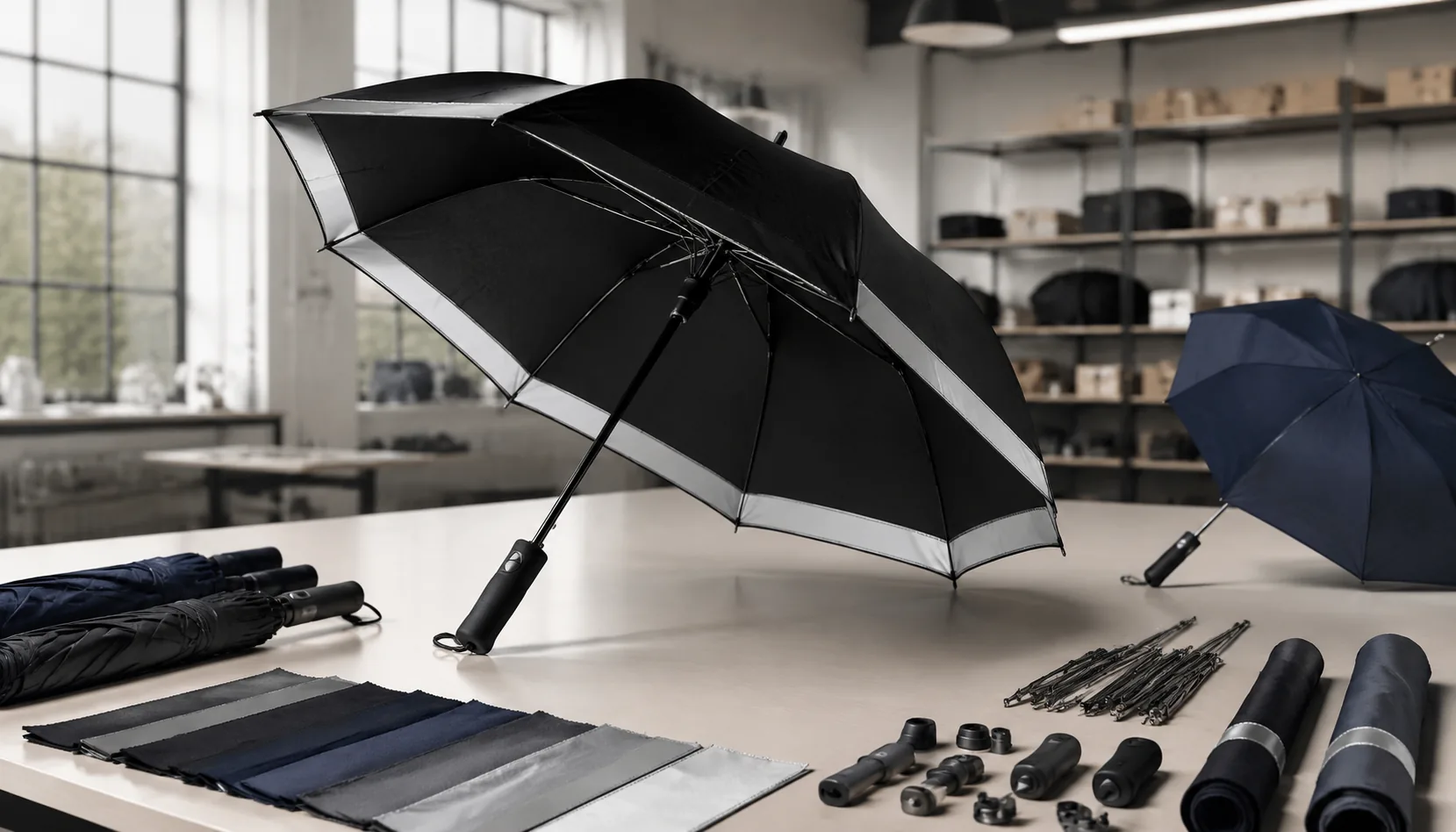
For commuter umbrella programs, the risk is not just rain failure—it is a product that looks reflective in a sample room but loses visibility, shape, or seam strength after production. On our Songxia factory floor, reflective safety umbrellas usually start with 190T or 210T pongee, fiberglass ribs, properly stitched reflective trim, and AQL 2.5 checks that catch coating flaws, rib weakness, and uneven tape placement before shipment.
Visibility Features Buyers Should Specify
Full-panel reflective coatings sound attractive in a buyer meeting, but on the factory floor they create problems: stiff hand feel, poor folding memory, higher needle abrasion, and inconsistent water repellency after coating. A whole reflective canopy also raises cost sharply and can fail where the fabric bends around steel or fiberglass ribs, especially on 8K and 10K frames. If high visibility is the goal, use targeted reflective architecture instead: edge piping for outline, vertical or chevron strips for directionality, and controlled logo placement for brand exposure. For rain performance, keep the base canopy as 190T/210T pongee with water-repellent treatment, or POE/EVA only when transparency is part of the design. Our standard practice at ZheBrella is to test trim adhesion after opening and closing cycles, spray testing, and packed compression, because reflective safety umbrellas must still behave like umbrellas first: smooth opening, no seam twisting, clean folds, and no sharp tape edges rubbing the user’s hand.
Frame Choices for Daily Commuter Use
For a commuter umbrella OEM program, the lowest-risk frame is usually a steel shaft with fiberglass ribs: it keeps cost under control while giving the canopy edge enough flex when a rider steps out of a subway exit into crosswind. A full steel frame is cheaper, but I do not recommend it for reflective safety umbrellas aimed at daily use; steel ribs bend sharply and stay bent, especially on 23" and 27" models. Fiberglass ribs recover better after inversion, and a steel center shaft still gives good vertical stiffness for auto-open springs. For retail or transit-agency orders, our standard practice at ZheBrella is to pair a 10 mm or 12 mm steel shaft with 8K fiberglass ribs, 190T or 210T pongee, reflective piping, and a manual or auto-open runner depending on target price.
Rib count changes both strength and buyer perception. An 8K reflective piping umbrella is the practical baseline for commuters: lighter, faster to assemble, and easier to keep inside a competitive FOB price. A 10K build gives slightly rounder canopy tension, but the cost increase is not always visible to end users. A 16K frame looks premium and spreads wind load better, but it adds weight, sewing time, and more points to inspect during AQL 2.5 umbrella inspection. I use 16K more often on 27" golf-style commuter umbrellas, not compact 21" or 23" folding units, because the extra ribs can make a small umbrella feel overbuilt. If the brand wants custom safety umbrellas for road crews, school crossings, or night events, 16K can be justified because stability matters more than handbag weight.
Auto-open is worth specifying for commuters because one-hand operation matters when carrying a laptop bag, coffee, or phone. The mechanism should be tested for clean release, no runner slip, and no spring binding after at least 500 open-close cycles; cheap auto-open parts fail before the canopy fabric does. Auto-open-close is useful on compact models but adds complexity, so I would reserve it for higher-margin retail SKUs. Double-canopy windproof construction is worth the added cost only when the umbrella will face open-street gusts, bridge crossings, or coastal city use. A vented double canopy with fiberglass ribs can survive 50+ mph wind-tunnel testing when the pattern is balanced, but it adds fabric consumption and sewing labor. For basic promotional giveaways, single canopy is enough; for reflective safety umbrellas sold as dependable commuter gear, the windproof build supports the safety claim.
Canopy Fabric, Coatings, and Color Planning
For reflective safety umbrellas, I usually steer commuter programs toward 190T or 210T pongee before discussing logos, because the fabric weight decides how the umbrella folds, prints, and survives daily abuse. 190T pongee is lighter, packs cleaner in a 21" or 23" auto-open-close frame, and keeps carton weight down for FOB or DDP shipments. It is also easier to sew around reflective piping because the edge seam does not get too bulky. 210T pongee feels denser in the hand, sheds water better after a proper water-repellent finish, and looks more retail-grade on 23" stick umbrellas or 27" golf-style commuter models. The tradeoff is folding thickness: on compact 8K frames, 210T plus reflective tape can make the closing strap short unless the pattern and Velcro position are adjusted. For a commuter umbrella OEM order, I would not approve bulk cutting until the folded sample is checked with the final rib count, shaft diameter, and sleeve size.
Black and navy remain the safest commuter palettes because they hide street dirt, match corporate uniforms, and make silver or gray reflective trim visible under headlights. A reflective piping umbrella needs contrast at the canopy edge, not just a small logo panel; 5 mm or 10 mm reflective binding along all eight panels gives better side visibility than one printed reflective strip. If the buyer wants custom safety umbrellas for transit agencies, security teams, or campus use, we usually test black, navy, charcoal, and safety yellow under wet conditions because reflective material can look different after the canopy darkens with rain. For logos, screen printing works well on standard pongee with PU or water-repellent finishing, while heat-transfer is cleaner for small multicolor marks. Sublimation is possible only on white or very light polyester panels, so it is not a good match for dark commuter palettes unless the design uses separate printed panels.
UPF 50+ coating is useful for commuters who walk in exposed parking lots or wait at bus stops, but it changes the umbrella more than many buyers expect. A silver UV coating gives strong sun blocking and a crisp interior look, yet it adds stiffness and can show fold marks on compact auto-open-close models. Blackout or double-layer UV constructions feel more premium but increase bulk, especially on 210T pongee and 10K windproof frames. Teflon-style water-repellent finishes keep a softer hand and better folding behavior, but they are not the same as UV blocking, so the spec sheet should separate water repellency, UPF rating, and colorfastness. Our standard practice at ZheBrella is to run print adhesion and rub tests after coating approval, then include canopy stains, coating scratches, seam puckering, and reflective trim alignment in the AQL 2.5 umbrella inspection checklist before shipment.
Branding, Packaging, and Compliance Checks
Branding on reflective safety umbrellas has to be planned around the reflective material, not added after the umbrella is finished. For commuter umbrella OEM orders, we usually put silkscreen logos on one or two 190T or 210T pongee panels when the artwork is simple, especially white, silver, or one-color corporate marks. Heat-transfer is better for gradients, small text, and multi-color sponsor graphics, but the press temperature must be controlled so it does not glaze the water-repellent coating or leave a rectangle mark on dark navy and black fabric. On a reflective piping umbrella, the logo should stay at least 15 mm away from the seam and piping edge; otherwise the print registration shifts when the canopy is tensioned over 8K or 10K ribs. Sleeves can take a vertical silkscreen logo, while reflective straps normally need heat-transfer film or woven labels because ink adhesion on reflective tape is weaker after repeated folding.
Packaging should be specified as carefully as the frame because retail and promotion buyers receive complaints when cartons look inconsistent. Standard export packing for custom safety umbrellas is one umbrella in a clear barcode bag, 12 pieces in an inner carton if required, and 24 or 36 pieces in a five-layer master carton depending on size and handle type. A 23" auto-open straight umbrella with fiberglass ribs needs more carton depth than a compact 21" auto-open-close unit, and curved J handles waste space if the carton drawing is copied from a folding model. Retail hangtags should list canopy fabric, open diameter, rib material, mechanism type, care warnings, country of origin, and any UPF 50+ or Teflon coating claim only if supported by test reports. Carton labels need PO number, SKU, color, quantity, gross/net weight, carton size, barcode, and destination marks for FOB Ningbo or Shanghai shipments.
AQL 2.5 umbrella inspection is where many reflective programs fail, because the defect is often small but highly visible under headlights. Our standard practice at ZheBrella is to check trim adhesion after rubbing and folding, not only on the flat table. Inspectors should pull-test reflective straps, check piping symmetry around all panel seams, and compare print registration against the approved pre-production sample under normal light and angled light. Mechanism cycling is also mandatory: manual, auto-open, and auto-open-close samples should be opened and closed at least 20 times during inline inspection, with extra attention to runner lock, spring kick, shaft wobble, and rib-tip seating. Major defects include peeling reflective tape, logo offset over 3 mm, exposed sharp wire, failed open/close function, broken stitch at strap attachment, and barcode mismatch. Minor defects include small loose threads, slight sleeve print skew, or carton scuffing that does not affect retail presentation.
MOQ, Lead Time, and Shipping Terms
FOB Ningbo or Shanghai is the cleanest term for buyers with their own forwarder: the factory controls production, export carton packing, China customs documents, and delivery to port, while the buyer controls ocean or air freight. For DDP delivery to a U.S. warehouse, EU distributor, or event site, add roughly 25–40 days by sea after production, or 7–12 days by air for urgent promotional launches. Reflective materials can affect export packing because creased piping or folded reflective strips may leave pressure marks, so we normally use larger cartons or stricter panel folding on premium commuter styles. Before shipment, specify AQL 2.5 umbrella inspection for critical appearance and function points: reflective tape alignment, open-close cycle, rib strength, print registration, canopy stains, and carton drop condition. That inspection window should be built into the schedule, not treated as a final-day formality.
Frequently Asked Questions
Can reflective trim be added to both folding and straight umbrellas?
Yes. Folding umbrellas usually use reflective piping or strap details, while straight umbrellas can support wider reflective panel strips because the canopy folds with less compression.
Does reflective material affect umbrella waterproofing?
It can if stitched through the canopy without proper seam control. Buyers should request water-leak testing and AQL 2.5 inspection for reflective seams and trim adhesion.
What reflective materials can be specified for commuter safety umbrellas?
Common options include reflective piping around the canopy edge, reflective tape panels, or a printed reflective logo. For commuter umbrellas, 1 cm to 2 cm reflective trim is typical because it improves visibility without making the umbrella look like industrial PPE.
What MOQ should buyers expect for custom reflective safety umbrellas?
For OEM reflective umbrellas, a realistic MOQ is usually 1,000 to 3,000 pieces per design, depending on fabric color, handle type, and reflective trim requirements. Custom molds, special reflective prints, or multiple colorways may increase the MOQ.
How is AQL 2.5 applied during umbrella inspection?
AQL 2.5 is commonly used for major defects such as broken ribs, poor opening function, fabric tears, failed stitching, or incorrect logo placement. Buyers can also set separate checks for reflective trim continuity, canopy waterproofing, and wind resistance before shipment.
Looking to Launch Your Custom Umbrella Line?
ZheBrella is a Zhejiang-based OEM/ODM umbrella manufacturer with 17 years of export experience. Free design, low MOQ from 100 pieces, windproof construction, full-color print.
Get Free Quote Now »People Also Search For
Related Articles
Reflective Umbrellas for Commuters: Buyer Spec Guide
Specify reflective commuter umbrellas with the right fabric, rib count, print placement, and QC checks for safer retail ...
Read More »
Reflective Safety Umbrellas: OEM Specs for Urban Programs
Specify reflective safety umbrellas with piping, panels, frames, and QC checks for commuter, campus, and corporate safet...
Read More »
Reflective Trim Umbrellas: Safety Specs for OEM Buyers
Specify reflective umbrellas for commuter, campus, and event programs with trim placement, fabric, frame, MOQ, QC, and p...
Read More »