Reflective Safety Umbrellas for Commuter Brand Programs
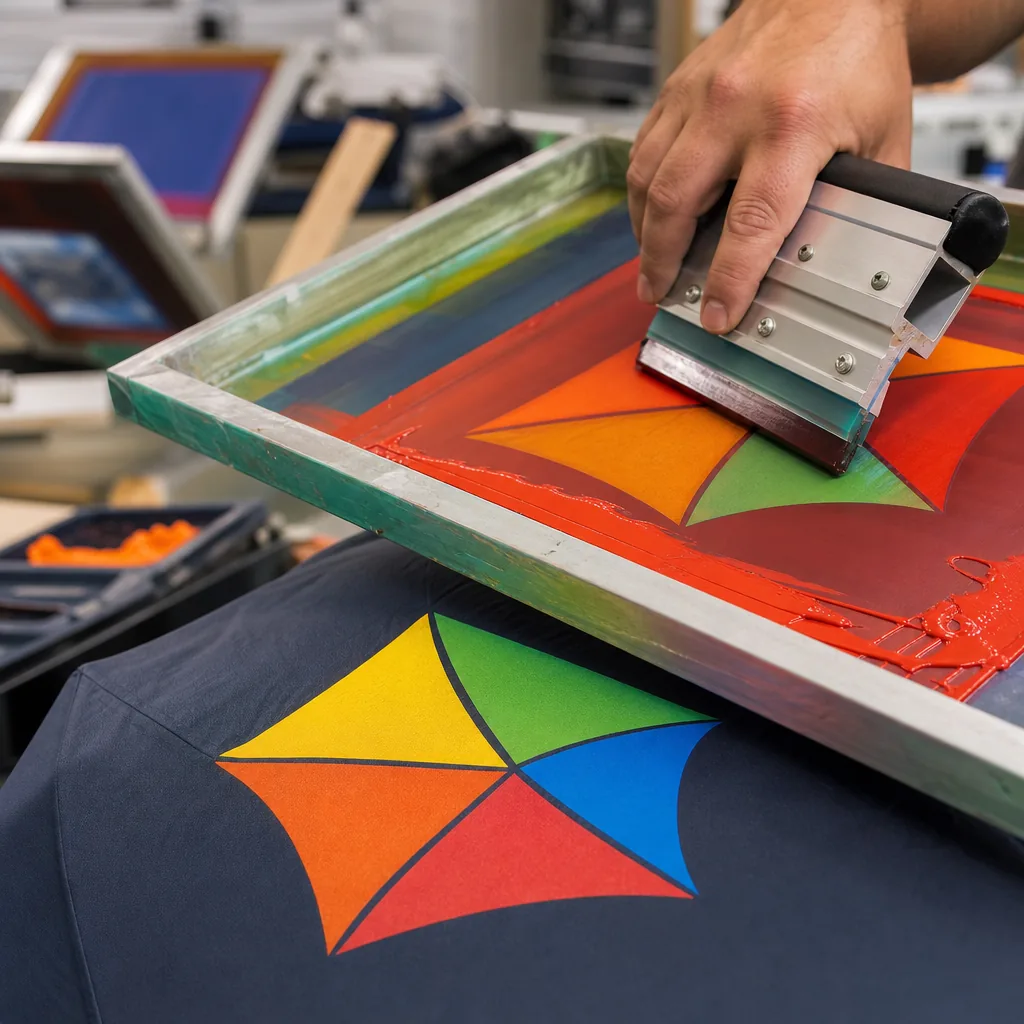
For commuter brand programs, reflective safety umbrellas only work if the visibility details survive real production: piping must stay straight through panel sewing, logos need clean registration, and reflective panels cannot fight the canopy fabric. On our Songxia factory floor, the trade-offs usually come down to 190T versus 210T pongee, windproof frame cost, MOQ planning, and inspection points that catch weak rib joints, uneven tape, or dull reflective print before shipment.
Define the Visibility Goal and User Scenario
The visibility goal should be set before anyone chooses fabric color or logo size, because commuter giveaways and road-safety campaigns solve different problems. For daily commuter promotional umbrellas, I usually specify reflective edge piping around a 23" or 27" canopy, because the moving outline is what headlights catch first when a person crosses a wet intersection. For school programs, the target is earlier recognition by drivers and parents, so a yellow, orange, or lime 190T pongee canopy with 360-degree reflective piping is more useful than a small chest-level logo. For municipal road-safety campaigns, a high visibility umbrella may need reflective panel strips on alternating panels, not just trim, so the umbrella reads as a safety object from 30–50 meters under low-beam headlights.
Night events need a different layout because the umbrella is often used in crowds, parking lots, shuttle lines, or outdoor venues where people stand close together. In that case, reflective logo placement matters: a silver reflective transfer at the lower panel edge can disappear when the umbrella is tilted, while a vertical reflective strip from ferrule toward the rib tip stays visible from more angles. Reflective umbrella printing also has process limits; heat-transfer reflective film gives stronger return than ordinary silver ink, but it should not be placed directly over heavy seam ridges or near high-flex folding points on compact 21" auto-open-close umbrellas. For full-size 30" golf umbrellas, we keep reflective strips at least 15–20 mm away from stitched seams to reduce cracking after repeated opening cycles.
For event safety umbrellas, I separate branding from safety performance in the artwork review. A logo can sit on one or two panels in screen print, while reflective edge piping or panel strips provide the actual visibility function. If the buyer wants the brand itself to reflect, we recommend testing one production panel first, because reflective films vary in wash resistance, fold memory, and adhesion on 190T versus 210T pongee, POE, PVC, or EVA. Our standard practice at ZheBrella is to check reflective alignment during in-line inspection and final AQL 2.5, especially on 8K and 10K frames where rib spacing makes uneven strip placement obvious. Good safety design is not the brightest artwork; it is consistent 360-degree recognition when the user is walking, waiting, and crossing in rain after dark.
Choose Reflective Materials That Survive Rain Use
Reflective tape gives the strongest night visibility, but it is also the least forgiving material on a folding canopy. Good microprismatic or glass-bead tape can throw light back clearly at 100–200 meters under headlights, which is why many buyers ask for it on reflective safety umbrellas for subway, bus, and parking-lot programs. The problem is fold resistance. A 21" or 23" auto-open-close umbrella folds the same panel lines hundreds of times, and cheap tape will crack, edge-lift, or delaminate after wet storage. On 190T pongee, tape needs a compatible hot-melt adhesive and controlled press temperature; too low and adhesion fails, too high and the fabric puckers or loses water repellency. On 210T pongee, the tighter weave handles tape better, especially with Teflon coating, but we still avoid placing wide tape across primary fold lines. For commuter promotional umbrellas, I prefer segmented tape strips near the lower canopy edge rather than one continuous band that fights the fabric every time the frame closes.
Reflective piping is less bright than tape, but it survives daily rain use better because it is sewn into the canopy edge instead of bonded flat to the fabric. It works well on 8K and 10K straight umbrellas, especially 23" and 27" sizes, where the canopy does not collapse into tight layers like a compact 3-fold. The tradeoff is sewing control. Piping adds thickness at the hem, so the operator must adjust stitch tension and needle size; otherwise the seam becomes wavy, needle holes enlarge, or the hem pulls unevenly under rib tension. On fiberglass ribs the canopy has more flex in wind, so piping seams must be checked after wind-tunnel cycling, not only after a static pull test. For a high visibility umbrella used in retail or transit campaigns, reflective piping is a good durability choice when the design needs a clean outline rather than a large reflective message. Our standard practice at ZheBrella is to run seam slippage and wet-fold checks before approving bulk production.
Printed reflective ink gives the most branding freedom, but it is not a direct substitute for tape or piping. Reflective umbrella printing uses special ink with glass beads or reflective additives, usually screen printed onto 190T or 210T pongee before final sewing. It can carry logos, arrows, safety slogans, or sponsor marks for event safety umbrellas, and it folds more naturally than tape when the ink film is thin and properly cured. The weakness is reflectivity loss if the ink deposit is too light, overcured, or buried under a clear top layer. Heavy ink coverage also stiffens the panel and may crack at fold creases, especially on compact umbrellas with auto-open-close mechanisms. For AQL 2.5 inspection, we check dry rub, wet rub, cross-hatch adhesion, folded appearance, and reflectivity under angled light, not just logo sharpness. My recommendation is simple: use piping for long-life edge visibility, segmented tape for maximum headlight return, and reflective ink for controlled branding areas away from seams and high-stress fold lines.
Match Frame Strength to Outdoor Safety Use
For commuter programs, the frame should be specified before the print artwork, because a failed rib makes the logo irrelevant. I would choose fiberglass ribs over basic painted steel ribs for most reflective safety umbrellas used near train stations, parking lots, campus shuttles, and night events. Steel is cheaper and acceptable for low-wind giveaways, but it bends at the joint after repeated gust loading, especially on 23" and 27" stick umbrellas. Fiberglass flexes and recovers, so the canopy does not invert as easily when a commuter steps out from behind a bus or building corner. An 8K fiberglass frame is the practical standard: 8 ribs, usually 23" arc for walking use or 27" for golf-style coverage, with a steel shaft if cost control matters or a fiberglass shaft for better corrosion resistance.
For premium commuter promotional umbrellas, I push buyers toward 16K fiberglass ribs when the budget allows, not because more ribs look fancy, but because load is distributed more evenly around the canopy edge. A 16K frame with 190T or 210T pongee, reinforced rib tips, and proper runner clearance can survive real street use better than a decorative umbrella that only passed a static open-close check. If the product is positioned as a high visibility umbrella for security teams, transit staff, construction visitor kits, or sponsored night walks, the frame should be tested with the reflective trim already sewn on, because extra tape weight changes canopy balance. Our standard practice at ZheBrella is to sample windproof models before bulk cutting, then inspect rib alignment, stretch tension, and open-close cycling under AQL 2.5.
Auto-open is worth paying for when one-hand operation matters: commuters often hold a phone, bag, access card, or child’s hand. For compact models, auto-open-close mechanisms are convenient but need stronger springs and tighter QC than manual shafts, so I avoid the cheapest units for event safety umbrellas. On full-size stick umbrellas, a smooth auto-open button with a plastic or rubberized handle is usually more reliable. If gust relief is a requirement, specify a double-canopy vented windproof structure, not just “windproof” in the quote sheet. The upper canopy lets pressure escape instead of turning the umbrella inside out, and it pairs well with reflective umbrella printing on panels, reflective piping along the edge, or silver reflective strips placed between ribs without blocking the vent gap.
Control Branding Without Reducing Reflectivity
The mistake I see most often with reflective safety umbrellas is treating the reflective band like leftover space after the logo is placed. For commuter promotional umbrellas, the reflective zone should be designed first: usually a 15–25 mm silver or white reflective tape along the canopy edge, or a wedge-shaped reflective print on alternating panels where headlights hit first. On a 23" auto-open straight umbrella with 8K fiberglass ribs and 190T pongee, I prefer keeping the main logo within the upper third of two or four panels, leaving the outer perimeter clean for low-light visibility. If the umbrella uses a double-canopy vented windproof structure, avoid placing reflective material too close to vent seams, because the overlap can wrinkle during sewing and reduce the return angle of the reflective surface.
Panel color controls both daytime brand impact and nighttime contrast. Navy, black, forest green, and charcoal make a high visibility umbrella look sharp in daylight while giving silver reflective material strong contrast under car headlights. If the buyer wants PMS-matched canopy panels, we test the fabric color on actual 190T or 210T pongee after water-repellent or Teflon coating, not just on a paper chart, because coating changes shade and gloss. White reflective material is useful on dark panels when the design needs a softer retail look; silver reflective tape is stronger for event safety umbrellas where function matters more than subtlety. For bright orange, yellow, or lime panels, I usually reduce logo size and use black or dark gray ink, because oversized white logos can compete with the reflective area instead of supporting it.
Reflective umbrella printing needs pre-production testing, especially when combining screen print, heat transfer, and reflective tape on one canopy. Our standard practice at ZheBrella is to make a strike-off before bulk cutting: PMS logo color, reflective placement, seam allowance, folding behavior, and wet-rub resistance are checked on the same fabric and rib structure intended for production. A 30" golf umbrella with 10K fiberglass ribs has much more branding area than a 21" folding auto-open-close model, but it also has longer fold lines that can crack poor reflective transfer film. Before approving mass production, buyers should review daylight photos, low-light flash photos, and one open-close folding test after 24 hours. That simple step prevents the common failure where the logo looks perfect on the art proof but the finished reflective safety umbrellas lose visibility once sewn, folded, and packed.
Inspect Reflective Umbrellas Before Shipment
Final inspection on reflective safety umbrellas should start with the reflective material, not the handle or sleeve. On commuter promotional umbrellas, the reflective strip must sit on the same panel position across the full production lot, usually within a 2–3 mm tolerance from the seam line. If the strip waves, twists, or crosses a rib tip, it looks cheap under daylight and performs poorly under headlights. For reflective umbrella printing, we also check ink adhesion on the strip after 3M tape pull, light rubbing, and folding stress, because some silver reflective tapes reject low-temperature screen ink. Stitching tension matters here: loose top thread causes puckering beside the reflective strip, while over-tight thread cuts into 190T or 210T pongee after repeated opening. I like inspectors to open at least 32 pieces across sizes, especially 21 inch auto-open-close and 23 inch straight umbrellas, then compare strip alignment under both factory light and a flashlight beam.
Canopy performance has to be checked before the umbrellas are packed, because water repellency failures are almost impossible to fix after carton sealing. A good high visibility umbrella should bead water cleanly after a spray test, with no wet-out along stitched seams or printed reflective areas; Teflon-coated pongee usually performs better than basic silver-coated fabric after folding. For POE or PVC transparent event safety umbrellas, inspectors should look for whitening at fold lines and cracking around the cap, since cold weather commuting exposes those weak points fast. Open-close cycles are another practical test: manual frames should open smoothly without rib jumping, auto-open units should fire without hesitation, and auto-open-close models should survive at least 20 continuous cycles during inspection. Rib symmetry is checked with the umbrella fully open on a flat table: 8K steel ribs should not lean to one side, and fiberglass ribs should recover evenly without a permanent bend.
Use AQL 2.5 for final inspection on branded commuter programs, with critical defects set separately for sharp rib ends, failed runner locks, broken tips, and unreadable reflective panels. For reflective safety umbrellas, I also recommend retaining one approved pre-production sample, one inline sample, and two final packed samples for repeat orders, because reflective tape batches and print density can change between shipments. Carton labeling should match the purchase order exactly: item number, color, size, rib count, quantity, gross weight, net weight, carton dimensions, country of origin, and any Amazon FBA or retail routing mark if the order ships DDP. Our standard practice at ZheBrella is to photograph carton marks, inner polybag warnings, barcode placement, and master carton sealing before release. That evidence saves arguments later when a distributor reorders the same event safety umbrellas six months later and expects the same reflective position, fabric hand feel, and retail packing.
Frequently Asked Questions
Can reflective umbrellas use full-color logo printing?
Yes, but reflective materials are usually silver, gray, or white, so full-color logos are normally printed on the pongee canopy while reflective piping or strips provide visibility. A pre-production sample should confirm the logo does not cover key reflective zones.
Are reflective umbrellas more expensive than standard promotional umbrellas?
Usually yes, because reflective tape or piping adds material and sewing labor. The increase is often smaller than upgrading the full frame, so many buyers pair reflective trim with an 8K fiberglass frame for a balanced spec.
Can reflective piping and panels be combined on the same umbrella without affecting branding space?
Yes. Most commuter programs use reflective piping on the edges and one or more reflective panels between canopy gores, then place logos on non-reflective panels. A common setup is 1-color or 2-color branding on 1-2 panels, which keeps visibility features intact.
What fabric is better for reflective safety umbrellas, 190T or 210T pongee?
190T is usually lighter and more cost-effective, while 210T offers a denser feel and slightly better hand protection in frequent-use programs. For commuter giveaways, many buyers choose 210T for a more premium look; for price-sensitive bulk orders, 190T is common.
What inspection points matter most for commuter safety umbrella orders?
Buyers usually check reflective brightness, print placement, frame wind resistance, opening/closing function, and canopy stitching at the piping or panel seams. For bulk orders, many importers request AQL inspection plus a pre-shipment photo or video check for logo alignment and reflective consistency.
Looking to Launch Your Custom Umbrella Line?
ZheBrella is a Zhejiang-based OEM/ODM umbrella manufacturer with 17 years of export experience. Free design, low MOQ from 100 pieces, windproof construction, full-color print.
Get Free Quote Now »People Also Search For
Related Articles
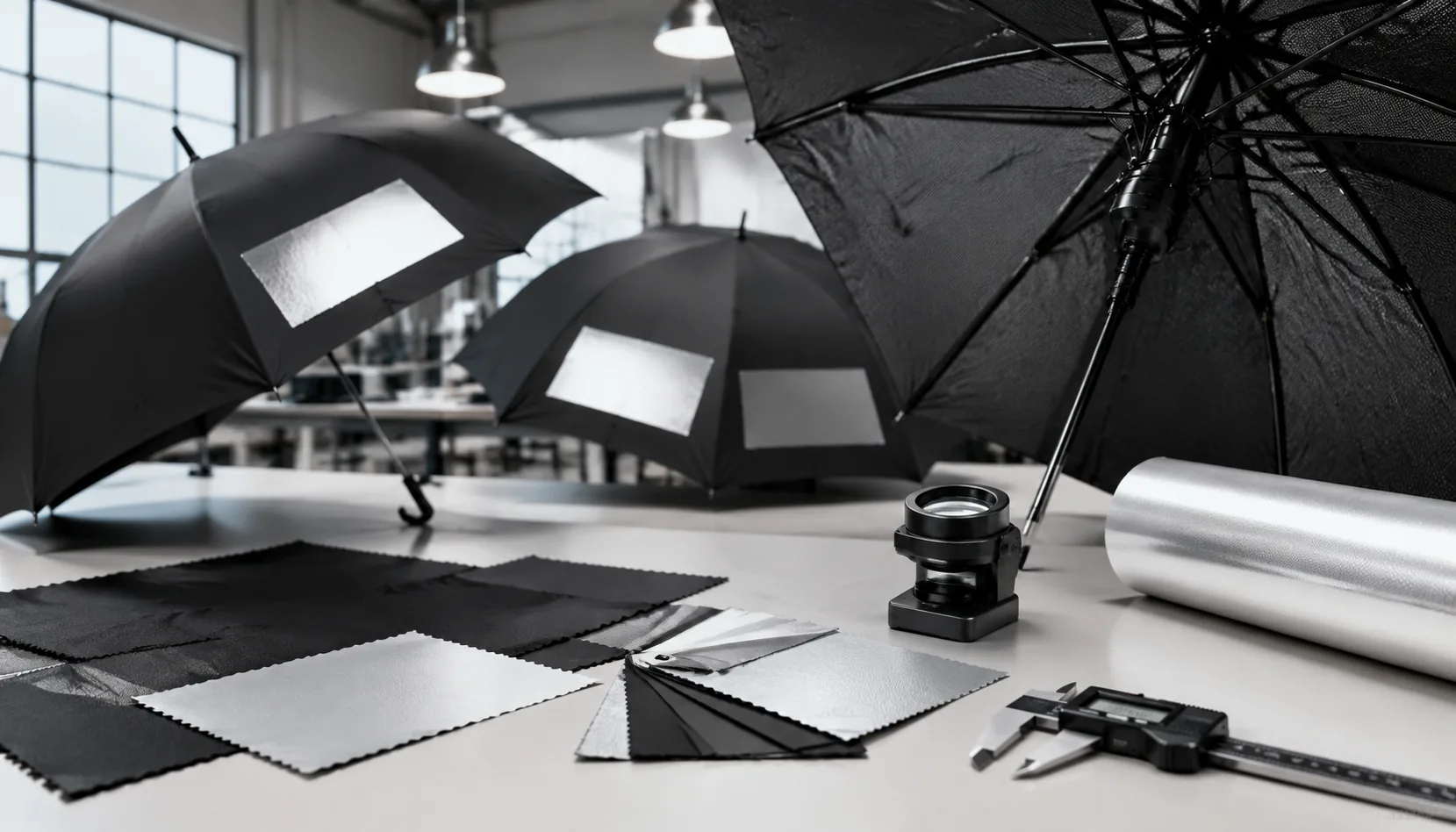
Reflective Umbrella Logos for Safety Brand Campaigns
Specify reflective logo films, panel locations, and AQL checks for promotional umbrellas used in night events, campuses,...
Read More »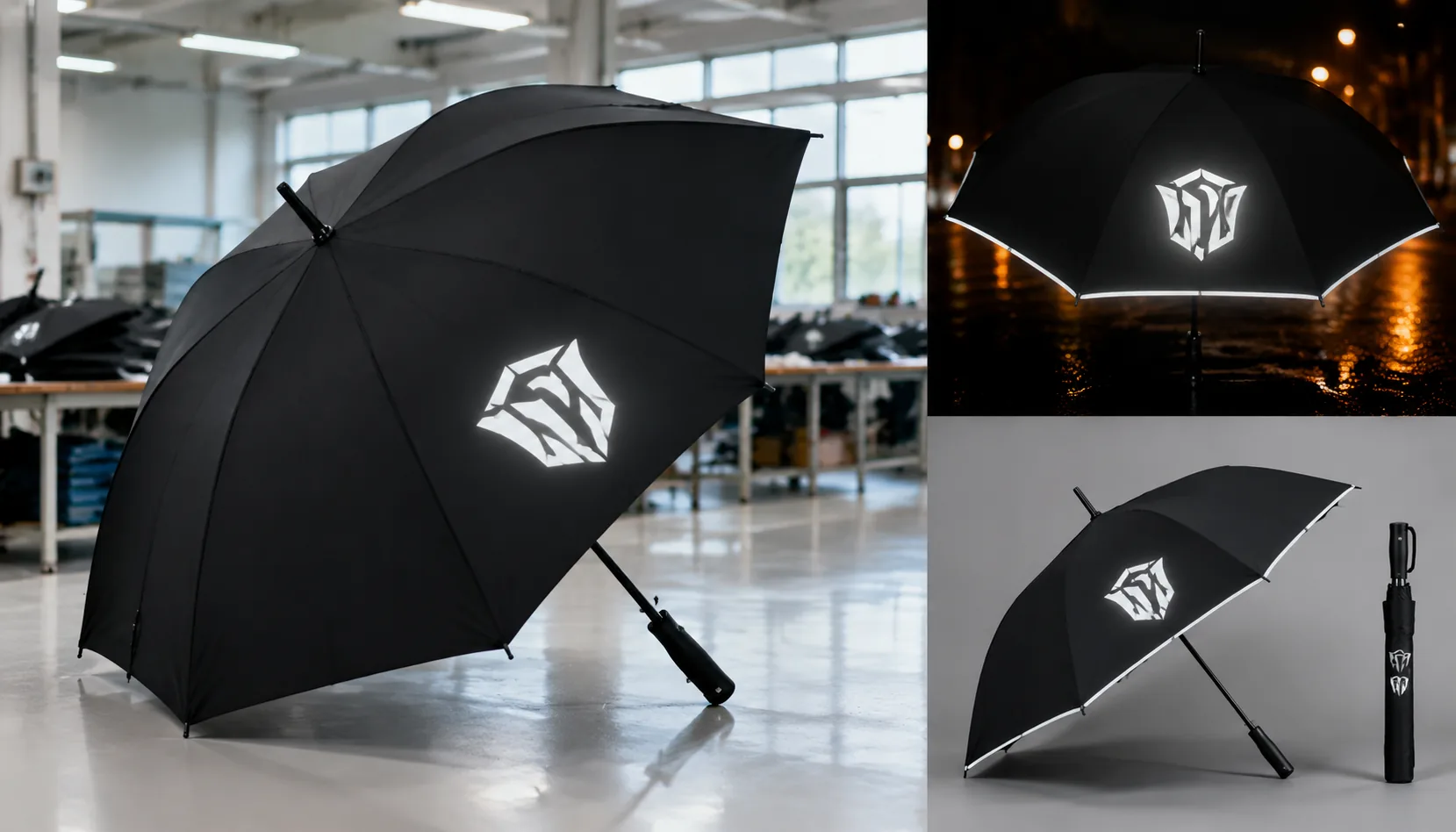
Reflective Umbrella Logos for Night Events and Safety Brands
Use reflective umbrella logos for night events, campuses, and safety brands while balancing visibility, durability, fram...
Read More »Reflective Umbrellas for Safety Programs: Materials and QA
Source reflective safety umbrellas with the right tape, prints, windproof frames, and AQL checks for utilities, campuses...
Read More »