Reflective Umbrella Logos for Night Events and Safety Brands
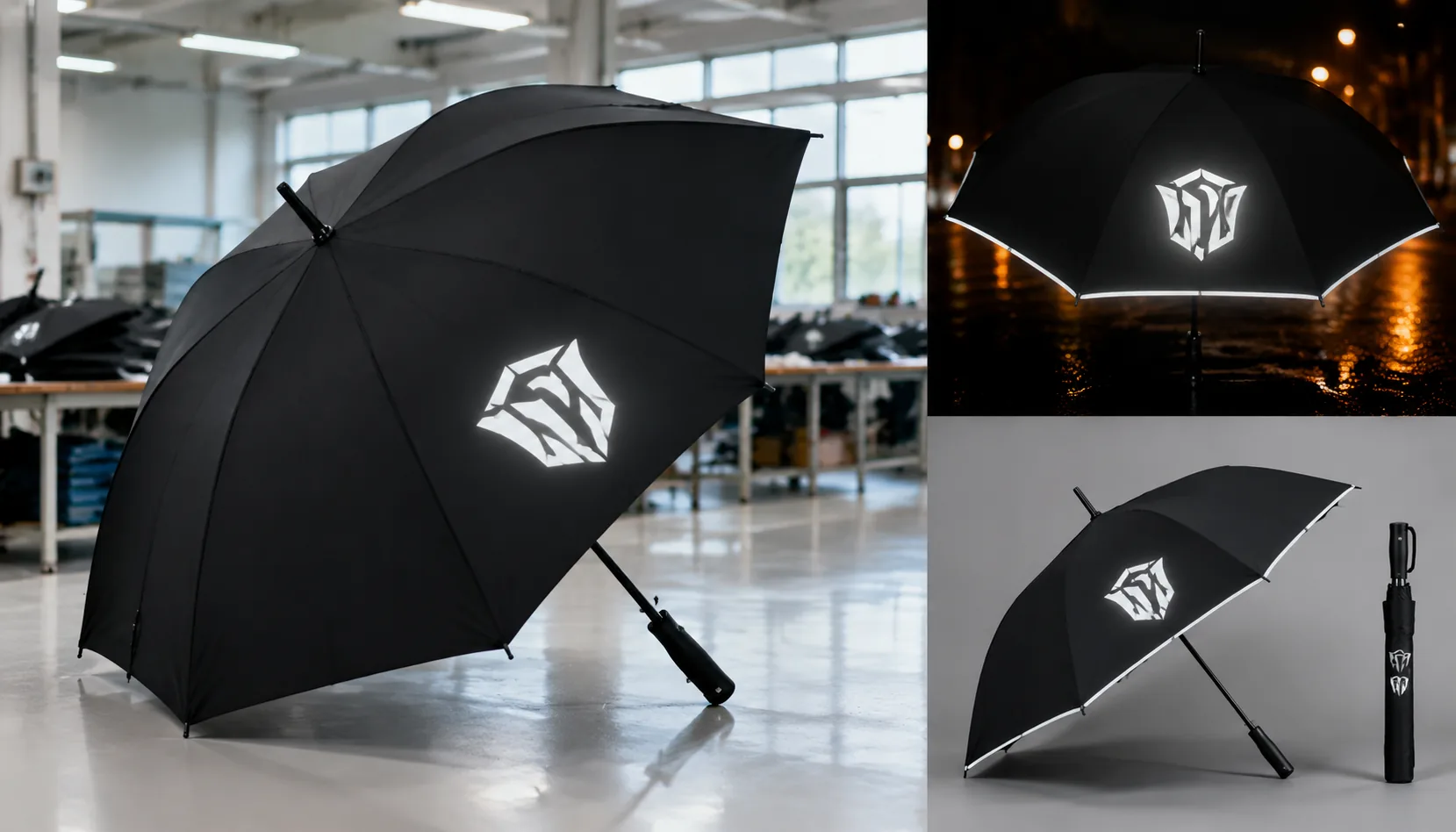
Night-event buyers often ask for a logo that looks sharp in daylight but still reads under headlights, phone flash, or campus pathway lighting. On our Songxia production floor, reflective umbrella logo printing starts with the right reflective film or ink, then depends on canopy fabric, heat setting, panel tension, and frame stability so the mark does not crack, peel, or disappear after repeated opening, rain, and packing.
Where Reflective Branding Adds Buyer Value
Reflective umbrella logo printing adds the most buyer value when the umbrella is already used in low-light movement: night runs, outdoor queues, hotel valet desks, school campus patrols, parking attendants, security teams, and roadside promotions. A normal white screen print is visible only when light is already on it; reflective transfer film or reflective ink returns light toward headlights, bike lamps, and flashlights, so the logo works harder after sunset. For 23" and 27" straight umbrellas, I usually place reflective marks on alternating panels instead of all 8K panels, because it keeps the branding clean and controls cost. On compact 21" auto-open-close models, a single reflective logo plus a reflective edge strip is often more practical than oversized artwork that wrinkles near the fold lines.
For reflective branded umbrellas, the substrate matters. 190T or 210T pongee accepts heat-transfer reflective film well if temperature, dwell time, and pressure are controlled; too much heat can leave a press box, especially on dark navy or black canopy panels. POE clear umbrellas are trickier because many reflective films do not bond cleanly to slick plastic without primer or special adhesive, and PVC can deform under heat. For safety promotional umbrellas, I prefer silver-gray reflective film on black, royal blue, fluorescent yellow, or orange panels, with artwork simplified to thick strokes above 1.5 mm. Fine QR codes, small serif text, and gradient logos usually fail after folding, wet use, and rub testing.
Reflective elements support visibility, but buyers should not sell night event umbrellas as certified PPE unless the finished product has been tested to the relevant standard and documented. An umbrella with high visibility umbrella branding is still a promotional or staff-use rain product unless it passes the required reflective performance, color, and durability testing for the target market. Our standard practice at ZheBrella is to label these as visibility-enhancing umbrellas, then confirm adhesion by cross-hatch tape test, wet rub, opening/closing cycles, and AQL 2.5 final inspection. For event planners and roadside campaigns, that wording matters: it gives staff, students, guests, or volunteers a more visible item without creating a false safety compliance claim.
Reflective Decoration Options and Trade-Offs
Sewn reflective tape is the most durable decoration, but it behaves like trim, not like printing. It is excellent for perimeter bands, rib-aligned strips, and simple safety accents on 23 inch, 27 inch, or 30 inch umbrellas, especially when the buyer wants visibility from moving vehicles rather than close-up logo detail. Standard tape widths are often 10 mm, 15 mm, or 20 mm; anything narrower is harder to sew straight on curved canopy panels and can pucker the fabric. Logos made from cut-and-sewn tape need very large geometry, because corners, counters, and curves lose sharpness once the operator follows the seam path. This is why simple one-color marks outperform detailed artwork in reflective decoration: night visibility depends on contrast and return angle, not photographic detail. Our standard practice at ZheBrella is to prototype one panel first, check folding behavior, then confirm AQL 2.5 appearance criteria before bulk production.
Canopy Fabrics, Colors, and Visibility Testing
Visibility starts with fabric choice, not the logo artwork. For most reflective branded umbrellas, 190T pongee is the cost-effective baseline: tight enough for clean screen printing, light enough for 21" and 23" auto-open models, and stable after water-repellent coating. 210T pongee gives a smoother hand feel and better ink edge definition, which matters when the reflective umbrella logo printing includes small text, thin line icons, or sponsor marks. I avoid loose polyester for safety promotional umbrellas because the weave movement makes reflective ink look broken under headlights. POE, PVC, and EVA can work for clear canopies, but reflective transfer adhesion must be tested more carefully because plastic films flex differently around panel seams and rib tips.
Dark canopy colors usually deliver the strongest nighttime contrast, but they can hide branding during the day if the logo is too small or placed low on the skirt. Black, navy, charcoal, and deep green make silver reflective logos pop under car headlights, while white or yellow reflective ink can lose its effect on light gray, sky blue, or beige panels. For night event umbrellas, I prefer alternating contrast panels: two or four bright panels in yellow, orange, or white, with reflective marks on the darker panels. On 8K and 10K golf umbrellas, a 27" or 30" canopy gives enough panel area to keep logos readable from 15–25 meters without wrapping artwork into the seam allowance.
Buyer approval should include real visibility checks, not just a flat photo from the sample room. Our standard practice at ZheBrella is to inspect high visibility umbrella branding under phone flash at 1–2 meters, car headlights at 10–20 meters, and mixed event lighting such as LED stage wash or street lamps. Phone flash shows whether the reflective layer is continuous; headlights reveal whether the logo is readable at pedestrian distance; event lighting shows if the canopy color kills contrast. For production, lock the test method before bulk cutting: same fabric lot, same ink or heat-transfer film, same coating, and same logo size. If the order is for safety promotional umbrellas, add an AQL 2.5 visual check for missing reflective sections, poor registration, and panel-to-panel shade variation.
Frame Choices for Outdoor Safety Programs
For outdoor safety programs, fiberglass ribs are the first choice when wind failure is more expensive than the umbrella itself. A fiberglass 8K frame flexes under gusts and springs back, while a steel 8K frame is stiffer, cheaper, and more likely to bend permanently at the rib joint after repeated inversion. For night event umbrellas used by security teams, parking attendants, or roadshow staff, I usually specify 23" or 27" fiberglass ribs with a steel shaft to balance flex and cost. Full steel frames still make sense for low-budget giveaways, especially manual-open 21" models, but they add weight and feel harsher in the hand after a long shift. If the umbrella carries reflective umbrella logo printing, the frame must keep the canopy stable; a twisted canopy makes reflective ink or heat-transfer film look uneven under headlights.
Rib count matters, but it is not a magic number. An 8K umbrella is lighter, folds cleaner, and costs less, so it fits staff kits, event giveaways, and safety promotional umbrellas ordered in high volume. A 16K structure spreads load across more ribs and gives a rounder canopy profile, which helps high visibility umbrella branding stay readable from the side, but it also adds labor, parts, and inspection points. For serious wind exposure, I trust an 8K fiberglass double-canopy design more than a cheap 16K steel single-canopy. The vented double canopy lets air escape instead of flipping the umbrella inside out, and well-built models can survive 50+ mph wind-tunnel tests when paired with reinforced tips, proper runner clearance, and a 190T or 210T pongee canopy.
Auto-open mechanisms are worth paying for when staff need one-hand deployment at gates, curbside pickup zones, or night patrol routes. A good auto-open 23" stick umbrella uses a stronger spring, clean runner travel, and a shaft button that does not jam after rain and grit exposure. For reflective branded umbrellas, I avoid over-heavy 16K frames with weak auto-open parts because the user feels the failure before the buyer sees the savings. Our standard practice at ZheBrella is to match mechanism testing with frame testing: open-close cycling, rib symmetry checks, canopy tension review, and AQL 2.5 inspection before shipment. For FOB orders, a fiberglass 8K auto-open model is usually the most practical middle ground; for DDP event deadlines, simpler manual-open steel frames can reduce lead-time risk when the schedule is under 30 days.
Production Specs, QC, and Shipping Terms
Reflective umbrella logo printing should be specified by placement first, not artwork size alone. On a 23" auto-open stick umbrella, the safest logo zone is usually one lower canopy panel, 120–180 mm wide, kept 25 mm away from rib seams so the reflective ink or film does not crack during folding. For 27" golf umbrellas and double-canopy vented windproof models, we can place reflective branding on two opposite panels or use a 360-degree edge strip, but I prefer avoiding seam-overlap unless the buyer accepts extra handwork and slower output. Common shells are 190T or 210T pongee with black, navy, safety yellow, or orange grounds; reflective transfer film reads best on darker fabric, while silver-gray reflective ink gives better flexibility on 8K fiberglass frames. For night event umbrellas and safety promotional umbrellas, the pre-production sample must be checked under both normal light and direct flashlight at 10–15 meters, because a logo that looks clean at the sewing table can disappear outdoors.
QC needs to be written into the purchase order, not discussed after mass production starts. Our standard practice at ZheBrella is to run adhesion testing after heat transfer or screen application: cross-hatch tape pull, then a wet and dry rub test of at least 20 cycles using white cotton cloth to check reflective particle loss and color migration. On coated 210T pongee with Teflon water repellent or UPF 50+ treatment, surface tension can reduce bond strength, so we either print before final coating or adjust dwell time and pressure on the heat press. Inspection should follow AQL 2.5 for major defects, with reflective logo peeling, wrong placement over 5 mm, cloudy transfer edges, and cracked ink after three open-close cycles counted as major. Minor defects include small registration drift, light pressure marks, or carton scuffs. For reflective branded umbrellas, I also recommend a packed-product flashlight check from random cartons, because stacked panels sometimes hide transfer-line defects until final folding.
MOQ is usually higher for high visibility umbrella branding because reflective material is not always stocked in every width, shade, and stretch grade. For standard silver reflective transfer on black 190T pongee, MOQ can start around 300–500 pieces per design; custom reflective colors, full-panel graphics, or edge piping often push MOQ to 1,000 pieces because the film supplier requires special sourcing. Normal sampling takes 7–10 days after artwork approval, while reflective material sourcing can add 5–12 days before sample making. Bulk production is typically 25–35 days after signed sample approval and deposit, longer for 16K windproof golf frames or mixed manual, auto-open, and auto-open-close mechanisms. Carton labels should show PO number, SKU, color, logo version, quantity, gross/net weight, carton size, and country of origin. FOB Ningbo or Shanghai keeps freight control with the buyer; DDP pricing includes inland trucking, export customs, ocean or air freight, duty, and final delivery, but needs destination ZIP code and HS code confirmation before quoting.
Frequently Asked Questions
Are reflective umbrella logos washable and durable?
They can be durable if the correct transfer temperature, pressure, and curing time are used. Buyers should request adhesion and rub-test results before approving bulk production.
Can reflective logos be used on UPF 50+ umbrellas?
Yes, but the reflective material must be tested against the coated canopy surface. Some black-coated UPF 50+ fabrics need adjusted transfer settings to avoid peeling or surface marks.
What reflective logo methods work best on umbrellas for night events?
Reflective heat transfer and reflective screen printing are the most common options for canopy logos. Reflective tape or piping can also be added to panel edges for stronger 360-degree visibility, but it may increase unit cost and sampling time.
What umbrella frame is recommended for reflective safety promotions?
For night events and campus safety programs, a 23-inch or 27-inch fiberglass frame is usually preferred because it balances wind resistance, weight, and cost. Automatic open straight umbrellas are common for giveaways, while compact folding models work better for commuter-focused retail programs.
What order details should buyers confirm before producing reflective branded umbrellas?
Confirm the reflective logo size, print location, canopy fabric color, frame type, windproof requirements, packing method, and compliance needs before sampling. Typical OEM orders start around 500–1,000 pieces, with sampling in about 7–10 days and bulk production around 25–40 days after approval.
Looking to Launch Your Custom Umbrella Line?
ZheBrella is a Zhejiang-based OEM/ODM umbrella manufacturer with 17 years of export experience. Free design, low MOQ from 100 pieces, windproof construction, full-color print.
Get Free Quote Now »People Also Search For
Related Articles
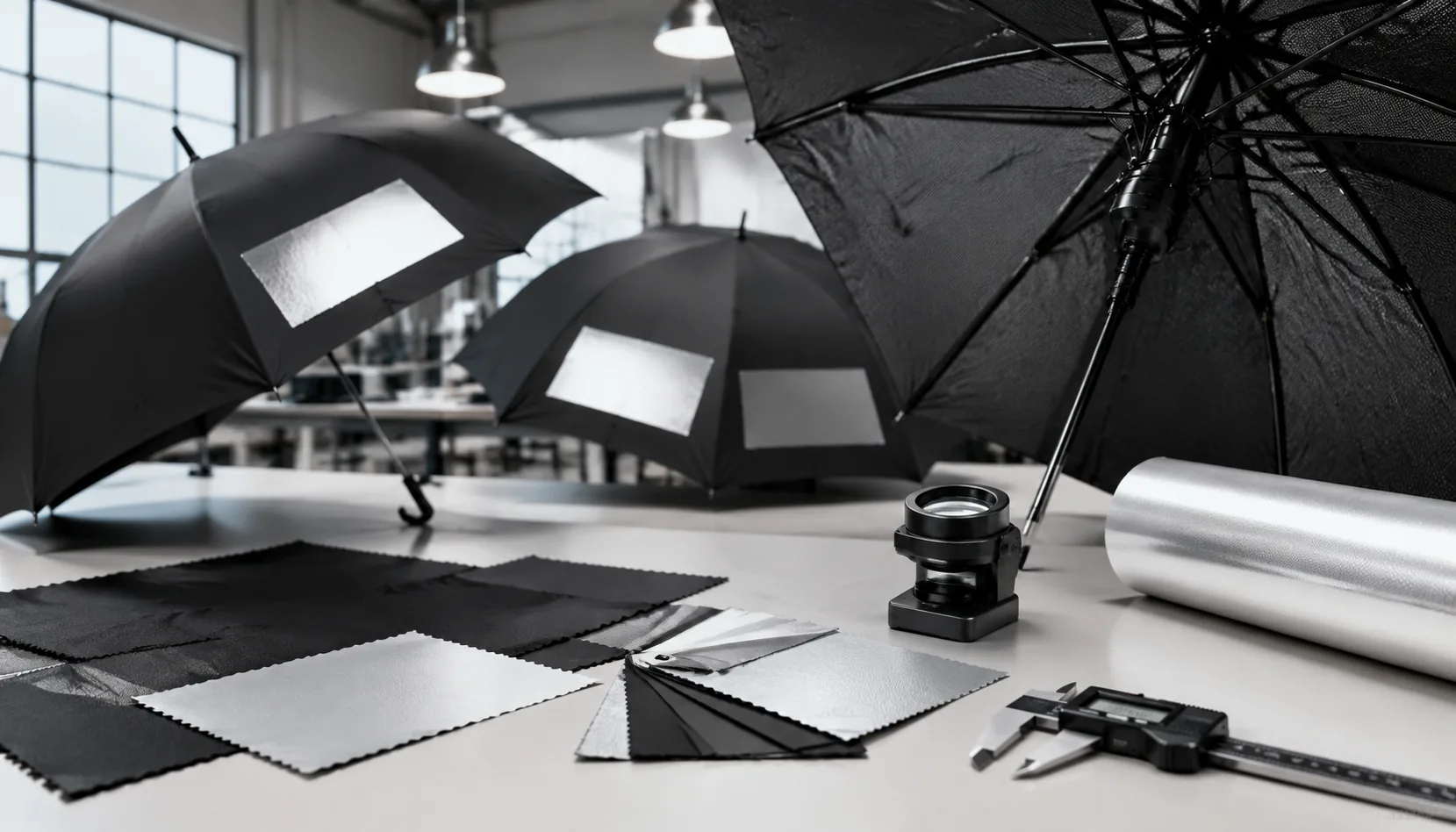
Reflective Umbrella Logos for Safety Brand Campaigns
Specify reflective logo films, panel locations, and AQL checks for promotional umbrellas used in night events, campuses,...
Read More »
Reflective Logo Printing on Branded Umbrellas for Events
Plan reflective logo umbrellas for night events with ink choices, fabric limits, MOQ, sampling, and QC checks for durabl...
Read More »
Reflective Umbrella Printing for Nighttime Brand Visibility
Plan reflective logos or trims that improve night visibility, with fabric, ink, MOQ, testing, and lead-time notes for B2...
Read More »