Reflective Logo Printing on Umbrellas for Safety Programs
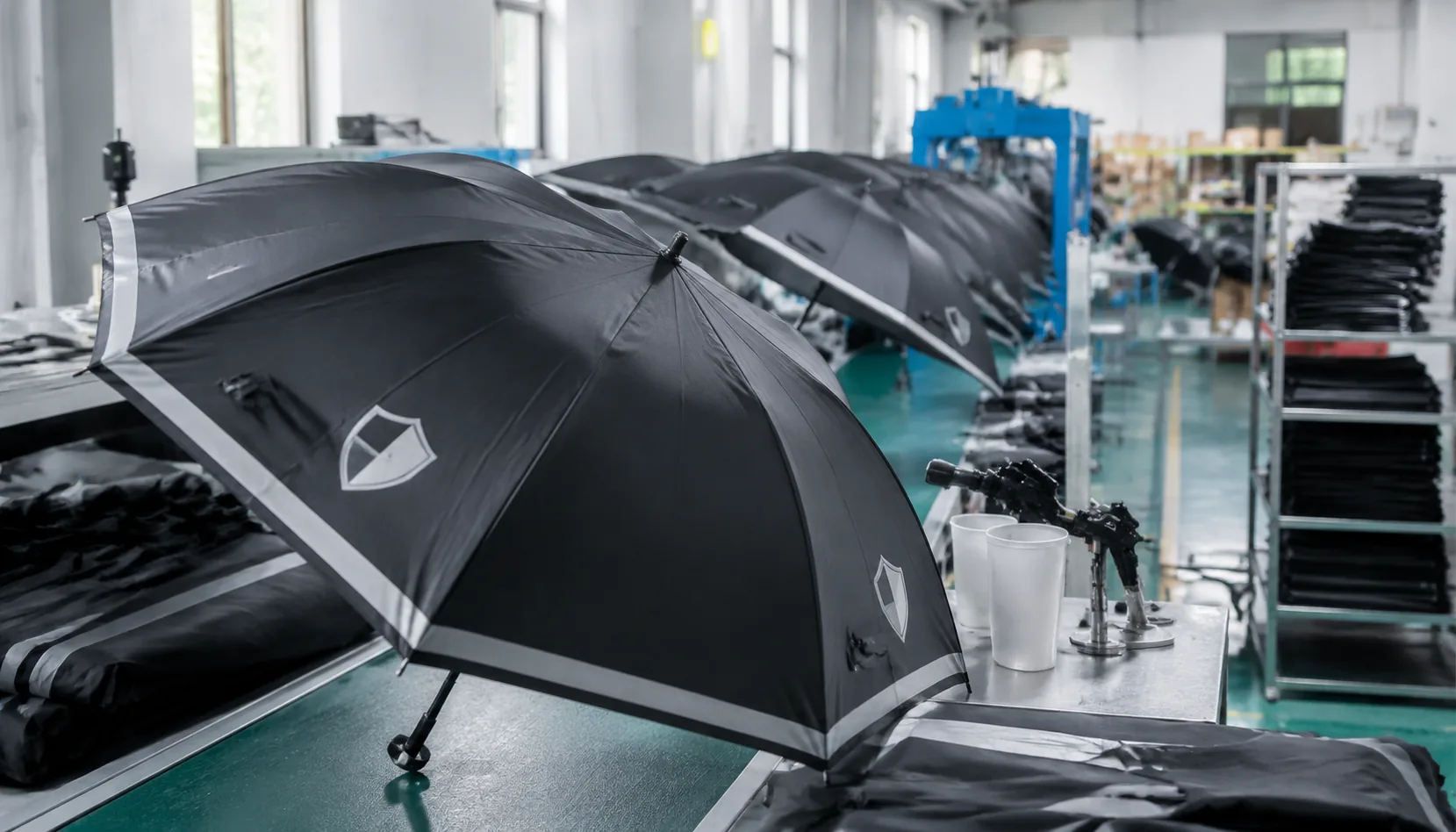
For safety programs, an umbrella logo has to do more than look clean in a daytime sample; it must stay visible in rain, low light, and repeated opening cycles. On our Songxia production floor, reflective umbrella logo printing usually comes down to matching the right reflective ink or film with canopy fabric, panel position, curing control, and batch QC so bulk orders don’t fail after packing. Buyers also need realistic MOQ and lead-time planning before artwork approval.
Where Reflective Branding Works Best
Reflective umbrella logo printing makes the most sense where visibility matters after dark, not as a vanity decoration. Road safety campaigns, municipal crews, insurance field teams, utility inspectors, campus security, and nighttime event staff all benefit because the umbrella becomes a moving marker in traffic, rain, and low light. For those programs, reflective umbrella printing works better than a full-surface graphic that tries to do everything at once. Keep the main logo on one or two panels, usually chest-height when carried, and use the reflective material as a secondary signal so the brand still reads cleanly in daylight. On safety promotional umbrellas, I would rather see a sharp 1-color logo plus reflective accents than a crowded multi-color print that disappears when wet.
Placement matters more than people expect. Border strips around the canopy edge, small marks on the strap, and reflective sleeves all add visibility without stealing space from the primary artwork. On branded rain umbrellas, especially double-canopy windproof umbrellas, the top panels already do a lot of work in wind and rain, so do not overload them with reflective ink that cracks or wrinkles at the seam lines. One or two panels are enough for the logo; the rest of the reflective umbrella logo printing can sit on the perimeter, handle loop, or matching sleeve so the brand stays recognizable when the umbrella is opened, closed, or carried at night. That balance gives you safety value without sacrificing the logo clarity procurement teams usually care about.
Reflective Ink, Transfer, and Trim Options
Reflective piping, binding, or tape is usually the most reliable safety feature when visibility matters more than reproducing a complex logo. A 5–10 mm reflective strip along the canopy edge, seam line, or vent perimeter catches light from multiple angles, while the main logo can stay as normal screen print, heat transfer, or sublimation. This is especially effective on double-canopy windproof umbrellas, where reflective tape can be placed around the lower canopy edge without interfering with the vent gap that helps the umbrella survive 50+ mph gust testing. On 190T pongee, sewn reflective trim adds less panel distortion than a large transfer patch; on 210T it looks cleaner because the heavier cloth supports the stitch line better. The tradeoff is branding precision: piping and tape cannot show gradients, small icons, or detailed sponsor marks. For reflective umbrella printing programs, I usually combine one bold reflective logo panel with perimeter trim, then inspect under both daylight and angled LED light before AQL 2.5 packing.
Frame and Canopy Specs for Safety Orders
UPF 50+ coating becomes relevant when the same umbrella is used for day-and-night campaigns: road safety week, school crossing programs, utility maintenance, outdoor security, and public-health outreach. Reflective umbrella logo printing handles night visibility, but daytime sun exposure is a separate performance requirement, so a silver UV layer or black UV-coated backing should be specified on the PO. For reflective umbrella printing, I recommend keeping the reflective logo on darker pongee panels, away from heavy seam curvature, because reflective ink or heat-transfer film needs a smooth contact area to maintain brightness after folding. ZheBrella’s standard practice is to confirm the frame layout, canopy fabric, UV requirement, and logo position before sampling, then inspect production under AQL 2.5 for frame function, print adhesion, panel alignment, and open-close reliability.
Testing Visibility and Print Durability
Reflective umbrella logo printing should be approved under the same abuse the umbrella will see in the field, not just under bright factory lights. For safety promotional umbrellas, I ask for a dry rub test first: 20 cycles with white cotton cloth across the reflective logo edge and center, then 20 more cycles after the ink or film has fully cured. If the print is heat-transfer reflective film, the operator checks for edge lifting, silver particle shedding, and visible cracking when the panel is flexed. If it is reflective ink screen printing, we check opacity, logo sharpness, and whether the reflective bead layer stays even after rubbing. Fold-line checks matter because umbrellas are collapsed hundreds of times; any logo placed across rib lines, panel seams, or deep fold channels needs extra bending tests before approval.
Water exposure is the second gate because branded rain umbrellas fail differently from bags or jackets. We open the umbrella, spray the printed panels for 10 minutes, then close it wet for 30 minutes to simulate a user putting it into a car trunk or office stand. After reopening, the inspector checks for transfer marks, tackiness, whitening, bubbling, and loss of reflectivity. On 190T or 210T pongee with Teflon coating, adhesion can change if the coating is too slick, so our standard practice at ZheBrella is to test the actual production fabric lot, not a random sample swatch. POE, PVC, and EVA canopies need separate temperature checks because reflective films may bond well at first but peel after heat cycling.
Low-light photo approval should happen before bulk production, especially for reflective umbrella printing used in municipal road crews, school programs, utility teams, or event traffic control. I recommend taking photos at 5 meters and 20 meters with a phone flash or vehicle headlight angle, then comparing the logo brightness against the buyer’s approved artwork position. Double-canopy windproof umbrellas add one more risk: the vent layer can shadow part of the logo if the artwork is placed too close to the overlap. During final inspection, use AQL 2.5 for print defects, panel alignment, and reflective material adhesion. Major defects include peeling corners, missing reflective areas, crooked logos over 3 mm, color contamination, and panel-to-panel logo mismatch on 8K, 10K, or 16K frames.
MOQ, Lead Time, and Shipping Planning
For reflective umbrella logo printing, the first practical question is not artwork, it is whether the reflective film or ink system is being applied to a flat panel, a curved panel, or a finished canopy. A standard printed strike-off usually takes 5 to 7 days after artwork is confirmed, while a reflective sample often takes 7 to 10 days because the film has to be cut, heat-pressed, and checked for edge lift or silver cracking. Our standard practice is to treat reflective umbrella printing as a separate decoration line, not a faster version of screen print. Typical MOQ is 300 pcs for screen printing, 500 pcs for heat-transfer reflective logos, and 1,000 pcs if the design uses a custom reflective patch or multi-color registration on branded rain umbrellas. For safety promotional umbrellas, buyers should also allow one extra approval cycle for visibility placement, because a logo that looks fine in daylight can disappear on a dark canopy at night.
Bulk lead time starts after artwork approval, not after PO issue, and that matters when you are shipping seasonally. For 300 to 1,000 pcs, standard logo printing on POE, pongee, or polyester umbrellas is usually 20 to 25 days; reflective umbrella logo printing is more often 25 to 35 days because the reflective layer needs curing, cooling, and a second inspection for wash/abrasion resistance. If the order includes double-canopy windproof umbrellas, add 3 to 5 days because the inner and outer panels must be aligned so the logo does not distort on the vent seam. Reflective materials are slower mainly because the adhesive and carrier film are less forgiving than normal ink, especially on coated fabrics and curved 8K or 10K frames. For event-driven orders, I tell buyers to freeze artwork early and avoid last-minute color changes, which are the usual reason a 28-day order becomes a 40-day order.
Shipping terms should be decided before production starts, not at the packing stage. FOB is better when the buyer already has a freight forwarder, wants control over ocean space, or is combining safety promotional umbrellas with other SKUs in the same container; DDP is better for smaller branded rain umbrellas orders when the consignee wants one landed price and no customs handling. On FOB Ningbo or Shanghai, cartons are normally ready 2 to 4 days after final QC, and the buyer books the vessel. Under DDP, add 7 to 15 days for export filing, main-carriage transit, import clearance, and last-mile delivery, depending on destination. Reflective umbrella logo printing can add a few days to the front end, but it usually does not change carton count, gross weight, or container loading much, so the freight impact is small compared with the decoration delay. For urgent campaigns, split the order: standard logo print for the first shipment, reflective items for the balance once the artwork is locked and the lane is confirmed.
Frequently Asked Questions
Can reflective logos be printed on dark and light umbrella canopies?
Yes, but contrast is strongest on navy, black, charcoal, or other dark 190T/210T pongee fabrics. On light canopies, reflective trim or a dark backing layer may be needed for visibility.
Does reflective printing affect umbrella folding or storage?
It can if the logo crosses heavy fold lines or uses thick transfer film. A factory sample should be opened, closed, folded, and rubbed before bulk approval.
Where is the best placement for a reflective logo on a safety umbrella?
Most buyers choose one panel on the canopy for brand visibility, and a second smaller mark near the edge or strap for directional recognition. On double-canopy windproof umbrellas, the outer canopy is usually the best surface for reflective effects because it is more visible in low light.
What MOQ is typical for reflective umbrella logo printing?
For OEM orders, MOQ is often 500-1,000 pieces per design, depending on print method, panel count, and canopy fabric. If you need multiple logo placements or mixed colors, the MOQ may increase slightly to cover setup and color matching.
How should bulk QC be handled for reflective logo umbrellas?
A practical QC check includes logo alignment, reflectivity consistency, color accuracy, stitch quality, and open-close function on sample units from each carton. For large orders, buyers usually request pre-production samples and an AQL inspection before shipment.
Looking to Launch Your Custom Umbrella Line?
ZheBrella is a Zhejiang-based OEM/ODM umbrella manufacturer with 17 years of export experience. Free design, low MOQ from 100 pieces, windproof construction, full-color print.
Get Free Quote Now »People Also Search For
Related Articles
Reflective Logo Printing for Branded Rain Umbrella Programs
Plan reflective logo umbrellas with the right ink, trim, fabric, and QA checks so safety-focused promotions stay visible...
Read More »
Reflective Umbrella Printing for Safety-Focused Branding
Plan reflective branded umbrellas with print placement, tape options, 190T pongee choices, AQL checks, MOQs, and lead ti...
Read More »
Reflective Umbrella Printing for Nighttime Brand Visibility
Plan reflective logos or trims that improve night visibility, with fabric, ink, MOQ, testing, and lead-time notes for B2...
Read More »