Reflective Safety Umbrellas: OEM Specs for Night Visibility
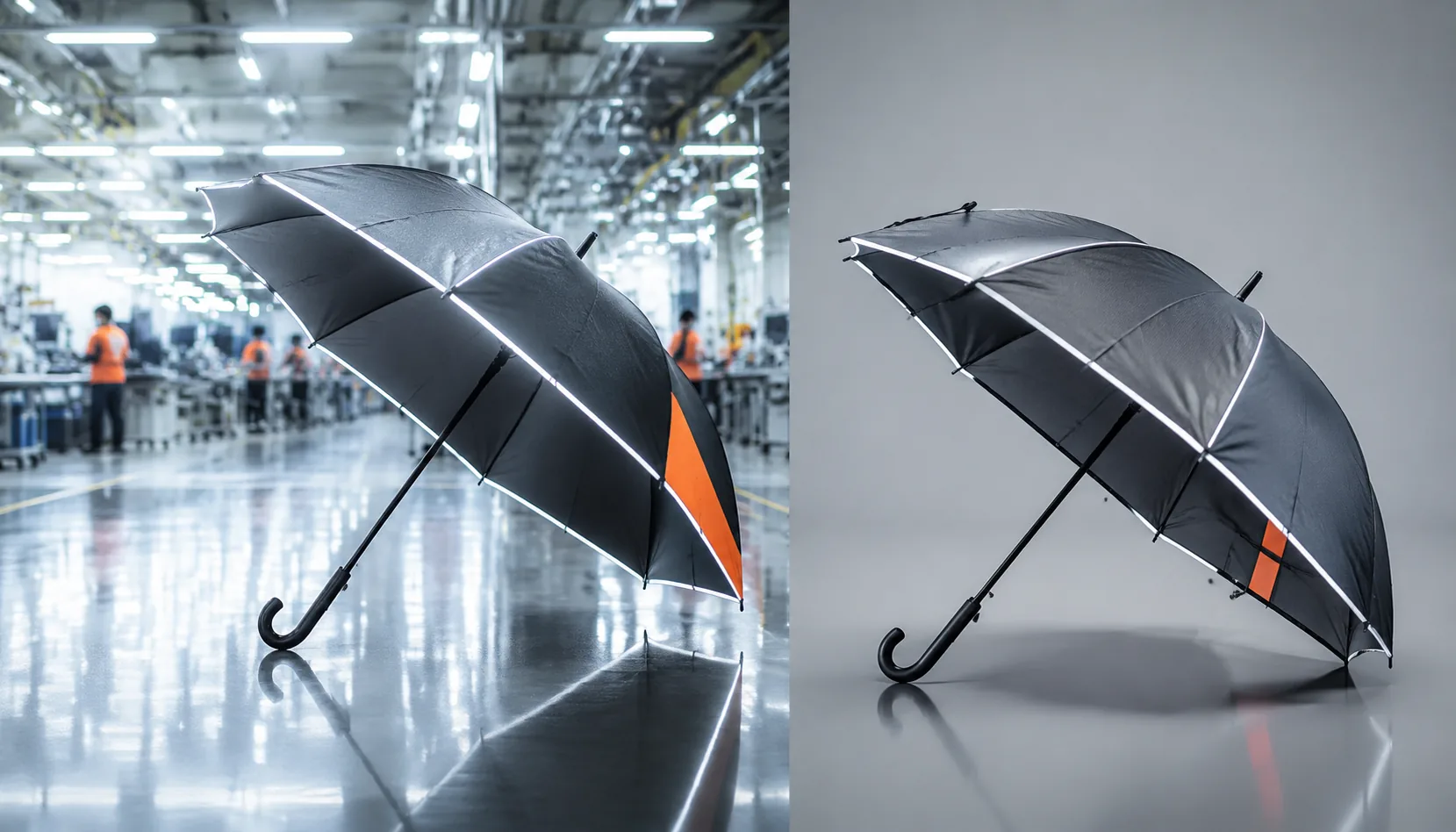
Night-visibility programs fail when the umbrella looks reflective in a sample room but loses contrast after rain, folding, and batch production. For reflective safety umbrellas, buyers need to specify trim width, placement, canopy coating, frame strength, and inspection methods together, not as separate line items. On our Songxia production floor, the difference usually shows up at sewing tension, tape adhesion, and final low-light QC before cartons close.
Visibility Features Buyers Should Specify
The visibility spec should start with placement, not decoration. On a standard 8-panel 23" or 27" canopy, I recommend reflective piping around the full outer edge plus one vertical reflective strip on every other seam, so a driver sees a flash from front, side, or rear. If the buyer wants stronger 360-degree recognition, put 10–15 mm reflective tape on all 8 rib seams, stopping 30–40 mm before the tip cup to avoid peeling during folding. For reflective safety umbrellas used by schools, road crews, hotel doormen, or evening event staff, silver-gray microprismatic trim is usually more visible than printed gray ink. It catches headlights sharply, while ordinary light-colored printing only looks bright under direct daylight.
Reflective umbrella printing works best when the logo is treated as a secondary safety feature, not the only visibility element. A reflective logo on two opposite panels is useful for brand recall, but it does not replace edge piping because logos disappear when the canopy angle changes. For night visibility umbrellas, we often specify a 120–180 mm wide reflective panel strip across four alternating panels, or a curved arc near the lower third of each panel where headlights naturally hit. Sleeve accents matter too: a 10 mm reflective band around the storage sleeve helps warehouse staff, commuters, and event teams find the umbrella before it is opened. If the canopy is 190T or 210T pongee with a Teflon coating, the reflective transfer film must be matched to the coating chemistry, otherwise adhesion looks fine on day one and fails after repeated roll-up pressure.
Testing should copy real use, because reflective trim fails first at fold lines and seam intersections. For OEM umbrella specs, ask the factory to test reflective tape after 30 open-close cycles, 500 dry rubs, 100 wet rubs, and at least 30 minutes of rain spray before final approval. On safety promo umbrellas, I also check whether the reflective strip cracks after being folded tightly around steel or fiberglass ribs, especially on auto-open and auto-open-close frames where closing force is higher. AQL 2.5 inspection should include night visibility checks under a fixed light source, not only daytime visual inspection. Our standard practice at ZheBrella is to reject trim that lifts at the stitch line, dulls after rubbing, or creates stiff ridges that stop the canopy from wrapping cleanly into the sleeve.
Canopy Fabric, Coatings, and Color Choices
For daily-use reflective safety umbrellas, I usually specify 190T pongee for cost-sensitive promotional orders and 210T pongee when the buyer wants a cleaner retail hand-feel, tighter weave, and better print edge control. A 190T polyester pongee canopy is light, dries reasonably fast, and works well on 21" folding, 23" stick, and 27" golf umbrellas, especially when the order target is safety promo umbrellas with MOQs around 500–1,000 pcs per color. The tradeoff is that thin light colors can show frame shadowing under strong light, and heavy reflective umbrella printing needs good ink curing so the coating does not crack along fold lines.
A 210T pongee canopy gives a denser surface for silver reflective strips, heat-transfer logos, and contrast-panel layouts, so it is better for corporate fleet umbrellas, school safety programs, and retail night visibility umbrellas. Black and navy look professional in daytime, but they need 360-degree reflective tape, reflective piping, or alternating high-contrast panels to be visible near headlights. Neon yellow, lime, and orange improve daytime recognition, while white or silver panels beside dark panels create stronger contrast at night. On the cutting table, I avoid placing reflective artwork directly across high-stress rib tips unless the buyer accepts extra reinforcement patches.
For OEM umbrella specs covering both rain and sun, add a water-repellent finish as standard and consider Teflon treatment when the buyer wants faster shake-off and better stain resistance. If the umbrella is sold for day and night use, UPF 50+ coating is practical on 210T pongee, but it changes fabric hand-feel and can affect sublimation brightness, so strike-off approval is important before bulk cutting. Our standard practice at ZheBrella is to test coating adhesion after opening cycles and wet rub, then inspect canopy seams, reflective alignment, and color consistency under AQL 2.5 before FOB shipment.
Frame Builds for Commuter and Event Use
For commuter programs, the most cost-effective frame is usually a steel shaft with fiberglass ribs: steel keeps the center tube straight, lowers unit cost, and gives enough weight in the hand to feel solid, while fiberglass ribs absorb side gusts better than painted steel ribs. A common 23" 8K stick umbrella with a 14 mm steel shaft, 8 fiberglass ribs, and 190T or 210T pongee canopy is a practical base for reflective safety umbrellas sold into transit, campus, utility, and employee-wellness channels. I avoid all-steel 8K frames for night visibility umbrellas unless the buyer is chasing the lowest giveaway price, because ribs bend permanently after a few curbside gusts. For retail or municipal use, upgrading to 10K or 16K only makes sense when the canopy size grows to 27" or 30"; otherwise the added ribs raise weight and sewing time without much real-world benefit.
Full fiberglass builds cost more, but they are the cleaner choice when the umbrella must survive repeated outdoor events, parking-lot staff shifts, or coastal rain. A fiberglass shaft plus fiberglass ribs reduces corrosion risk, flexes through gust loads, and can be paired with a double-canopy vented windproof construction that spills air instead of flipping inside out. In our factory testing, a well-balanced 8K full-fiberglass frame with a vented 210T pongee canopy can pass 50+ mph wind-tunnel cycling when rib length, runner clearance, and tip tension are controlled. The weak point is usually not the rib material; it is poor riveting, loose stretchers, or a canopy cut too tight across the bias. For reflective umbrella printing, the vent seam position matters because reflective tape or heat-transfer panels should not block airflow between the upper and lower canopy layers.
Auto-open is worth specifying for safety promo umbrellas because commuters and event staff often carry bags, radios, phones, or sample cartons in the other hand. A 23" auto-open straight umbrella typically uses a spring-loaded runner and J-handle or EVA straight handle, while compact versions may use 21" auto-open or auto-open-close mechanisms with 3-section steel or aluminum shafts. For OEM umbrella specs, I recommend confirming opening force, runner lock strength, and cycle testing before approving bulk production; cheap auto-open systems feel fine in a sample room but fail after 300-500 cycles if springs are under-gauged. Reflective safety umbrellas also need frame choices matched to decoration: silver reflective piping adds little weight, but wide reflective panels or logos can stiffen canopy sections, so rib tension and seam allowance should be adjusted before the pre-production sample is signed.
Printing and Reflective Material Compatibility
Reflective material changes the printing plan because it is not just another ink color. For reflective safety umbrellas, we usually separate three decoration methods: standard screen printing on 190T or 210T pongee panels, heat-transfer logos on coated fabric, and sewn or bonded reflective logo patches using glass-bead or micro-prismatic film. Screen printing is cost-effective for large safety promo umbrellas, but reflective ink has lower elasticity and heavier hand feel than normal plastisol-style umbrella ink, so it can crack if placed across high-fold zones. Heat transfer gives cleaner edges on small logos, but the press temperature and dwell time must be matched to the canopy coating; Teflon water-repellent finishes and PU/UV coatings can reduce adhesion if the film is not tested first.
Registration tolerance is the detail buyers often underestimate. On a 23 inch or 27 inch 8K umbrella, each canopy panel is cut and sewn before the frame is assembled, so artwork near seams, rib tips, and the top notch area will shift more than artwork centered on the panel. For reflective umbrella printing, I normally keep critical text at least 20–30 mm away from stitched seams and 35–50 mm away from rib tips, especially on auto-open and auto-open-close frames where canopy tension is higher. A continuous reflective ring around the canopy looks good in a rendering, but in production it crosses eight or ten panel joins, so a 2–4 mm visual step at each seam is realistic unless the design is broken into separate panel graphics.
Pre-production samples are non-negotiable for night visibility umbrellas because reflectivity, adhesion, fold behavior, and daytime appearance cannot be judged from a PDF mockup. A proper approval sample should be made with the same pongee, POE/PVC/EVA panel if applicable, coating, rib count, frame tension, and packaging method planned for bulk production. We check reflective brightness under flashlight and vehicle-headlamp angles, then fold the canopy through 20–30 open-close cycles to see whether the film lifts, creases, or leaves pressure marks. Our standard practice at ZheBrella is to lock the approved sample with photos and material codes before mass production, then inspect bulk under AQL 2.5 with specific checks for logo position, seam clearance, reflective patch edge lifting, and color contamination from wet ink transfer.
MOQ, Testing, and Import Planning
For reflective safety umbrellas, the MOQ depends less on the umbrella shape and more on how the reflective area is applied. A stock 23" auto-open straight umbrella with one-color reflective umbrella printing can usually start around 500–1,000 pieces per design, while a custom 190T or 210T pongee canopy with reflective piping, segmented reflective panels, or a molded safety handle is more realistic at 1,500–3,000 pieces. Full OEM umbrella specs, such as a 27" golf size, fiberglass shaft, 8K or 10K fiberglass ribs, double-canopy vent, custom carton, and EN 13356-style reflective film requests, can push MOQ to 3,000–5,000 pieces because materials must be booked separately. Pre-production samples normally take 7–12 days for printed stock fabric and 12–18 days when reflective tape placement, heat-transfer film, or custom color matching is involved. I do not recommend approving only a digital mockup for night visibility umbrellas; a physical sample under headlights tells you much more than a PDF.
Mass production lead time is usually 25–35 days after sample approval for standard safety promo umbrellas, and 40–50 days when the order includes custom-dyed fabric, UPF 50+ coating, special reflective tape, or multiple print positions. The factory inspection plan should include reflective adhesion after rubbing and folding, not just appearance on a flat fabric swatch. On the assembly line, we check frame function across manual, auto-open, and auto-open-close mechanisms; weak springs or misaligned runners show up quickly after 20–30 open-close cycles. Canopy sewing needs seam strength checks at the tips, ferrule, and tie-wrap area because reflective tape adds stiffness and can distort the stitch line if tension is wrong. Our standard practice at ZheBrella is to run final inspection to AQL 2.5 for major defects, with special checkpoints for reflective placement tolerance, rib symmetry, rust spots on steel parts, loose tips, carton drop resistance, barcode accuracy, and color consistency under daylight and low-beam light.
FOB works well when the buyer already controls consolidation, freight contracts, and customs clearance, but it requires honest calendar planning. If an event is fixed for a road-safety campaign, school program, marathon, or construction-site giveaway, count backward from the in-hands date: 5–7 days for final inspection and booking, 25–35 days for production, 7–18 days for sampling, and another 25–40 days for ocean freight to many U.S. or EU ports. DDP costs more per unit, but it gives distributors and event planners a cleaner landed-cost picture because duties, customs handling, and last-mile delivery are included. For reflective safety umbrellas tied to a launch date, I prefer DDP air or rail-truck options for small urgent batches, then FOB sea for replenishment. The mistake I see most often is approving artwork late and still expecting the original event deadline; reflective printing and adhesion testing should be locked before bulk fabric cutting starts.
Frequently Asked Questions
Can reflective safety umbrellas use full-color logos?
Yes, but the logo print and reflective trim should be treated as separate artwork layers. Buyers should approve a strike-off or pre-production sample to confirm reflectivity is not reduced by ink coverage.
Are reflective umbrellas only suitable for black canopies?
No. Black and navy make reflective piping stand out at night, while neon yellow, orange, and silver-gray can improve daytime visibility for schools, security teams, and outdoor events.
What reflective materials should buyers specify for night visibility umbrellas?
Common options include reflective piping, reflective tape panels, and reflective screen-printed logos. For commuter or school programs, buyers usually specify 1–2 cm reflective trim around the canopy edge plus reflective details on 2–4 panels.
Can reflective umbrella printing pass normal folding and rain-use tests?
Yes, but the print method and placement matter. A factory should test adhesion after 24-hour curing, repeated open-close cycles, water exposure, and rub testing to confirm the reflective print does not crack or peel.
What MOQ and lead time are typical for OEM reflective safety umbrellas?
For customized reflective umbrellas, typical MOQ is around 1,000–3,000 pieces depending on frame, fabric, and reflective trim. Sampling usually takes 7–10 days, with bulk production around 30–45 days after sample approval and deposit.
Looking to Launch Your Custom Umbrella Line?
ZheBrella is a Zhejiang-based OEM/ODM umbrella manufacturer with 17 years of export experience. Free design, low MOQ from 100 pieces, windproof construction, full-color print.
Get Free Quote Now »People Also Search For
Related Articles
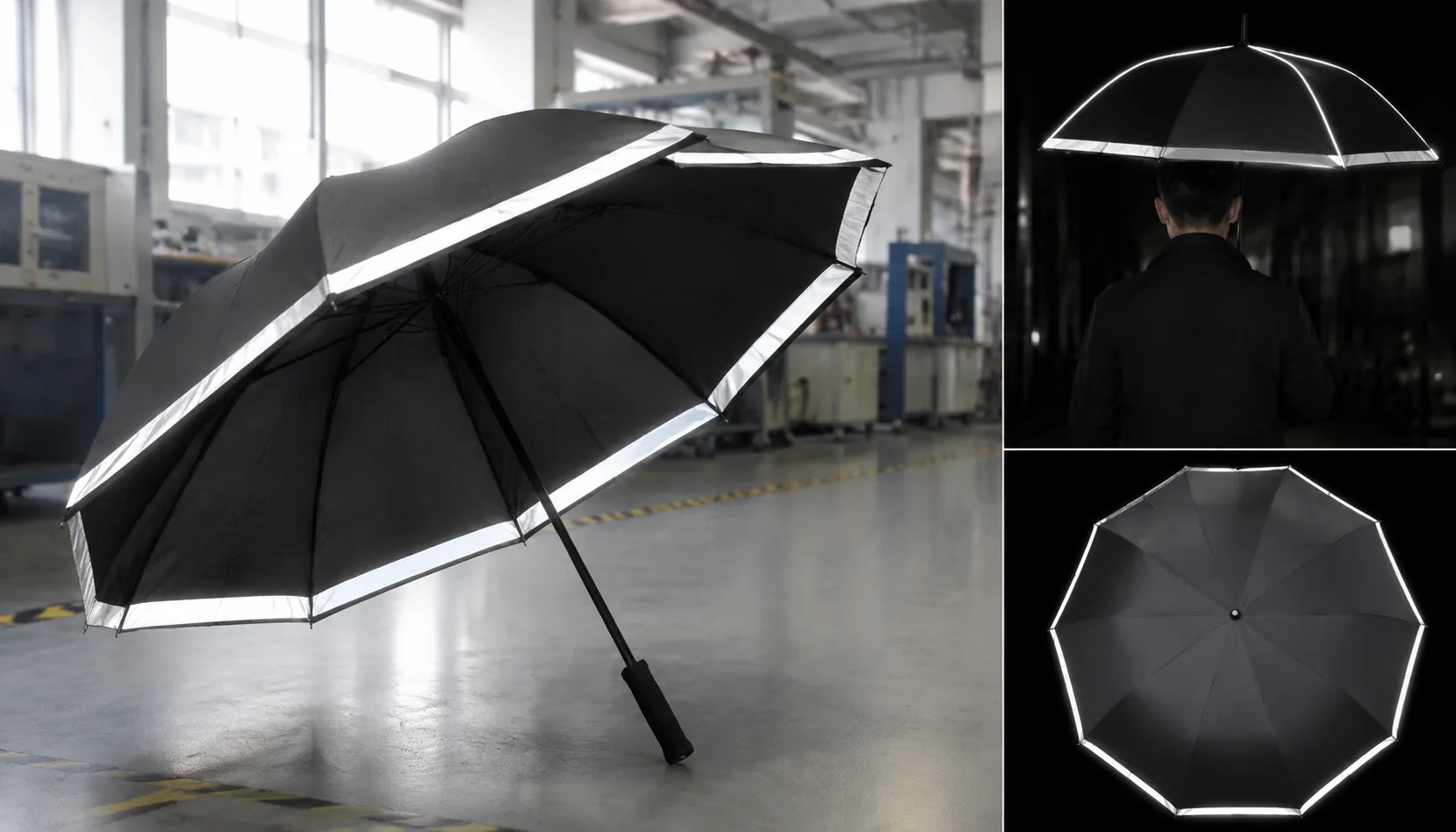
Reflective Safety Umbrellas: Specs for Night Visibility
Learn how to specify reflective safety umbrellas with visible trim, durable frames, compliant printing, MOQ planning, an...
Read More »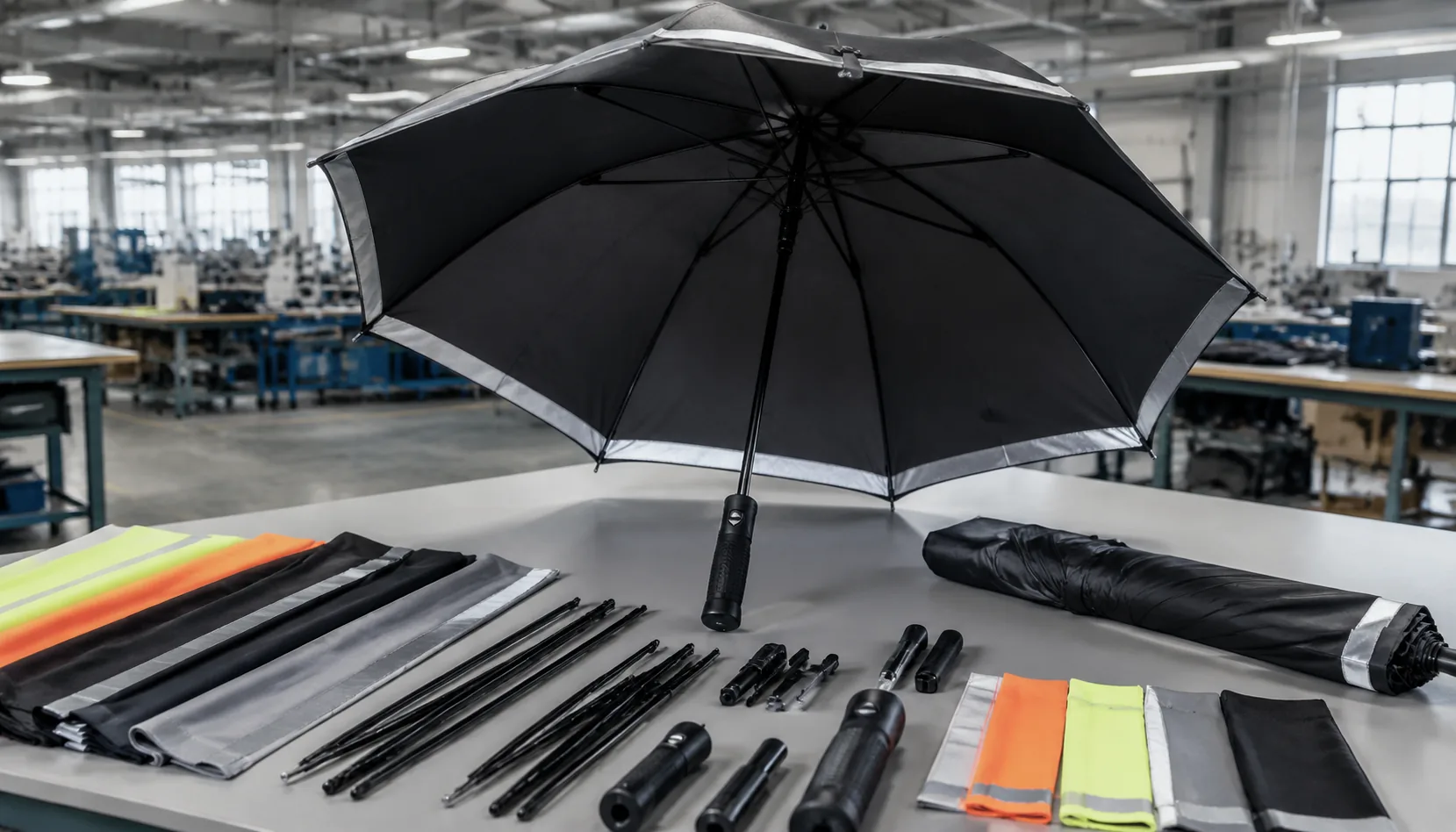
Reflective Safety Umbrellas: Buyer Spec Guide for Brands
Specify reflective safety umbrellas with proper tape, print zones, frame strength, and QC tests for commuter, school, an...
Read More »
Reflective Safety Umbrellas for Promo Buyer Spec Guide
Specify reflective safety umbrellas with 190T/210T pongee, fiberglass ribs, reflective piping, QC checks, MOQ, and shipp...
Read More »