Reflective Safety Umbrellas: Buyer Spec Guide for Brands
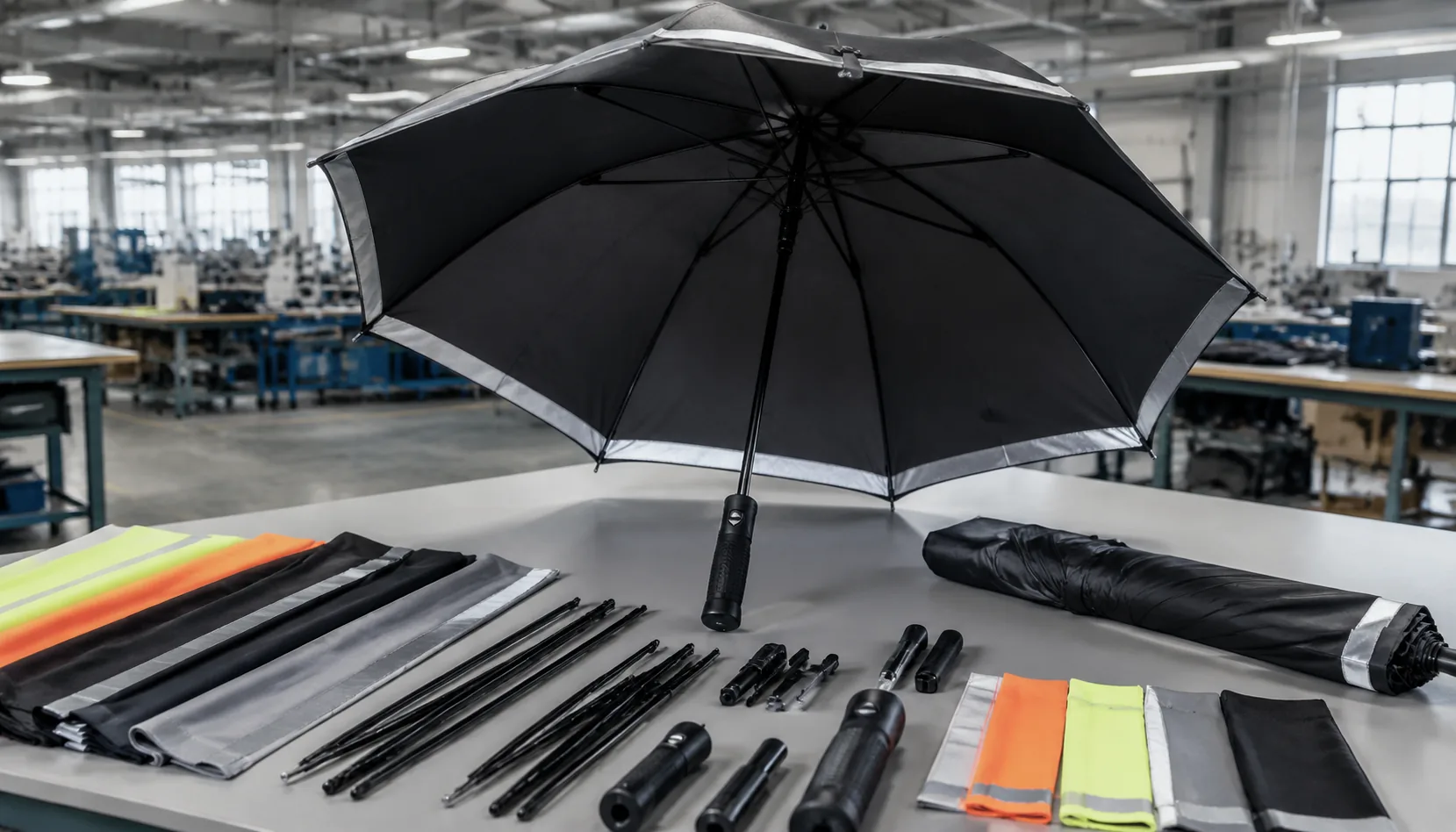
Buyers often approve a bright sample, then discover too late that the reflective band cracks after folding, the logo sits in a weak print zone, or the frame cannot survive daily commuter use. For reflective safety umbrellas, the spec has to connect fabric coating, tape placement, rib strength, and inspection tests before bulk cutting starts. On our Songxia production floor, these details decide whether a school, promo, or transit program ships cleanly or comes back with claims.
Use Cases That Need Reflective Umbrella Specs
Reflective safety umbrellas make the most sense when the umbrella is part of a controlled visibility program, not just a rainy-day giveaway. For commuter campaigns, I usually spec a 23" auto-open stick umbrella or a 21" auto-open-close folding model with 190T or 210T pongee, fiberglass ribs, and reflective tape on alternating panels so the user is visible from more than one angle. Transit agencies, insurance companies, and corporate wellness teams often choose navy, black, or charcoal canopies for daily use, then add silver reflective piping or segmented reflective strips near the canopy edge. That layout keeps the product looking like a proper business umbrella in daylight while improving head-and-shoulder outline visibility under headlights. For safety promotional umbrellas, the common mistake is printing a large white logo and assuming it performs like reflective material. It does not. Real reflective umbrella printing needs glass-bead or micro-prismatic transfer film, tested for adhesion after wet folding and rib contact.
School safety programs need a different specification because children carry umbrellas lower, swing them more, and are harder for drivers to see at crosswalk height. I prefer 8K fiberglass ribs over painted steel for junior and standard school models because fiberglass bends instead of kinking when a child pushes through a gate or bus queue. Canopies can be bright yellow, orange, or lime green polyester, but the important detail is where the reflective element sits: canopy edge, strap, sleeve, and sometimes a vertical panel strip facing traffic. A 23" manual-open model with rounded tips is safer than a strong auto-open spring for younger students, while older students can handle a 21" compact auto-open-close if the runner lock is smooth and pinch points are covered. Night visibility umbrellas for schools should be labeled as visibility aids, not protective equipment. They help drivers notice movement in rain, but they do not replace crossing guards, reflective vests, or certified road-safety PPE.
Roadside staff, parking attendants, event marshals, hotel doormen, and queue-control teams need durability first, then branding. For roadside staff, a 27" or 30" vented double-canopy umbrella with 10K fiberglass ribs, reinforced tips, and a straight EVA or rubberized handle performs better than a lightweight promo frame; wind-tunnel targets should be stated clearly, such as surviving 50+ mph gusts without frame inversion. Outdoor events often need lower MOQ color matching, fast logo approval, and DDP delivery to multiple venues, but the spec still has to include AQL 2.5 inspection for reflective film placement, seam strength, opening force, and wet crocking. OEM safety umbrellas can carry client logos, event maps, or sponsor marks, but certified PPE language should stay off the product unless the buyer has a valid compliance basis. Visibility features supplement ANSI/ISEA or EN ISO certified garments; they do not turn an umbrella into a legal high-visibility garment.
Reflective Materials and Placement Options
Reflective piping is the cleanest upgrade when a brand wants visibility without turning the umbrella into a traffic cone. We usually sew 3M-style or domestic high-reflective cord into the seam between two canopy panels, so on an 8-panel umbrella the reflection appears as eight radial lines from tip to runner area. It works well on 23" and 27" straight umbrellas, especially with 190T or 210T pongee, because the seam already exists and the added bulk is manageable. Panel strips are more visible from the side: a 10–20 mm reflective strip can be stitched or heat-pressed along one or two panels, often opposite the main logo. For reflective safety umbrellas sold to roadside crews, school programs, or night events, I prefer piping plus two panel strips rather than reflective material on every panel, because full coverage can look uneven after folding.
Edge tape gives the strongest 360-degree outline, but it is also the least forgiving in production. A reflective band around the canopy perimeter must follow the arc of all 8 panels, and if the cutting tolerance is off by even 2–3 mm, the tape will wave, pucker, or pull the skirt out of round. On manual and auto-open frames, the edge also takes abrasion when the umbrella is closed and strapped, so we specify stronger lockstitch tension and check the tips carefully during AQL 2.5 inspection. Reflective umbrella printing is a different choice: screen printing with reflective ink is useful for logos, warning icons, or short text, but it will not reflect as strongly as certified tape. It also needs a flatter panel area, away from rib tips and seam allowances, to avoid cracked edges after repeated opening.
For an 8-panel layout, the safest design rule is to keep reflective trim symmetrical: use all 8 seams for piping, 4 alternating panels for short vertical strips, or the full perimeter for edge tape. A single reflective strip beside one logo can look cheap unless it is intentionally placed as a design accent. For safety promotional umbrellas, we often recommend a dark canopy such as navy, black, or safety green with silver reflective elements, because contrast matters before headlights even hit the surface. On OEM safety umbrellas, placement should be confirmed on a pre-production sample, not just a flat artwork file, since rib count, canopy curve, and seam overlap change the final look. Our standard practice at ZheBrella is to add 1–2 mm sewing allowance when reflective trim crosses a seam, then test folding to confirm the strap still closes cleanly.
Frame and Canopy Builds for Daily Commuters
For commuter programs, the canopy fabric choice matters more than most buyers expect. 190T pongee is the practical baseline for safety promotional umbrellas: tight enough for clean reflective umbrella printing, light enough for compact 21" and 23" auto-open models, and cost-efficient when the MOQ is 500–1,000 pieces. 210T pongee has a denser hand, better color depth, and slightly cleaner panel tension after sewing, so I prefer it for retail-grade night visibility umbrellas or corporate safety kits where the umbrella will be used for more than one rainy season. If you specify silver reflective piping or segmented reflective tape, ask the factory to test adhesion and needle perforation after folding, because cheap tape can crack at the panel seam after 300–500 open-close cycles.
An 8K fiberglass rib frame is the safest default for daily commuters because fiberglass bends instead of permanently deforming when wind hits at an angle. Steel ribs are cheaper and feel rigid on the inspection table, but once a commuter gets caught between buildings or at a bus stop, steel ribs can kink and leave the canopy uneven. A steel shaft is still acceptable, especially for 23" straight umbrellas and 27" golf-style safety umbrellas, because it gives good torsional stability and keeps FOB pricing under control. Our standard practice at ZheBrella is to pair fiberglass ribs with a black electroplated steel shaft for mid-range OEM safety umbrellas, then move to full fiberglass shafts only when the buyer needs a lighter build or a higher wind-tunnel claim, such as 50+ mph on a vented sample.
Compact auto-open models are better when the umbrella is handed to subway commuters, campus staff, delivery teams, or conference attendees who need something that fits in a backpack. For these, I would avoid oversized reflective layouts and use reflective edge binding, one-panel logo printing, and a 190T or 210T pongee canopy with a reliable auto-open mechanism. Straight umbrellas are better for road crews, parking staff, hotel doormen, and school crossing programs because the larger 23", 27", or 30" canopy gives more visible reflective area and is less likely to be forgotten in a bag. For exposed routes, a double-canopy windproof build is worth the added cost: the vent releases uplift, the 8K frame stays flatter, and the reflective safety umbrellas remain readable from vehicle headlights instead of turning inside out at the first gust.
Testing, Compliance, and QC Expectations
Testing for reflective safety umbrellas should start with the reflective material, not the canopy color. For reflective piping, tape, or logo panels, specify adhesion checks after printing and after simulated handling, because reflective films can lift at curved canopy edges if the bonding temperature, pressure, or dwell time is wrong. For reflective umbrella printing, I like a cross-hatch tape test on printed reflective zones, plus a bend-and-rub check around rib tips and seam intersections where stress is highest. Brightness consistency should be checked under a fixed light source and viewing angle, comparing trim from different panels and production lots. A buyer does not need a lab-grade retroreflectometer for every shipment, but the factory should keep master swatches and reject obvious dull, cloudy, cracked, or mismatched reflective sections before final assembly.
Quality control for safety promotional umbrellas also needs normal umbrella performance tests, because visibility does not help if the frame fails in the first rainstorm. Include seam strength checks at the canopy crown, rib pockets, and reflective trim attachment points; weak stitching often shows up where 190T or 210T pongee is combined with thicker reflective tape. Water repellency should be tested by spray or shower testing after printing, especially when logos are screen printed across coated fabric. Open-close cycle testing should match the mechanism: manual, auto-open, or auto-open-close compact frames should be cycled repeatedly to catch spring fatigue, runner jamming, and loose tips. For night visibility umbrellas with fiberglass ribs, also check that the reflective tape does not distort when the canopy flexes under wind load.
For shipment inspection, use AQL 2.5 for major defects, with a separate defect checklist for reflective trim because general umbrella inspection forms often miss visibility problems. Our standard practice at ZheBrella is to classify missing reflective tape, major brightness mismatch, peeling trim, cracked reflective print, and reflective panels sewn inside-out as major defects, even if the umbrella opens normally. Minor issues may include slight trim waviness or small alignment variation, but buyers should define tolerance in millimeters before production. OEM safety umbrellas should also have retained samples from pre-production and bulk production, carton drop checks, barcode and warning-label verification, and packing inspections for mixed colors or sizes. If the order is for retail, event staff, school safety, or roadside programs, require inspection photos taken in both normal light and low light with flash so visibility claims are not judged only on a bright factory table.
MOQ, Sampling, and Shipping Considerations
Custom reflective tape is the MOQ driver on reflective safety umbrellas, not the umbrella frame itself. A plain 23" auto-open stick umbrella with 190T pongee can often start around 300–500 pcs if using stock silver tape, but custom-width tape, color-matched binding, or printed reflective panels usually pushes the practical MOQ to 1,000–3,000 pcs because the tape mill needs a separate slitting and coating run. For OEM safety umbrellas with 8K fiberglass ribs, black electroplated steel shafts, and logo work on two panels, I tell buyers to lock the reflective trim position first: canopy edge, vertical rib seam, or alternating panel arc. Changing that after sampling forces new sewing guides and can add 3–5 days before bulk cutting starts.
Sampling should prove visibility and sewing quality, not just logo placement. A digital mockup is useful for safety promotional umbrellas, but it cannot show whether reflective tape puckers on a curved 210T pongee canopy or whether heat-transfer logos crack near the taped seam after folding. Normal pre-production samples take 7–10 days with stock tape and existing 23" or 27" frames; custom reflective umbrella printing, sublimated safety graphics, or private-label woven labels usually take 12–18 days. Our standard practice at ZheBrella is to photograph the sample under direct flash at 5–10 meters, then check opening force, rib alignment, and packed length before buyer approval. For agencies and school bids, keep one sealed golden sample for AQL 2.5 inspection reference.
Carton packing matters because reflective tape creases permanently if umbrellas are compressed sideways. For night visibility umbrellas, specify individual polybags, straight shaft protection, 5-ply export cartons, and no more than 24–36 pcs per carton for 23" stick models; golf umbrellas at 27" or 30" often need 12–24 pcs depending on handle size. FOB Ningbo or Shanghai is usually cleaner for promotional-product distributors already consolidating caps, bags, and lanyards in China. DDP works better for schools, municipal agencies, and small brand owners that need landed cost certainty, but buyers should confirm duties, Amazon-style carton labels if required, and whether the forwarder will accept umbrellas with metal shafts. Reflective safety umbrellas are bulky, so sea freight is normally the only sensible option above 500 pcs unless event timing forces air shipment.
Frequently Asked Questions
Can reflective umbrellas meet PPE visibility standards?
Most promotional reflective umbrellas are visibility aids, not certified PPE. If a buyer needs EN ISO 20471 or ANSI-style compliance, the reflective material and finished product must be tested against that requirement.
Does reflective tape affect umbrella folding?
It can if the tape is too stiff or placed across fold lines. Buyers should approve a folded sample to check bulk, creasing, and strap closure before mass production.
What reflective tape width is usually specified for safety umbrellas?
Most B2B programs use 10 mm to 25 mm reflective tape around the canopy edge or selected panels. Wider tape improves visibility but may increase unit cost and affect folding if the tape is too stiff.
Can reflective umbrellas include both logo printing and reflective trim?
Yes. Logos are usually screen printed on 1 to 4 canopy panels, while reflective tape is applied along panel seams, the canopy edge, or selected ribs. Artwork should keep at least 10 mm clearance from stitched reflective areas.
What QC tests should buyers request for reflective safety umbrellas?
Common checks include reflective tape adhesion, open-close cycling, wind resistance, colorfastness, and print rub testing. For promotional orders, buyers often request AQL inspection plus photo or video confirmation before shipment.
Looking to Launch Your Custom Umbrella Line?
ZheBrella is a Zhejiang-based OEM/ODM umbrella manufacturer with 17 years of export experience. Free design, low MOQ from 100 pieces, windproof construction, full-color print.
Get Free Quote Now »People Also Search For
Related Articles
Reflective Safety Umbrellas for Promo Buyer Spec Guide
Specify reflective safety umbrellas with 190T/210T pongee, fiberglass ribs, reflective piping, QC checks, MOQ, and shipp...
Read More »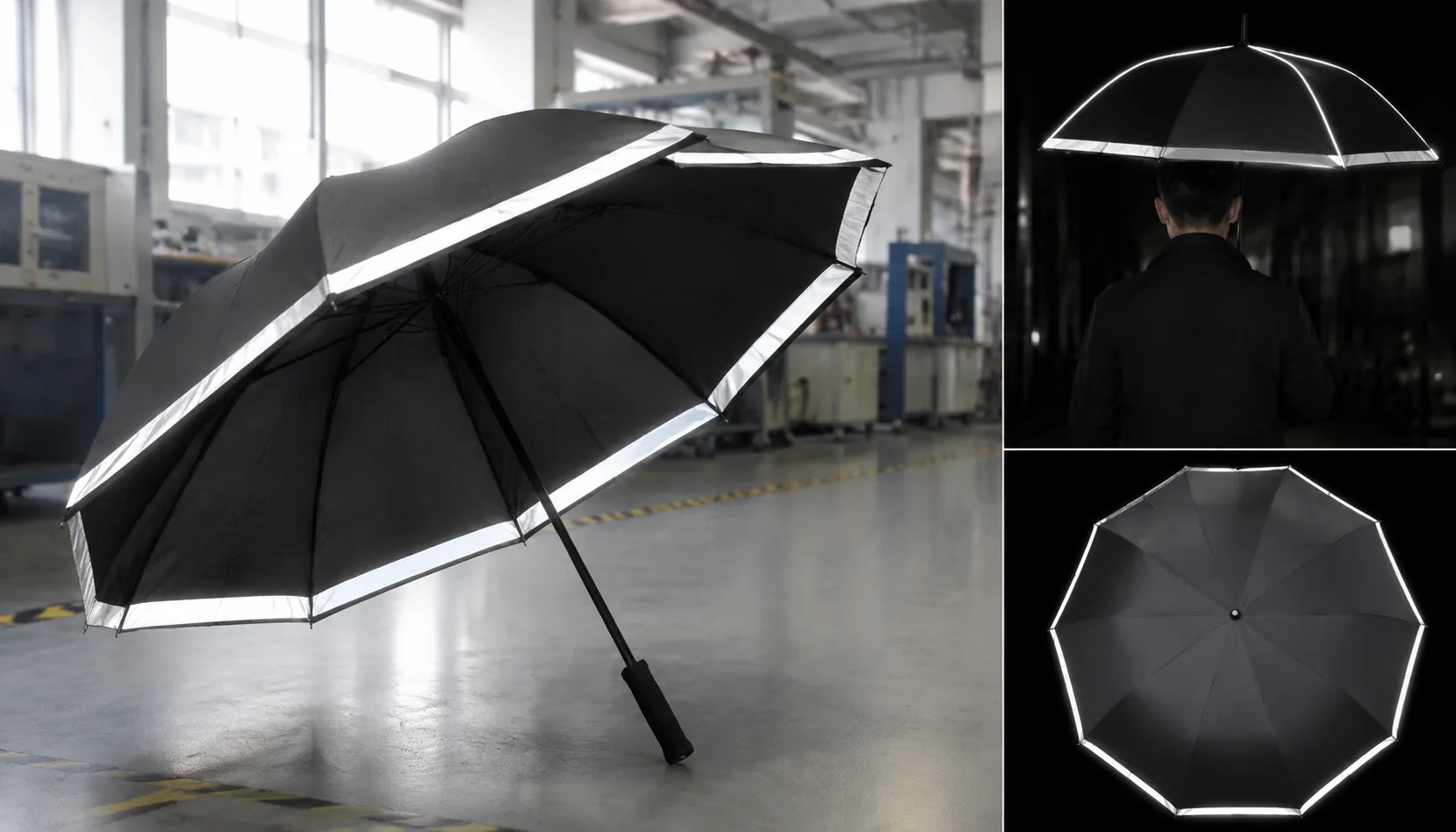
Reflective Safety Umbrellas: Specs for Night Visibility
Learn how to specify reflective safety umbrellas with visible trim, durable frames, compliant printing, MOQ planning, an...
Read More »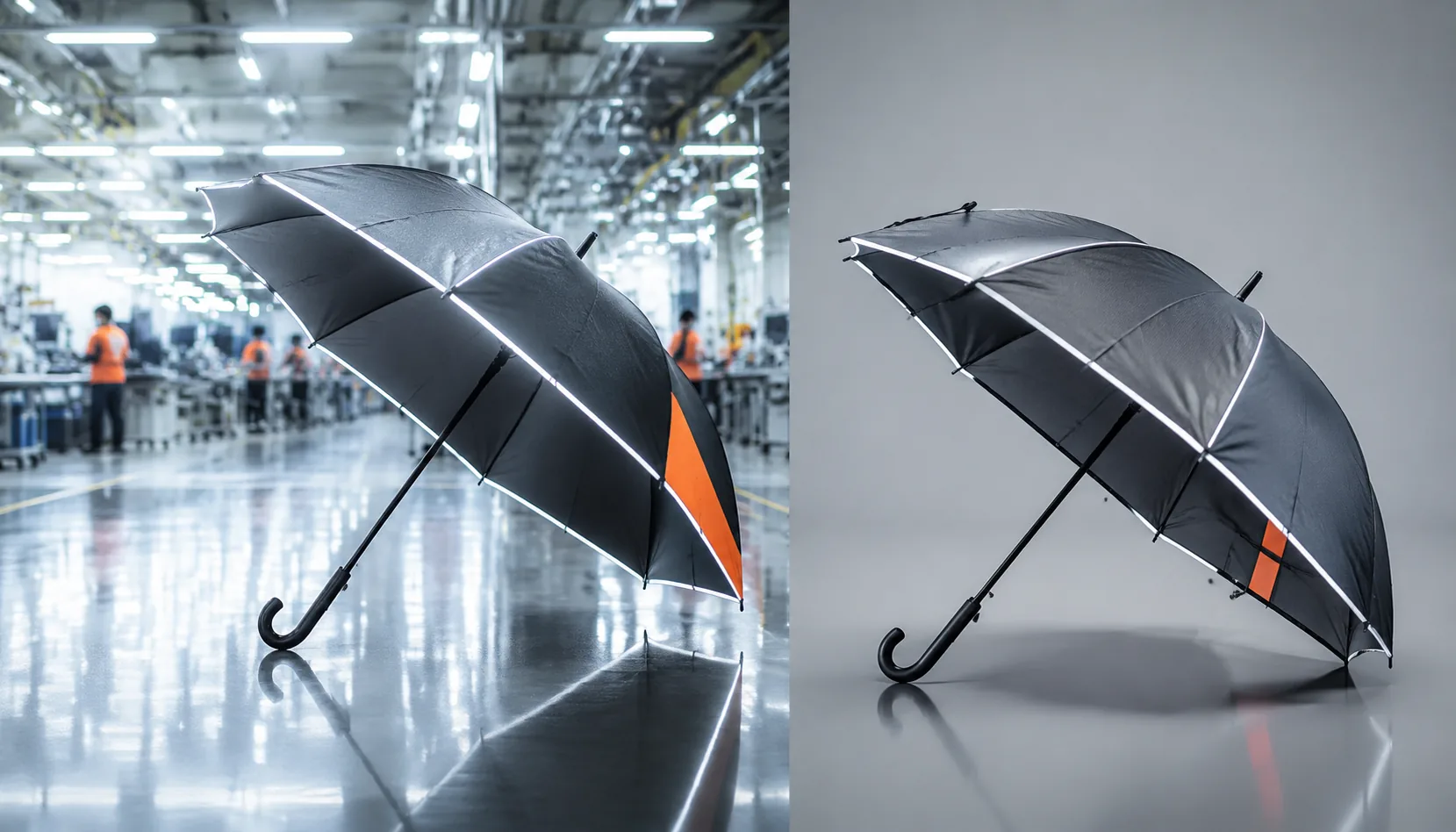
Reflective Safety Umbrellas: OEM Specs for Night Visibility
Specify reflective safety umbrellas with the right trims, canopy fabric, frames, and QC tests for commuter, school, and ...
Read More »